PUBLISHER: Mordor Intelligence | PRODUCT CODE: 2120713

PUBLISHER: Mordor Intelligence | PRODUCT CODE: 2120713
Marketing Analytics - Market Share Analysis, Industry Trends & Statistics, Growth Forecasts (2026 - 2031)
According to Mordor Intelligence, the marketing analytics market size is expected to grow from USD 7.12 billion in 2025 to USD 8.02 billion in 2026 and is forecast to reach USD 14.55 billion by 2031 at 12.65% CAGR over 2026-2031.
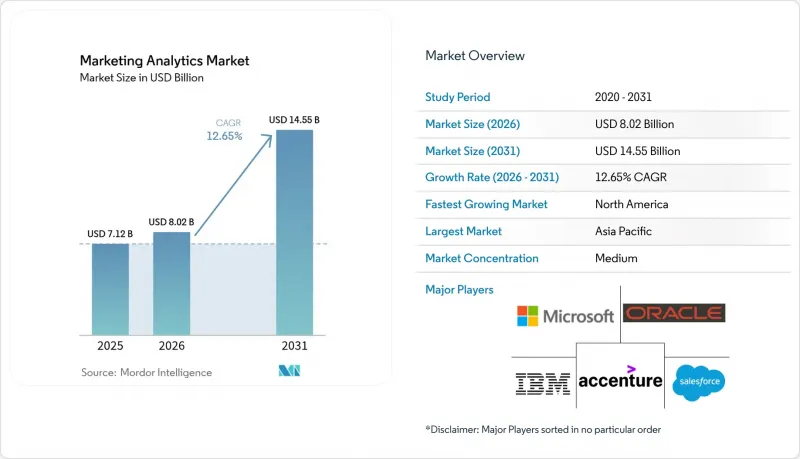
This report is Segmented by Deployment (Cloud, and On-Premise), Application (Online Marketing, Email Marketing, Content Marketing, Social Media Marketing, and More), End User (Retail, Banking and Financial Service, Education, Healthcare, Manufacturing, Travel and Hospitality, and More), and Geography (North America, Europe, Asia Pacific, and More). The Market Forecasts are Provided in Terms of Value (USD).
Global Marketing Analytics Market Trends and Insights
AI-Powered Predictive Insights Improving Marketing ROI
Machine-learning algorithms now assess purchase propensity, lifetime value, and churn probability in milliseconds, with accuracy above 85% in controlled tests. Google Analytics 4's release of autonomous insight cards in July 2024 shows how embedded AI eliminates manual segmentation and reallocates spend toward high-yield cohorts, lifting ROI by 15-25% for adopters. Predictive capabilities once limited to digital-native firms are therefore becoming table stakes, intensifying pressure on legacy vendors to infuse comparable models or risk displacement.
Acceleration of Cloud-Native Analytics Platforms
Enterprises are migrating to serverless stacks that elastically scale query workloads and cut provisioning cycles from weeks to minutes. Microsoft's January 2025 linkage of Clarity behavioral logs to Google Ads datasets demonstrates cross-platform synthesis that was previously impractical on-premise. The marketing analytics market consequently favors vendors that expose low-code APIs, enabling non-technical marketers to pin up experiments without IT queues.
High Total Cost of Ownership and Integration Complexity
Platform fees represent a fraction of full program costs once data unification, schema harmonization, and quality assurance are tallied. Integration timelines stretch six to twelve months for firms saddled with legacy stacks, and ongoing maintenance often doubles original budgets over a three-year horizon. Mid-market companies without dedicated data engineers therefore gravitate toward lighter SaaS suites, narrowing accessible functionality.
Other drivers and restraints analyzed in the detailed report include:
- Widespread Adoption of Omnichannel Campaign Tracking
- Demand for Real-Time Analytics to Optimize Customer Journeys
- Stringent Data Governance and Privacy Regulations
For complete list of drivers and restraints, kindly check the Table Of Contents.
Segment Analysis
Cloud models captured 61.58% marketing analytics market share in 2025 and are projected to grow at 12.96% CAGR through 2031. The marketing analytics market size for cloud deployment is therefore on track to almost double during the forecast window. Enterprises choose cloud to access GPU-accelerated AI services and pay-as-you-use pricing that sidesteps capital outlays. On-premise installations persist in finance and healthcare where sovereignty rules demand local processing, but even these industries experiment with hybrid models that pipe de-identified data to the cloud for modeling.
Cloud-first spending patterns mirror a cultural pivot toward self-service analytics. Marketing teams now launch SQL-less dashboards, run uplift tests, and activate segments in media platforms without waiting for IT backlogs. Adobe's partnership with Snowflake and Google BigQuery lets clients query petabyte-scale datasets directly inside analytics workspaces. This composability anchors future innovation, from real-time ad bidding to generative-AI copy optimization.
Complete Report Scope:
- By Deployment
- Cloud
- On-Premise
- By Application
- Online Marketing
- Email Marketing
- Content Marketing
- Social Media Marketing
- Other Applications
- By End User
- Retail
- Banking and Financial Services
- Education
- Healthcare
- Manufacturing
- Travel and Hospitality
- Other End Users
- By Geography
- North America
- United States
- Canada
- Mexico
- South America
- Brazil
- Argentina
- Rest of South America
- Europe
- United Kingdom
- Germany
- France
- Italy
- Spain
- Russia
- Rest of Europe
- Asia Pacific
- China
- Japan
- India
- South Korea
- Australia and New Zealand
- Southeast Asia
- Rest of Asia Pacific
- Middle East
- United Arab Emirates
- Saudi Arabia
- Turkey
- Rest of Middle East
- Africa
- South Africa
- Nigeria
- Egypt
- Rest of Africa
- North America
Geography Analysis
North America held 41.12% revenue share of the marketing analytics market in 2025. Deep digital-advertising maturity, ample venture funding, and dense talent pools sustain sophisticated deployments, yet cookie deprecation pushes firms to accelerate first-party data capture and privacy-preserving attribution. State-level bills echoing CCPA broaden compliance scope, extending implementation lead times.
Asia Pacific drives the highest expansion at 13.31% CAGR through 2031. Regional digital-ad spend surpasses USD 200 billion in 2025, underwritten by 1.8 billion mobile internet users who browse and buy via super-apps. China and India anchor scale, while Southeast Asian markets embrace multi-language insights and cross-border payments. Variability in privacy statutes compels vendors to deliver granular localization and zero-data-export designs.
Europe benefits from GDPR-sparked urgency to cultivate first-party databases and invest in federated analytics. Germany, France, and the United Kingdom champion privacy-by-design, but fragmented language and regulatory nuances necessitate region-specific consultative support. Middle East and Africa and South America progress from exploratory pilots to scaled rollouts, prioritizing mobile social commerce metrics and low-latency dashboards that fit bandwidth constraints.
- Adobe Inc.
- Salesforce Inc.
- Oracle Corporation
- SAS Institute Inc.
- IBM Corporation
- Microsoft Corporation
- Teradata Corporation
- HubSpot Inc.
- Google LLC
- SAP SE
- Neustar Inc.
- Pegasystems Inc.
- Tableau Software LLC
- Alteryx Inc.
- Mixpanel Inc.
- Amplitude Inc.
- Sprinklr Inc.
- Hootsuite Inc.
- Marketo Inc.
- Experian plc
- Clarabridge Inc.
Additional Benefits:
- The market estimate (ME) sheet in Excel format
- 3 months of analyst support
TABLE OF CONTENTS
1 INTRODUCTION
- 1.1 Study Assumptions and Market Definition
- 1.2 Scope of the Study
2 RESEARCH METHODOLOGY
3 EXECUTIVE SUMMARY
4 MARKET LANDSCAPE
- 4.1 Market Overview
- 4.2 Market Drivers
- 4.2.1 Widespread adoption of omnichannel campaign tracking
- 4.2.2 Demand for real-time analytics to optimize customer journeys
- 4.2.3 Acceleration of cloud-native analytics platforms
- 4.2.4 AI-powered predictive insights improving marketing ROI
- 4.2.5 Privacy sandbox forcing first-party data analytics investments
- 4.2.6 Proliferation of composable CDPs enabling modular analytics
- 4.3 Market Restraints
- 4.3.1 High total cost of ownership and integration complexity
- 4.3.2 Abundance of free and freemium analytics tools
- 4.3.3 Stringent data governance and privacy regulations (GDPR, CCPA)
- 4.3.4 Shortage of marketing data-science talent
- 4.4 Industry Value Chain Analysis
- 4.5 Regulatory Landscape
- 4.6 Impact of Macroeconomic Factors
- 4.7 Technological Outlook
- 4.8 Porter's Five Forces Analysis
- 4.8.1 Bargaining Power of Suppliers
- 4.8.2 Bargaining Power of Buyers
- 4.8.3 Threat of New Entrants
- 4.8.4 Threat of Substitutes
- 4.8.5 Intensity of Competitive Rivalry
5 MARKET SIZE AND GROWTH FORECASTS (VALUE)
- 5.1 By Deployment
- 5.1.1 Cloud
- 5.1.2 On-Premise
- 5.2 By Application
- 5.2.1 Online Marketing
- 5.2.2 Email Marketing
- 5.2.3 Content Marketing
- 5.2.4 Social Media Marketing
- 5.2.5 Other Applications
- 5.3 By End User
- 5.3.1 Retail
- 5.3.2 Banking and Financial Services
- 5.3.3 Education
- 5.3.4 Healthcare
- 5.3.5 Manufacturing
- 5.3.6 Travel and Hospitality
- 5.3.7 Other End Users
- 5.4 By Geography
- 5.4.1 North America
- 5.4.1.1 United States
- 5.4.1.2 Canada
- 5.4.1.3 Mexico
- 5.4.2 South America
- 5.4.2.1 Brazil
- 5.4.2.2 Argentina
- 5.4.2.3 Rest of South America
- 5.4.3 Europe
- 5.4.3.1 United Kingdom
- 5.4.3.2 Germany
- 5.4.3.3 France
- 5.4.3.4 Italy
- 5.4.3.5 Spain
- 5.4.3.6 Russia
- 5.4.3.7 Rest of Europe
- 5.4.4 Asia Pacific
- 5.4.4.1 China
- 5.4.4.2 Japan
- 5.4.4.3 India
- 5.4.4.4 South Korea
- 5.4.4.5 Australia and New Zealand
- 5.4.4.6 Southeast Asia
- 5.4.4.7 Rest of Asia Pacific
- 5.4.5 Middle East
- 5.4.5.1 United Arab Emirates
- 5.4.5.2 Saudi Arabia
- 5.4.5.3 Turkey
- 5.4.5.4 Rest of Middle East
- 5.4.6 Africa
- 5.4.6.1 South Africa
- 5.4.6.2 Nigeria
- 5.4.6.3 Egypt
- 5.4.6.4 Rest of Africa
- 5.4.1 North America
6 COMPETITIVE LANDSCAPE
- 6.1 Market Concentration
- 6.2 Strategic Moves
- 6.3 Market Share Analysis
- 6.4 Company Profiles (includes Global level Overview, Market level overview, Core Segments, Financials as available, Strategic Information, Market Rank/Share for key companies, Products and Services, and Recent Developments)
- 6.4.1 Adobe Inc.
- 6.4.2 Salesforce Inc.
- 6.4.3 Oracle Corporation
- 6.4.4 SAS Institute Inc.
- 6.4.5 IBM Corporation
- 6.4.6 Microsoft Corporation
- 6.4.7 Teradata Corporation
- 6.4.8 HubSpot Inc.
- 6.4.9 Google LLC
- 6.4.10 SAP SE
- 6.4.11 Neustar Inc.
- 6.4.12 Pegasystems Inc.
- 6.4.13 Tableau Software LLC
- 6.4.14 Alteryx Inc.
- 6.4.15 Mixpanel Inc.
- 6.4.16 Amplitude Inc.
- 6.4.17 Sprinklr Inc.
- 6.4.18 Hootsuite Inc.
- 6.4.19 Marketo Inc.
- 6.4.20 Experian plc
- 6.4.21 Clarabridge Inc.
7 MARKET OPPORTUNITIES AND FUTURE OUTLOOK
- 7.1 White-space and unmet-need assessment

