PUBLISHER: Mordor Intelligence | PRODUCT CODE: 2122946

PUBLISHER: Mordor Intelligence | PRODUCT CODE: 2122946
United States Marketing Analytics - Market Share Analysis, Industry Trends & Statistics, Growth Forecasts (2026 - 2031)
According to Mordor Intelligence, the United States marketing analytics market size was valued at USD 5.26 billion in 2025 and estimated to grow from USD 5.92 billion in 2026 to reach USD 10.67 billion by 2031, at a CAGR of 12.54% during the forecast period (2026-2031).
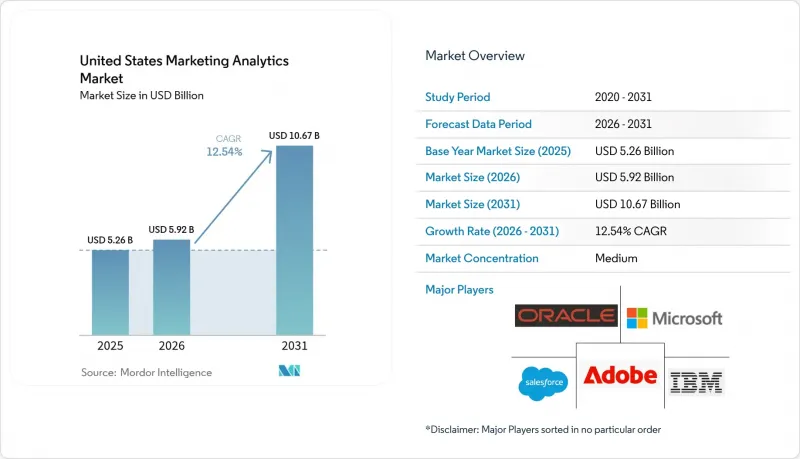
This report is Segmented by Deployment (Cloud, and On-Premise), Analytics Type (Descriptive, Diagnostic, Predictive, and Prescriptive), Application (Online, E-Mail, Content, Social Media, and Other), End User (Retail, BFSI, Education, Healthcare, Manufacturing, Travel and Hospitality, and More). The Market Forecasts are Provided in Terms of Value (USD).
United States Marketing Analytics Market Trends and Insights
Increasing Need to Utilize Marketing Budgets for an Effective ROI
Boards are scrutinizing discretionary spending, prompting chief marketing officers to demonstrate the direct contribution of every campaign to revenue. The Duke CMO Survey showed that martech utilization remained below 40% in Fall 2024, even as budgets held steady at 9.1% of firm revenue, underscoring a gap between investment and realized value. Unified dashboards that consolidate data from advertising, CRM, and commerce platforms are replacing siloed point solutions, enabling multi-touch attribution and lifetime-value modeling. Vendors offering no-code connectors shorten implementation windows from quarters to weeks, making advanced analytics accessible to non-technical teams. As return-on-ad-spend becomes the North Star metric, enterprises that operationalize analytics experience faster budget approval cycles and higher campaign velocity.
Adoption of Cloud Technology and Big Data
Elastic cloud infrastructure has become the default for martech workloads, with 71% of enterprises migrating at least one marketing analytics process to the cloud in 2024, up from 58% in 2023. Cloud data lakes ingest streaming web, mobile, and point-of-sale events, then execute machine-learning models that create micro-segments in real time. Partnerships such as Snowflake's integration with Adobe Experience Platform allow activation of first-party data without duplicating storage, cutting latency and reducing cost. Open-source engines like Apache Spark now power incremental processing that updates profiles within seconds rather than overnight batches. These architectural gains translate into agile experimentation and faster feedback loops.
High Cost of Implementation and System Integration Issues
Deploying a full-stack analytics solution requires software licenses, cloud resources, data engineering, and change management. Mid-market firms often manage more than 90 marketing applications, which creates fragmented schemas and duplicate customer identifiers that inflate the labor needed for integration. Cloud spending can also exceed projections as data volumes surge, prompting finance teams to re-examine total cost of ownership. Vendors now respond with bundled managed services, consumption-based pricing, and pre-built connectors, yet the up-front lift still delays time-to-insight for resource-constrained buyers.
Other drivers and restraints analyzed in the detailed report include:
- Proliferation of Social Media Channels
- Growing Regulatory Focus on First-Party Data Strategies
- Increasing State-Level Consumer Data-Protection Statutes
For complete list of drivers and restraints, kindly check the Table Of Contents.
Segment Analysis
The United States marketing analytics market size for cloud deployment stood at USD 3.73 billion in 2025 and is forecast to rise at a 13.74% CAGR, cementing its dominance over on-premise alternatives. Cloud captured 70.88% of United States marketing analytics market share in 2025, reflecting enterprises' preference for elastic capacity, automatic feature releases, and usage-based billing. Cost avoidance from hardware refresh cycles and data-center overhead further tilts investment toward infrastructure-as-a-service.
Major providers now offer HIPAA-eligible environments, FedRAMP authorizations, and SOC 2 Type II attestations, giving compliance teams confidence to migrate regulated workloads. Even highly regulated sectors are piloting hybrid architectures that keep sensitive data on-premise while offloading compute-intensive analytics to the cloud. Machine-learning services embedded within the same environment reduce data-movement costs and speed model deployment, a benefit resonating with mid-market firms lacking data-science headcount.
Predictive analytics maintained the largest slice of the United States marketing analytics market size at USD 1.81 billion in 2025, equal to 34.35% share in 2025. Prescriptive analytics, however, is expanding at a 13.28% CAGR, reflecting marketer appetite for automated next-best-action recommendations that close the gap between insight and activation. Prescriptive engines evaluate permutations of send times, offer values, and creative variants, then trigger the highest-yield action in real time.
AutoML tooling embedded in cloud platforms automates feature engineering and model tuning, democratizing access for teams with limited data-science resources. Diagnostic and descriptive analytics remain table stakes for executive reporting, yet their reactive nature limits strategic impact. As algorithmic decision-making permeates daily operations, governance processes around explainability and bias review are becoming standard, particularly in financial-services and healthcare use cases.
Complete Report Scope:
- By Deployment
- Cloud
- On-Premise
- By Analytics Type
- Descriptive Analytics
- Diagnostic Analytics
- Predictive Analytics
- Prescriptive Analytics
- By Application
- Online Marketing
- E-Mail Marketing
- Content Marketing
- Social Media Marketing
- Other Applications
- By End User
- Retail
- Banking, Financial Services and Insurance
- Education
- Healthcare
- Manufacturing
- Travel and Hospitality
- Other End Users
List of Companies Covered in this Report:
- IBM Corporation
- Microsoft Corporation
- Oracle Corporation
- Salesforce Inc.
- Adobe Inc.
- SAS Institute Inc.
- Teradata Corporation
- Accenture plc
- Neustar Inc.
- Pegasystems Inc.
- Alphabet Inc.
- HubSpot Inc.
- Amplitude Inc.
- Mixpanel Inc.
- Sprinklr Inc.
- Hootsuite Inc.
- Klaviyo Inc.
- Nielsen Holdings plc
- Experian plc
- Similarweb Ltd.
Additional Benefits:
- The market estimate (ME) sheet in Excel format
- 3 months of analyst support
TABLE OF CONTENTS
1 INTRODUCTION
- 1.1 Study Assumptions and Market Definition
- 1.2 Scope of the Study
2 RESEARCH METHODOLOGY
3 EXECUTIVE SUMMARY
4 MARKET LANDSCAPE
- 4.1 Market Overview
- 4.2 Market Drivers
- 4.2.1 Increasing Need to Utilize Marketing Budgets for an Effective ROI
- 4.2.2 Adoption of Cloud Technology and Big Data
- 4.2.3 Proliferation of Social Media Channels
- 4.2.4 Growing Regulatory Focus on First-Party Data Strategies
- 4.2.5 Accelerated Shift to Real-Time Personalization Engines
- 4.2.6 Emergence of Privacy-Preserving Analytics Frameworks
- 4.3 Market Restraints
- 4.3.1 High Cost of Implementation and System Integration Issues
- 4.3.2 Availability of Feature-Rich Open-Source Tools
- 4.3.3 Increasing State-Level Consumer Data-Protection Statutes
- 4.3.4 Talent Shortage in Advanced Analytics and Data Engineering
- 4.4 Industry Value Chain Analysis
- 4.5 Impact of Macroeconomic Factors on the Market
- 4.6 Technological Outlook
- 4.7 Porter's Five Forces Analysis
- 4.7.1 Threat of New Entrants
- 4.7.2 Bargaining Power of Buyers
- 4.7.3 Bargaining Power of Suppliers
- 4.7.4 Threat of Substitute Products
- 4.7.5 Intensity of Competitive Rivalry
- 4.8 Regulatory Landscape
5 MARKET SIZE AND GROWTH FORECASTS (VALUE)
- 5.1 By Deployment
- 5.1.1 Cloud
- 5.1.2 On-Premise
- 5.2 By Analytics Type
- 5.2.1 Descriptive Analytics
- 5.2.2 Diagnostic Analytics
- 5.2.3 Predictive Analytics
- 5.2.4 Prescriptive Analytics
- 5.3 By Application
- 5.3.1 Online Marketing
- 5.3.2 E-Mail Marketing
- 5.3.3 Content Marketing
- 5.3.4 Social Media Marketing
- 5.3.5 Other Applications
- 5.4 By End User
- 5.4.1 Retail
- 5.4.2 Banking, Financial Services and Insurance
- 5.4.3 Education
- 5.4.4 Healthcare
- 5.4.5 Manufacturing
- 5.4.6 Travel and Hospitality
- 5.4.7 Other End Users
6 COMPETITIVE LANDSCAPE
- 6.1 Market Concentration
- 6.2 Strategic Moves
- 6.3 Market Share Analysis
- 6.4 Company Profiles (includes Global level Overview, Market level overview, Core Segments, Financials as available, Strategic Information, Market Rank/Share for key companies, Products and Services, and Recent Developments)
- 6.4.1 IBM Corporation
- 6.4.2 Microsoft Corporation
- 6.4.3 Oracle Corporation
- 6.4.4 Salesforce Inc.
- 6.4.5 Adobe Inc.
- 6.4.6 SAS Institute Inc.
- 6.4.7 Teradata Corporation
- 6.4.8 Accenture plc
- 6.4.9 Neustar Inc.
- 6.4.10 Pegasystems Inc.
- 6.4.11 Alphabet Inc.
- 6.4.12 HubSpot Inc.
- 6.4.13 Amplitude Inc.
- 6.4.14 Mixpanel Inc.
- 6.4.15 Sprinklr Inc.
- 6.4.16 Hootsuite Inc.
- 6.4.17 Klaviyo Inc.
- 6.4.18 Nielsen Holdings plc
- 6.4.19 Experian plc
- 6.4.20 Similarweb Ltd.
7 MARKET OPPORTUNITIES AND FUTURE OUTLOOK
- 7.1 White-Space and Unmet-Need Assessment

