PUBLISHER: Mordor Intelligence | PRODUCT CODE: 2120728

PUBLISHER: Mordor Intelligence | PRODUCT CODE: 2120728
Secondary Battery - Market Share Analysis, Industry Trends & Statistics, Growth Forecasts (2026 - 2031)
According to Mordor Intelligence, the secondary battery market size is estimated at USD 188.87 billion in 2026, and is expected to reach USD 437.79 billion by 2031, at a CAGR of 18.31% during the forecast period (2026-2031).
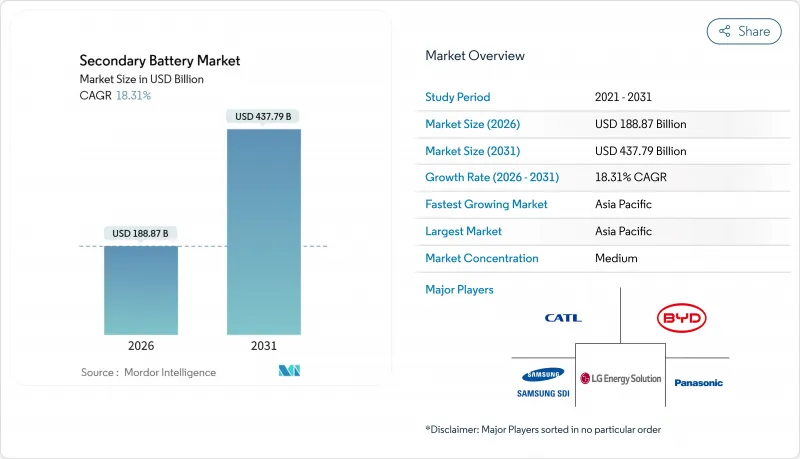
This report is Segmented by Technology (Lead-Acid, Lithium-Ion, Nickel-Cadmium, Nickel-Metal Hydride, Flow Batteries, and Solid-State), Form Factor (Cylindrical, Prismatic, and Pouch), Application (Electric Vehicles, Stationary Energy Storage, and More), End-User (Automotive, Utilities and Power, Electronics and IT, and More), and Geography (North America, Europe, Asia-Pacific, South America, and More).
Global Secondary Battery Market Trends and Insights
Surging EV Adoption Boosts Li-ion Demand
EV sales reached 13.9 million units in 2024, equal to 16% of global passenger car sales, and industry trackers expect the share to exceed 25% by 2026 . Automakers already have offtake contracts that lock in roughly two-thirds of 2027 cell capacity, tightening supply. China crossed 38% domestic EV penetration in 2024, reinforcing a cost-driven shift toward LFP chemistries for mass-market cars. Platforms adopting 800-volt architectures, such as Hyundai E-GMP, need higher energy density, which is pushing suppliers toward silicon-rich anodes and high-nickel cathodes. Those chemistry changes force cell makers to retool lines mid-cycle, squeezing margins even as volume rises.
Growth of Renewable-Integrated Storage Projects
Utility-scale battery storage installations climbed to 45 GW worldwide in 2024, with forecasts pointing to 120 GW by 2026. California mandates 11.5 GW of storage by 2026, while Texas has a 10 GW pipeline, making four-hour lithium-ion systems a cost-effective alternative to gas peakers. Ancillary service markets pay USD 15-25 per MW-hour for frequency regulation, supporting project returns near 20%. Europe's REPowerEU funding has accelerated tender volumes, though permitting delays shifted 40% of 2024 bids into later years. Developers with ready-to-build sites are therefore well positioned to capture the backlog.
Critical-Mineral Supply Constraints
Battery-grade lithium demand hit 620,000 tons LCE in 2024 and could double by 2030, yet new mine approvals lag by almost two years. Cobalt remains concentrated in the Democratic Republic of Congo, where artisanal output adds ESG risk that forces automakers to audit sub-tier suppliers. Nickel sulfate prices spiked to USD 22,000 per ton in early 2024 on Indonesian supply questions and carbon-intensity scrutiny, complicating long-term contract pricing. Recycling may cover just 10-12% of cathode metal demand by 2030 because hydrometallurgical recovery still loses around 10% of lithium.
Other drivers and restraints analyzed in the detailed report include:
- Declining Li-ion Cost Curve (Pack < USD 85/kWh)
- Rapid LFP Uptake for Cost and Safety Gains
- Safety and Thermal-Runaway Incidents
For complete list of drivers and restraints, kindly check the Table Of Contents.
Segment Analysis
Lithium-ion held 74.8% of the secondary battery market share in 2025. However, solid-state variants are forecast to post a 24.9% CAGR to 2031 as Toyota, Samsung SDI, and QuantumScape scale pilot lines. The solid-state architecture replaces liquid electrolytes with ceramic separators, enabling lithium-metal anodes that double energy density to 400-500 Wh/kg. Toyota reported 1,200 cycles at 80% retention for its sulfide-based cell and plans 10,000 units annually by 2027. QuantumScape's oxide separator passed 800 cycles with less than 10% fade, securing Volkswagen's supply for 2028 platforms.
Commercial viability hinges on manufacturing yield and raw-material availability, especially for sulfide powders. Incumbent suppliers hedge risk by licensing solid-state IP while continuing to expand conventional lines. Lead-acid batteries still serve forklifts and telecom sites because of low upfront cost, yet their share slips each year. Flow batteries grow at a 19% CAGR for multi-hour grid storage, though their contribution to the secondary battery market size remains under 1% due to high capital cost.
Cylindrical formats led the secondary battery market in 2025 with 53.5% share, underpinned by Tesla's 4680 and ubiquitous 2170 cells. Yet pouch cells are forecast to expand at 22.2% CAGR through 2031 as automakers seek thinner packs that maximize cabin space. General Motors uses LG-made pouch cells in its Ultium platform, stacking layers vertically to deliver 200 kWh per pack. Hyundai's E-GMP also favors pouch designs, which dissipate heat more evenly under 350 kW fast charging.
Manufacturing dynamics differ by region. Chinese producers lean toward prismatic cells for automation gains, European startups trial large-format pouches for premium EVs, and U.S. players balance cylindrical and pouch output to meet IRA domestic-content thresholds. The form-factor battle, therefore, reflects strategic positioning rather than one-size-fits-all design.
Complete Report Scope:
- By Technology
- Lead-acid
- Lithium-ion
- Nickel-metal Hydride
- Nickel-cadmium
- Flow Batteries
- Solid-state (pre-commercial)
- By Form Factor
- Cylindrical
- Prismatic
- Pouch
- By Application
- Electric Vehicles
- Stationary Energy Storage
- Industrial Motive Power
- Consumer Electronics
- Power Tools and Others
- By End-user Industry
- Automotive
- Utilities and Power
- Electronics and IT
- Logistics and Warehousing
- Aerospace and Defense
- Healthcare and Others
- By Geography
- North America
- United States
- Canada
- Mexico
- Europe
- United Kingdom
- Germany
- France
- Spain
- NORDIC Countries
- Russia
- Rest of Europe
- Asia-Pacific
- China
- India
- Japan
- South Korea
- ASEAN Countries
- Australia and New Zealand
- Rest of Asia-Pacific
- South America
- Brazil
- Argentina
- Colombia
- Rest of South America
- Middle East and Africa
- Saudi Arabia
- United Arab Emirates
- South Africa
- Egypt
- Rest of Middle East and Africa
- North America
Geography Analysis
Asia-Pacific dominated the secondary battery market with a 49.7% share in 2025 and is forecast to expand at a 20.1% CAGR. China's 1,200 GWh of cell capacity delivers up to 20% cost advantages through full vertical integration. South Korean suppliers focus on high-nickel chemistries that command price premiums in premium EV segments. Japan's Panasonic has seen its share slide to 18% as Chinese rivals undercut on price, yet it retains a strong foothold with Tesla.
North America is undergoing rapid supply-chain reshoring under the Inflation Reduction Act. Manufacturing tax credits of USD 35 per kWh have triggered USD 73 billion in announced investments, lifting planned capacity to 550 GWh by 2030. General Motors, Ford, and Stellantis all co-locate cell plants with vehicle assembly lines to minimize logistics costs. Canada is positioning itself as a raw-material hub, and Mexico is securing cost-sensitive assembly contracts, though labor shortages and permitting delays remain constraints.
Europe held just under one-quarter of global demand in 2025, driven by its 2035 internal-combustion ban and strict carbon-footprint rules. Northvolt's Swedish facility satisfies premium OEM needs with cells below 60 kg CO2 per kWh. Germany operates a complete ecosystem, from BASF cathode materials to Volkswagen's PowerCo cell lines. Southern and Eastern Europe attract new gigafactories because of lower labor costs and EU structural funds. South America's lithium triangle offers long-term resource security, but water scarcity and political risk slow expansion. The Middle East and Africa remain nascent, accounting for only a low single-digit share.
- CATL
- LG Energy Solution
- Panasonic Holdings
- BYD Co. Ltd
- Samsung SDI
- SK On
- Envision AESC
- Northvolt AB
- Tesla Inc. (Gigafactory)
- GS Yuasa
- Clarios
- EnerSys
- Saft Groupe
- Duracell
- Showa Denko Materials
- Toshiba SCiB
- SVOLT Energy
- CALB
- Farasis Energy
- A123 Systems
- Tianjin Lishen
- VARTA AG
- Hitachi Astemo Battery
- EVE Energy
- Amara Raja
Additional Benefits:
- The market estimate (ME) sheet in Excel format
- 3 months of analyst support
TABLE OF CONTENTS
1 Introduction
- 1.1 Study Assumptions & Market Definition
- 1.2 Scope of the Study
2 Research Methodology
3 Executive Summary
4 Market Landscape
- 4.1 Market Overview
- 4.2 Market Drivers
- 4.2.1 Surging EV adoption boosts Li-ion demand
- 4.2.2 Growth of renewable-integrated storage projects
- 4.2.3 Declining Li-ion cost curve (pack <$85/kWh)
- 4.2.4 Second-life battery repurposing ecosystems
- 4.2.5 Policy-driven localization of gigafactories
- 4.2.6 Rapid LFP uptake for cost & safety advantages
- 4.3 Market Restraints
- 4.3.1 Critical-mineral supply constraints
- 4.3.2 Safety / thermal-runaway incidents
- 4.3.3 End-of-life compliance cost escalation
- 4.3.4 Capital diversion to alternative storage tech
- 4.4 Supply-Chain Analysis
- 4.5 Regulatory Landscape
- 4.6 Technological Outlook
- 4.7 Porter's Five Forces
- 4.7.1 Bargaining Power of Suppliers
- 4.7.2 Bargaining Power of Consumers
- 4.7.3 Threat of New Entrants
- 4.7.4 Threat of Substitute Products & Services
- 4.7.5 Intensity of Competitive Rivalry
- 4.8 Battery & Raw-Material Price Trends
- 4.9 International Trade Statistics
5 Market Size & Growth Forecasts
- 5.1 By Technology
- 5.1.1 Lead-acid
- 5.1.2 Lithium-ion
- 5.1.3 Nickel-metal Hydride
- 5.1.4 Nickel-cadmium
- 5.1.5 Flow Batteries
- 5.1.6 Solid-state (pre-commercial)
- 5.2 By Form Factor
- 5.2.1 Cylindrical
- 5.2.2 Prismatic
- 5.2.3 Pouch
- 5.3 By Application
- 5.3.1 Electric Vehicles
- 5.3.2 Stationary Energy Storage
- 5.3.3 Industrial Motive Power
- 5.3.4 Consumer Electronics
- 5.3.5 Power Tools and Others
- 5.4 By End-user Industry
- 5.4.1 Automotive
- 5.4.2 Utilities and Power
- 5.4.3 Electronics and IT
- 5.4.4 Logistics and Warehousing
- 5.4.5 Aerospace and Defense
- 5.4.6 Healthcare and Others
- 5.5 By Geography
- 5.5.1 North America
- 5.5.1.1 United States
- 5.5.1.2 Canada
- 5.5.1.3 Mexico
- 5.5.2 Europe
- 5.5.2.1 United Kingdom
- 5.5.2.2 Germany
- 5.5.2.3 France
- 5.5.2.4 Spain
- 5.5.2.5 NORDIC Countries
- 5.5.2.6 Russia
- 5.5.2.7 Rest of Europe
- 5.5.3 Asia-Pacific
- 5.5.3.1 China
- 5.5.3.2 India
- 5.5.3.3 Japan
- 5.5.3.4 South Korea
- 5.5.3.5 ASEAN Countries
- 5.5.3.6 Australia and New Zealand
- 5.5.3.7 Rest of Asia-Pacific
- 5.5.4 South America
- 5.5.4.1 Brazil
- 5.5.4.2 Argentina
- 5.5.4.3 Colombia
- 5.5.4.4 Rest of South America
- 5.5.5 Middle East and Africa
- 5.5.5.1 Saudi Arabia
- 5.5.5.2 United Arab Emirates
- 5.5.5.3 South Africa
- 5.5.5.4 Egypt
- 5.5.5.5 Rest of Middle East and Africa
- 5.5.1 North America
6 Competitive Landscape
- 6.1 Market Concentration
- 6.2 Strategic Moves (M&A, Partnerships, PPAs)
- 6.3 Market Share Analysis (Market Rank/Share for key companies)
- 6.4 Company Profiles (includes Global level Overview, Market level overview, Core Segments, Financials as available, Strategic Information, Products & Services, and Recent Developments)
- 6.4.1 CATL
- 6.4.2 LG Energy Solution
- 6.4.3 Panasonic Holdings
- 6.4.4 BYD Co. Ltd
- 6.4.5 Samsung SDI
- 6.4.6 SK On
- 6.4.7 Envision AESC
- 6.4.8 Northvolt AB
- 6.4.9 Tesla Inc. (Gigafactory)
- 6.4.10 GS Yuasa
- 6.4.11 Clarios
- 6.4.12 EnerSys
- 6.4.13 Saft Groupe
- 6.4.14 Duracell
- 6.4.15 Showa Denko Materials
- 6.4.16 Toshiba SCiB
- 6.4.17 SVOLT Energy
- 6.4.18 CALB
- 6.4.19 Farasis Energy
- 6.4.20 A123 Systems
- 6.4.21 Tianjin Lishen
- 6.4.22 VARTA AG
- 6.4.23 Hitachi Astemo Battery
- 6.4.24 EVE Energy
- 6.4.25 Amara Raja
7 Market Opportunities & Future Outlook
- 7.1 White-space & Unmet-need Assessment

