PUBLISHER: Mordor Intelligence | PRODUCT CODE: 2120770

PUBLISHER: Mordor Intelligence | PRODUCT CODE: 2120770
India Aesthetic Devices - Market Share Analysis, Industry Trends & Statistics, Growth Forecasts (2026 - 2031)
According to Mordor Intelligence, the India aesthetic devices market size is projected to be USD 0.76 billion in 2025, USD 0.87 billion in 2026, and reach USD 1.73 billion by 2031, growing at a CAGR of 14.81% from 2026 to 2031.
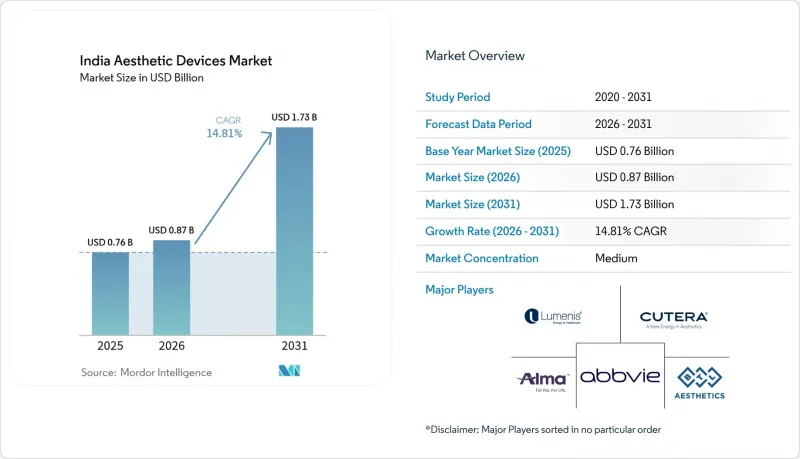
This report is Segmented by Device Type (Energy-Based Devices [Laser-Based, Radiofrequency, IPL & Light-Based, Ultrasound/HIFU] Non-Energy Devices [Dermal Fillers & Injectables, and More), Application (Skin Resurfacing & Tightening, and More), End User (Dermatology Clinics, and More), Gender (Female, Male), Age Group (18-34 Years, and More). The Market Forecasts are Provided in Terms of Value (USD).
India Aesthetic Devices Market Trends and Insights
Increasing Awareness Regarding Aesthetic Procedures
Urban consumers view cosmetic enhancement as routine wellness rather than vanity, a perception shift amplified by celebrity endorsements and social-media narratives. India now ranks second in rhinoplasty volume and third in liposuction counts worldwide, giving clinics deeper case experience that feeds further acceptance. Male demand grows for gynecomastia correction and hair restoration, broadening the gender mix once skewed toward female clientele. Consultation numbers surge in tier-2 cities yet infrastructure gaps still limit procedural throughput outside metros. Training institutes respond by running short intensive programs, which in turn seed new clinics in smaller urban clusters.
Rising Disposable Incomes & Beauty-Conscious Consumers
India's per-capita disposable income is growing 14.6% annually through 2027, widening the pool of consumers who can afford elective aesthetic treatments. Dual-income households in metros now direct 3-5% of discretionary spend to personal grooming, and the broader beauty-and-personal-care sector is on track to double to USD 30 billion by 2027. Elevated workplace grooming norms in IT services, banking and hospitality are prompting earlier intervention, with the typical first procedure age slipping from the mid-40s to the early-30s. Clinics bundle entry-level services with installment plans, lowering the trial barrier and sustaining demand for consumables.
High Device and Treatment Costs Limiting Tier-2/3 Penetration
Capital equipment prices range from INR 15 lakh to INR 1.5 crore (USD 18,000-180,000), a hurdle for single-doctor clinics beyond major metros. May 2025 pricing data showed skin-rejuvenation sessions averaging INR 27,000-55,000 (USD 325-660), far above the spending power of most households. Banks treat aesthetic platforms as non-essential assets, so loans carry 12-15% interest with five-year ceilings, pushing up practice overhead. The National Pharmaceutical Pricing Authority does not cap these procedures, leaving prices to market forces. Consequently, the India aesthetic devices market still skews toward the top income decile, slowing rural penetration.
Other drivers and restraints analyzed in the detailed report include:
- Growing Medical Tourism & Premium Wellness Segment Expansion
- Technological Advances in Energy-Based and AI-Integrated Devices
- Fragmented Regulatory Pathways and CDSCO Approval Delays
For complete list of drivers and restraints, kindly check the Table Of Contents.
Segment Analysis
Energy-based systems captured 61.43% of the India aesthetic devices market share in 2025. Non-energy options-fillers, injectables and microdermabrasion kits-are projected to grow 16.67% a year because sessions last just 15-30 minutes and have little downtime. A microdermabrasion unit costs INR 1-3 lakh (USD 1,200-3,600), versus INR 25-50 lakh (USD 30,000-60,000) for a fractional CO2 laser, so new clinics find entry barriers lower. Dermal-filler demand rises as certified injectors multiply in tier-1 cities, while hyaluronic-acid brands from Galderma and AbbVie lead supply.
Radiofrequency devices are expanding fastest within the energy cohort, favored for treating Fitzpatrick IV-V skin without risking post-inflammatory hyperpigmentation. InMode's Morpheus8 marries RF with microneedling, and BTL's Exilis Ultra combines RF and ultrasound in a single handpiece. High-intensity focused ultrasound (HIFU) gains ground for non-surgical facelifts, whereas intense pulsed light (IPL) fills a lower-price niche at INR 8-15 lakh (USD 10,000-18,000). All energy units must clear CDSCO Class C rules, prolonging market-entry lead times by up to a year, yet technology upgrades continue to refresh the India aesthetic devices market.
Hair removal delivered 23.75% of 2025 application revenue and remains a core entry point for many clinics. Even so, body-contouring and cellulite-reduction procedures are set to expand at a 17.01% CAGR, the fastest among all uses. BTL's Emsculpt NEO produced 30% fat reduction and 25% muscle gain in trials, reinforcing a non-surgical alternative narrative. Cryolipolysis brands such as CoolSculpting price a single area at INR 80,000-150,000 (USD 960-1,800) but still undercut surgical liposuction by roughly half.
Skin resurfacing with fractional CO2 or erbium lasers forms the second-largest slice, treating acne scars and photoaging in the 40-60 age group. Picosecond lasers like Candela's PicoWay shorten treatment cycles to three or four sessions. Facial injectables grow fastest in metros, while pigmented- and vascular-lesion therapies benefit from improved selectivity at 755 nm and 1,064 nm wavelengths. Together these shifts broaden procedure menus and enlarge the India aesthetic devices market.
Complete Report Scope:
- By Device Type
- Energy-based Devices
- Laser-based
- Radiofrequency
- IPL & Light-based
- Ultrasound / HIFU
- Non-energy Devices
- Dermal Fillers & Injectables
- Implants
- Microdermabrasion & Dermarollers
- Energy-based Devices
- By Application
- Skin Resurfacing & Tightening
- Hair Removal
- Body Contouring & Cellulite Reduction
- Facial Aesthetic Procedures
- Pigmented & Vascular Lesion Treatment
- Others
- By End User
- Dermatology Clinics
- Hospitals & Surgical Centers
- Medical Spas & Wellness Centers
- Home-use
- By Gender
- Female
- Male
- By Age Group
- 18-34 Years
- 35-50 Years
- Above 50 Years
List of Companies Covered in this Report:
- 7E Wellness India Pvt Ltd
- Abbvie
- Alma Lasers
- BTL India Pvt Ltd
- Candela Medical
- Cutera Healthcare Pvt Ltd
- Fotona
- Galderma India Pvt Ltd
- Hologic
- InMode India
- Johari Digital Healthcare Ltd
- Johnson & Johnson Pvt Ltd
- Lumenis Be India Pvt Ltd
- Merz Pharma India
- Piramal Group
- Sciton
- Sinclair Pharma India
- Solta Medical
- Venus Concept
- Zimmer India Pvt Ltd
Additional Benefits:
- The market estimate (ME) sheet in Excel format
- 3 months of analyst support
TABLE OF CONTENTS
1 Introduction
- 1.1 Study Assumptions & Market Definition
- 1.2 Scope of the Study
2 Research Methodology
3 Executive Summary
4 Market Landscape
- 4.1 Market Overview
- 4.2 Market Drivers
- 4.2.1 Rising Disposable Incomes & Beauty-Conscious Consumers
- 4.2.2 Growing Medical Tourism & Premium Wellness Segment Expansion
- 4.2.3 Technological Advances in Energy-Based and AI-Integrated Devices
- 4.2.4 Favourable Government Policies & PLI Scheme for Medtech Manufacturing
- 4.2.5 Shift Towards Non-Invasive, Home-Use Aesthetic Devices
- 4.2.6 Localization of Device Manufacturing to Reduce Import Dependence
- 4.3 Market Restraints
- 4.3.1 High Device & Treatment Costs Limiting Tier-2/3 Penetration
- 4.3.2 Fragmented Regulatory Pathways & CDSCO Approval Delays
- 4.3.3 Shortage of Skilled Practitioners Outside Metros
- 4.3.4 Proliferation of Low-Quality/Grey-Market Devices Undermining Trust
- 4.4 Value / Supply-Chain Analysis
- 4.5 Regulatory Landscape
- 4.6 Technological Outlook
- 4.7 Porter's Five Forces Analysis
- 4.7.1 Threat of New Entrants
- 4.7.2 Bargaining Power of Suppliers
- 4.7.3 Bargaining Power of Buyers
- 4.7.4 Threat of Substitutes
- 4.7.5 Intensity of Competitive Rivalry
5 Market Size & Growth Forecasts (Value in USD)
- 5.1 By Device Type
- 5.1.1 Energy-based Devices
- 5.1.1.1 Laser-based
- 5.1.1.2 Radiofrequency
- 5.1.1.3 IPL & Light-based
- 5.1.1.4 Ultrasound / HIFU
- 5.1.2 Non-energy Devices
- 5.1.2.1 Dermal Fillers & Injectables
- 5.1.2.2 Implants
- 5.1.2.3 Microdermabrasion & Dermarollers
- 5.1.1 Energy-based Devices
- 5.2 By Application
- 5.2.1 Skin Resurfacing & Tightening
- 5.2.2 Hair Removal
- 5.2.3 Body Contouring & Cellulite Reduction
- 5.2.4 Facial Aesthetic Procedures
- 5.2.5 Pigmented & Vascular Lesion Treatment
- 5.2.6 Others
- 5.3 By End User
- 5.3.1 Dermatology Clinics
- 5.3.2 Hospitals & Surgical Centers
- 5.3.3 Medical Spas & Wellness Centers
- 5.3.4 Home-use
- 5.4 By Gender
- 5.4.1 Female
- 5.4.2 Male
- 5.5 By Age Group
- 5.5.1 18-34 Years
- 5.5.2 35-50 Years
- 5.5.3 Above 50 Years
6 Competitive Landscape
- 6.1 Market Concentration
- 6.2 Market Share Analysis
- 6.3 Company Profiles (includes Global level Overview, Market level overview, Core Segments, Financials as available, Strategic Information, Market Rank/Share for key companies, Products and Services, and Recent Developments)
- 6.3.1 7E Wellness India Pvt Ltd
- 6.3.2 AbbVie
- 6.3.3 Alma Lasers
- 6.3.4 BTL India Pvt Ltd
- 6.3.5 Candela Medical
- 6.3.6 Cutera Healthcare Pvt Ltd
- 6.3.7 Fotona
- 6.3.8 Galderma India Pvt Ltd
- 6.3.9 Hologic
- 6.3.10 InMode India
- 6.3.11 Johari Digital Healthcare Ltd
- 6.3.12 Johnson & Johnson Pvt Ltd
- 6.3.13 Lumenis Be India Pvt Ltd
- 6.3.14 Merz Pharma India
- 6.3.15 Piramal Enterprises Ltd
- 6.3.16 Sciton Inc.
- 6.3.17 Sinclair Pharma India
- 6.3.18 Solta Medical
- 6.3.19 Venus Concept
- 6.3.20 Zimmer India Pvt Ltd
7 Market Opportunities & Future Outlook
- 7.1 White-space & Unmet-need Assessment

