PUBLISHER: Mordor Intelligence | PRODUCT CODE: 2121204

PUBLISHER: Mordor Intelligence | PRODUCT CODE: 2121204
Asia-Pacific Ammunition - Market Share Analysis, Industry Trends & Statistics, Growth Forecasts (2026 - 2031)
According to Mordor Intelligence, the Asia-Pacific ammunition market size reached USD 4.85 billion in 2026 and is projected to climb to USD 5.93 billion by 2031, advancing at a 4.08% CAGR over the forecast period.
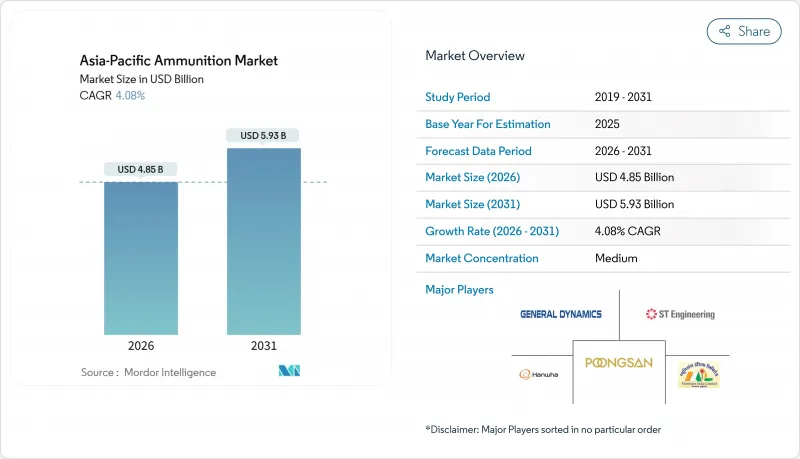
This report is Segmented by Caliber (Small Caliber, Medium Caliber, and More), Product (Bullets and Cartridges, Artillery Shells and Mortars, and More), Guidance (Guided and Unguided), End-User (Military, Law Enforcement, and More), Platform (Land, Naval, and Airborne), and Geography (China, India, Japan, South Korea, Australia, and More). The Market Forecasts are Provided in Terms of Value (USD).
Asia-Pacific Ammunition Market Trends and Insights
Rising Defense Budgets Across Asia-Pacific Nations
China increased its 2024 defense allocation by 7.2%, allocating fresh funds to replenish Rocket Force stockpiles and extend-range artillery ammunition. Japan set a record budget of JPY 8.9 trillion for fiscal 2024, prioritizing counter-strike inventories, such as 155 mm shells and Type 12 missile warheads. South Korea maintained a 4-5% annual growth rate and relied on K2 tank and K9 howitzer ammunition to fuel export-scale production, which reduced unit costs for domestic forces. India earmarked USD 130 billion over five years to lift ammunition war reserves from 10 to 30 combat days, a target that is already reshaping supplier rosters. Australia allocated AUD 4 billion (USD 2.67 billion) to the Guided Weapons and Explosive Ordnance Enterprise, securing sovereign production and reducing reliance on trans-Pacific supply chains.
Modernization Programs Demanding Advanced Calibers and Smart Munitions
India's 155 mm overhaul is replacing 105 mm and 130 mm guns, creating recurring demand for 40,000 rounds a month and pulling private newcomers into a traditionally state-run niche. South Korea's Cheongeom fire-and-forget missile underscores the region's pivot away from unguided recoilless rifles toward precision anti-armor effects. Japan extended the range of its Type 12 surface-to-ship missile beyond 1,000 km, prompting the development of new propellant and guidance electronics lines. Australia's LAND 400 Phase 3 calls for 30 mm airburst rounds to equip its next-generation infantry fighting vehicles (IFVs), forcing suppliers to integrate programmable fuzes at scale. The Philippines' Horizon 2 modernization, valued at PHP 35 billion, converts Vietnam-era howitzers to 155 mm platforms and associated smart projectiles.
Complex Multi-Layer Export Controls and Licensing
The Missile Technology Control Regime rules cap transfers of munitions capable of a range exceeding 300 km or a payload exceeding 500 kg, complicating India's BrahMos-NG supply talks with the Philippines. The Wassenaar Arrangement broadened its 2024 lists to include programmable fuzes, adding 42-state clearance cycles to intra-Asian transactions. US ITAR reviews now average 90-120 days, with denial rates up 8% in 2024 as end-use scrutiny tightens. Australia's export permit regime applies human rights tests that slowed 155 mm shell deliveries to Southeast Asia in 2024. South Korea's K9 ammunition exports to Poland faced delays in NATO certification, indicating that even OECD suppliers may encounter administrative hurdles.
Other drivers and restraints analyzed in the detailed report include:
- Expansion of Regional Manufacturing Capacity and Self-Reliance Initiatives
- Civilian and Law-Enforcement Surge in Sporting/ Self-Defense Ammo
- Raw-Material Price Volatility (Copper, Lead)
For complete list of drivers and restraints, kindly check the Table Of Contents.
Segment Analysis
Small caliber ammunition dominated the Asia-Pacific ammunition market with a 57.74% share in 2025, thanks to the sheer volume of 5.56 mm, 7.62 mm, and 9 mm rounds procured for infantry weapons. Large caliber shells exceeding 100 mm are projected to grow at a 5.16% CAGR, outpacing the overall Asia-Pacific ammunition market as regional armies prioritize long-range fires and counter-battery missions. India's annual 155 mm capacity now exceeds 100,000 rounds, illustrating how self-reliance ambitions can alter supplier maps. South Korea leverages domestic demand to price K9 ammunition 15-20% below European quotes, capturing export programs in Poland and Australia.
Medium caliber autocannons, with calibers ranging from 20 mm to 57 mm, serve armored vehicles and naval guns, with Australia's LAND 400 program specifying smart 30 mm airburst options. The "others" bracket, which includes 12.7 mm machine gun rounds and 40 mm grenades, remains stable, driven by special forces and helicopter door guns. While small-caliber volumes will still dominate training consumption, their growth rate moderates as inventory turn stabilizes. In contrast, artillery demand reacts directly to shifting threat perceptions and exercises that draw down war stocks.
Bullets and cartridges accounted for 62.67% of the Asia-Pacific ammunition market share in 2025, driven by predictable replacement cycles for training and operational readiness. The segment is expanding at a 4.98% CAGR, benefiting from dual military-civilian overlap and the ease of scaling small-caliber production lines. Artillery shells and mortars, although lower in unit volume, carry higher average selling prices, especially when precision-guidance kits are added, keeping revenue contribution sizable despite smaller share counts.
Aerial bombs and 40 mm grenades fill niche close-air-support and infantry-assault roles; the Philippines, for example, earmarked Horizon 2 funds for automatic grenade launchers and stocks of dual-purpose rounds. Australian and Indonesian facilities ramping 155 mm shells illustrate how economies of scale are emerging outside traditional US and European hubs. Continued modernization ensures ongoing refresh cycles, locking in baseline demand even should overall training tempos fluctuate.
Complete Report Scope:
- By Caliber
- Small Caliber
- Medium Caliber
- Large Caliber
- Others
- By Product
- Bullets and Cartridges
- Artillery Shells and Mortars
- Aerial Bombs and Grenades
- By Guidance
- Guided
- Unguided
- By End-User
- Military
- Law Enforcement
- Civil and Sports Shooting
- By Platform
- Land
- Naval
- Airborne
- By Geography
- China
- India
- Japan
- South Korea
- Australia
- Indonesia
- Philippines
- Thailand
- Rest of Asia-Pacific
List of Companies Covered in this Report:
- BAE Systems plc
- Rheinmetall AG
- Elbit Systems Ltd.
- KNDS N.V.
- General Dynamics Corporation
- Nammo AS
- Singapore Technologies Engineering Ltd.
- Denel SOC Ltd.
- Munitions India Limited
- PT Pindad (Persero)
- CBC Global Ammunition
- Hanwha Corporation
- Winchester Ammunition (Olin Corporation)
- Poongsan Corporation
- Sellier & Bellot (Colt CZ Group SE)
Additional Benefits:
- The market estimate (ME) sheet in Excel format
- 3 months of analyst support
TABLE OF CONTENTS
1 INTRODUCTION
- 1.1 Study Assumptions and Market Definition
- 1.2 Scope of the Study
2 RESEARCH METHODOLOGY
3 EXECUTIVE SUMMARY
4 MARKET LANDSCAPE
- 4.1 Market Overview
- 4.2 Market Drivers
- 4.2.1 Rising defense budgets across Asia-Pacific region
- 4.2.2 Modernization programs demanding advanced calibers and smart munitions
- 4.2.3 Expansion of regional manufacturing capacity and self-reliance initiatives
- 4.2.4 Civilian and law-enforcement surge in sporting/self-defense ammo
- 4.2.5 Growth in private military/security companies needing tailored logistics
- 4.2.6 Shift to green/lead-free rounds under stricter environmental rules
- 4.3 Market Restraints
- 4.3.1 Complex multi-layer export controls and licensing
- 4.3.2 Raw-material price volatility
- 4.3.3 Cyber-security risks in smart-ammo interfaces
- 4.3.4 Proliferation of 3D-printed improvised munitions
- 4.4 Value Chain Analysis
- 4.5 Regulatory Landscape
- 4.6 Technological Outlook
- 4.7 Porter's Five Forces Analysis
- 4.7.1 Threat of New Entrants
- 4.7.2 Bargaining Power of Suppliers
- 4.7.3 Bargaining Power of Buyers
- 4.7.4 Threat of Substitutes
- 4.7.5 Intensity of Competitive Rivalry
5 MARKET SIZE AND GROWTH FORECASTS (VALUE)
- 5.1 By Caliber
- 5.1.1 Small Caliber
- 5.1.2 Medium Caliber
- 5.1.3 Large Caliber
- 5.1.4 Others
- 5.2 By Product
- 5.2.1 Bullets and Cartridges
- 5.2.2 Artillery Shells and Mortars
- 5.2.3 Aerial Bombs and Grenades
- 5.3 By Guidance
- 5.3.1 Guided
- 5.3.2 Unguided
- 5.4 By End-User
- 5.4.1 Military
- 5.4.2 Law Enforcement
- 5.4.3 Civil and Sports Shooting
- 5.5 By Platform
- 5.5.1 Land
- 5.5.2 Naval
- 5.5.3 Airborne
- 5.6 By Geography
- 5.6.1 China
- 5.6.2 India
- 5.6.3 Japan
- 5.6.4 South Korea
- 5.6.5 Australia
- 5.6.6 Indonesia
- 5.6.7 Philippines
- 5.6.8 Thailand
- 5.6.9 Rest of Asia-Pacific
6 COMPETITIVE LANDSCAPE
- 6.1 Market Concentration
- 6.2 Strategic Moves
- 6.3 Market Share Analysis
- 6.4 Company Profiles (includes Global level Overview, Market level overview, Core Segments, Financials as available, Strategic Information, Market Rank/Share for key companies, Products and Services, and Recent Developments)
- 6.4.1 BAE Systems plc
- 6.4.2 Rheinmetall AG
- 6.4.3 Elbit Systems Ltd.
- 6.4.4 KNDS N.V.
- 6.4.5 General Dynamics Corporation
- 6.4.6 Nammo AS
- 6.4.7 Singapore Technologies Engineering Ltd.
- 6.4.8 Denel SOC Ltd.
- 6.4.9 Munitions India Limited
- 6.4.10 PT Pindad (Persero)
- 6.4.11 CBC Global Ammunition
- 6.4.12 Hanwha Corporation
- 6.4.13 Winchester Ammunition (Olin Corporation)
- 6.4.14 Poongsan Corporation
- 6.4.15 Sellier & Bellot (Colt CZ Group SE)
7 MARKET OPPORTUNITIES AND FUTURE OUTLOOK
- 7.1 White-space and Unmet-need Assessment

