PUBLISHER: Mordor Intelligence | PRODUCT CODE: 2121233

PUBLISHER: Mordor Intelligence | PRODUCT CODE: 2121233
China In-Vitro Diagnostics - Market Share Analysis, Industry Trends & Statistics, Growth Forecasts (2026 - 2031)
According to Mordor Intelligence, the China in-Vitro diagnostics market size is projected to be USD 18.65 billion in 2025, USD 19.57 billion in 2026, and reach USD 24.92 billion by 2031, growing at a CAGR of 4.95% from 2026 to 2031.
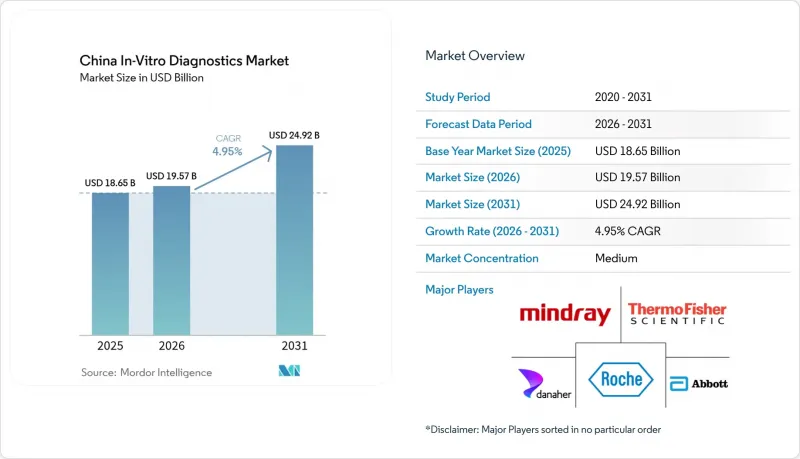
This report is Segmented by Test Type (Clinical Chemistry, Immuno-Diagnostics, and More), Product (Instruments, Reagents & Kits, and Software & Services), Usability (Disposable IVD Devices and Re-Usable Equipment), Application (Infectious Diseases, Diabetes, and More), and End User (Stand-Alone Laboratories, and More). The Market Forecasts are Provided in Terms of Value (USD).
China In-Vitro Diagnostics Market Trends and Insights
Rising Chronic and Infectious Disease Burden
Diabetes affected 148 million adults in 2024, and cardiovascular disease caused 40% of deaths, driving sustained demand for HbA1c, lipid panels, and cardiac biomarkers. The National Cancer Center recorded 4.82 million new cancer cases in 2024, spurring adoption of tumor-marker panels and next-generation sequencing companion diagnostics for therapies such as EGFR inhibitors. Mandatory HIV, hepatitis B, and syphilis screening for pregnant women expanded the addressable immunoassay market. Rapid pathogen response capability was demonstrated when Daan Gene secured approval for a monkeypox nucleic acid test kit in August 2024. Although mutual recognition of test results lowers duplicate routine panels, specialty assay volumes continue to rise.
Rapidly Ageing Population
The 60-plus cohort reached 297 million in 2024 and is projected to reach 400 million by 2035, escalating the use of coagulation, hematology, and renal-function assays. Community elder-care centers now deploy point-of-care devices for glucose, lipid, and uric acid monitoring under a 2025 pilot spanning 10,000 sites in Jiangsu, Zhejiang, and Sichuan. Mindray released a compact chemiluminescence analyzer in 2025, tailored for primary care, that integrates WeChat-based result delivery to offset staffing shortages in rural clinics. Regulatory fast-tracking led to NMPA clearance for 12 self-testing devices in 2024-2025, underscoring policy support for at-home monitoring.
Price Erosion from Volume-Based Procurement
Provincial tenders in 2024-2025 slashed immunoassay reagent prices to CNY 3-5 per test from CNY 15-20, wiping 30 percentage points off gross margins and prompting Roche and Siemens to exit unprofitable SKUs. Jiangxi's 2025 biochemical-reagent round cut average selling prices by 72%, driving smaller firms to shutter niche assay lines below 1 million annual tests. Mutual recognition of results across 31 provinces trimmed routine-panel volumes 15-20%. Manufacturers are countering by bundling instruments at cost and focusing R&D on premium assays that remain outside tender scope, though specialty validation cycles are delaying revenue recovery.
Other drivers and restraints analyzed in the detailed report include:
- Rapid Decentralisation to Point-of-Care Settings
- Technological Advancements in Molecular and Point-of-Care Testing
- Stringent and Evolving Regulatory Requirements
For complete list of drivers and restraints, kindly check the Table Of Contents.
Segment Analysis
Molecular diagnostics accounted for 38.65% of the market in 2025, underpinned by next-generation sequencing and infectious-disease panels. Immunodiagnostics is on track for the fastest 6.87% CAGR through 2031 as domestic chemiluminescence systems displace imports in provincial tenders. The China in-vitro diagnostics market size for molecular platforms is expected to rise alongside companion-diagnostic uptake, yet reimbursement exclusions for 12 liquid-biopsy assays in 2025 temper short-term growth. Clinical-chemistry volumes dropped by 15-20% in Jiangsu and Zhejiang due to mutual recognition policies that reduced duplicate lipid and liver-function tests. Hematology benefited from ISO 15189-driven replacement of legacy 3-part analyzers, with Mindray and Sysmex offering automated slide-making modules that captured 60% combined share.
In 2025, BGI Genomics launched a CNY 500 whole-exome panel and won reimbursement in eight provinces, illustrating how falling sequencing costs are broadening access. YHLO's iFlash 3000, priced 45% below Abbott's Alinity, penetrated 700 tier-2 hospitals within its first year. Although molecular diagnostics remains the largest revenue pool, continued price cuts necessitate workflow innovation and clinical-value demonstration to sustain margins in the China in-vitro diagnostics market.
Reagents and kits generated 61.43% of product revenue in 2025, yet software and services are growing at 6.67% CAGR as laboratories digitize. Instruments face lengthening replacement cycles under DRG budgets, but vendors offset this by bundling zero-margin analyzers with multi-year reagent contracts. Mindray's Wuhan complex embodies this shift, securing consumable deals worth up to CNY 1 billion per hospital chain.
Real-time data mandates from the National Health Commission bolster middleware demand. Mindray-Alibaba AI modules cut troponin false positives by 12%, helping hospitals avoid readmission penalties. Zhejiang's blockchain repository demonstrated CNY 800 million in annual cost savings, propelling adoption of the HL7 FHIR standard. With reagent gross margins compressed to 40%, after-sales service, cloud subscriptions, and quality-control consulting now account for 8-12% of leading firms' sales, a ratio expected to rise within the China in-vitro diagnostics market.
Complete Report Scope:
- By Test Type
- Clinical Chemistry
- Immuno-Diagnostics
- Molecular Diagnostics
- Hematology
- Coagulation
- Microbiology
- Other Test Types
- By Product
- Instruments
- Reagents & Kits
- Software & Services
- By Usability
- Disposable IVD Devices
- Re-Usable Equipment
- By Application
- Infectious Diseases
- Diabetes
- Oncology
- Cardiology
- Auto-Immune Disorders
- Nephrology
- Other Applications
- By End User
- Stand-Alone Laboratories
- Hospital-Based Laboratories
- Point-Of-Care Settings
- Home-Care & Self-Testing Users
List of Companies Covered in this Report:
- Abbott Laboratories
- Agilent Technologies
- Arkray
- Autobio Diagnostics Co. Ltd
- BD (Becton, Dickinson & Co.)
- BGI Genomics Co. Ltd
- Bio-Rad Laboratories
- Biomerieux SA
- Danaher Corp. (Beckman Coulter, Cepheid)
- Daan Gene Co. Ltd
- Roche
- Getein Biotech Inc.
- Maccura Biotechnology
- Sansure Biotech Inc.
- Shanghai Kehua Bio-Engineering
- Mindray
- Siemens Healthineers
- Sysmex
- Thermo Fisher Scientific
- Wondfo Biotech Co. Ltd
- Zhongshan Bio-Tech Co. Ltd
Additional Benefits:
- The market estimate (ME) sheet in Excel format
- 3 months of analyst support
TABLE OF CONTENTS
1 Introduction
- 1.1 Study Assumptions & Market Definition
- 1.2 Scope Of The Study
2 Research Methodology
3 Executive Summary
4 Market Landscape
- 4.1 Market Overview
- 4.2 Market Drivers
- 4.2.1 Rising Chronic and Infectious Disease Burden
- 4.2.2 Rapidly Ageing Population
- 4.2.3 Government Healthcare Reform and Insurance Expansion
- 4.2.4 Technological Advancements in Molecular and Point-Of-Care Testing
- 4.2.5 Local Manufacturing Expansion and Import Substitution
- 4.2.6 Digital Health Integration and Real-Time Data Connectivity
- 4.3 Market Restraints
- 4.3.1 Price Erosion from Volume-Based Procurement
- 4.3.2 Stringent and Evolving Regulatory Requirements
- 4.3.3 Regional Disparities in Laboratory Infrastructure
- 4.3.4 Data Privacy and Cybersecurity Compliance Costs
- 4.4 Regulatory Landscape
- 4.5 Porter's Five Forces
- 4.5.1 Threat Of New Entrants
- 4.5.2 Bargaining Power Of Buyers
- 4.5.3 Bargaining Power Of Suppliers
- 4.5.4 Threat Of Substitutes
- 4.5.5 Competitive Rivalry
5 Market Size & Growth Forecasts (Value, USD)
- 5.1 By Test Type
- 5.1.1 Clinical Chemistry
- 5.1.2 Immuno-Diagnostics
- 5.1.3 Molecular Diagnostics
- 5.1.4 Hematology
- 5.1.5 Coagulation
- 5.1.6 Microbiology
- 5.1.7 Other Test Types
- 5.2 By Product
- 5.2.1 Instruments
- 5.2.2 Reagents & Kits
- 5.2.3 Software & Services
- 5.3 By Usability
- 5.3.1 Disposable IVD Devices
- 5.3.2 Re-Usable Equipment
- 5.4 By Application
- 5.4.1 Infectious Diseases
- 5.4.2 Diabetes
- 5.4.3 Oncology
- 5.4.4 Cardiology
- 5.4.5 Auto-Immune Disorders
- 5.4.6 Nephrology
- 5.4.7 Other Applications
- 5.5 By End User
- 5.5.1 Stand-Alone Laboratories
- 5.5.2 Hospital-Based Laboratories
- 5.5.3 Point-Of-Care Settings
- 5.5.4 Home-Care & Self-Testing Users
6 Competitive Landscape
- 6.1 Market Concentration
- 6.2 Market Share Analysis
- 6.3 Company Profiles {(Includes Global Level Overview, Market Level Overview, Core Segments, Financials As Available, Strategic Information, Market Rank/Share For Key Companies, Products & Services, And Recent Developments)}
- 6.3.1 Abbott Laboratories
- 6.3.2 Agilent Technologies Inc.
- 6.3.3 Arkray Inc.
- 6.3.4 Autobio Diagnostics Co. Ltd
- 6.3.5 BD (Becton, Dickinson & Co.)
- 6.3.6 BGI Genomics Co. Ltd
- 6.3.7 Bio-Rad Laboratories Inc.
- 6.3.8 Biomerieux SA
- 6.3.9 Danaher Corp. (Beckman Coulter, Cepheid)
- 6.3.10 Daan Gene Co. Ltd
- 6.3.11 F. Hoffmann-La Roche AG
- 6.3.12 Getein Biotech Inc.
- 6.3.13 Maccura Biotechnology Co. Ltd
- 6.3.14 Sansure Biotech Inc.
- 6.3.15 Shanghai Kehua Bio-Engineering Co. Ltd
- 6.3.16 Shenzhen Mindray Bio-Medical Electronics Co. Ltd
- 6.3.17 Siemens Healthineers AG
- 6.3.18 Sysmex Corporation
- 6.3.19 Thermo Fisher Scientific Inc.
- 6.3.20 Wondfo Biotech Co. Ltd
- 6.3.21 Zhongshan Bio-Tech Co. Ltd
7 Market Opportunities & Future Outlook
- 7.1 White-Space & Unmet-Need Assessment

