PUBLISHER: Mordor Intelligence | PRODUCT CODE: 2121958

PUBLISHER: Mordor Intelligence | PRODUCT CODE: 2121958
Japan In-vitro Diagnostics - Market Share Analysis, Industry Trends & Statistics, Growth Forecasts (2026 - 2031)
According to Mordor Intelligence, the Japan in-vitro diagnostics market size is expected to grow from USD 7.29 billion in 2025 to USD 7.61 billion in 2026 and is forecast to reach USD 9.46 billion by 2031 at 4.43% CAGR over 2026-2031.
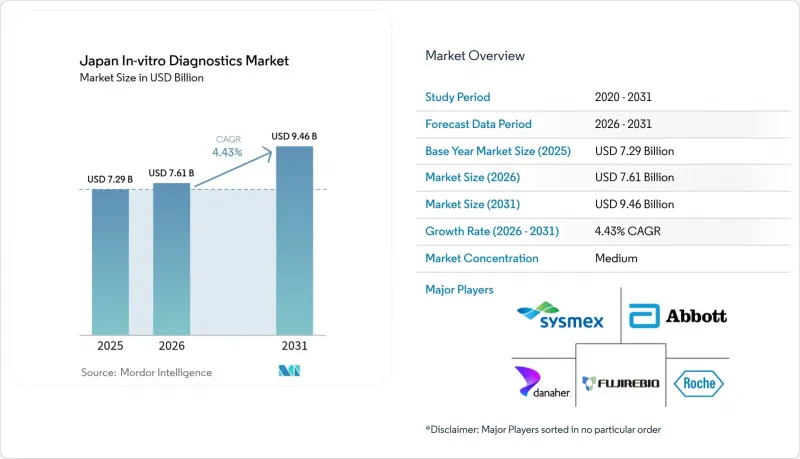
This report is Segmented by Test Type (Clinical Chemistry, and More), Product (Instruments and Analyzers, and More), Usability (Disposable IVD Devices and Re-Usable IVD Devices), Test Setting (Central-Laboratory Testing and Point-Of-Care Testing), Application (Infectious Diseases, and More), End-User (Hospital-Based Laboratories, and More). The Market Forecasts are Provided in Terms of Value (USD).
Japan In-vitro Diagnostics Market Trends and Insights
Rising Chronic Disease Burden & Rapidly Aging Population Elevating Overall Diagnostic Demand
Japan's 65-and-older cohort reached 29.1% of the total population in 2024, the world's highest proportion. The prevalence of diabetes in 10 million adults and cardiovascular deaths comprising 27% of all mortalities are increasing longitudinal monitoring needs. Elderly patients undergo 2.3 times more laboratory tests than younger groups, inflating baseline test volumes across chemistry, hematology, and immuno-assay menus. Providers are embedding multi-biomarker geriatric panels into care pathways, reinforcing demand for comprehensive test menus. Healthcare outlays are projected to climb to JPY 89 trillion by 2040, steering hospitals toward high-throughput analyzers that maintain quality while curbing per-test costs.
Government-Backed Oncology & Precision-Medicine Programs Accelerating Advanced Molecular Testing
The Quad Cancer Moonshot, launched in September 2024, earmarks substantial funding for Indo-Pacific cancer control, with Japan supplying core genomic expertise. Fast-track PMDA review now shortens approval from 14 months to six for breakthrough tests, exemplified by the Toray APOA2-iTQ pancreatic assay cleared in 2023. Public funding has catalyzed adoption of digital PCR and next-generation sequencing as frontline tools for tumor-mutation detection. Hospitals are expanding companion-diagnostic laboratories to align with targeted-therapy reimbursement, pushing the Japan in-vitro diagnostics market toward higher-value molecular assays. The same platforms are migrating into rare-disease and inherited-disorder testing, broadening revenue streams for assay developers.
Currency Volatility & Import Dependence Inflating Reagent and Analyzer Costs
Roughly 60% of IVD systems are imported, exposing labs to yen depreciation that hit 15% against the dollar in 2024. Reagent prices climbed 18% year-on-year, outpacing fee-schedule revisions and squeezing laboratory margins. To hedge forex risk, providers are shifting toward reagent-rental contracts that cut capital outlays but lock in higher long-term reagent spend. Sysmex responded by localizing analyzer production, buffering clients from currency swings and fortifying its domestic share. Persistent volatility continues to weigh on purchasing decisions for high-complexity molecular platforms.
Other drivers and restraints analyzed in the detailed report include:
- Preventive Health Mandates and Corporate Wellness Schemes Expanding Routine Screening Volumes
- Technology Shift Toward Decentralized Point-of-Care Platforms Supporting Care-at-Home & Retail Clinics
- Ongoing Hospital Consolidation Reducing Central-Lab Testing Capacity
For complete list of drivers and restraints, kindly check the Table Of Contents.
Segment Analysis
Molecular diagnostics contributed USD 1.88 billion to the Japan in-vitro diagnostics market size in 2025 and is projected to grow at an 7.86% CAGR through 2031, outpacing all other test categories. Immuno-diagnostics retained 31.35% share in 2025, underpinned by entrenched infectious-disease and hormone assays, whereas chemistry platforms remain indispensable for metabolic panels. Next-generation sequencing and digital PCR are accelerating oncology mutation screening, leveraging PMDA fast-track approvals that halve review times. Roche's Sequencing by Expansion system, commercialized locally in February 2025, compresses whole-genome turnaround to under six hours, enabling same-day precision-oncology decisions. Concomitantly, high-sensitivity cardiac-troponin and brain-natriuretic-peptide immuno-assays are broadening acute-care utility, reinforcing immuno-diagnostics' revenue base within the Japan in-vitro diagnostics market.
Adoption of multiplex PCR respiratory panels surged 35% post-pandemic as clinicians demanded rapid pathogen differentiation. Digital-enzyme-linked immunosorbent systems are improving lower-limit detection for autoimmune markers, enhancing early-stage disease management. Automated smear-differential hematology analyzers with AI-powered image recognition are boosting lab productivity amid workforce shortages. Microbiology segments integrate MALDI-TOF mass-spectrometry for same-day organism ID, critical for antimicrobial stewardship. Collectively, these technology inflections are galvanizing test-mix upgrade cycles that favor higher-margin reagents, sustaining robust revenue momentum.
Reagents and kits secured 59.25% of the Japan in-vitro diagnostics market share in 2025, reflecting the dominance of consumable-centric business models. Laboratories prioritize premium reagents to ensure assay reliability, supporting annual price elasticity despite reimbursement pressures. Instruments and analyzers demonstrate steady replacement demand as legacy equipment is swapped for fully automated racks that integrate pre-analytical robotics and middleware. The Japan in-vitro diagnostics market size for middleware grew 9% in 2025, propelled by Beckman Coulter's cloud-native DxONE suite that optimizes consumable tracking and auto-validates results.
AI-enabled decision-support modules are now bundled with analyzer purchases, transforming software from ancillary to core value. Vendors monetize algorithm updates via subscription, stabilizing revenue streams beyond one-time capital sales. Consumables such as controls and calibrators log mid-single-digit growth tied to rising quality-assurance mandates. Hybrid procurement models-capital-free analyzer placement against reagent volume commitments-are gaining favor among budget-constrained public hospitals, reshaping vendor contract structures.
Complete Report Scope:
- By Test Type
- Clinical Chemistry
- Molecular Diagnostics
- Immuno-Diagnostics
- Haematology
- Microbiology
- Coagulation
- Others
- By Product
- Instruments and Analyzers
- Reagents & Consumables
- Software & Services
- By Usability
- Disposable IVD Devices
- Re-usable IVD Devices
- By Test Setting
- Central-Laboratory Testing
- Point-of-Care / Near-Patient Testing
- By Application
- Infectious Diseases
- Diabetes
- Oncology
- Cardiology
- Auto-immune Disorders
- Nephrology
- Others
- By End-User
- Hospital-based Laboratories
- Independent Diagnostic Labs
- Physician-Office / Retail Clinics
- Academic & Research Centers
List of Companies Covered in this Report:
- Roche Diagnostics KK
- Sysmex
- Abbott Japan LLC
- Danaher Corp.
- Fujirebio Holdings Inc.
- Siemens Healthineers
- Thermo Fisher Scientific
- bioMerieux Japan
- Bio-Rad Laboratories
- Qiagen KK
- Tosoh
- Horiba Medical
- Nihon Kohden
- LSI Medience
- Kyowa Medex
- Arkray
- Sekisui Diagnostics
- Ortho Clinical Diagnostics
- Illumina KK
- Revvity, Inc.
Additional Benefits:
- The market estimate (ME) sheet in Excel format
- 3 months of analyst support
TABLE OF CONTENTS
1 Introduction
- 1.1 Study Assumptions & Market Definition
- 1.2 Scope of the Study
2 Research Methodology
3 Executive Summary
4 Market Landscape
- 4.1 Market Overview
- 4.2 Market Drivers
- 4.2.1 Rising Chronic Disease Burden & Rapidly Aging Population Elevating Overall Diagnostic Demand
- 4.2.2 Government-Backed Oncology & Precision-Medicine Programs Accelerating Advanced Molecular Testing
- 4.2.3 Preventive Health Mandates and Corporate Wellness Schemes Expanding Routine Screening Volumes
- 4.2.4 Technology Shift Toward Decentralized Point-of-Care Platforms Supporting Care-at-Home & Retail Clinics
- 4.2.5 Strengthened National Infectious-Disease Preparedness Sustaining Demand for Rapid Test Panels
- 4.3 Market Restraints
- 4.3.1 Currency Volatility & Import Dependence Inflating Reagent and Analyzer Costs
- 4.3.2 Ongoing Hospital Consolidation Reducing Central-Lab Testing Capacity
- 4.3.3 Lengthy PMDA Review Cycles and Compliance Burden Delaying New Product Commercialization
- 4.4 Regulatory Outlook
- 4.5 Porter's Five Forces
- 4.5.1 Threat of New Entrants
- 4.5.2 Bargaining Power of Buyers
- 4.5.3 Bargaining Power of Suppliers
- 4.5.4 Threat of Substitutes
- 4.5.5 Intensity of Competitive Rivalry
5 Market Size & Growth Forecasts (Value, USD)
- 5.1 By Test Type
- 5.1.1 Clinical Chemistry
- 5.1.2 Molecular Diagnostics
- 5.1.3 Immuno-Diagnostics
- 5.1.4 Haematology
- 5.1.5 Microbiology
- 5.1.6 Coagulation
- 5.1.7 Others
- 5.2 By Product
- 5.2.1 Instruments and Analyzers
- 5.2.2 Reagents & Consumables
- 5.2.3 Software & Services
- 5.3 By Usability
- 5.3.1 Disposable IVD Devices
- 5.3.2 Re-usable IVD Devices
- 5.4 By Test Setting
- 5.4.1 Central-Laboratory Testing
- 5.4.2 Point-of-Care / Near-Patient Testing
- 5.5 By Application
- 5.5.1 Infectious Diseases
- 5.5.2 Diabetes
- 5.5.3 Oncology
- 5.5.4 Cardiology
- 5.5.5 Auto-immune Disorders
- 5.5.6 Nephrology
- 5.5.7 Others
- 5.6 By End-User
- 5.6.1 Hospital-based Laboratories
- 5.6.2 Independent Diagnostic Labs
- 5.6.3 Physician-Office / Retail Clinics
- 5.6.4 Academic & Research Centers
6 Competitive Landscape
- 6.1 Market Concentration
- 6.2 Market Share Analysis
- 6.3 Company Profiles (includes Global level Overview, Market level overview, Core Business Segments, Financials, Headcount, Key Information, Market Rank, Market Share, Products and Services, and analysis of Recent Developments)
- 6.3.1 Roche Diagnostics KK
- 6.3.2 Sysmex Corporation
- 6.3.3 Abbott Japan LLC
- 6.3.4 Danaher Corp.
- 6.3.5 Fujirebio Holdings Inc.
- 6.3.6 Siemens Healthineers
- 6.3.7 Thermo Fisher Scientific
- 6.3.8 bioMerieux Japan
- 6.3.9 Bio-Rad Laboratories
- 6.3.10 Qiagen KK
- 6.3.11 Tosoh Corporation
- 6.3.12 Horiba Medical
- 6.3.13 Nihon Kohden
- 6.3.14 LSI Medience
- 6.3.15 Kyowa Medex
- 6.3.16 ARKRAY Inc.
- 6.3.17 Sekisui Diagnostics
- 6.3.18 Ortho Clinical Diagnostics
- 6.3.19 Illumina KK
- 6.3.20 Revvity, Inc.
7 Market Opportunities & Future Outlook
- 7.1 White-space & Unmet-Need Assessment

