PUBLISHER: Mordor Intelligence | PRODUCT CODE: 2121252

PUBLISHER: Mordor Intelligence | PRODUCT CODE: 2121252
Automotive Adhesive Tape - Market Share Analysis, Industry Trends & Statistics, Growth Forecasts (2026 - 2031)
According to Mordor Intelligence, the automotive adhesive tape market size is projected to be USD 5.29 billion in 2025, USD 5.59 billion in 2026, and reach USD 7.36 billion by 2031, growing at a CAGR of 5.67% from 2026 to 2031.
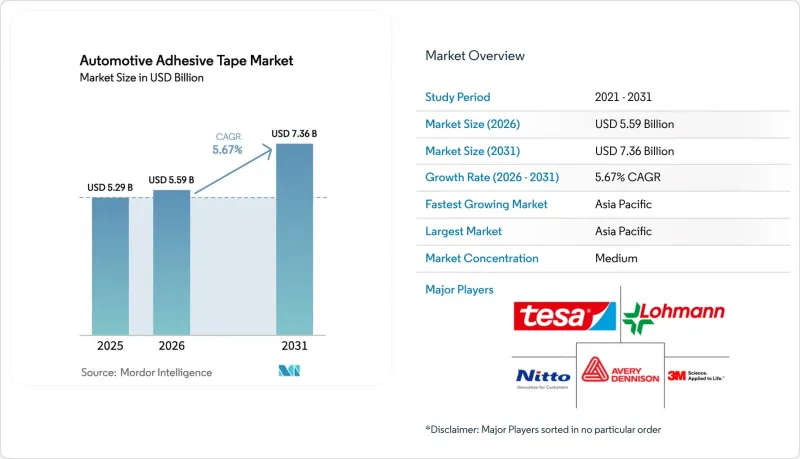
This report is Segmented by Backing Material (PET, PVC, PP, Paper, PA, and Other Backing Material), Adhesive Type (Epoxy, Acrylic, Polyurethane, Silicone, and Other Adhesive Type), Application (Exterior, Interior, Powertrain, and Electronics), and Geography (Asia-Pacific, North America, Europe, South America, and Middle-East and Africa). Market Forecasts are Provided in Terms of Value (USD).
Global Automotive Adhesive Tape Market Trends and Insights
EV Battery Thermal-Management Tape Demand
As lithium-ion packs increasingly demand continuous heat dissipation to prevent thermal runaway, thermally conductive, flame-retardant tapes have surged beyond their traditional powertrain applications. Tesa's ACXplus line adeptly bonds cooling plates directly to cell modules at a consistent 180 °C, eliminating the need for mechanical clamps. Lohmann's DuploFLEX solutions not only meet the stringent UL 94 V-0 standards but also maintain a thickness variation of less than 5% across one-meter widths, a critical requirement for automated dispensing systems. Collectively, these advancements are steering the market towards specialty tape formulations, which command prices significantly outpacing traditional interior-trim grades.
Lightweighting Replacing Mechanical Fasteners
In response to Corporate Average Fuel Economy mandates in the U.S. and Euro 7 regulations in Europe, automakers are increasingly replacing rivets and screws with structural adhesive tapes. Ford, for instance, lightened the 2024 F-150 Lightning's body-in-white by using adhesive tape to bond roof panels. This change not only lightened the vehicle but also significantly reduced the bonding cycle time. The use of adhesive tapes on assembly lines boosts throughput by evenly distributing stress, preventing rework due to heat distortion, and reducing tool maintenance costs. In a similar vein, Avery Dennison is capitalizing on consistent acrylic chemistries across both original equipment (OE) and graphic films, effectively distributing research and development costs across diverse revenue streams. Interior suppliers are also adopting this approach, using double-coated PET tapes to bond decorative trims. This not only conceals visible fasteners but also minimizes squeaks, elevating cabin refinement for luxury brands.
Petrochemical Feedstock Price Volatility
Crude oil fluctuations directly influence the prices of polypropylene and polyethylene terephthalate films, as both resins are products of naphtha cracking. Polypropylene resin prices have surged, leading converters to face margin compression. While automotive contracts typically lock in tape prices for a year, resin suppliers adjust their prices quarterly. This discrepancy heightens the risk for mid-scale converters lacking hedging strategies. Avery Dennison has adopted tolling arrangements, transferring resin procurement responsibilities to OEMs, thereby reducing its risk. However, regional specialists continue to face vulnerabilities. The unpredictable nature of resin costs complicates capacity-planning decisions, causing delays in investments for solvent-free coating lines, which could hasten the adoption of polypropylene.
Other drivers and restraints analyzed in the detailed report include:
- Composite Materials Need Compatible Tapes
- ADAS Sensor EMI-Shielding Tape Adoption
- PFAS Regulatory Scrutiny on Adhesives
For complete list of drivers and restraints, kindly check the Table Of Contents.
Segment Analysis
PVC held 33.65% of 2025 revenue because it balances cost, conformability, and flame retardancy, especially for wire-harness wrapping inside the automotive adhesive tape market. Polypropylene's lighter basis weight, however, propels a 6.13% growth rate as every gram saved in tape backing supports OEM lightweight targets. Avery Dennison's polypropylene film not only cut material spending but also adhered to interior flammability norms, leading several European programs to pivot from PVC. In 2024, Lohmann introduced a bio-based PP backing, aligning with the rising trend of scope-3 emission audits and aiding suppliers in retaining their approved-vendor status with sustainability-centric OEMs.
Throughput is a key focus in the segment's competitive discussions. A polypropylene tape yields more linear meters per master roll compared to a PVC tape, leading to reduced freight costs per unit area and enhanced line productivity in the automotive adhesive tape sector. While PET holds a consistent position in exhaust-adjacent heat zones, PVC outperforms in under-body areas due to its chlorine content, which curbs combustion without incurring additive costs. Polyamide carves out a niche for ultra-high-temperature joints surpassing 200 °C.
Complete Report Scope:
- By Backing Material
- Polyethylene Terephthalate (PET)
- Polyvinyl Chloride (PVC)
- Polypropylene (PP)
- Paper
- Polyamide (PA)
- Other Backing Material
- By Adhesive Type
- Epoxy
- Acrylic
- Polyurethane
- Silicone
- Other Adhesive Tape
- By Application
- Exterior
- Interior
- Powertrain
- Electronics
- By Geography
- Asia-Pacific
- China
- India
- Japan
- South Korea
- Rest of Asia-Pacific
- North America
- United States
- Canada
- Mexico
- Europe
- Germany
- United Kingdom
- France
- Italy
- Spain
- Russia
- NORDIC Countries
- Rest of Europe
- South America
- Brazil
- Argentina
- Rest of South America
- Middle-East and Africa
- Saudi Arabia
- South Africa
- Rest of Middle-East and Africa
- Asia-Pacific
Geography Analysis
Asia-Pacific contributed 53.26% of global volume in 2025 and is forecast to grow 5.90% annually through 2031. This growth is driven by the sale of new energy vehicles in China and a substantial consumption of thermal tape at CATL's single Ningde site. Following closely, India is set to grow, thanks to localization incentives. These incentives impose duties on finished tapes but exempt raw materials, prompting converters to invest locally. Meanwhile, Japan and South Korea continue to be at the forefront of innovation. For instance, Nitto Denko's graphene-enhanced thermal tape, boasting superior performance, commands a premium over conventional grades and has secured spots on premium EV platforms.
North America, with a notable revenue share, owes much of its buoyancy to Mexico's assembly corridor. In 2024, Avery Dennison bolstered its Tijuana capacity by adding clean-room space, catering to the rising demand for electronics-grade tape. This move underscores the region's pivot towards more intricate value streams. Additionally, U.S. OEMs are leveraging long-term resin contracts to mitigate feedstock volatility, thereby safeguarding margins for converters operating North American coating lines. Europe, while accounting for a significant portion of 2025's revenue, grapples with challenges. Industrial electricity costs in Germany are significantly higher than in China. This disparity squeezes margins on commodity tapes, nudging converters to pivot towards high-specification products tailored for luxury brands.
In 2025, South America and the combined regions of the Middle East and Africa accounted for a modest share of the total value. Brazil, buoyed by local outputs from Volkswagen and Fiat, registered growth. However, the market remains highly price-sensitive, showing a preference for PVC-backed tapes. The limited production of EVs in the region curtails the uptake of specialty grades, indicating a slower penetration of advanced electronics tapes in the automotive adhesive tape market.
- 3M
- American Biltrite Inc.
- Avery Dennison Corporation
- Berry Global Inc.
- Certoplast Technische Klebebander Gmbh
- Coroplast Fritz Muller Gmbh & Co. Kg
- Godson Tapes Private Limited
- IPG
- L&L Products
- Lintec Corporation
- Lohmann Gmbh & Co. Kg
- Nitto Denko Corporation
- Saint-Gobain
- Scapa Group Ltd
- Shurtape Technologies, LLC
- Sika AG
- tesa Tapes (India) Private Limited
- VIBAC Group S.P.A.
Additional Benefits:
- The market estimate (ME) sheet in Excel format
- 3 months of analyst support
TABLE OF CONTENTS
1 Introduction
- 1.1 Study Assumptions and Market Definition
- 1.2 Scope of the Study
2 Research Methodology
3 Executive Summary
4 Market Landscape
- 4.1 Market Overview
- 4.2 Market Drivers
- 4.2.1 EV battery thermal-management tape demand
- 4.2.2 Lightweighting replacing mechanical fasteners
- 4.2.3 Composite materials need compatible tapes
- 4.2.4 ADAS sensor EMI-shielding tape adoption
- 4.2.5 Modular vehicle architectures enable disassembly tapes
- 4.3 Market Restraints
- 4.3.1 Petrochemical feedstock price volatility
- 4.3.2 PFAS regulatory scrutiny on adhesives
- 4.3.3 Poor recyclability of multi-material tapes
- 4.4 Value Chain Analysis
- 4.5 Porter's Five Forces Analysis
- 4.5.1 Bargaining Power of Suppliers
- 4.5.2 Bargaining Power of Buyers
- 4.5.3 Threat of New Entrants
- 4.5.4 Threat of Substitutes
- 4.5.5 Degree of Competition
5 Market Size and Growth Forecasts (Value)
- 5.1 By Backing Material
- 5.1.1 Polyethylene Terephthalate (PET)
- 5.1.2 Polyvinyl Chloride (PVC)
- 5.1.3 Polypropylene (PP)
- 5.1.4 Paper
- 5.1.5 Polyamide (PA)
- 5.1.6 Other Backing Material
- 5.2 By Adhesive Type
- 5.2.1 Epoxy
- 5.2.2 Acrylic
- 5.2.3 Polyurethane
- 5.2.4 Silicone
- 5.2.5 Other Adhesive Tape
- 5.3 By Application
- 5.3.1 Exterior
- 5.3.2 Interior
- 5.3.3 Powertrain
- 5.3.4 Electronics
- 5.4 By Geography
- 5.4.1 Asia-Pacific
- 5.4.1.1 China
- 5.4.1.2 India
- 5.4.1.3 Japan
- 5.4.1.4 South Korea
- 5.4.1.5 Rest of Asia-Pacific
- 5.4.2 North America
- 5.4.2.1 United States
- 5.4.2.2 Canada
- 5.4.2.3 Mexico
- 5.4.3 Europe
- 5.4.3.1 Germany
- 5.4.3.2 United Kingdom
- 5.4.3.3 France
- 5.4.3.4 Italy
- 5.4.3.5 Spain
- 5.4.3.6 Russia
- 5.4.3.7 NORDIC Countries
- 5.4.3.8 Rest of Europe
- 5.4.4 South America
- 5.4.4.1 Brazil
- 5.4.4.2 Argentina
- 5.4.4.3 Rest of South America
- 5.4.5 Middle-East and Africa
- 5.4.5.1 Saudi Arabia
- 5.4.5.2 South Africa
- 5.4.5.3 Rest of Middle-East and Africa
- 5.4.1 Asia-Pacific
6 Competitive Landscape
- 6.1 Market Concentration
- 6.2 Strategic Moves
- 6.3 Market Share/Ranking Analysis
- 6.4 Company Profiles (includes Global Overview, Market Overview, Core Segments, Financials, Strategic Information, Market Rank/Share)
- 6.4.1 3M
- 6.4.2 American Biltrite Inc.
- 6.4.3 Avery Dennison Corporation
- 6.4.4 Berry Global Inc.
- 6.4.5 Certoplast Technische Klebebander Gmbh
- 6.4.6 Coroplast Fritz Muller Gmbh & Co. Kg
- 6.4.7 Godson Tapes Private Limited
- 6.4.8 IPG
- 6.4.9 L&L Products
- 6.4.10 Lintec Corporation
- 6.4.11 Lohmann Gmbh & Co. Kg
- 6.4.12 Nitto Denko Corporation
- 6.4.13 Saint-Gobain
- 6.4.14 Scapa Group Ltd
- 6.4.15 Shurtape Technologies, LLC
- 6.4.16 Sika AG
- 6.4.17 tesa Tapes (India) Private Limited
- 6.4.18 VIBAC Group S.P.A.
7 Market Opportunities and Future Outlook
- 7.1 White-space and Unmet-Need Assessment

