PUBLISHER: Mordor Intelligence | PRODUCT CODE: 2121362

PUBLISHER: Mordor Intelligence | PRODUCT CODE: 2121362
Propionic Acid - Market Share Analysis, Industry Trends & Statistics, Growth Forecasts (2026 - 2031)
According to Mordor Intelligence, the propionic acid market size was valued at USD 1.63 billion in 2025 and is estimated to grow from USD 1.73 billion in 2026 to reach USD 2.31 billion by 2031, at a CAGR of 5.92% during the forecast period (2026-2031).
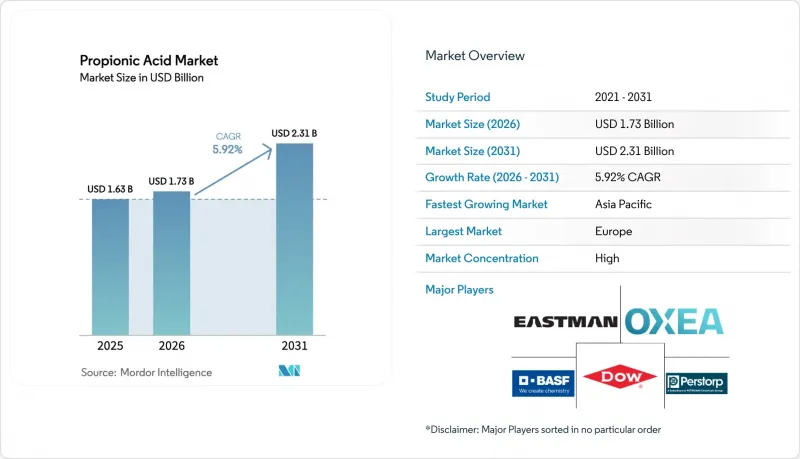
This report is Segmented by Application (Animal Feed and Preservatives, Calcium Ammonium and Sodium Salts, and More), End-User Industry (Agriculture, Food and Beverage, Personal Care, and More), Production Route (Petrochemical and Bio-Based Fermentation), Grade (Feed Grade, Food Grade, and More), and Geography (Asia-Pacific, North America, and More). Market Forecasts are Provided in Terms of Value (USD).
Global Propionic Acid Market Trends and Insights
Expanding Demand for Grain and Silage Preservatives
Grain moisture levels exceeding a certain threshold foster the growth of Aspergillus and Penicillium, leading to aflatoxin levels surpassing Codex limits. However, many cooperatives find mechanical drying to be prohibitively expensive. Propionic acid effectively halts fungal growth, ensuring toxin levels remain within global standards. The U.S. Food and Drug Administration's GRAS status for direct feed inclusion provides livestock producers with regulatory assurance. In silage, both calcium and ammonium propionate prevent aerobic spoilage upon opening bunkers, safeguarding dry matter from potential loss. Adoption rates are highest in humid tropical regions, where mycotoxin pressures are pronounced. Consequently, the propionic acid market plays a pivotal role in enhancing feed safety and bolstering farmer profitability.
Uptake of Feed-Grade Acids in Antibiotic-Free Meat Chains
In response to European bans on sub-therapeutic antibiotics and similar policies in North America, integrators are increasingly turning to organic-acid programs. Propionic acid, known for lowering intestinal pH, effectively suppresses harmful pathogens like Salmonella and Clostridium, all while safeguarding beneficial lactobacilli. Field trials in broiler production have demonstrated its economic advantages. A 2024 assessment by the European Food Safety Authority, which found no genotoxic concerns, reaffirmed the safety of propionic acid. In a notable industry trend, leading suppliers are now blending propionic, formic, and butyric acids. This move not only broadens their antimicrobial coverage but also indicates a shift away from single-acid strategies, bolstering the growth trajectory of the propionic acid market.
Volatile Petro-Based Feedstock Prices
In 2025, refinery turnarounds and fluctuating cracker operating rates caused propylene spot prices to oscillate. These price swings tightened margins for producers without integrated olefin capacity and made pricing negotiations challenging for bakeries locked into fixed-price contracts. While fermentation offers a partial hedge-thanks to crude glycerol feedstock's independent trading from oil-bio routes remain costly, often reaching twice the price of petrochemical synthesis. This financial disparity moderates the immediate transition to a wholly renewable supply in the propionic acid market.
Other drivers and restraints analyzed in the detailed report include:
- Packaged-Bakery Boom in Emerging Asia
- Growing Requirement for Shelf-Life Extension in Processed Foods
- Health Concerns over Chronic Intake in Ultra-Processed Foods
For complete list of drivers and restraints, kindly check the Table Of Contents.
Segment Analysis
Animal feed and food preservatives held 51.92% of the propionic acid market share in 2025. Cellulose acetate propionate posted a 6.49% CAGR outlook thanks to high-solids automotive refinish coatings and bio-content nail lacquers. The segment benefits from patents that increase propionyl content and support bio-content claims, boosting specialty demand. Calcium, ammonium, and sodium propionates remain indispensable in bread, dairy, and feed, where pH control is critical. Perstorp's 2024 capacity addition supports captive production of salts and plasticizers, reinforcing supply stability. Herbicides and plasticizers occupy smaller shares, but their steady volumes diversify revenue and lessen risk.
Steady requirement for mold inhibition in global grain chains underpins the application hierarchy. The propionic acid market size for feed additives is projected to track livestock expansion in Asia-Pacific and South America at a mid-single-digit CAGR. Specialty coatings draw on cellulose acetate propionate to cut volatile organic compound levels in line with tightening regulations, adding high-margin growth. Producers balance commodity feed-grade manufacturing with smaller pharmaceutical and specialty runs to optimize capacity utilization, ensuring broad coverage of propionic acid market demand.
Agriculture absorbed 56.98% of consumption in 2025 as integrators mandate organic-acid programs in antibiotic-free systems. The segment anchors baseline tonnage for the propionic acid market. Pharmaceuticals are forecast to grow at a 6.02% CAGR through 2031 on the rising adoption of controlled-release excipients and topical antimicrobials. Pharmacopeial monographs set the purity of propionic acid at high levels, solidifying its price premium over feed grade.
Manufacturers in the food and beverage sector rely on calcium propionate to prolong bread's shelf life, ensuring its viability through extensive distribution networks. Meanwhile, sectors like personal care, textiles, and electronics serve as niche markets, balancing out the seasonal fluctuations in demand from agriculture and bakeries. The pharmaceutical grade, bound by cGMP regulations, faces a limited supplier base, safeguarding its margins. This dynamic not only fortifies the pharmaceutical sector but also broadens the horizons of the propionic acid market, extending its reach beyond mere bulk feed preservation.
Complete Report Scope:
- By Application
- Animal Feed and Preservatives
- Calcium, Ammonium and Sodium Salts
- Cellulose Acetate Propionate (CAP)
- Herbicides
- Plasticizers and Solvents
- Others
- By End-user Industry
- Agriculture
- Food and Beverage
- Personal Care
- Pharmaceutical
- Other End user Industries
- By Production Route
- Petrochemical
- Bio-based Fermentation
- By Grade
- Feed Grade
- Food Grade
- Pharmaceutical Grade
- Industrial Grade
- By Geography
- Asia-Pacific
- China
- India
- Japan
- South Korea
- Rest of Asia-Pacific
- North America
- United States
- Canada
- Mexico
- Europe
- Germany
- United Kingdom
- France
- Italy
- Rest of Europe
- South America
- Brazil
- Argentina
- Rest of South America
- Middle-East and Africa
- Saudi Arabia
- South Africa
- Rest of Middle-East and Africa
- Asia-Pacific
Geography Analysis
Europe controlled 49.83% of the global value in 2025. Early elimination of antibiotic growth promoters and stringent European Food Safety Authority evaluations stabilized demand for calcium propionate and feed-grade acids. Germany's industrial bakeries and poultry farms consume large volumes, while funding for CO2-free steam at BASF's Ludwigshafen complex exemplifies policy support for lower-carbon chemicals. Capacity additions at Perstorp's Stenungsund site further anchor Europe as a production base that can comply with emerging carbon-border adjustments. Mature yet stable bakery and livestock sectors keep the propionic acid market resilient across the region.
Asia-Pacific is projected to grow at a 6.34% CAGR through 2031, the fastest among regions. China leads consumption, supported by the BASF-YPC joint venture that supplies domestic feed mills and bakeries. India is ramping up organic-acid programs in poultry, and packaged-bread demand is climbing alongside urbanization. High-value markets such as Japan and South Korea require pharmaceutical-grade material, while Southeast Asia benefits from export-oriented poultry complexes. Corbion's 2024 investment in Thailand signals confidence in fermentation-based preservatives within the region, pointing to future capacity shifts favorable to the propionic acid market.
North America, bolstered by its vast livestock operations and prominent bakery chains, accounts for about a quarter of the world's propionic acid demand. The U.S. Environmental Protection Agency reports that domestic production of propionic acid ensures a steady local supply. In a bid to enhance cross-border trade, Mexico and Canada have aligned their feed-safety protocols with those of the U.S. South America, predominantly driven by Brazil and Argentina, showcases a significant yet price-sensitive market, particularly in grain preservation. Meanwhile, the Middle East and Africa, though smaller, are on an upward trajectory. In Saudi Arabia, poultry expansion and a growing bakery sector in South Africa are fueling increased imports. Together, these varied regional dynamics play a pivotal role in sustaining the global propionic acid market.
- BASF SE
- Celanese Corporation
- Dow
- Eastman Chemical Company
- KANTO KAGAKU
- Kishida Chemical Co., Ltd
- Luxi Group
- Merck KGaA
- OXEA Gmbh
- Perstorp
- Shanghai Jianbei Organic Chemical Co., Ltd.
- Yancheng Hongtai Bioengineering Co., Ltd.
- Yancheng Huade (Dancheng) Biological Engineering Co.,Ltd.
Additional Benefits:
- The market estimate (ME) sheet in Excel format
- 3 months of analyst support
TABLE OF CONTENTS
1 Introduction
- 1.1 Study Assumptions and Market Definition
- 1.2 Scope of the Study
2 Research Methodology
3 Executive Summary
4 Market Landscape
- 4.1 Market Overview
- 4.2 Market Drivers
- 4.2.1 Expanding demand for grain and silage preservatives
- 4.2.2 Uptake of feed-grade acids in antibiotic-free meat chains
- 4.2.3 Packaged-bakery boom in emerging Asia
- 4.2.4 Growing requirement for shelf-life extension in processed foods
- 4.2.5 Food-brand Scope-3 decarbonisation targets favouring low-carbon polyvinyl amide
- 4.3 Market Restraints
- 4.3.1 Volatile petro-based feedstock prices
- 4.3.2 Health concerns over chronic intake in ultra-processed foods
- 4.3.3 Capacity concentration-driven supply-chain risk
- 4.4 Value Chain Analysis
- 4.5 Porter's Five Forces
- 4.5.1 Bargaining Power of Suppliers
- 4.5.2 Bargaining Power of Buyers
- 4.5.3 Threat of New Entrants
- 4.5.4 Threat of Substitutes
- 4.5.5 Degree of Competition
5 Market Size and Growth Forecasts (Value)
- 5.1 By Application
- 5.1.1 Animal Feed and Preservatives
- 5.1.2 Calcium, Ammonium and Sodium Salts
- 5.1.3 Cellulose Acetate Propionate (CAP)
- 5.1.4 Herbicides
- 5.1.5 Plasticizers and Solvents
- 5.1.6 Others
- 5.2 By End-user Industry
- 5.2.1 Agriculture
- 5.2.2 Food and Beverage
- 5.2.3 Personal Care
- 5.2.4 Pharmaceutical
- 5.2.5 Other End user Industries
- 5.3 By Production Route
- 5.3.1 Petrochemical
- 5.3.2 Bio-based Fermentation
- 5.4 By Grade
- 5.4.1 Feed Grade
- 5.4.2 Food Grade
- 5.4.3 Pharmaceutical Grade
- 5.4.4 Industrial Grade
- 5.5 By Geography
- 5.5.1 Asia-Pacific
- 5.5.1.1 China
- 5.5.1.2 India
- 5.5.1.3 Japan
- 5.5.1.4 South Korea
- 5.5.1.5 Rest of Asia-Pacific
- 5.5.2 North America
- 5.5.2.1 United States
- 5.5.2.2 Canada
- 5.5.2.3 Mexico
- 5.5.3 Europe
- 5.5.3.1 Germany
- 5.5.3.2 United Kingdom
- 5.5.3.3 France
- 5.5.3.4 Italy
- 5.5.3.5 Rest of Europe
- 5.5.4 South America
- 5.5.4.1 Brazil
- 5.5.4.2 Argentina
- 5.5.4.3 Rest of South America
- 5.5.5 Middle-East and Africa
- 5.5.5.1 Saudi Arabia
- 5.5.5.2 South Africa
- 5.5.5.3 Rest of Middle-East and Africa
- 5.5.1 Asia-Pacific
6 Competitive Landscape
- 6.1 Market Concentration
- 6.2 Strategic Moves
- 6.3 Market Share(%)/Ranking Analysis
- 6.4 Company Profiles (includes Global level Overview, Market level overview, Core Segments, Financials as available, Strategic Information, Products and Services, and Recent Developments)
- 6.4.1 BASF SE
- 6.4.2 Celanese Corporation
- 6.4.3 Dow
- 6.4.4 Eastman Chemical Company
- 6.4.5 KANTO KAGAKU
- 6.4.6 Kishida Chemical Co., Ltd
- 6.4.7 Luxi Group
- 6.4.8 Merck KGaA
- 6.4.9 OXEA Gmbh
- 6.4.10 Perstorp
- 6.4.11 Shanghai Jianbei Organic Chemical Co., Ltd.
- 6.4.12 Yancheng Hongtai Bioengineering Co., Ltd.
- 6.4.13 Yancheng Huade (Dancheng) Biological Engineering Co.,Ltd.
7 Market Opportunities and Future Outlook
- 7.1 White-space and Unmet-need Assessment

