PUBLISHER: Mordor Intelligence | PRODUCT CODE: 2121367

PUBLISHER: Mordor Intelligence | PRODUCT CODE: 2121367
Evaporative Cooling - Market Share Analysis, Industry Trends & Statistics, Growth Forecasts (2026 - 2031)
According to Mordor Intelligence, the evaporative cooling market size is expected to grow from USD 7.65 billion in 2025 to USD 8.19 billion in 2026 and is forecast to reach USD 11.55 billion by 2031 at 7.10% CAGR over 2026-2031.
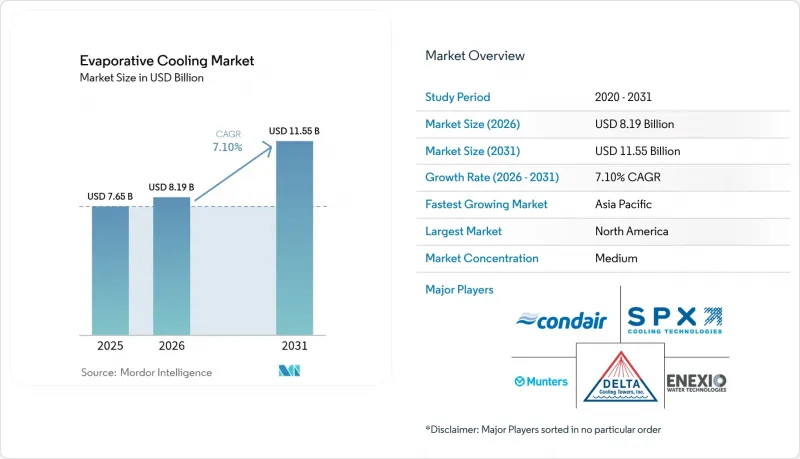
This report is Segmented by Cooling Principle (Direct Evaporative Cooling, Indirect Evaporative Cooling, and More), Application (Residential Buildings, Commercial Buildings, and More), Cooling Capacity - CFM ( Less Than or Equal To 5, 000 CFM, and More), Component (Cooling Pads, Fans and Blowers, and More), and Geography. The Market Forecasts are Provided in Terms of Value (USD).
Global Evaporative Cooling Market Trends and Insights
Cost-Effectiveness Drives Industrial Adoption
Manufacturing plants in dry U.S. states report operating expenses that are 60-80% lower than those of mechanical refrigeration, with capital recovery inside two years as electricity tariffs climb. Typical wet-bulb conditions below 78 °F enable 15-20 °F air temperature reductions using one-tenth the power of chilled-water systems. Texas and Arizona poultry farms cite 25% lower heat-stress mortality alongside 70% savings on cooling bills.
Data Centers Embrace Evaporative Cooling for PUE Optimization
Hyperscale operators use indirect and two-stage designs to achieve PUE as low as 1.06, far outperforming traditional averages of 1.4-1.6. The EU Energy Efficiency Directive obliges facilities above 500 kW IT load to recover waste heat by 2025, positioning evaporative technology as a compliance enabler. Microsoft's Arizona campus proves all-year viability even in desert climates by pre-cooling intake air before final adiabatic conditioning.
Climate Dependence Limits Geographic Expansion
Efficiency drops below 50% when ambient humidity rises beyond 60%, limiting standalone adoption in tropical belts. Southeastern U.S. facilities report seasonal performance swings that necessitate hybrid HVAC, boosting upfront spending by 30-40%. Manufacturers respond with two-stage and desiccant-assisted variants, yet cost premiums still deter small commercial buyers.
Other drivers and restraints analyzed in the detailed report include:
- Construction Boom in Arid Regions Fuels Demand
- Environmental Regulations Accelerate Low-GWP Adoption
- Water Scarcity Challenges Adoption in Arid Markets
For complete list of drivers and restraints, kindly check the Table Of Contents.
Segment Analysis
Direct evaporative designs retained 66.20% of revenue in 2025 because of low installed cost between USD 3,000 and USD 8,000. Yet two-stage solutions are forecast to deliver a 7.72% CAGR as they sustain comfortable supply air at ambient humidity up to 75%. The evaporative cooling market size for two-stage units is projected to double by 2031 as data centers and schools in mixed-humid climates prioritize efficiency without sacrificing comfort. Manufacturers hedge risk by offering modular upgrades that convert installed direct units into two-stage configurations, deferring large capital outlays until humidity demands change.
Demand for indirect evaporative modules grows inside packaged rooftop units that serve big-box retail and logistics centers. Air-side economizers route cool outdoor air through polymer heat exchangers that never contact conditioned space, protecting indoor air quality while capturing free cooling hours. Integrators bundle ultraviolet lamps and antimicrobial coatings to address Legionella fears, assembling turnkey kits that slot into existing ductwork. As a result, the evaporative cooling market continues to blend traditional pads with emerging polymer membranes and high-surface-area heat pipes.
Residential installations hold 71.05% of 2025 revenue, a legacy of widespread adoption across U.S. Sunbelt states and Australia. Low energy draw lets homeowners offset power needs with rooftop solar, and utility incentives of USD 500-2,000 cut net cost further. Still, hyperscale cloud operators will add the most new capacity, with the segment advancing at a 9.05% CAGR. The evaporative cooling market share for data centers is expected to rise sharply as more jurisdictions require PUE reporting and waste-heat reuse.
Commercial properties deploy roof-mounted evaporative pre-coolers to trim compressor runtime and dodge peak-demand tariffs that can reach USD 0.35 per kWh. Poultry houses and greenhouses integrate pads for animal welfare and crop protection, noting 25% mortality reductions and 15% yield gains during extreme heat. Such cross-sector versatility shields the evaporative cooling industry from cyclical swings in residential construction.
Complete Report Scope:
- By Cooling Principle
- Direct Evaporative Cooling
- Indirect Evaporative Cooling
- Two-stage Evaporative Cooling
- By Application
- Residential Buildings
- Commercial Buildings
- Industrial Facilities
- Confinement Farming
- Data Centers
- By Cooling Capacity - CFM
- less than or equal to 5,000 CFM
- 5,001-15,000 CFM
- above 15,000 CFM
- By Component
- Cooling Pads
- Fans and Blowers
- Water Pumps
- Control Systems and Sensors
- Other Components
- By Geography
- North America
- United States
- Canada
- South America
- Brazil
- Argentina
- Rest of South America
- Europe
- Germany
- United Kingdom
- France
- Spain
- Italy
- Rest of Europe
- Asia-Pacific
- China
- India
- Japan
- South Korea
- Rest of Asia-Pacific
- Middle East and Africa
- Middle East
- Saudi Arabia
- United Arab Emirates
- Turkey
- Rest of Middle East
- Africa
- South Africa
- Nigeria
- Rest of Africa
- Middle East
- North America
Geography Analysis
North America held 38.20% of global revenue in 2025, anchored by the United States Southwest where daytime wet-bulb temperatures make evaporative cooling the most economical choice. Title 24 energy codes in California assign compliance credits that reduce compressor capacity, effectively subsidizing the evaporative cooling market. Incentive programs from Nevada and Arizona utilities reimburse up to USD 2,000 per residential install, sustaining demand amid high mortgage rates. Yet prolonged drought keeps policy fluid. During 2022-2023 shortages some utilities paused rebates, signaling a need for recirculating designs and alternative water sources.
Asia-Pacific is forecast to be the fastest-growing cluster at an 8.10% CAGR, and its evaporative cooling market size is projected to double by 2031. Saudi Arabia's NEOM alone represents a USD 2 billion lifetime opportunity as codes demand adiabatic conditioning for 80% of planned homes. Australia offers accelerated depreciation, while India's green-building council now recognizes evaporative pre-cooling points under its IGBC rating. Rapid urbanization and tight power reserves make low-energy HVAC essential, pushing state governments to explore water-recycling pads and treated wastewater loops.
Europe shows mixed momentum. Northern climates deploy indirect evaporative economizers in data centers across Ireland and the Nordics, leveraging cool ambient air for free cooling 80% of the year. Southern Europe is slower due to higher humidity, but Spain's logistics parks integrate two-stage systems that guarantee supply temperatures under 75 °F even at 60% relative humidity. The Middle East, despite water scarcity, moves ahead with high-efficiency pads and brackish-water tolerant materials. South America remains nascent but promising, led by Brazil where automotive paint booths adopt adiabatic coolers to save 70% on energy.
- Baltimore Aircoil Company Inc.
- SPX Cooling Technologies Inc.
- Delta Cooling Towers Inc.
- Condair Group AG
- Munters Group AB
- Seeley International Pty Ltd
- Symphony Limited
- Portacool LLC
- Phoenix Manufacturing Inc.
- Honeywell International Inc. (Honeywell Comfort)
- Colt Group Limited
- Cambridge Air Solutions Inc.
- Frigiking - Nortek Global HVAC LLC
- Bonaire - Climate Technologies Pty Ltd
- Hessaire Products Inc.
- Airgroup Australia Pty Ltd (Coolair)
- Oasis Coolers LLC
- Swiss Evaporative Systems AG
- Celsius Design Limited
- CFW Evapcool (CFW Industries Ltd.)
- ENEXIO Water Technologies GmbH
- Temperzone Ltd.
- SPIG S.p.A.
Additional Benefits:
- The market estimate (ME) sheet in Excel format
- 3 months of analyst support
TABLE OF CONTENTS
1 INTRODUCTION
- 1.1 Study Assumptions and Market Definition
- 1.2 Scope of the Study
2 RESEARCH METHODOLOGY
3 EXECUTIVE SUMMARY
4 MARKET LANDSCAPE
- 4.1 Market Overview
- 4.2 Market Drivers
- 4.2.1 Demand for cost-effective cooling solutions
- 4.2.2 Data-center adoption for energy efficiency
- 4.2.3 Booming construction in arid regions
- 4.2.4 Environmental regulations favoring low-GWP cooling
- 4.2.5 Integration with off-grid solar-hybrid HVAC
- 4.2.6 Water-recapture pads cutting consumptive use
- 4.3 Market Restraints
- 4.3.1 Dependence on external climate conditions
- 4.3.2 High water footprint in water-stressed zones
- 4.3.3 Legionella and microbial health concerns
- 4.3.4 Sensor interoperability issues in smart buildings
- 4.4 Industry Value Chain Analysis
- 4.5 Regulatory Landscape
- 4.6 Technological Outlook
- 4.7 Porter's Five Forces Analysis
- 4.7.1 Threat of New Entrants
- 4.7.2 Bargaining Power of Suppliers
- 4.7.3 Bargaining Power of Buyers
- 4.7.4 Threat of Substitutes
- 4.7.5 Competitive Rivalry
- 4.8 Evaporative-Cooling Hotspot Analysis
- 4.9 Comparative Analysis of Alternative/Substitute Cooling Technologies
5 MARKET SIZE AND GROWTH FORECASTS (VALUE)
- 5.1 By Cooling Principle
- 5.1.1 Direct Evaporative Cooling
- 5.1.2 Indirect Evaporative Cooling
- 5.1.3 Two-stage Evaporative Cooling
- 5.2 By Application
- 5.2.1 Residential Buildings
- 5.2.2 Commercial Buildings
- 5.2.3 Industrial Facilities
- 5.2.4 Confinement Farming
- 5.2.5 Data Centers
- 5.3 By Cooling Capacity - CFM
- 5.3.1 less than or equal to 5,000 CFM
- 5.3.2 5,001-15,000 CFM
- 5.3.3 above 15,000 CFM
- 5.4 By Component
- 5.4.1 Cooling Pads
- 5.4.2 Fans and Blowers
- 5.4.3 Water Pumps
- 5.4.4 Control Systems and Sensors
- 5.4.5 Other Components
- 5.5 By Geography
- 5.5.1 North America
- 5.5.1.1 United States
- 5.5.1.2 Canada
- 5.5.2 South America
- 5.5.2.1 Brazil
- 5.5.2.2 Argentina
- 5.5.2.3 Rest of South America
- 5.5.3 Europe
- 5.5.3.1 Germany
- 5.5.3.2 United Kingdom
- 5.5.3.3 France
- 5.5.3.4 Spain
- 5.5.3.5 Italy
- 5.5.3.6 Rest of Europe
- 5.5.4 Asia-Pacific
- 5.5.4.1 China
- 5.5.4.2 India
- 5.5.4.3 Japan
- 5.5.4.4 South Korea
- 5.5.4.5 Rest of Asia-Pacific
- 5.5.5 Middle East and Africa
- 5.5.5.1 Middle East
- 5.5.5.1.1 Saudi Arabia
- 5.5.5.1.2 United Arab Emirates
- 5.5.5.1.3 Turkey
- 5.5.5.1.4 Rest of Middle East
- 5.5.5.2 Africa
- 5.5.5.2.1 South Africa
- 5.5.5.2.2 Nigeria
- 5.5.5.2.3 Rest of Africa
- 5.5.5.1 Middle East
- 5.5.1 North America
6 COMPETITIVE LANDSCAPE
- 6.1 Market Concentration
- 6.2 Strategic Moves
- 6.3 Market Share Analysis
- 6.4 Company Profiles (includes Global level Overview, Market level overview, Core Segments, Financials as available, Strategic Information, Market Rank/Share, Products and Services, Recent Developments)
- 6.4.1 Baltimore Aircoil Company Inc.
- 6.4.2 SPX Cooling Technologies Inc.
- 6.4.3 Delta Cooling Towers Inc.
- 6.4.4 Condair Group AG
- 6.4.5 Munters Group AB
- 6.4.6 Seeley International Pty Ltd
- 6.4.7 Symphony Limited
- 6.4.8 Portacool LLC
- 6.4.9 Phoenix Manufacturing Inc.
- 6.4.10 Honeywell International Inc. (Honeywell Comfort)
- 6.4.11 Colt Group Limited
- 6.4.12 Cambridge Air Solutions Inc.
- 6.4.13 Frigiking - Nortek Global HVAC LLC
- 6.4.14 Bonaire - Climate Technologies Pty Ltd
- 6.4.15 Hessaire Products Inc.
- 6.4.16 Airgroup Australia Pty Ltd (Coolair)
- 6.4.17 Oasis Coolers LLC
- 6.4.18 Swiss Evaporative Systems AG
- 6.4.19 Celsius Design Limited
- 6.4.20 CFW Evapcool (CFW Industries Ltd.)
- 6.4.21 ENEXIO Water Technologies GmbH
- 6.4.22 Temperzone Ltd.
- 6.4.23 SPIG S.p.A.
7 MARKET OPPORTUNITIES AND FUTURE OUTLOOK
- 7.1 White-space and Unmet-need Assessment

