PUBLISHER: Mordor Intelligence | PRODUCT CODE: 2122479

PUBLISHER: Mordor Intelligence | PRODUCT CODE: 2122479
North America Evaporative Cooling - Market Share Analysis, Industry Trends & Statistics, Growth Forecasts (2026 - 2031)
According to Mordor Intelligence, the North America evaporative cooling market size was valued at USD 1.88 billion in 2025 and estimated to grow from USD 1.98 billion in 2026 to reach USD 2.57 billion by 2031, at a CAGR of 5.31% during the forecast period (2026-2031).
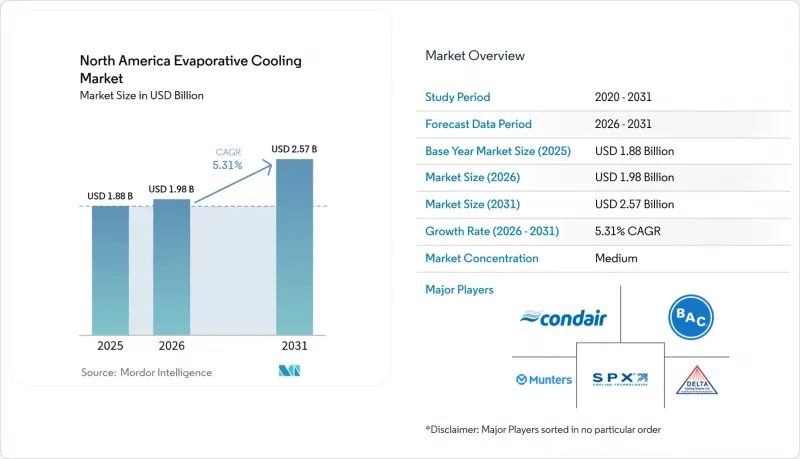
This report is Segmented by Cooling Method (Direct, Indirect, and Two-Stage), Application (Residential, Commercial, Industrial, and More), Component (Equipment, Pads and Media, and More), Sales Channel (Direct, HVAC Contractors/Integrators, Distribution and Wholesale, and Online Retail/E-Commerce), and Geography. The Market Forecasts are Provided in Terms of Value (USD).
North America Evaporative Cooling Market Trends and Insights
Data-center shift to low-PUE cooling
Hyperscale operators are deploying adiabatic precooling modules that shave condenser inlet temperatures by up to 40 °F, freeing as much as 14 MW for IT loads in a 300 MW campus. Microsoft's closed-loop zero-water designs and NREL's underground thermal energy storage trials highlight an ecosystem focused on water-neutral, power-lean architectures. Immersion-ready evaporative towers licensed by Baltimore Aircoil further illustrate convergence between liquid and air side solutions. As AI workloads heighten rack densities, indirect-direct stages deliver tighter thermal bands without compressor lift, placing evaporative cooling at the core of digital-infrastructure expansion.
Industrial and commercial energy-efficiency mandates
Title 24 in California now stipulates 350 Btuh/W minimums for evaporative-cooled condensers above 8,000 MBH and requires wet-bulb responsive variable-speed fans. Federal refrigerant rules that phase out GWP> 750 options accelerate the adoption of natural refrigerant systems feedable by evaporative rejectors. Natural Resources Canada mirrors U.S. thresholds, enabling cross-border equipment harmonization. Together, these policies lock in minimum performance levels that favor adiabatic or hybrid towers capable of 75% energy savings versus direct expansion chillers.
Climate humidity dependency
Evaporative effectiveness declines sharply when relative humidity climbs above 60%, leaving southeastern states reliant on hybrid desiccant-evaporative pairs. Simulations for Mexicali confirm viability only during seasonal low-humidity windows, necessitating backup dehumidification in peak months. Although dew-point indirect stages extend performance envelopes, added complexity narrows the Cap-ex gap that defines the North America evaporative cooling market advantage.
Other drivers and restraints analyzed in the detailed report include:
- CAP-ex advantage vs. compressor-based HVAC
- Renewable-microgrid + evaporative hybrid roll-outs
- Water-scarcity regulations
For complete list of drivers and restraints, kindly check the Table Of Contents.
Segment Analysis
Direct units retained a 63.20% foothold in the North America evaporative cooling market in 2025, reflecting decades of installation across arid western facilities. Indirect towers held 23.70%, favored in food processing and pharmaceuticals that prohibit direct air-water contact. Two-stage indirect-direct designs recorded the fastest 5.69% CAGR, propelled by data-center and high-heat industrial retrofits that need sub-dewpoint delivery without excessive water draw.
Performance gaps are narrowing as perforated dew-point heat exchangers raise indirect effectiveness, enabling supply-air ratios below 0.5 while maintaining low pressure drops. As these materials mature, two-stage platforms are eclipsing single-stage gear in design-build specifications, a trend expected to lift their slice of the North America evaporative cooling market size by 2031. Vendors now integrate chemical-free water treatment and antimicrobial films, extending pad life and alleviating the labor bottleneck facing large campus operators.
Industrial plants generated 36.60% of 2025 revenue, driven by food, chemical, and general-manufacturing loads that prioritize robust operation and energy savings. Data centers, although smaller, are growing at a 5.34% CAGR as AI accelerates rack heat densities beyond what air-conditioned CRAC units can manage. Controlled-environment agriculture, greenhouses, and confinement farming chart a 8.74% CAGR, benefiting from the legalization of cannabis and vertical-farm momentum that positions evaporative solutions as low-energy, humidity-tunable alternatives to compressor coils.
Commercial buildings capture a 24.30% share through retail and office retrofits tied to sustainability certifications, while residential adoption advances at a modest 5.12% CAGR, largely confined to dry-climate locales. Agricultural uptake is expected to raise its chunk of the North America evaporative cooling market share beyond 10.5% by 2031 as growers seek low-carbon, low-water HVAC that protects crop transpiration profiles without costly desiccant wheels.
Complete Report Scope:
- By Cooling Method
- Direct
- Indirect
- Two-Stage (Indirect-Direct)
- By Application
- Residential
- Commercial (Retail, Offices, Hospitality)
- Industrial (Food and Beverage, Chemical, Manufacturing)
- Confinement Farming and Greenhouses
- Others
- By Component
- Equipment (Coolers and Towers)
- Pads and Media
- Water Distribution Systems
- Controls and Automation
- Services and Maintenance
- By Sales Channel
- Direct (Manufacturer to End-User)
- HVAC Contractors / Integrators
- Distribution and Wholesale
- Online Retail / E-Commerce
- By Country
- United States
- Canada
- Mexico
List of Companies Covered in this Report:
- Condair Group AG
- Baltimore Aircoil Company, Inc.
- Munters Group AB
- SPX Cooling Technologies, Inc.
- Delta Cooling Towers Private Limited
- Phoenix Manufacturing, Inc.
- Colt Group Holdings Limited
- Bonaire Pty Ltd
- Cambridge Engineering, Inc.
- Portacool, LLC
- EVAPCO, Inc.
- Seeley International Pty Ltd
- Symphony Limited
- Honeywell International India Private Limited
- Champion Cooler Corp.
- Mastercool, U.S.A., Inc.
- Excel Air Systems
- Air2O Cooling Limited
- The Chemours Company
- Hydro Cool Inc. (Anderson, SC)
Additional Benefits:
- The market estimate (ME) sheet in Excel format
- 3 months of analyst support
TABLE OF CONTENTS
1 INTRODUCTION
- 1.1 Study Assumptions and Market Definition
- 1.2 Scope of the Study
2 RESEARCH METHODOLOGY
3 EXECUTIVE SUMMARY
4 MARKET LANDSCAPE
- 4.1 Market Overview
- 4.2 Market Drivers
- 4.2.1 Data-center shift to low-PUE cooling
- 4.2.2 Industrial and commercial energy-efficiency mandates
- 4.2.3 CAP-ex advantage vs. compressor-based HVAC
- 4.2.4 Renewable-microgrid + evaporative hybrid roll-outs
- 4.2.5 Cannabis and controlled-environment agriculture demand
- 4.2.6 Bio-based/hydrogel pads extending maintenance cycles
- 4.3 Market Restraints
- 4.3.1 Climate humidity dependency
- 4.3.2 Escalating water-scarcity regulations
- 4.3.3 Wildfire-smoke IAQ compliance hurdles
- 4.3.4 Skilled-labor shortages for scale-control and hygiene
- 4.4 Industry Value Chain Analysis
- 4.5 Regulatory Landscape
- 4.6 Technological Outlook
- 4.7 Porter's Five Forces Analysis
- 4.7.1 Bargaining Power of Buyers
- 4.7.2 Bargaining Power of Suppliers
- 4.7.3 Threat of New Entrants
- 4.7.4 Threat of Substitutes
- 4.7.5 Intensity of Competitive Rivalry
- 4.8 Assessment of Macro-economic Impact
- 4.9 Investment Analysis
5 MARKET SIZE AND GROWTH FORECASTS (VALUE)
- 5.1 By Cooling Method
- 5.1.1 Direct
- 5.1.2 Indirect
- 5.1.3 Two-Stage (Indirect-Direct)
- 5.2 By Application
- 5.2.1 Residential
- 5.2.2 Commercial (Retail, Offices, Hospitality)
- 5.2.3 Industrial (Food and Beverage, Chemical, Manufacturing)
- 5.2.4 Confinement Farming and Greenhouses
- 5.2.5 Others
- 5.3 By Component
- 5.3.1 Equipment (Coolers and Towers)
- 5.3.2 Pads and Media
- 5.3.3 Water Distribution Systems
- 5.3.4 Controls and Automation
- 5.3.5 Services and Maintenance
- 5.4 By Sales Channel
- 5.4.1 Direct (Manufacturer to End-User)
- 5.4.2 HVAC Contractors / Integrators
- 5.4.3 Distribution and Wholesale
- 5.4.4 Online Retail / E-Commerce
- 5.5 By Country
- 5.5.1 United States
- 5.5.2 Canada
- 5.5.3 Mexico
6 COMPETITIVE LANDSCAPE
- 6.1 Market Concentration
- 6.2 Strategic Moves
- 6.3 Market Share Analysis
- 6.4 Company Profiles (includes Global level Overview, Market level overview, Core Segments, Financials as available, Strategic Information, Market Rank/Share for key companies, Products and Services, and Recent Developments)
- 6.4.1 Condair Group AG
- 6.4.2 Baltimore Aircoil Company, Inc.
- 6.4.3 Munters Group AB
- 6.4.4 SPX Cooling Technologies, Inc.
- 6.4.5 Delta Cooling Towers Private Limited
- 6.4.6 Phoenix Manufacturing, Inc.
- 6.4.7 Colt Group Holdings Limited
- 6.4.8 Bonaire Pty Ltd
- 6.4.9 Cambridge Engineering, Inc.
- 6.4.10 Portacool, LLC
- 6.4.11 EVAPCO, Inc.
- 6.4.12 Seeley International Pty Ltd
- 6.4.13 Symphony Limited
- 6.4.14 Honeywell International India Private Limited
- 6.4.15 Champion Cooler Corp.
- 6.4.16 Mastercool, U.S.A., Inc.
- 6.4.17 Excel Air Systems
- 6.4.18 Air2O Cooling Limited
- 6.4.19 The Chemours Company
- 6.4.20 Hydro Cool Inc. (Anderson, SC)
7 MARKET OPPORTUNITIES AND FUTURE OUTLOOK
- 7.1 White-space and unmet-need assessment

