PUBLISHER: Mordor Intelligence | PRODUCT CODE: 2121371

PUBLISHER: Mordor Intelligence | PRODUCT CODE: 2121371
DC Distribution Network - Market Share Analysis, Industry Trends & Statistics, Growth Forecasts (2026 - 2031)
According to Mordor Intelligence, the DC distribution network market size is estimated at USD 21.24 billion in 2026, and is expected to reach USD 31.40 billion by 2031, at a CAGR of 8.13% during the forecast period (2026-2031).
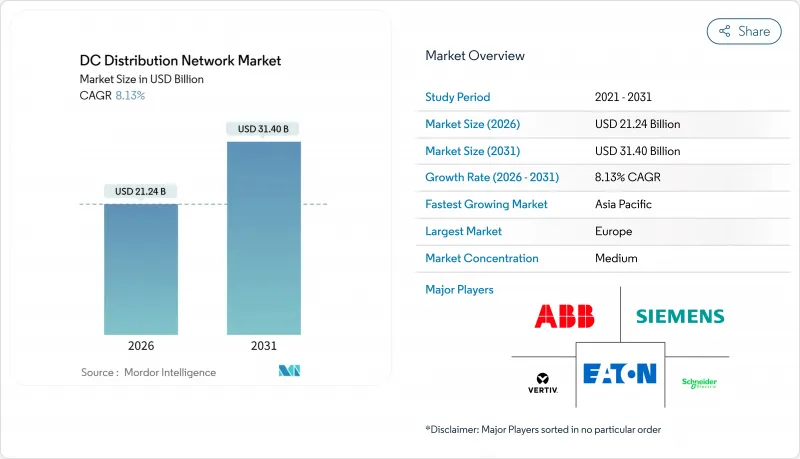
This report is Segmented by Technology (DC-DC Converters, DC Circuit Breakers, Advanced Control Systems, and Others), Voltage Level (Low Voltage, Medium Voltage, and High Voltage), Application (Data Centers, Telecom and Remote Cell Towers, Commercial and Institutional Buildings, EV Fast Charging Infrastructure, and More), and Geography (North America, Europe, Asia-Pacific, South America, and More).
Global DC Distribution Network Market Trends and Insights
Renewable-Energy Build-Out Accelerates LVDC and MVDC Microgrids
Solar and wind installations are increasingly paired with batteries and DC feeders to eliminate inverter losses that can reach 12% in AC-coupled topologies. China added 217 GW of solar in 2024, much of it in remote provinces where MVDC microgrids bypass long AC lines and step-up transformers. India's 2025 program to electrify 10,000 villages with LVDC microgrids combines rooftop solar, lithium-iron-phosphate batteries, and DC appliances, backed by USD 1.2 billion in funding. A 500 kW installation in Rajasthan delivered a 22% lower levelized cost of electricity than an AC equivalent by removing inverter stages and reducing copper cross-section. Island nations are following suit to integrate diesel, solar, and storage without synchronizing AC phases, a long-standing technical barrier for small grids. The net effect is accelerated uptake of DC Distribution Network market solutions across emerging economies.
Hyperscale Data-Center Surge Adopts 380 V LVDC Bus Architectures
Meta, Microsoft, and Google each operate multiple hyperscale facilities that are migrating to 380 V LVDC to reduce server-rack power loss and airflow requirements. Lawrence Berkeley National Laboratory quantified a 15-20% reduction in distribution losses compared with 480 V AC, translating to USD 2 million in annual savings for a 20 MW site. Vertiv and Schneider Electric launched modular LVDC shelves integrating lithium-ion batteries directly on the bus, enabling sub-millisecond failover and trimming UPS footprint by 40%. Singapore's data-center regulations now mandate a Power Usage Effectiveness below 1.3, a threshold more readily met with LVDC. Widespread replication of this architecture is reinforcing the DC Distribution Network market's medium-term growth trajectory.
Fragmented Codes and Standards for Building-Level DC Wiring
Architects must navigate a patchwork of jurisdictions where many rules fail to address voltages above 60 V DC, forcing project-by-project approvals that add six to twelve months to schedules. Brazil's ABNT standards still omit IEC 63290, while South Africa references outdated clauses that predate modern LVDC topologies. Insurance underwriters in the United States assess premiums that are 15-20% higher for DC installations, citing uncertain arc-flash risk profiles. These gaps slow the flow of capital into the DC Distribution Network market, particularly for retrofit projects.
Other drivers and restraints analyzed in the detailed report include:
- Fast-Charging Corridors for EVs Demand High-Power DC Backbones
- Energy-Efficiency Mandates Cut AC/DC Conversion Losses
- High Upfront Cost of DC-Rated Protection and Switchgear
For complete list of drivers and restraints, kindly check the Table Of Contents.
Segment Analysis
DC-DC converters captured 39.7% of 2025 revenue as the interface that harmonizes 600-800 V solar arrays, 400-750 V battery strings, and 380 V or 750 V distribution buses, ensuring bidirectional power flow and grid-services revenue streams. Silicon-carbide MOSFET designs pushed efficiency above 98% in 2025, trimming thermal losses and cooling loads. DC circuit breakers form the second-largest slice of the DC Distribution Network market, helped by sub-2 ms solid-state interruption launched in 2024. Advanced control software layers predictive maintenance and revenue optimization atop hardware, yielding up to 18% higher internal rates of return than unmanaged systems. Secondary devices, contactors, fuses, and meters round out a USD 1.5 billion niche that supplies specialty applications such as telecom shelters and defense outposts.
A brighter outlook emerges as gallium-nitride devices mature, opening a path toward 99% efficient megawatt-scale converters that could reshape the DC Distribution Network market over the long term. Vendors are also integrating digital twins that forecast equipment aging and schedule condition-based maintenance, a feature set valued by data-center operators facing 99.999% uptime requirements. Chinese suppliers bundle converters with lithium-iron-phosphate batteries at aggressive price points that undercut European offerings by 25%, accelerating penetration in Southeast Asia and the Middle East. Nonetheless, intellectual-property-heavy segments such as fault-current limiters remain dominated by European incumbents.
Complete Report Scope:
- By Technology
- DC-DC Converters
- DC Circuit Breakers
- Advanced Control Systems
- Others
- By Voltage Level
- Low Voltage (Up to 1 kV)
- Medium Voltage (1 kV to 15 kV)
- High Voltage (15 kV to 150 kV)
- By Application
- Data Centers
- Telecom and Remote Cell Towers
- Commercial and Institutional Buildings
- Industrial Facilities
- EV Fast Charging Infrastructure
- Military and Defense
- Renewable Energy and Storage
- Transportation and Mobility
- Other Applications
- By Geography
- North America
- United States
- Canada
- Mexico
- Europe
- Germany
- United Kingdom
- France
- Italy
- Spain
- NORDIC Countries
- Russia
- Rest of Europe
- Asia-Pacific
- China
- India
- Japan
- South Korea
- ASEAN Countries
- Australia and New Zealand
- Rest of Asia-Pacific
- South America
- Brazil
- Argentina
- Colombia
- Rest of South America
- Middle East and Africa
- Saudi Arabia
- United Arab Emirates
- South Africa
- Egypt
- Rest of Middle East and Africa
- North America
Geography Analysis
Europe's 40.8% share in 2025 reflects coherent policy, readily available subsidies, and deep engineering expertise in power-electronics manufacturing. Germany's Federal Ministry for Economic Affairs and Climate Action extended its DC microgrid subsidy to 2027 with EUR 200 million earmarked for commercial and industrial facilities. Nordic utilities employ MVDC links for offshore wind collection, reducing platform weight by 30% and lowering installation risk. France is retrofitting 50 government buildings with 380 V LVDC to secure 20% energy savings, and the United Kingdom's grid operator plans MVDC interconnections to defer GBP 1 billion in conventional transmission upgrades. Policy synchrony under the Energy Performance of Buildings Directive shortens approval cycles, encouraging cross-border equipment procurement that enlarges the DC Distribution Network market.
Asia-Pacific is forecast to post a 9.6% CAGR as China scales MVDC industrial parks and India rolls out rural LVDC microgrids. China's State Grid invested USD 3.2 billion in 2025 to develop direct-current feeders across industrial zones in Jiangsu and Guangdong, cementing domestic suppliers' dominance. India's Bureau of Energy Efficiency introduced a star-rating program for microgrids that ties fiscal incentives to performance, raising design standards and ensuring replicability. Japan and South Korea experiment with smart-city LVDC to support peer-to-peer energy trading, while Australia funds MVDC for remote mining, cutting diesel reliance by 40%. Regional uptake is amplified by aggressive price plays from Chinese converter and switchgear manufacturers that market integrated packages at 20-30% discounts to European imports.
North America holds 22% of 2025 revenue but reveals uneven progress. Fifty new hyperscale data centers embraced LVDC, yet commercial-building projects stall under fragmented codes and cautious utilities. California's Self-Generation Incentive Program allocates USD 200 million for DC microgrids in critical facilities, while Canada backs LVDC in remote Indigenous communities to displace diesel generation. Mexico pilots MVDC in automotive corridors but faces regulatory uncertainty that clouds private investment. South America and the Middle East & Africa represent smaller but rising contributors; Brazil approved its first MVDC microgrid in 2024, and the United Arab Emirates extended its 380 V LVDC backbone in Masdar City to 500 buildings. Together, these trends signal steady, albeit regionally variable, expansion for the DC Distribution Network market.
- ABB Ltd.
- Siemens AG
- Schneider Electric SE
- Vertiv Group Corp.
- Eaton Corporation plc
- Hitachi Energy Ltd.
- General Electric Co.
- Mitsubishi Electric Corp.
- Prysmian Group
- Delta Electronics, Inc.
- Nextek Power Systems, Inc.
- Alpha Technologies Ltd.
- Secheron SA
- TE Connectivity Ltd.
- Johnson Controls International plc
- Huawei Technologies Co.
- Legrand SA
- Chint Group
- Littelfuse, Inc.
- Socomec Group
Additional Benefits:
- The market estimate (ME) sheet in Excel format
- 3 months of analyst support
TABLE OF CONTENTS
1 Introduction
- 1.1 Study Assumptions & Market Definition
- 1.2 Scope of the Study
2 Research Methodology
3 Executive Summary
4 Market Landscape
- 4.1 Market Overview
- 4.2 Market Drivers
- 4.2.1 Renewable-energy build-out accelerates LVDC and MVDC microgrids
- 4.2.2 Hyperscale data-centre surge adopts 380 V LVDC bus architectures
- 4.2.3 Fast-charging corridors for EVs demand high-power DC backbones
- 4.2.4 Energy-efficiency mandates cut AC/DC conversion losses
- 4.2.5 380 V DC standardisation in commercial buildings (IEC 63290) unlocks plug-and-play ecosystems
- 4.2.6 MVDC electrification of heavy-industry drives copper & footprint savings
- 4.3 Market Restraints
- 4.3.1 Fragmented codes & standards for building-level DC wiring
- 4.3.2 High upfront cost of DC-rated protection & switchgear
- 4.3.3 Legacy AC asset lock-in among facility owners
- 4.3.4 Shortage of DC-skilled workforce in emerging MVDC projects
- 4.4 Supply-Chain Analysis
- 4.5 Regulatory Landscape
- 4.6 Technological Outlook
- 4.7 Porter's Five Forces
- 4.7.1 Bargaining Power of Suppliers
- 4.7.2 Bargaining Power of Consumers
- 4.7.3 Threat of New Entrants
- 4.7.4 Threat of Substitutes
- 4.7.5 Intensity of Competitive Rivalry
5 Market Size & Growth Forecasts
- 5.1 By Technology
- 5.1.1 DC-DC Converters
- 5.1.2 DC Circuit Breakers
- 5.1.3 Advanced Control Systems
- 5.1.4 Others
- 5.2 By Voltage Level
- 5.2.1 Low Voltage (Up to 1 kV)
- 5.2.2 Medium Voltage (1 kV to 15 kV)
- 5.2.3 High Voltage (15 kV to 150 kV)
- 5.3 By Application
- 5.3.1 Data Centers
- 5.3.2 Telecom and Remote Cell Towers
- 5.3.3 Commercial and Institutional Buildings
- 5.3.4 Industrial Facilities
- 5.3.5 EV Fast Charging Infrastructure
- 5.3.6 Military and Defense
- 5.3.7 Renewable Energy and Storage
- 5.3.8 Transportation and Mobility
- 5.3.9 Other Applications
- 5.4 By Geography
- 5.4.1 North America
- 5.4.1.1 United States
- 5.4.1.2 Canada
- 5.4.1.3 Mexico
- 5.4.2 Europe
- 5.4.2.1 Germany
- 5.4.2.2 United Kingdom
- 5.4.2.3 France
- 5.4.2.4 Italy
- 5.4.2.5 Spain
- 5.4.2.6 NORDIC Countries
- 5.4.2.7 Russia
- 5.4.2.8 Rest of Europe
- 5.4.3 Asia-Pacific
- 5.4.3.1 China
- 5.4.3.2 India
- 5.4.3.3 Japan
- 5.4.3.4 South Korea
- 5.4.3.5 ASEAN Countries
- 5.4.3.6 Australia and New Zealand
- 5.4.3.7 Rest of Asia-Pacific
- 5.4.4 South America
- 5.4.4.1 Brazil
- 5.4.4.2 Argentina
- 5.4.4.3 Colombia
- 5.4.4.4 Rest of South America
- 5.4.5 Middle East and Africa
- 5.4.5.1 Saudi Arabia
- 5.4.5.2 United Arab Emirates
- 5.4.5.3 South Africa
- 5.4.5.4 Egypt
- 5.4.5.5 Rest of Middle East and Africa
- 5.4.1 North America
6 Competitive Landscape
- 6.1 Market Concentration
- 6.2 Strategic Moves (M&A, Partnerships, PPAs)
- 6.3 Market Share Analysis (Market Rank/Share for key companies)
- 6.4 Company Profiles (includes Global level Overview, Market level overview, Core Segments, Financials as available, Strategic Information, Products & Services, and Recent Developments)
- 6.4.1 ABB Ltd.
- 6.4.2 Siemens AG
- 6.4.3 Schneider Electric SE
- 6.4.4 Vertiv Group Corp.
- 6.4.5 Eaton Corporation plc
- 6.4.6 Hitachi Energy Ltd.
- 6.4.7 General Electric Co.
- 6.4.8 Mitsubishi Electric Corp.
- 6.4.9 Prysmian Group
- 6.4.10 Delta Electronics, Inc.
- 6.4.11 Nextek Power Systems, Inc.
- 6.4.12 Alpha Technologies Ltd.
- 6.4.13 Secheron SA
- 6.4.14 TE Connectivity Ltd.
- 6.4.15 Johnson Controls International plc
- 6.4.16 Huawei Technologies Co.
- 6.4.17 Legrand SA
- 6.4.18 Chint Group
- 6.4.19 Littelfuse, Inc.
- 6.4.20 Socomec Group
7 Market Opportunities & Future Outlook
- 7.1 White-space & Unmet-Need Assessment

