PUBLISHER: Mordor Intelligence | PRODUCT CODE: 2121379

PUBLISHER: Mordor Intelligence | PRODUCT CODE: 2121379
Wall Covering - Market Share Analysis, Industry Trends & Statistics, Growth Forecasts (2026 - 2031)
According to Mordor Intelligence, the wall covering market size was valued at USD 41.40 billion in 2025 and estimated to grow from USD 43.22 billion in 2026 to reach USD 53.63 billion by 2031, at a CAGR of 4.41% during the forecast period (2026-2031).
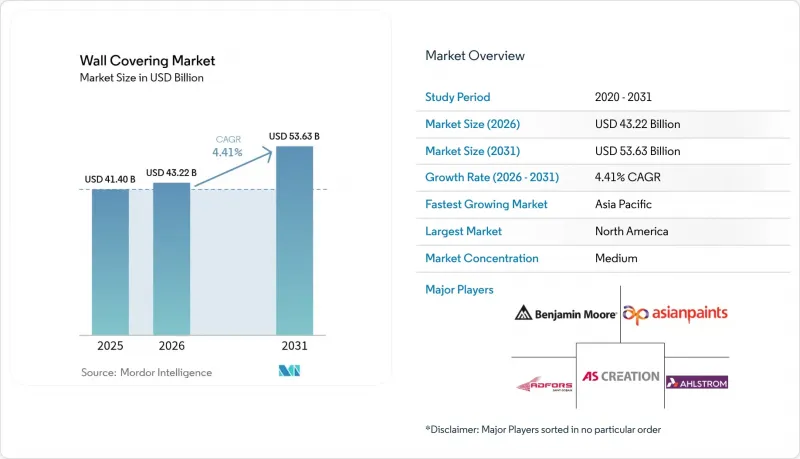
This report is Segmented by Material (Paper-Based, Fabric/Textile, Wood-Based, and More), Product Type (Wall Panel, Wallpaper, Tile, and More), End-Use Industry (Hospitality, Healthcare, Retail, Corporate Offices, and More), Distribution Channel (Specialty Store, Franchise Store, and More), and Geography (North America, South America, and More). The Market Forecasts are Provided in Terms of Value (USD).
Global Wall Covering Market Trends and Insights
Rapid Urban Refurbishment Cycles Drive Commercial Demand
Office landlords and hotel operators are front-loading interior upgrades to shorten vacancy periods and conform to evolving workspace standards. Modular wall systems that minimize downtime while boosting acoustics have become preferred specifications. Shaw Industries' pact with PPG for integrated flooring demonstrates supplier moves to own more of the renovation scope. Tarkett's 35,000 m2 vinyl installation at Joan Kirner Women's and Children's Hospital signals scale benefits in fast-track healthcare projects. These dynamics reinforce a premium on rapid installation, phased build-outs, and one-stop material sourcing, all of which propel the wall covering market.
Rise of Vinyl-Backed Peel-and-Stick Solutions Transforms Residential Market
Vinyl-backed peel-and-stick products trim install time to minutes and eliminate adhesives, turning renters into viable purchasers. Brands such as Tempaper, RoomMates, and Astek promoted influencer-ready collections that remove perceived complexity. Drytac's 2024 PVC-free Paper Fleece Smooth iteration keeps pace with sustainability rhetoric without compromising consumer ease. Viral "before-and-after" clips deliver outsized marketing returns, cementing peel-and-stick as a strategic foothold in the wall covering market.
Volatility in PVC and Petrochemical Feedstock Prices Pressures Margins
Spiking ethylene and chloride values make vinyl cost curves unpredictable. Orbia's early-2025 cost rationalization shows manufacturers countering raw-material swings through overhead cuts and portfolio shifts. Asian PVC spot markets add extra turbulence, exposing export-oriented converters to exchange-rate and freight shocks. Substitution toward bio-based laminates offers a hedge, but scaling capacity remains capital intensive, slowing short-term relief in the wall covering market.
Other drivers and restraints analyzed in the detailed report include:
- Commercial Demand for Modular Acoustic Wall Panels Accelerates
- Growth of DIY Decor Influencers on Social Media Reshapes Consumer Behavior
- High Landfill Cost of Demolition Waste Adds Disposal Burdens
For complete list of drivers and restraints, kindly check the Table Of Contents.
Segment Analysis
Vinyl contributed 37.78% wall covering market share in 2025 on the strength of water resistance, print versatility, and modest install costs. The wood category's 6.17% CAGR underscores a pivot toward biophilic design and eco labels, with cork, bamboo, and engineered timber veneers meeting stringent low-VOC limits that attract commercial specifiers. Vinyl suppliers counter with recycling programs and ultralow-emission plasticizers, seeking to retain position as bio-based materials bite into the wall covering market.
Production scale sets the competitive pace. IZODEKOR's 750,000 m2 annual output of 3-D panels highlights capital depth among innovation-minded players. Kirkby Design's 2025 recycled-cotton launch fuses textile feel with reclaimed content, positioning fabric-wall alternatives for boutique hotels and premium residential niches. The tug-of-war between vinyl's installed base and rising eco criteria will define material share shifts within the wall covering market through 2031.
Wallpaper accounted for 38.95% of the wall covering market size in 2025, spanning vinyl, non-woven, and fabric backings that suit diverse pattern and durability needs. Wall panels, however, are projected to outpace all other formats at a 5.28% CAGR because they marry acoustic control with rapid clip-on installation that compresses labor hours.
Open-plan offices and schools intensify the call for noise mitigation, pushing producers like New York Soundproofing to amplify design-forward acoustic lines. Amico Architectural's Medtronics health-care fitout underscores how modular panels accelerate large-footprint jobs without extended shutdowns. These dynamics lift wall panels from niche to mainstream status inside the wall covering market.
Complete Report Scope:
- By Material
- Paper-Based
- Fabric/Textile
- Wood-Based
- Vinyl
- Other Materials
- By Product Type
- Wall Panel
- Wallpaper
- Vinyl Wallpaper
- Non-woven Wallpaper
- Paper-based Wallpaper
- Fabric Wallpaper
- Other Wallpaper Types
- Tile
- Metal Wall Covering
- Other Product Types
- By End-use Industry
- Hospitality
- Healthcare
- Retail
- Corporate Offices
- Education
- Domestic Housing
- Industrial Facilities
- Other End-use Industries
- By Distribution Channel
- Specialty Store
- Franchise store
- E-commerce
- Other Distribution Channels
- By Geography
- North America
- United States
- Canada
- Mexico
- South America
- Brazil
- Argentina
- Rest of South America
- Europe
- United Kingdom
- Germany
- France
- Spain
- Italy
- Rest of Europe
- Asia-Pacific
- China
- India
- Japan
- Australia
- South Korea
- Rest of Asia-Pacific
- Middle East and Africa
- Middle East
- Saudi Arabia
- United Arab Emirates
- Turkey
- Rest of Middle East
- Africa
- South Africa
- Kenya
- Rest of Africa
- Middle East
- North America
Geography Analysis
North America recorded the largest regional revenue in 2025 on the back of robust commercial remodel demand, deep distribution networks, and progressive energy and indoor-air codes. United States spending on corporate re-stacking and hospitality lobbies sustains premium price points, while Canada benefits from institutional upgrades in healthcare and education. Mexico adds steady low-to-mid-grade volume to the wall covering market through shopping-mall and resort pipelines.
Asia-Pacific is projected to deliver a 7.86% CAGR, the fastest worldwide, powered by China's infrastructure surge, India's expanding middle-class housing, and Southeast Asian hospitality corridor growth. Affordable peel-and-stick wallpaper gains traction among first-time urban homeowners, while Japanese and Australian designers specify bio-based wall coverings to meet wellness objectives in mature high-end markets. Regulatory harmonization and rising preference for modular acoustic panels push the wall covering market deeper into the region's grade-A office buildout cycle.
Europe maintains a sustainability-driven trajectory. Germany and France head adoption of PVC-free laminates under tightened EPD and circular-economy rules. United Kingdom hotel brands re-skin interiors every two to three years, channeling consistent retrofit flow. Italy and Spain contribute design know-how and small-batch digital-print capacity. South America shows incipient demand focused on Brazilian and Argentine mixed-use complexes, whereas the Middle East and Africa cluster growth around UAE leisure hubs and Saudi Vision 2030 public-sector investments.
- Saint-Gobain Adfors SA
- Ahlstrom-Munksjo Oyj
- AS Creation Tapeten AG
- Asian Paints Limited
- Benjamin Moore & Co.
- Brewster Home Fashions LLC
- York Wallcoverings, Inc.
- J. Josephson Inc.
- Walker Greenbank PLC
- Grandeco Wallfashion Group NV
- Graham & Brown Ltd.
- F. Schumacher & Co. LLC
- Rasch GmbH & Co. KG
- Mohawk Industries, Inc.
- Armstrong World Industries, Inc.
- 3M Company
- Ceramiche Caesar S.p.A.
- Shaw Industries Group, Inc.
- Interface, Inc.
- Kingfisher plc
Additional Benefits:
- The market estimate (ME) sheet in Excel format
- 3 months of analyst support
TABLE OF CONTENTS
1 INTRODUCTION
- 1.1 Study Assumptions and Market Definition
- 1.2 Scope of the Study
2 RESEARCH METHODOLOGY
3 EXECUTIVE SUMMARY
4 MARKET LANDSCAPE
- 4.1 Market Overview
- 4.2 Market Drivers
- 4.2.1 Rapid urban refurbishment cycles
- 4.2.2 Rise of vinyl-backed peel-and-stick solutions
- 4.2.3 Commercial demand for modular acoustic wall panels
- 4.2.4 Growth of DIY decor influencers on social media
- 4.2.5 Green-certified bio-based substrates
- 4.2.6 Post-pandemic commercial interior upgrades
- 4.3 Market Restraints
- 4.3.1 Volatility in PVC and petrochemical feedstock prices
- 4.3.2 High landfill cost of demolition waste
- 4.3.3 Fire-code compliance hurdles for composite panels
- 4.3.4 In-house digital printing eroding third-party demand
- 4.4 Industry Value Chain Analysis
- 4.5 Regulatory Landscape
- 4.6 Technological Outlook
- 4.7 Porter's Five Forces Analysis
- 4.7.1 Bargaining Power of Suppliers
- 4.7.2 Bargaining Power of Buyers
- 4.7.3 Threat of New Entrants
- 4.7.4 Threat of Substitute Products
- 4.7.5 Intensity of Competitive Rivalry
- 4.8 The Impact of Macroeconomic Factors on the Market
5 MARKET SIZE AND GROWTH FORECASTS (VALUE)
- 5.1 By Material
- 5.1.1 Paper-Based
- 5.1.2 Fabric/Textile
- 5.1.3 Wood-Based
- 5.1.4 Vinyl
- 5.1.5 Other Materials
- 5.2 By Product Type
- 5.2.1 Wall Panel
- 5.2.2 Wallpaper
- 5.2.2.1 Vinyl Wallpaper
- 5.2.2.2 Non-woven Wallpaper
- 5.2.2.3 Paper-based Wallpaper
- 5.2.2.4 Fabric Wallpaper
- 5.2.2.5 Other Wallpaper Types
- 5.2.3 Tile
- 5.2.4 Metal Wall Covering
- 5.2.5 Other Product Types
- 5.3 By End-use Industry
- 5.3.1 Hospitality
- 5.3.2 Healthcare
- 5.3.3 Retail
- 5.3.4 Corporate Offices
- 5.3.5 Education
- 5.3.6 Domestic Housing
- 5.3.7 Industrial Facilities
- 5.3.8 Other End-use Industries
- 5.4 By Distribution Channel
- 5.4.1 Specialty Store
- 5.4.2 Franchise store
- 5.4.3 E-commerce
- 5.4.4 Other Distribution Channels
- 5.5 By Geography
- 5.5.1 North America
- 5.5.1.1 United States
- 5.5.1.2 Canada
- 5.5.1.3 Mexico
- 5.5.2 South America
- 5.5.2.1 Brazil
- 5.5.2.2 Argentina
- 5.5.2.3 Rest of South America
- 5.5.3 Europe
- 5.5.3.1 United Kingdom
- 5.5.3.2 Germany
- 5.5.3.3 France
- 5.5.3.4 Spain
- 5.5.3.5 Italy
- 5.5.3.6 Rest of Europe
- 5.5.4 Asia-Pacific
- 5.5.4.1 China
- 5.5.4.2 India
- 5.5.4.3 Japan
- 5.5.4.4 Australia
- 5.5.4.5 South Korea
- 5.5.4.6 Rest of Asia-Pacific
- 5.5.5 Middle East and Africa
- 5.5.5.1 Middle East
- 5.5.5.1.1 Saudi Arabia
- 5.5.5.1.2 United Arab Emirates
- 5.5.5.1.3 Turkey
- 5.5.5.1.4 Rest of Middle East
- 5.5.5.2 Africa
- 5.5.5.2.1 South Africa
- 5.5.5.2.2 Kenya
- 5.5.5.2.3 Rest of Africa
- 5.5.5.1 Middle East
- 5.5.1 North America
6 COMPETITIVE LANDSCAPE
- 6.1 Market Concentration
- 6.2 Strategic Moves
- 6.3 Market Share Analysis
- 6.4 Company Profiles (includes Global level Overview, Market level overview, Core Segments, Financials as available, Strategic Information, Market Rank/Share for key companies, Products and Services, and Recent Developments)
- 6.4.1 Saint-Gobain Adfors SA
- 6.4.2 Ahlstrom-Munksjo Oyj
- 6.4.3 AS Creation Tapeten AG
- 6.4.4 Asian Paints Limited
- 6.4.5 Benjamin Moore & Co.
- 6.4.6 Brewster Home Fashions LLC
- 6.4.7 York Wallcoverings, Inc.
- 6.4.8 J. Josephson Inc.
- 6.4.9 Walker Greenbank PLC
- 6.4.10 Grandeco Wallfashion Group NV
- 6.4.11 Graham & Brown Ltd.
- 6.4.12 F. Schumacher & Co. LLC
- 6.4.13 Rasch GmbH & Co. KG
- 6.4.14 Mohawk Industries, Inc.
- 6.4.15 Armstrong World Industries, Inc.
- 6.4.16 3M Company
- 6.4.17 Ceramiche Caesar S.p.A.
- 6.4.18 Shaw Industries Group, Inc.
- 6.4.19 Interface, Inc.
- 6.4.20 Kingfisher plc
7 MARKET OPPORTUNITIES AND FUTURE OUTLOOK
- 7.1 White-space and Unmet-Need Assessment

