PUBLISHER: Mordor Intelligence | PRODUCT CODE: 2121395

PUBLISHER: Mordor Intelligence | PRODUCT CODE: 2121395
Japan Plastic Packaging - Market Share Analysis, Industry Trends & Statistics, Growth Forecasts (2026 - 2031)
According to Mordor Intelligence, the Japan plastic packaging market size was valued at 5.41 million tonnes in 2025 and estimated to grow from 5.65 million tonnes in 2026 to reach 7.03 million tonnes by 2031, at a CAGR of 4.47% during the forecast period (2026-2031).
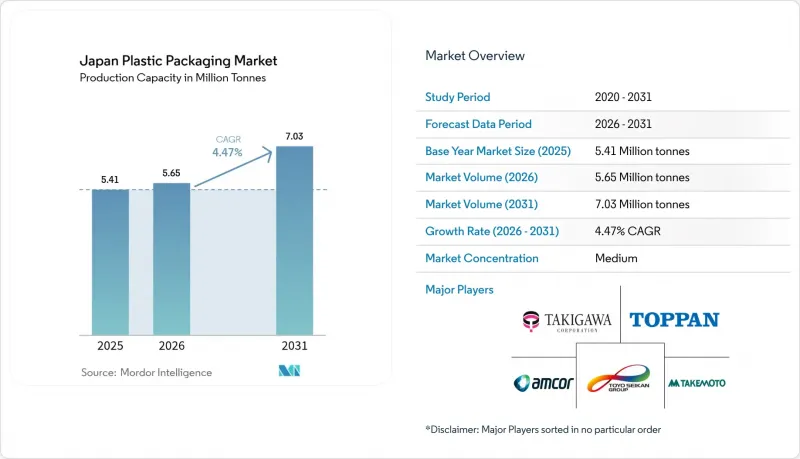
This report is Segmented by Material (PET, PE, PP, Bio-Based Plastics, and More), Type (Rigid Plastic, Flexible Plastic), Product (Bottles and Jars, Cans, Pouches, Trays and Clamshells, Caps and Closures, and More), End-User Industry (Food, Beverage, Healthcare and Pharmaceuticals, Retail and E-Commerce, and More). The Market Forecasts are Provided in Terms of Volume (Tonnes).
Japan Plastic Packaging Market Trends and Insights
Growth of E-commerce Driving Demand for High-Barrier Flexible Packs
Parcel volumes handled by Japan Post and private couriers continue to set records, prompting online retailers to specify packaging that withstands multistep distribution without overpacking. Film producers answer with multi-layer structures combining EVOH and mLLDPE that deliver oxygen-barrier performance at reduced gauge, thereby trimming logistics emissions and freight cost per unit. The result is steady volume gains for converters specialized in lamination and digital printing, solidifying the e-commerce channel as the single largest new demand node for the Japan plastic packaging market.
Ageing Population Escalating Demand for Pharma Blister and Pouch Formats
Citizens aged 65 and older now represent more than 29% of Japan's population, lifting prescription volumes and over-the-counter supplement usage. Pharma packagers report double-digit volume growth for push-through blisters with tactile cues and easy-tear pouches that aid seniors with reduced grip strength. Regulatory reforms that encourage home-based care intensify the need for unit-dose compliance packaging, a trend that injects resilient demand into the Japan plastic packaging market.
Stricter Extended Producer Responsibility Fees on Single-Use Plastics
Japan's EPR law now requires brand owners to finance collection and recycling, lifting compliance outlays by up to 60% for single-use categories. As invoices arrive, food manufacturers labor to redesign packs that cut gram-weight or move toward reusable containers. The near-term burden trims profit margins and tempers volume expansion in the Japan plastic packaging market.
Other drivers and restraints analyzed in the detailed report include:
- Beverage PET Bottle Lightweighting Lowering Cost and Boosting Volumes
- Convenience Food Boom Raising Use of Retort Pouches
- Consumer Shift Toward Paper and Glass Alternatives
For complete list of drivers and restraints, kindly check the Table Of Contents.
Segment Analysis
Polyethylene held a 28.12% share of the Japan plastic packaging market size in 2025, buoyed by versatility across grocery films and industrial liners. Cost advantages and mature processing infrastructure sustain its dominance, yet decarbonization pledges push brand owners to trial drop-in bio-PE made from sugarcane ethanol. Bio-based plastics, though under 5% of tonnage today, post the fastest 4.93% CAGR and attract subsidies that close price gaps with fossil grades.
R&D groups tap cellulose nanofibers from forestry residues to engineer resins that match HDPE stiffness while offering landfill biodegradability. Resin majors aim for 20,000 tonnes of bioethanol-derived output by 2027, positioning Japan to meet the national 2 million-tonne bio-plastic target by 2030. These initiatives introduce fresh feedstocks into the Japan plastic packaging market, diversifying material supply and mitigating crude-derived volatility.
Flexible packaging captured 53.85% of the Japan plastic packaging market share in 2025 and leads forecast growth at 5.84% CAGR. Material-efficient films minimize freight emissions and storage space, critical for e-commerce parcel density. Advances in solvent-free lamination and digital presses shorten artwork changeovers, letting converters cater to limited-edition SKUs without costly inventory. Rigid categories such as jars and tubs soldier on in ambient staples, yet their growth trails flexible peers given higher resin intensity.
Patented layer-separation films allow post-consumer peel-off that feeds single-polymer streams, eroding recyclability disadvantages historically linked to multi-layer pouches. As national recycling targets tighten, the shift bolsters the flexible segment's share in the Japan plastic packaging market while containing lifecycle impacts.
Complete Report Scope:
- By Material
- Polyethylene Terephthalate (PET)
- Polyethylene (PE)
- High-Density Polyethylene (HDPE)
- Low-Density and Linear-LDPE
- Linear Low-Density Polyethylene (LLDPE)
- Polypropylene (PP)
- Bio-based Plastics
- Other Materials
- By Type
- Rigid Plastic
- Flexible Plastic
- By Product
- Bottles and Jars
- Cans
- Pouches
- Trays and Clamshells
- Caps and Closures
- Other Products
- By End-User Industry
- Food
- Beverage
- Healthcare and Pharmaceuticals
- Retail and E-commerce
- Industrial Manufacturing
- Personal Care and Household
- Other End-User Industries
List of Companies Covered in this Report:
- Amcor plc
- Toyo Seikan Group Holdings, Ltd.
- Toppan Inc.
- Takigawa Corporation Japan G.K.
- Sealed Air Corporation
- Sonoco Products Company
- Takemoto Yohki Co., Ltd.
- Hosokawa Yoko Co., Ltd.
- Kodama Plastics Co., Ltd.
- Fujimori Kogyo Co., Ltd.
- Nihon Yamamura Glass Co., Ltd.
- Sumitomo Bakelite Co., Ltd.
- Mitsubishi Chemical Group Corporation
- Ube Packaging Materials Co., Ltd.
- Dai Nippon Printing Co., Ltd. (DNP)
- Rengo Co., Ltd. (Plastic Unit)
- Shibusawa Package Co., Ltd.
- Kureha Corporation
- Plastikon Japan Inc.
Additional Benefits:
- The market estimate (ME) sheet in Excel format
- 3 months of analyst support
TABLE OF CONTENTS
1 INTRODUCTION
- 1.1 Study Assumptions and Market Definition
- 1.2 Scope of the Study
2 RESEARCH METHODOLOGY
3 EXECUTIVE SUMMARY
4 MARKET LANDSCAPE
- 4.1 Market Overview
- 4.2 Market Drivers
- 4.2.1 Growth of e-commerce driving demand for high-barrier flexible packs
- 4.2.2 Ageing population escalating demand for pharma blister and pouch formats
- 4.2.3 Beverage PET bottle lightweighting lowering cost and boosting volumes
- 4.2.4 Convenience food boom raising use of retort pouches
- 4.2.5 Government subsidies for chemical-recycling pilot plants
- 4.2.6 Spread of plasma-coated mono-material films for 2030 recyclability goals
- 4.3 Market Restraints
- 4.3.1 Stricter Extended Producer Responsibility (EPR) fees on single-use plastics
- 4.3.2 Consumer shift toward paper and glass alternatives
- 4.3.3 Corporate zero-plastic pledges by Japan Inc. FMCG majors
- 4.3.4 Volatility in naphtha prices disrupting resin cost economics
- 4.4 Industry Value Chain Analysis
- 4.5 Regulatory Landscape
- 4.6 Technological Outlook
- 4.7 Porter's Five Forces Analysis
- 4.7.1 Bargaining Power of Suppliers
- 4.7.2 Bargaining Power of Buyers
- 4.7.3 Threat of New Entrants
- 4.7.4 Threat of Substitutes
- 4.7.5 Intensity of Competitive Rivalry
- 4.8 The Impact of Macroeconomic Factors on the Market
- 4.9 Investment Analysis
5 MARKET SIZE AND GROWTH FORECASTS (VOLUME)
- 5.1 By Material
- 5.1.1 Polyethylene Terephthalate (PET)
- 5.1.2 Polyethylene (PE)
- 5.1.2.1 High-Density Polyethylene (HDPE)
- 5.1.2.2 Low-Density and Linear-LDPE
- 5.1.2.3 Linear Low-Density Polyethylene (LLDPE)
- 5.1.3 Polypropylene (PP)
- 5.1.4 Bio-based Plastics
- 5.1.5 Other Materials
- 5.2 By Type
- 5.2.1 Rigid Plastic
- 5.2.2 Flexible Plastic
- 5.3 By Product
- 5.3.1 Bottles and Jars
- 5.3.2 Cans
- 5.3.3 Pouches
- 5.3.4 Trays and Clamshells
- 5.3.5 Caps and Closures
- 5.3.6 Other Products
- 5.4 By End-User Industry
- 5.4.1 Food
- 5.4.2 Beverage
- 5.4.3 Healthcare and Pharmaceuticals
- 5.4.4 Retail and E-commerce
- 5.4.5 Industrial Manufacturing
- 5.4.6 Personal Care and Household
- 5.4.7 Other End-User Industries
6 COMPETITIVE LANDSCAPE
- 6.1 Market Concentration
- 6.2 Strategic Moves
- 6.3 Market Share Analysis
- 6.4 Company Profiles (includes Global Level Overview, Market Level Overview, Core Segments, Financials as available, Strategic Information, Market Rank/Share, Products and Services, Recent Developments)
- 6.4.1 Amcor plc
- 6.4.2 Toyo Seikan Group Holdings, Ltd.
- 6.4.3 Toppan Inc.
- 6.4.4 Takigawa Corporation Japan G.K.
- 6.4.5 Sealed Air Corporation
- 6.4.6 Sonoco Products Company
- 6.4.7 Takemoto Yohki Co., Ltd.
- 6.4.8 Hosokawa Yoko Co., Ltd.
- 6.4.9 Kodama Plastics Co., Ltd.
- 6.4.10 Fujimori Kogyo Co., Ltd.
- 6.4.11 Nihon Yamamura Glass Co., Ltd.
- 6.4.12 Sumitomo Bakelite Co., Ltd.
- 6.4.13 Mitsubishi Chemical Group Corporation
- 6.4.14 Ube Packaging Materials Co., Ltd.
- 6.4.15 Dai Nippon Printing Co., Ltd. (DNP)
- 6.4.16 Rengo Co., Ltd. (Plastic Unit)
- 6.4.17 Shibusawa Package Co., Ltd.
- 6.4.18 Kureha Corporation
- 6.4.19 Plastikon Japan Inc.
7 MARKET OPPORTUNITIES AND FUTURE OUTLOOK
- 7.1 White-space and Unmet-Need Assessment

