PUBLISHER: Mordor Intelligence | PRODUCT CODE: 2122006

PUBLISHER: Mordor Intelligence | PRODUCT CODE: 2122006
Middle East And Africa Plastic Packaging - Market Share Analysis, Industry Trends & Statistics, Growth Forecasts (2026 - 2031)
According to Mordor Intelligence, the Middle East and Africa plastic packaging market size is projected to expand from USD 26.39 billion in 2025 and USD 26.80 billion in 2026 to USD 30.41 billion by 2031, registering a CAGR of 2.56% between 2026 to 2031.
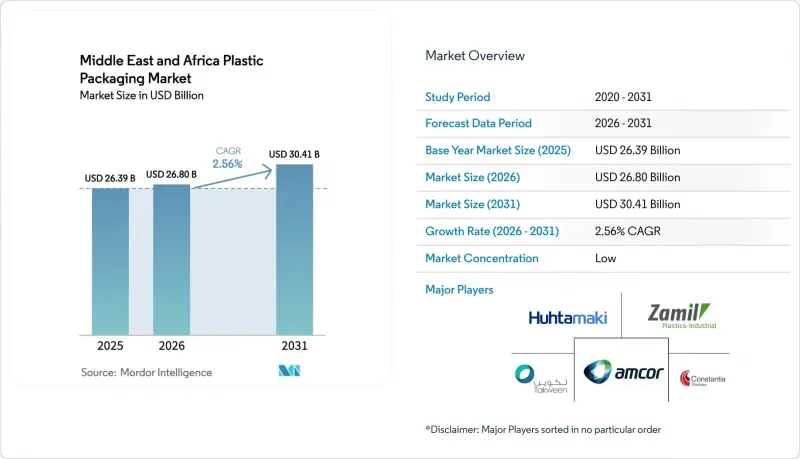
This report is Segmented by Material Type (Polyethylene, Polypropylene, and More), Packaging Type (Flexible, and Rigid), Product Form (Trays and Containers, and More), End-User Industry (Food, Beverage, Pharmaceuticals and Healthcare, and More), Manufacturing Process (Extrusion, Injection Molding, and More), and Country. The Market Forecasts are Provided in Terms of Value (USD).
Middle East And Africa Plastic Packaging Market Trends and Insights
Steady Rise in Demand for Processed Food
Urban migration, rising dual-income households, and climate-driven food-safety concerns lift demand for hermetically sealed, portion-controlled grocery lines across the region. Supermarket chains shift shelf space from loose staples to pre-packed meats, dairy, and snacks, pulling through multilayer barrier films that extend shelf life under 40 °C ambient temperatures. Saudi Arabia already approaches Western European packaged-food consumption benchmarks, while Nigeria's penetration lags below 15%, indicating significant headroom for new capacity. Converters respond with modified-atmosphere sachets and vacuum-skin trays that curb spoilage and shrink in-store waste. As distribution networks reach second-tier cities, small-format pouches allow retailers to balance affordability with hygiene, reinforcing adoption of flexible plastic solutions within the Middle East and Africa plastic packaging market.
Accelerating Growth of E-Commerce Fulfilment Packaging
Online retail expanded at 30% in 2024 and continues to outpace other channels, driven by consumers under 35 who dominate the Gulf workforce. Fragile supply routes that involve bumpy roads or multiple hand-offs increase breakage risk, pushing logistics operators to over-specify cushioning layers. Lightweight flow-wraps, air pillows, and stretch films safeguard orders without unduly raising freight costs, deepening penetration of plastics in last-mile distribution. Nigerian e-commerce alone is expected to add USD 5.71 billion in sales between 2023 and 2028, translating into millions of additional parcels that demand protective films and bubble mailers. Quick-commerce platforms in Dubai and Riyadh introduce a parallel stream for temperature-controlled shipments, spurring uptake of expanded polystyrene liners and vacuum panels. These dynamics collectively underpin above-average volume growth for the Middle East and Africa plastic packaging market.
Emerging Gulf Single-Use Plastic Bans
The United Arab Emirates enforces Federal Decree-Law 36 of 2024, prohibiting single-use bags, cutlery, and straws from January 2026, with escalating fines through 2028. Saudi Arabia signals similar intent under its Green Initiative, though timelines remain fluid, generating investment uncertainty for converters. Compostable resin supply is nascent and priced 40% above conventional polyethylene, raising cost barriers for smaller firms. The possibility of asset write-offs on extrusion and injection lines tuned for single-use products threatens margins. Nonetheless, bans catalyze portfolio pivots toward reusable or certified-recyclable formats, ultimately embedding higher specification standards across the Middle East and Africa plastic packaging market.
Other drivers and restraints analyzed in the detailed report include:
- Sovereign Wealth-Fund Backing for Recycling Capacity
- Expanding Regional Healthcare Infrastructure
- High Raw-Material Costs and Limited Recycling Infrastructure
For complete list of drivers and restraints, kindly check the Table Of Contents.
Segment Analysis
Polyethylene holds a 39.32% market share in the Middle East and Africa plastic packaging market in 2025, driven by its cost advantages and versatility across blown-film, injection, and rotational molding operations. Linear low-density polyethylene dominates the stretch-wrap and shrink-film segments that secure pallets traveling on dusty highways, while high-density polyethylene leads the way in detergent and lubricant bottles, which require chemical resistance. Polypropylene remains attractive for closures and woven sacks, particularly as tethered-cap regulations gain traction, although its recycling pathways lag behind those of PET. PET is forecast to expand at a 3.56% CAGR, surpassing the overall Middle East and Africa plastic packaging market. Indorama Ventures launched a lightweight PET bottle in 2024 that reduces preform mass by 15% while maintaining top-load strength, thereby lowering resin use and freight emissions. Hot-fill beverage lines prefer PET because it withstands 85 °C pasteurization without warping, unlike polyethylene. Extended producer responsibility schemes in South Africa and Kenya impose steeper fees on non-recyclable formats, prompting brand owners to shift toward PET.
Polyethylene's resilience rests on local feedstock from Saudi petrochemical giants, ensuring timely supply and price leverage. Polypropylene benefits from growing demand for injection-molded reclosable lids in dairy and coffee. Polystyrene's niche covers insulated food containers and protective cushioning, yet regulators scrutinize its micro-fragmentation tendencies. Meanwhile, mono-material PET lidding films enter ready-meal trays to improve recyclability. As recycled-content quotas tighten, converters weigh the security of captive polyethylene supply against end-market preference for PET circularity. This competitive interplay keeps both polymers central to the Middle East and Africa plastic packaging market, even as PET captures incremental growth.
Flexible packaging commanded 55.62% share in 2025 and is projected to record a 3.87% CAGR, reflecting its weight efficiency and low shipping footprint. Stand-up pouches reduce landfill volumes and cut transportation emissions in half compared to glass jars, an attribute that retailers' marketing eco-scores leverage heavily. Huhtamaki rationalized its United Arab Emirates sites in 2024 to pool five-layer coextrusion assets, signaling a race toward higher throughput and thinner gauges. Rigid containers maintain relevance in sauces, spreads, and household cleansers where controlled dispensing and tactile branding influence purchase decisions. Nonetheless, the rising demand for courier shipments of cosmetics sachets, nutraceutical powders, and meal kits amplifies the need for flow-wraps and mailer films. The Middle East and Africa plastic packaging market size for flexible formats will, therefore, remain on an expansion path relative to rigid counterparts.
Rigid solutions still dominate beverages, yogurts, and vitamins, where shelf impact and tamper evidence are critical. Injection stretch blow moulding of PET bottles ensures clarity and crack resistance, particularly important for premium juices sold across the Gulf's travel retail channel. Blow-molded high-density polyethylene jerrycans secure agrochemicals and motor oils that require UN-certification for hazardous goods. Hybrid designs blur boundaries; paperboard sleeves bonded to thin polyethylene liners give brand owners improved stiffness and printability without compromising recyclability. The dual strategy allows converters to safeguard margins while meeting opposing pressures of regulatory compliance and consumer convenience.
Complete Report Scope:
- By Material Type
- Polyethylene (PE)
- Polypropylene (PP)
- Polyethylene Terephthalate (PET)
- Polystyrene and EPS
- Other Material Types
- By Packaging Type
- Flexible Plastic Packaging
- Rigid Plastic Packaging
- By Product Form
- Bottles and Jars
- Trays and Containers
- Pouches and Sachets
- Bags and Sacks
- Films and Wraps
- Other Product Forms
- By End-User Industry
- Food
- Beverage
- Pharmaceuticals and Healthcare
- Cosmetics and Personal Care
- Industrial
- Other End-user Industries
- By Manufacturing Process
- Extrusion
- Injection Molding
- Blow Molding
- Thermoforming
- Other Manufacturing Processes
- By Region
- Middle East
- Saudi Arabia
- United Arab Emirates
- Rest of Middle East
- Africa
- South Africa
- Egypt
- Nigeria
- Rest of Africa
- Middle East
List of Companies Covered in this Report:
- Zamil Plastic Industries Co.
- Huhtamaki South Africa (Pty) Ltd
- Takween Advanced Industries
- Napco National
- Constantia Flexibles Afripack
- Packaging Products Company (PPC)
- PrimePak Industries Nigeria Ltd (Enpee Group)
- Al Bayader International (H and H Group of Companies)
- Falcon Pack
- Arabian Flexible Packaging LLC
- Hotpack Packaging Industries LLC
- ENPI Group
- Gulf East Paper and Plastic Industries LLC
- Obeikan Investment Group (OIG Packaging)
- Sealed Air Corporation
- Taghleef Industries
- Alpla Group
- Greif Inc.
- RPC M&H Plastics
Additional Benefits:
- The market estimate (ME) sheet in Excel format
- 3 months of analyst support
TABLE OF CONTENTS
1 INTRODUCTION
- 1.1 Study Assumptions and Market Definition
- 1.2 Scope of the Study
2 RESEARCH METHODOLOGY
3 EXECUTIVE SUMMARY
4 MARKET LANDSCAPE
- 4.1 Market Overview
- 4.2 Market Drivers
- 4.2.1 Demand for Oxo-Degradable Plastics
- 4.2.2 Steady Rise in Demand for Processed Food
- 4.2.3 Accelerating Growth of E-Commerce Fulfilment Packaging
- 4.2.4 Expanding Regional Healthcare Infrastructure
- 4.2.5 Sovereign Wealth-Fund Backing for Recycling Capacity
- 4.2.6 Adoption of High-Barrier Films for Hot-Fill Beverages
- 4.3 Market Restraints
- 4.3.1 Environmental Concerns Over Recycling and Safe Disposal
- 4.3.2 High Raw-Material Costs and Limited Recycling Infrastructure
- 4.3.3 Emerging Gulf Single-Use Plastic Bans
- 4.3.4 Currency Volatility Impacting Polymer Resin Imports
- 4.4 Industry Value Chain Analysis
- 4.5 Impact of Macroeconomic Factors on the Market
- 4.6 Recycling and Sustainability Landscape
- 4.7 Technological Outlook
- 4.8 Regulatory Landscape
- 4.9 Porter's Five Forces Analysis
- 4.9.1 Bargaining Power of Suppliers
- 4.9.2 Bargaining Power of Consumers
- 4.9.3 Threat of New Entrants
- 4.9.4 Threat of Substitute Products
- 4.9.5 Intensity of Competitive Rivalry
5 MARKET SIZE AND GROWTH FORECASTS (VALUE)
- 5.1 By Material Type
- 5.1.1 Polyethylene (PE)
- 5.1.2 Polypropylene (PP)
- 5.1.3 Polyethylene Terephthalate (PET)
- 5.1.4 Polystyrene and EPS
- 5.1.5 Other Material Types
- 5.2 By Packaging Type
- 5.2.1 Flexible Plastic Packaging
- 5.2.2 Rigid Plastic Packaging
- 5.3 By Product Form
- 5.3.1 Bottles and Jars
- 5.3.2 Trays and Containers
- 5.3.3 Pouches and Sachets
- 5.3.4 Bags and Sacks
- 5.3.5 Films and Wraps
- 5.3.6 Other Product Forms
- 5.4 By End-User Industry
- 5.4.1 Food
- 5.4.2 Beverage
- 5.4.3 Pharmaceuticals and Healthcare
- 5.4.4 Cosmetics and Personal Care
- 5.4.5 Industrial
- 5.4.6 Other End-user Industries
- 5.5 By Manufacturing Process
- 5.5.1 Extrusion
- 5.5.2 Injection Molding
- 5.5.3 Blow Molding
- 5.5.4 Thermoforming
- 5.5.5 Other Manufacturing Processes
- 5.6 By Region
- 5.6.1 Middle East
- 5.6.1.1 Saudi Arabia
- 5.6.1.2 United Arab Emirates
- 5.6.1.3 Rest of Middle East
- 5.6.2 Africa
- 5.6.2.1 South Africa
- 5.6.2.2 Egypt
- 5.6.2.3 Nigeria
- 5.6.2.4 Rest of Africa
- 5.6.1 Middle East
6 COMPETITIVE LANDSCAPE
- 6.1 Market Concentration
- 6.2 Strategic Moves
- 6.3 Market Share Analysis
- 6.4 Company Profiles (Includes Global Level Overview, Market Level Overview, Core Segments, Financials as Available, Strategic Information, Market Rank/Share, Products and Services, and Recent Developments)
- 6.4.1 Zamil Plastic Industries Co.
- 6.4.2 Huhtamaki South Africa (Pty) Ltd
- 6.4.3 Takween Advanced Industries
- 6.4.4 Napco National
- 6.4.5 Constantia Flexibles Afripack
- 6.4.6 Packaging Products Company (PPC)
- 6.4.7 PrimePak Industries Nigeria Ltd (Enpee Group)
- 6.4.8 Al Bayader International (H and H Group of Companies)
- 6.4.9 Falcon Pack
- 6.4.10 Arabian Flexible Packaging LLC
- 6.4.11 Hotpack Packaging Industries LLC
- 6.4.12 ENPI Group
- 6.4.13 Gulf East Paper and Plastic Industries LLC
- 6.4.14 Obeikan Investment Group (OIG Packaging)
- 6.4.15 Sealed Air Corporation
- 6.4.16 Taghleef Industries
- 6.4.17 Alpla Group
- 6.4.18 Greif Inc.
- 6.4.19 RPC M&H Plastics
7 MARKET OPPORTUNITIES AND FUTURE OUTLOOK
- 7.1 White-Space and Unmet-Need Assessment

