PUBLISHER: Mordor Intelligence | PRODUCT CODE: 2121415

PUBLISHER: Mordor Intelligence | PRODUCT CODE: 2121415
India Plastic Packaging - Market Share Analysis, Industry Trends & Statistics, Growth Forecasts (2026 - 2031)
According to Mordor Intelligence, the India plastic packaging market size was valued at USD 22.44 billion in 2025 and estimated to grow from USD 23.13 billion in 2026 to reach USD 26.89 billion by 2031, at a CAGR of 3.06% during the forecast period (2026-2031).
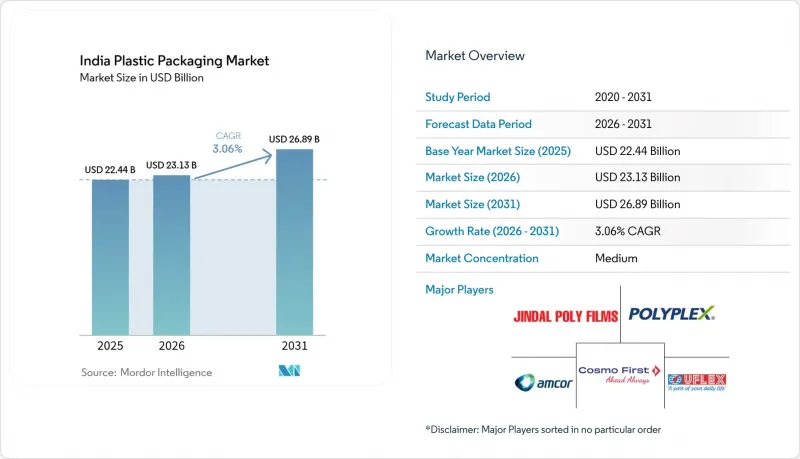
[1] Ministry of Environment, Forest and Climate Change, "Extended Producer Responsibility Guidelines," moef.gov.in Demand pivots from pure volume to value-added formats as Extended Producer Responsibility (EPR) rules enacted in 2024 place the onus of post-consumer waste on brand owners, pushing converters toward recycled-content resins and higher-margin barrier technologies. This report is Segmented by Material Type (Polyethylene, Polypropylene, and More), Packaging Type (Flexible, Rigid), Product Form (Bottles and Jars, Trays and Containers, and More), End-User Industry (Food, Beverage, and More), Manufacturing Process (Extrusion, Injection Molding, Blow Molding, Thermoforming, and More). The Market Forecasts are Provided in Terms of Value (USD).
India Plastic Packaging Market Trends and Insights
Growing e-commerce and quick-commerce logistics boom
Package volumes from 15-minute delivery platforms grew 300% in major metros during 2024, requiring tamper-proof pouches that preserve integrity across multiple handling points. Converters that deploy automated pouch lines achieve cycle times near 200 packs per minute, shortening lead times for grocery aggregators that refresh inventory thrice daily. FMCG majors have responded by relocating filling operations closer to demand centers; for example, a leading beverage maker commissioned a plant in Assam in 2025, trimming average transit distance to 450 km and cutting secondary packaging spend by 14%. This shift concentrates demand for low-gauge stretch films that withstand vibration and thermal fluctuations common in last-mile two-wheeler delivery. Regional warehousing networks now specify moisture-barrier films with WVTR below 10 g / m2 / day to avoid condensation damage during the monsoon. The India plastic packaging market, therefore, receives a rapid influx of orders for small-format, high-barrier solutions that command price premiums over legacy SKUs without eroding fill-rate economics.
Demand for lightweight flexible formats
Logistics providers levy fuel-surcharge pass-throughs that incentivize weight reduction, steering brands away from rigid packs toward mono-material laminates that are 40% lighter yet meet drop-test thresholds. Barrier-coated substrates now achieve oxygen transmission rates below 1 cc / m2 / day, allowing shelf-stable food to travel farther without a cold chain. As flexible pouches replace composite cans in powdered beverage mixes, converters save up to 30% resin weight per 100 g serving, easing EPR fee liabilities that scale with grammage. Thermoforming lines that once served dairy tubs now pivot to form-fill-seal cup lidding, capturing an outsized share of premium yogurt launches. The India plastic packaging market also witnesses bi-axially oriented PE films gaining traction because they allow all-PE laminates that qualify for single-material recycling streams. Capital outlay for retrofitting lamination equipment averages USD 2 million per line; SMEs mitigate risk by forming cooperatives that share finishing assets inside government-backed plastic parks.
Resin price volatility
Crude swings drove PE and PP contract prices up to 30% during 2024, yet converters locked into six-month supply agreements could only reprice quarterly, compressing EBITDA margins by nearly 4 percentage points. Flexible converters carry inventory covering just 20 production days on average; sudden price hikes strain working capital facilities that already carry 11% interest. Hedging via polymer futures remains nascent, with low liquidity restricting meaningful coverage beyond 5% of monthly volume. The India plastic packaging market, therefore, sees cooperatives negotiating pooled contracts to gain bulk discounts while sharing storage depots adjacent to refinery tank farms. Government plans for a Production-Linked Incentive (PLI) scheme in petrochemicals promise duty waivers, but capacity additions will not materialize until 2028, leaving the near-term outlook vulnerable to global feedstock volatility.
Other drivers and restraints analyzed in the detailed report include:
- Uptake of recycled-content plastics
- EPR-linked rPET / rHDPE localization push
- Single-use-plastic regulatory bans
For complete list of drivers and restraints, kindly check the Table Of Contents.
Segment Analysis
Polyethylene commands the highest 37.78% share of the India plastic packaging market in 2025, underpinned by competitive resin pricing and compatibility with blown-film and injection-molding lines already installed nationwide. Its role in high-volume SKUs such as shopping bags, agricultural sheets, and detergent pouches sustains throughput that keeps average operating rates above 80% in major plants. PE also benefits from the flexible feedstock slate of domestic crackers, which maintains a steady monomer supply even during global disruptions, giving local converters stable price benchmarks against imported parity levels. However, polyethylene terephthalate is projected to grow at a 4.18% CAGR through 2031 as brands seek clarity, gloss, and superior barrier credentials for ready-to-drink beverages and condiments. PET's recyclability advantage dovetails with EPR targets, and multiple bottle-to-bottle projects under implementation aim to lift the India plastic packaging market size for food-grade rPET flakes to more than 1 million TPA by 2027.
In spite of its growth, PET faces melt-filtration bottlenecks that raise capital intensity; integrated PET lines cost 20-25% more than equivalent PE lines due to solid-state polycondensation and higher-pressure injection stretches. Polypropylene fills specialized slots where rigidity and heat resistance matter, such as microwaveable trays and pharma caps, but supply remains tight because domestic PP capacities favor fiber and automotive grades. Polystyrene and EPS gradually decline owing to state bans on foamed tableware, though niche demand persists in appliance liners where cushioning outweighs recyclability concerns. Emerging bioplastics like PLA, backed by a USD 342 million greenfield project in Uttar Pradesh, hold potential in compostable snack packs but remain contingent on municipal composting infrastructure scaling beyond pilot units. As regulators publish draft norms to equate recycled-content thresholds across polymers, converters anticipate a multi-material portfolio balancing cost, performance, and recycle-content quotas, reshaping the India plastic packaging industry over the next decade.
Flexible formats account for 54.05% share of the India plastic packaging market size in 2025, demonstrating the clear economic edge of film-based systems that deliver 30% lower transportation cost per unit of packed weight than rigid alternatives. Multi-layer laminates engineered with EVOH or AlOx coatings extend aroma barrier life, enabling rural distribution without refrigerated trucks. Brand owners pursuing carbon-footprint disclosures favor flexible pouches because life-cycle-assessment models credit them with 60% fewer greenhouse-gas emissions per liter of beverage compared with glass bottles. Flexible packaging is forecast to expand at a 4.6% CAGR through 2031 as quick-commerce spurts heighten demand for single-serve sachets that meet impulse-buy price points. Flexible's dominance also stems from rapid line changeovers; digital solventless lamination cures in under two hours, allowing converters to manage SKU proliferation from regional flavor launches.
Rigid plastic packaging retains relevance in cosmetics where shelf presence and tactile cues command premium price points. Extrusion-blow-molded HDPE bottles for personal-care products now feature near-infrared sortable masterbatches that ease downstream recycling, aligning rigid formats with circularity goals. Injection-stretch-blown PET jars gain share in nutraceuticals because 38-mm neck finishes accommodate induction-seal liners, preserving volatile ingredients. However, cap-and-closure resin consumption plateaus as tethered-cap EU requirements influence design globally, prompting material light-weighting of hinge bridges. The India plastic packaging market thus exhibits a nuanced co-existence: flexible growth rides on e-commerce cycles, while rigid solutions maintain foothold in premium niches that value aesthetics and reusability.
Complete Report Scope:
- By Material Type
- Polyethylene (PE)
- Polypropylene (PP)
- Polyethylene Terephthalate (PET)
- Polystyrene and EPS
- Other Material Types
- By Packaging Type
- Flexible Plastic Packaging
- Rigid Plastic Packaging
- By Product Form
- Bottles and Jars
- Trays and Containers
- Pouches and Sachets
- Bags and Sacks
- Films and Wraps
- Other Product Forms
- By End-User Industry
- Food
- Beverage
- Pharmaceuticals and Healthcare
- Cosmetics and Personal Care
- Industrial
- Other End-user Industries
- By Manufacturing Process
- Extrusion
- Injection Molding
- Blow Molding
- Thermoforming
- Other Manufacturing Processes
List of Companies Covered in this Report:
- Amcor plc
- UFlex Limited
- Jindal Poly Films Limited
- Cosmo First Limited
- Polyplex Corporation Limited
- Manjushree Technopack Limited
- Hitech Corporation Limited
- TCPL Packaging Limited
- AptarGroup, Inc.
- Constantia Flexibles Group GmbH
- Mondi plc
- Sealed Air Corporation
- Huhtamaki India Limited
- Mold-Tek Packaging Limited
- ALPLA India Private Limited
- Garware Hi-Tech Films Limited
- Ester Industries Limited
- Chemco Plastic Industries Pvt. Ltd.
- Essel Propack Limited (EPL Ltd.)
- Sonoco Products Company
Additional Benefits:
- The market estimate (ME) sheet in Excel format
- 3 months of analyst support
TABLE OF CONTENTS
1 INTRODUCTION
- 1.1 Study Assumptions and Market Definition
- 1.2 Scope of the Study
2 RESEARCH METHODOLOGY
3 EXECUTIVE SUMMARY
4 MARKET LANDSCAPE
- 4.1 Market Overview
- 4.2 Market Drivers
- 4.2.1 Growing e-commerce and quick-commerce logistics boom
- 4.2.2 Demand for lightweight flexible formats
- 4.2.3 Uptake of recycled-content plastics
- 4.2.4 EPR-linked rPET/rHDPE localization push
- 4.2.5 AI-enabled converting lines for SMEs
- 4.2.6 Single-dose pharma pouch surge
- 4.3 Market Restraints
- 4.3.1 Resin price volatility
- 4.3.2 Single-use-plastic regulatory bans
- 4.3.3 Scarce food-grade PCR infrastructure
- 4.3.4 Import-dependent hi-end film machinery CAPEX
- 4.4 Regulatory Landscape
- 4.5 Technological Outlook
- 4.6 Investment Analysis
- 4.7 Industry Value Chain Analysis
- 4.8 Porter's Five Forces Analysis
- 4.8.1 Threat of New Entrants
- 4.8.2 Bargaining Power of Buyers
- 4.8.3 Bargaining Power of Suppliers
- 4.8.4 Threat of Substitute Products
- 4.8.5 Intensity of Competitive Rivalry
- 4.9 Impact of Macroeconomic Factors on the Market
5 MARKET SIZE AND GROWTH FORECASTS (VALUE)
- 5.1 By Material Type
- 5.1.1 Polyethylene (PE)
- 5.1.2 Polypropylene (PP)
- 5.1.3 Polyethylene Terephthalate (PET)
- 5.1.4 Polystyrene and EPS
- 5.1.5 Other Material Types
- 5.2 By Packaging Type
- 5.2.1 Flexible Plastic Packaging
- 5.2.2 Rigid Plastic Packaging
- 5.3 By Product Form
- 5.3.1 Bottles and Jars
- 5.3.2 Trays and Containers
- 5.3.3 Pouches and Sachets
- 5.3.4 Bags and Sacks
- 5.3.5 Films and Wraps
- 5.3.6 Other Product Forms
- 5.4 By End-User Industry
- 5.4.1 Food
- 5.4.2 Beverage
- 5.4.3 Pharmaceuticals and Healthcare
- 5.4.4 Cosmetics and Personal Care
- 5.4.5 Industrial
- 5.4.6 Other End-user Industries
- 5.5 By Manufacturing Process
- 5.5.1 Extrusion
- 5.5.2 Injection Molding
- 5.5.3 Blow Molding
- 5.5.4 Thermoforming
- 5.5.5 Other Manufacturing Processes
6 COMPETITIVE LANDSCAPE
- 6.1 Market Concentration
- 6.2 Strategic Moves
- 6.3 Market Share Analysis
- 6.4 Company Profiles (includes Global level Overview, Market level Overview, Core Segments, Financials as available, Strategic Information, Market Rank/Share, Products and Services, Recent Developments)
- 6.4.1 Amcor plc
- 6.4.2 UFlex Limited
- 6.4.3 Jindal Poly Films Limited
- 6.4.4 Cosmo First Limited
- 6.4.5 Polyplex Corporation Limited
- 6.4.6 Manjushree Technopack Limited
- 6.4.7 Hitech Corporation Limited
- 6.4.8 TCPL Packaging Limited
- 6.4.9 AptarGroup, Inc.
- 6.4.10 Constantia Flexibles Group GmbH
- 6.4.11 Mondi plc
- 6.4.12 Sealed Air Corporation
- 6.4.13 Huhtamaki India Limited
- 6.4.14 Mold-Tek Packaging Limited
- 6.4.15 ALPLA India Private Limited
- 6.4.16 Garware Hi-Tech Films Limited
- 6.4.17 Ester Industries Limited
- 6.4.18 Chemco Plastic Industries Pvt. Ltd.
- 6.4.19 Essel Propack Limited (EPL Ltd.)
- 6.4.20 Sonoco Products Company
7 MARKET OPPORTUNITIES AND FUTURE OUTLOOK
- 7.1 White-space and Unmet-Need Assessment

