PUBLISHER: Mordor Intelligence | PRODUCT CODE: 2121418

PUBLISHER: Mordor Intelligence | PRODUCT CODE: 2121418
Europe Bioplastics - Market Share Analysis, Industry Trends & Statistics, Growth Forecasts (2026 - 2031)
According to Mordor Intelligence, the Europe bioplastics market size is estimated at 0.79 million tons in 2026, and is expected to reach 1.81 million tons by 2031, at a CAGR of 17.98% during the forecast period (2026-2031).
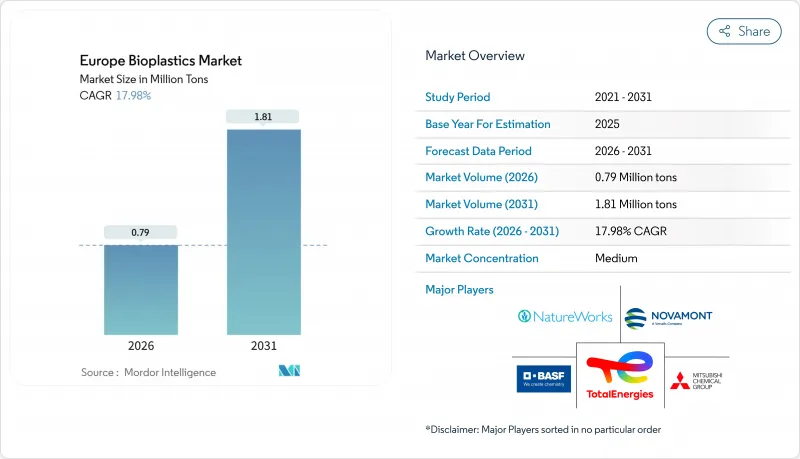
This report is Segmented by Type (Bio-Based Biodegradables and Bio-Based Non-Biodegradables), Feedstock (Sugarcane/Beet, Corn, and More), Processing Technology (Extrusion, Injection Molding, and More), Application (Flexible Packaging, Rigid Packaging, Automotive, and More), and Geography (Germany, United Kingdom, Italy, and More). Market Forecasts are Provided in Terms of Volume (Tons).
Europe Bioplastics Market Trends and Insights
EU Single-Use Plastics Directive Accelerates Compostable Uptake
The directive that took effect in July 2024 prohibits polystyrene food containers, cups, and cutlery, forcing immediate substitution with EN 13432-compliant items. France extended this rule through the AGEC law and will require compostable or reusable food-service packaging in 2025, so quick-service outlets now specify PBAT-starch blends that degrade within 90 days in industrial facilities. Italy's 360 certified composters create a seamless loop for co-collecting food scraps and bioplastic packaging, a model that German municipalities replicate through public-private deals. Starch resins and PBAT copolymers dominate the switch because their melt-flow index matches polystyrene, allowing converters to keep legacy thermoforming lines. Eastern Europe lags, with only 28% municipal coverage, so brands use dual-spec compostable packaging for the West and recyclable bio-PE for the East.
Brand-Owner Sustainability Commitments in Packaging and Textiles
Consumer-goods leaders embed bio-content clauses in procurement, and cost premiums are now written into contracts. Danone disclosed that it paid EUR 12 million above spot PET to secure 45,000 tons of bio-PET in 2025. In apparel, H&M and Inditex pilot PLA fibers that cut cradle-to-gate carbon by 30% versus nylon 6,6, while Procter & Gamble released bio-PE bottles for Fairy dish soap in early 2025. These long agreements stabilize demand and justify capacity expansions that lenders once viewed as risky. As a result, the Europe bioplastics market receives durable price support.
Limited Industrial-Composting Capacity
Only 42% of municipalities across the bloc run certified facilities, and those plants already operate at 78% utilization, leaving little spare capacity for the expected 340,000-ton surge in compostable waste by 2028. Madrid's single composter cannot handle city volumes, so overflow swings to landfill, where anaerobic settings stall degradation. Germany enforces a 58 °C, 10-day rule for certification, a hurdle that small rural sites miss, sparking disputes over residual films. Though France earmarked EUR 300 million for new sites, permits, and buildings will not finish until 2028.
Other drivers and restraints analyzed in the detailed report include:
- Corporate Net-Zero Targets Favor Bio-Content Substitution
- Lignocellulosic Sugar Integration by Pulp Mills
- High EU Energy Prices Inflate Extrusion and Conversion Costs
For complete list of drivers and restraints, kindly check the Table Of Contents.
Segment Analysis
Bio-based biodegradables held 59.81% of the Europe bioplastics market in 2025 and will post a 22.59% CAGR to 2031. Starch blends serve loose-fill and shopping bags at a cost of 15% below PLA. PLA commands the premium slice in rigid clamshells and 3D printing, where clarity matters. PHA stays below 3% share for now, yet new waste-oil capacity in Greece signals that economics can equal PBAT by 2029. PBAT, PBS, and PCL remain critical for flexibility, blended with starch to meet EN 13432.
Bio-based non-biodegradables also held a considerable market share in 2025. Bio-PET appeals to beverage brands such as Coca-Cola, which reported 22% of bottles with 30% bio-content in 2025. Bio-PE lets home-care brands shift without line changes, a gain in automotive fuel tanks and detergent bottles with long validation cycles. Arkema's PA11 from castor oil keeps a foothold in high-abrasion parts despite a 40% price premium.
Sugarcane/sugar beet supplied 44.77% of inputs in 2025, but cellulosic and wood waste will outpace at 22.42% CAGR. Corn prices averaged EUR 245 per ton in 2025 and continue upward due to bioethanol demand. Cassava and potato acreage expansion remains limited. By contrast, enzymatic hydrolysis of sawmill residue delivers sugars at EUR 180-210 per ton, 15% under corn glucose. Gas fermentation using CO2 and hydrogen has pilot backing from Evonik and a EUR 25 million Innovation Fund grant, targeting 5,000 tons in 2027.
Complete Report Scope:
- By Type
- Bio-based Biodegradables
- Starch-based
- Polylactic Acid (PLA)
- Polyhydroxyalkanoates (PHA)
- Polyesters (PBS, PBAT, PCL)
- Other Bio-based Biodegradables
- Bio-based Non-biodegradables
- Bio Polyethylene Terephthalate (PET)
- Bio Polyethylene
- Bio Polyamides
- Bio Polytrimethylene Terephthalate
- Other Bio-based Non-biodegradables
- Bio-based Biodegradables
- By Feedstock
- Sugarcane / Sugar Beet
- Corn
- Cassava and Potato
- Cellulosic and Wood Waste
- Others (Algae and Microbial Oil)
- By Processing Technology
- Extrusion
- Injection Molding
- Blow Molding
- 3D Printing
- Others (Thermoforming, etc.)
- By Application
- Flexible Packaging
- Rigid Packaging
- Automotive and Assembly Operations
- Agriculture and Horticulture
- Construction
- Textiles
- Electrical and Electronics
- Other Applications
- By Country
- Germany
- United Kingdom
- Italy
- France
- Netherlands
- Spain
- Nordic
- Rest of Europe
List of Companies Covered in this Report:
- Arkema
- BASF
- BIO ON SpA
- Biome Bioplastics
- BIOTEC Biologische Naturverpackungen GmbH & Co. KG.
- Eni S.p.A. (Novamont)
- Evonik Industries AG
- FKuR
- FUTERRO
- Green Dot Bioplastics Inc
- Innovia Films
- Lactips
- Minima
- Mitsubishi Chemical Group Corporation
- NatureWorks LLC
- Plantic
- Rodenburg Biopolymers
- RWDC Industries
- Sulapac Oy
- TORAY INDUSTRIES, INC.
- TotalEnergies (Total Corbion)
Additional Benefits:
- The market estimate (ME) sheet in Excel format
- 3 months of analyst support
TABLE OF CONTENTS
1 Introduction
- 1.1 Study Assumptions and Market Definition
- 1.2 Scope of the Study
2 Research Methodology
3 Executive Summary
4 Market Landscape
- 4.1 Market Overview
- 4.2 Market Drivers
- 4.2.1 EU Single-Use Plastics Directive accelerates compostable uptake
- 4.2.2 Brand-owner sustainability commitments in packaging and textiles
- 4.2.3 Corporate net-zero targets favour bio-content substitution
- 4.2.4 Lignocellulosic sugar integration by EU pulp mills enables on-site PLA/PHA
- 4.2.5 CBAM cost on fossil polymer imports boosts EU bioplastics economics
- 4.3 Market Restraints
- 4.3.1 Limited industrial-composting capacity
- 4.3.2 High EU energy prices inflate extrusion and conversion costs
- 4.3.3 Feedstock competition from RED-III advanced-biofuel mandates
- 4.4 Value Chain Analysis
- 4.5 Porter's Five Forces
- 4.5.1 Bargaining Power of Suppliers
- 4.5.2 Bargaining Power of Buyers
- 4.5.3 Threat of New Entrants
- 4.5.4 Threat of Substitutes
- 4.5.5 Degree of Competition
5 Market Size and Growth Forecasts (Volume)
- 5.1 By Type
- 5.1.1 Bio-based Biodegradables
- 5.1.1.1 Starch-based
- 5.1.1.2 Polylactic Acid (PLA)
- 5.1.1.3 Polyhydroxyalkanoates (PHA)
- 5.1.1.4 Polyesters (PBS, PBAT, PCL)
- 5.1.1.5 Other Bio-based Biodegradables
- 5.1.2 Bio-based Non-biodegradables
- 5.1.2.1 Bio Polyethylene Terephthalate (PET)
- 5.1.2.2 Bio Polyethylene
- 5.1.2.3 Bio Polyamides
- 5.1.2.4 Bio Polytrimethylene Terephthalate
- 5.1.2.5 Other Bio-based Non-biodegradables
- 5.1.1 Bio-based Biodegradables
- 5.2 By Feedstock
- 5.2.1 Sugarcane / Sugar Beet
- 5.2.2 Corn
- 5.2.3 Cassava and Potato
- 5.2.4 Cellulosic and Wood Waste
- 5.2.5 Others (Algae and Microbial Oil)
- 5.3 By Processing Technology
- 5.3.1 Extrusion
- 5.3.2 Injection Molding
- 5.3.3 Blow Molding
- 5.3.4 3D Printing
- 5.3.5 Others (Thermoforming, etc.)
- 5.4 By Application
- 5.4.1 Flexible Packaging
- 5.4.2 Rigid Packaging
- 5.4.3 Automotive and Assembly Operations
- 5.4.4 Agriculture and Horticulture
- 5.4.5 Construction
- 5.4.6 Textiles
- 5.4.7 Electrical and Electronics
- 5.4.8 Other Applications
- 5.5 By Country
- 5.5.1 Germany
- 5.5.2 United Kingdom
- 5.5.3 Italy
- 5.5.4 France
- 5.5.5 Netherlands
- 5.5.6 Spain
- 5.5.7 Nordic
- 5.5.8 Rest of Europe
6 Competitive Landscape
- 6.1 Market Concentration
- 6.2 Strategic Moves
- 6.3 Market Share(%)/Ranking Analysis
- 6.4 Company Profiles {(includes Global level Overview, Market level overview, Core Segments, Financials as available, Strategic Information, Market Rank/Share for key companies, Products and Services, Recent Developments)}
- 6.4.1 Arkema
- 6.4.2 BASF
- 6.4.3 BIO ON SpA
- 6.4.4 Biome Bioplastics
- 6.4.5 BIOTEC Biologische Naturverpackungen GmbH & Co. KG.
- 6.4.6 Eni S.p.A. (Novamont)
- 6.4.7 Evonik Industries AG
- 6.4.8 FKuR
- 6.4.9 FUTERRO
- 6.4.10 Green Dot Bioplastics Inc
- 6.4.11 Innovia Films
- 6.4.12 Lactips
- 6.4.13 Minima
- 6.4.14 Mitsubishi Chemical Group Corporation
- 6.4.15 NatureWorks LLC
- 6.4.16 Plantic
- 6.4.17 Rodenburg Biopolymers
- 6.4.18 RWDC Industries
- 6.4.19 Sulapac Oy
- 6.4.20 TORAY INDUSTRIES, INC.
- 6.4.21 TotalEnergies (Total Corbion)
7 Market Opportunities and Future Outlook
- 7.1 EU Circular Economy and Green Deal Strategies
- 7.2 White-space and Unmet-need Assessment

