PUBLISHER: Mordor Intelligence | PRODUCT CODE: 2121434

PUBLISHER: Mordor Intelligence | PRODUCT CODE: 2121434
Europe Location Analytics - Market Share Analysis, Industry Trends & Statistics, Growth Forecasts (2026 - 2031)
According to Mordor Intelligence, the Europe location analytics market size was valued at USD 4.82 billion in 2025 and estimated to grow from USD 5.56 billion in 2026 to reach USD 11.34 billion by 2031, at a CAGR of 15.34% during the forecast period (2026-2031).
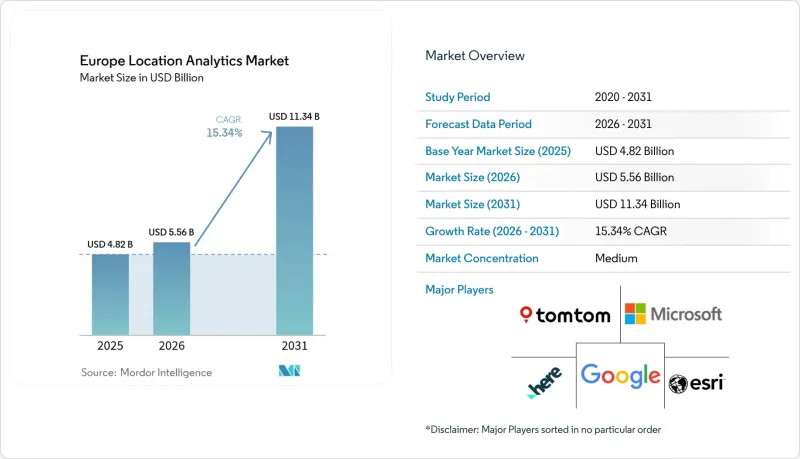
This report is Segmented by Location Type (Indoor, and Outdoor), Deployment (Cloud, and On-Premise), End User (Banking, Financial Services and Insurance, and More), Application (Customer Footfall Analytics, Asset Tracking, Risk and Incident Management, and More), and Geography (Germany, United Kingdom, and More). The Market Forecasts are Provided in Terms of Value (USD).
Europe Location Analytics Market Trends and Insights
Rising Adoption of Real-Time Fleet Management Solutions
Logistics carriers are embedding geospatial analytics into their telematics stacks to reduce empty-mile kilometers and meet the scope 3 requirements of the Corporate Sustainability Reporting Directive. DHL earmarked EUR 2 billion (USD 2.33 billion) for European EV fleets in 2024, pairing edge gateways with traffic, weather, and volume density feeds to reduce route variance by 12%. Maersk's predictive ETA engine cut hub dwell time 12% in H1 2024 by applying location AI to rail-port handoffs. DB Cargo has adopted automated geofencing, which reduces border crossings by 18 minutes per shipment, thereby accelerating customs clearance. Fleet software now bundles location analytics with predictive maintenance, tying elevation profiles and road quality to part-wear forecasts that pre-empt breakdowns.
Accelerated 5G Roll-Out Enabling Hyper-Local Analytics
Standalone 5G with network slicing guarantees sub-10 ms latency, unlocking augmented-reality navigation and autonomous warehouse forklifts. Vodafone Germany reached 90% population coverage by mid-2024, enabling private 5G networks employing centimeter-accurate indoor positioning. Orange France extended 5G to 75% of citizens by late-2024 to fuel real-time crowd-density heatmaps for retailers. EU Digital Decade aims for 75% 5G coverage by 2030, supporting millimeter-wave beamforming in airports and arenas. Deutsche Telekom and TRUMPF reached 30 cm accuracy in UWB-enabled factories, illustrating how 5G edge compute can localize work-in-progress inventory without relying on cloud cores.
Stringent GDPR Location-Consent Requirements
The European Data Protection Board clarified in 2024 that Wi-Fi and BLE MAC tracking counts as personal data, forcing retailers to deploy consent banners that sink opt-in rates 30-40% below opt-out regions. Germany's BSI urges on-device processing and differential privacy to curb cloud transfers. Belgium fined a beacon vendor EUR 250,000 (USD 291596.25) for lack of explicit consent, triggering sector-wide audits. Compliance costs hit SMEs hardest, steering contracts toward big-platform players with legal benches, yet also spur demand for on-premise deployments that avoid cross-border transfers flagged by the Schrems II ruling.
Other drivers and restraints analyzed in the detailed report include:
- Integration of Geospatial AI in Public-Safety Operations
- Mandates for Smart-City Open Data Portals
- De-Fragmented Local Government Procurement Cycles
For complete list of drivers and restraints, kindly check the Table Of Contents.
Segment Analysis
Indoor analytics posted a 15.52% CAGR forecast from 2026 to 2031, eclipsing outdoor systems that still held 63.61% of 2025 spend. Sub-USD 1 ambient-IoT tags from Wiliot and 10-cm angle-of-arrival UWB from Quuppa shrink hardware barriers and push the Europe location analytics market deeper into theaters, terminals, and wards. Enterprise buyers prize the batteryless form factor that eliminates monthly maintenance rounds, while hospitals cut equipment loss 18%. The Galileo High Accuracy Service and ubiquitous GPS keep outdoor analytics indispensable for transit and precision agriculture. Still, indoor adoption surges as national health systems and retailers converge on hybrid BLE-UWB blueprints.
Edge gateways translate sub-second indoor feeds to cloud dashboards only when bandwidth permits, honoring GDPR minimization. Deutsche Telekom's 30-cm UWB pilot inside metal-dense factories validates robustness where Wi-Fi multipath prevails. Ultra-wideband captures high-value industrial cases, while BLE dominates cost-sensitive retail. Collectively these factors multiply addressable use cases, reinforcing the Europe location analytics market as indoor accuracy climbs.
Cloud held 57.12% of the 2025 spend and is projected to have a 16.1% CAGR, reflecting API bundling within Azure, AWS, and Fabric. Microsoft and TomTom extended Orbis Maps in Azure through 2030, simplifying licensing and encouraging developers to adopt consumption-based billing. HERE's EUR 428 million(USD 499.21 million) Q3 2024 revenue, up 16%, underscores migration from on-premise estates. Microsoft Fabric has added spatial joins to OneLake, enabling SQL analysts to run geofencing queries without requiring GIS installations.
On-premise remains vital for defense, banking, and critical infrastructure. The European Banking Authority's outsourcing guide encourages financial institutions to maintain customer geolocation in private clouds. Esri's January 2025 link-up with TomTom channels cloud routing into ArcGIS, while datasets remain local, demonstrating hybrid traction. As hyperscalers swallow routine spatial operations, vendors pivot to value-added twin simulations and AI-driven insight layers, sustaining differentiation inside the Europe location analytics market.
Complete Report Scope:
- By Location Type
- Indoor
- Outdoor
- By Deployment
- Cloud
- On-Premise
- By End User
- Banking, Financial Services and Insurance (BFSI)
- Retail
- Transportation and Logistics
- Tourism and Hospitality
- Healthcare
- By Application
- Customer Footfall Analytics
- Asset Tracking
- Risk and Incident Management
- Marketing Campaign Optimization
- Urban Planning and Zoning
- By Country
- Germany
- United Kingdom
- France
- Rest of Europe
List of Companies Covered in this Report:
- Microsoft Corporation
- Esri Global, Inc.
- HERE Global B.V.
- Google LLC
- TomTom International B.V.
- SAS Institute Inc.
- Tableau Software LLC
- QlikTech International AB
- TIBCO Software Inc.
- Alteryx Inc.
- Hexagon AB
- Cisco Systems Inc.
- SAP SE
- Pitney Bowes Inc.
- Galigeo SAS
- Carto
- Foursquare
Additional Benefits:
- The market estimate (ME) sheet in Excel format
- 3 months of analyst support
TABLE OF CONTENTS
1 INTRODUCTION
- 1.1 Study Assumptions and Market Definition
- 1.2 Scope of the Study
2 RESEARCH METHODOLOGY
3 EXECUTIVE SUMMARY
4 MARKET LANDSCAPE
- 4.1 Market Overview
- 4.2 Market Drivers
- 4.2.1 Rising Adoption of Real-Time Fleet Management Solutions
- 4.2.2 Accelerated 5G Roll-Out Enabling Hyper-Local Analytics
- 4.2.3 Integration of Geospatial AI in Public-Safety Operations
- 4.2.4 Mandates for Smart-City Open Data Portals
- 4.2.5 Growth of Digital-Twin Infrastructure Projects
- 4.2.6 Surge in Indoor IoT Sensor Fusion for Retail
- 4.3 Market Restraints
- 4.3.1 Stringent GDPR Location-Consent Requirements
- 4.3.2 De-Fragmented Local Government Procurement Cycles
- 4.3.3 Rising Cost of High-Resolution Satellite Imagery Licensing
- 4.3.4 Limited Availability of Qualified Geo-AI Talent
- 4.4 Industry Value Chain Analysis
- 4.5 Regulatory Landscape
- 4.6 Technological Outlook
- 4.7 Impact of Macroeconomic Factors on the Market
- 4.8 Porter's Five Forces Analysis
- 4.8.1 Threat of New Entrants
- 4.8.2 Bargaining Power of Suppliers
- 4.8.3 Bargaining Power of Buyers
- 4.8.4 Threat of Substitute Products
- 4.8.5 Intensity of Competitive Rivalry
5 MARKET SIZE AND GROWTH FORECASTS (VALUE)
- 5.1 By Location Type
- 5.1.1 Indoor
- 5.1.2 Outdoor
- 5.2 By Deployment
- 5.2.1 Cloud
- 5.2.2 On-Premise
- 5.3 By End User
- 5.3.1 Banking, Financial Services and Insurance (BFSI)
- 5.3.2 Retail
- 5.3.3 Transportation and Logistics
- 5.3.4 Tourism and Hospitality
- 5.3.5 Healthcare
- 5.4 By Application
- 5.4.1 Customer Footfall Analytics
- 5.4.2 Asset Tracking
- 5.4.3 Risk and Incident Management
- 5.4.4 Marketing Campaign Optimization
- 5.4.5 Urban Planning and Zoning
- 5.5 By Country
- 5.5.1 Germany
- 5.5.2 United Kingdom
- 5.5.3 France
- 5.5.4 Rest of Europe
6 COMPETITIVE LANDSCAPE
- 6.1 Market Concentration
- 6.2 Strategic Moves
- 6.3 Market Share Analysis
- 6.4 Company Profiles (includes Global level Overview, Market level overview, Core Segments, Financials as available, Strategic Information, Market Rank/Share for key companies, Products and Services, and Recent Developments)
- 6.4.1 Microsoft Corporation
- 6.4.2 Esri Global, Inc.
- 6.4.3 HERE Global B.V.
- 6.4.4 Google LLC
- 6.4.5 TomTom International B.V.
- 6.4.6 SAS Institute Inc.
- 6.4.7 Tableau Software LLC
- 6.4.8 QlikTech International AB
- 6.4.9 TIBCO Software Inc.
- 6.4.10 Alteryx Inc.
- 6.4.11 Hexagon AB
- 6.4.12 Cisco Systems Inc.
- 6.4.13 SAP SE
- 6.4.14 Pitney Bowes Inc.
- 6.4.15 Galigeo SAS
- 6.4.16 Carto
- 6.4.17 Foursquare
7 MARKET OPPORTUNITIES AND FUTURE OUTLOOK
- 7.1 White-Space and Unmet-Need Assessment

