PUBLISHER: Mordor Intelligence | PRODUCT CODE: 2121498

PUBLISHER: Mordor Intelligence | PRODUCT CODE: 2121498
Beer - Market Share Analysis, Industry Trends & Statistics, Growth Forecasts (2026 - 2031)
According to Mordor Intelligence, the beer market size was valued at USD 0.81 trillion in 2025 and estimated to grow from USD 0.85 trillion in 2026 to reach USD 1.09 trillion by 2031, reflecting a 5.16% CAGR during the forecast period.
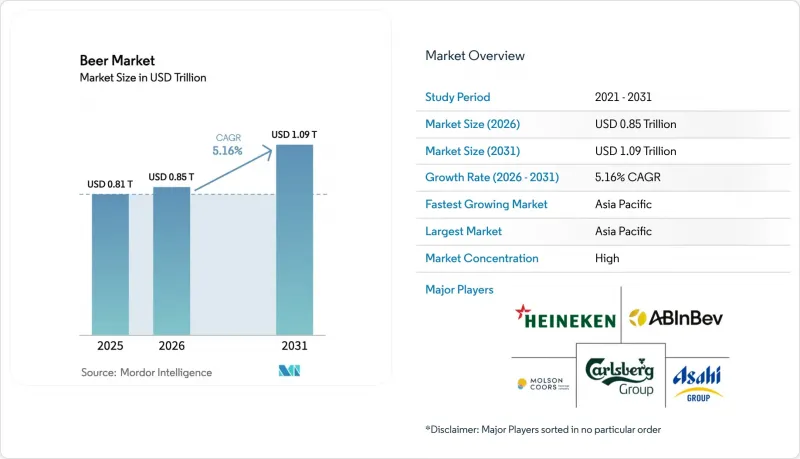
This report is Segmented by Product Type (Ale, Lager, Non/Low-Alcohol Beer, and Other Beer Types), Category (Standard and Premium), Packaging Type (Bottles, Cans, and Others), Distribution Channel (On-Trade and Off-Trade), and Geography (North America, Europe, Asia-Pacific, South America, and Middle East and Africa). The Market Forecasts are Provided in Terms of Value (USD).
Global Beer Market Trends and Insights
Growing Number of Breweries Leading to High Prevalence of Craft Beer
The rapid proliferation of craft breweries continues to reshape market dynamics, intensifying competition for shelf space and encouraging consolidation strategies among established players. In the United States, more than 9,922 craft breweries were operational in 2025. Large-scale players increasingly acquire successful regional craft brands and invest in innovation pipelines that replicate local authenticity while benefiting from operational scale. For example, Carlsberg's GBP 3.3 billion acquisition of Britvic in January 2025 enhanced its exposure to premium mixers and craft-aligned beverage categories. In the Asia-Pacific region, particularly India, the craft beer ecosystem continues to benefit from urbanization and evolving consumer lifestyles. Taproom chains backed by B9 Beverages have gained traction among young professionals in metropolitan areas, driving double-digit revenue growth in fiscal year 2025. This expansion reflects sustained demand for localized, experiential beer consumption and reinforces the role of craft and premium formats in diversifying a beer market traditionally dominated by mass-produced lagers.
Growing Tourism and Hospitality Impact Positive Growth
The tourism and hospitality sectors' recovery is increasing beer market growth, primarily in the on-trade segment. Across Asia, markets such as Hong Kong, Singapore, Thailand, and Vietnam demonstrate strong on-trade alcohol consumption driven by vibrant nightlife, dining cultures, and international tourism flows. Large-scale events, including beer festivals, live entertainment, and cultural celebrations, further amplify beer consumption by increasing foot traffic and broadening distribution touchpoints. These experiential settings support premium pricing and brand discovery, reinforcing beer's position within leisure-driven consumption occasions. In parallel, beer tourism has emerged as a meaningful growth lever for regional markets, as consumers increasingly seek immersive experiences through craft brewery visits, production facility tours, and industry-led events. For instance, breweries in Belgium attract substantial visitor volumes through guided tours and flagship events such as Belgian Beer Weekend, underscoring the role of beer tourism in elevating market value and supporting long-term industry growth.
Stringent Government Regulations
Government regulations continue to exert a significant influence on the beer market through tax reforms, marketing restrictions, and expanded labeling mandates, increasing compliance complexity for brewers and constraining volume growth in highly regulated regions. Changes in excise duty structures directly affect pricing, consumption patterns, and on-trade viability. For example, the United Kingdom transitioned to an alcohol-by-volume (ABV)-linked excise tax system in August 2023, which contributed to a 4% decline in on-trade beer volumes in 2024. Regulatory harmonization efforts at the regional level further elevate operational costs for beer manufacturers. Under a European Union directive issued in December 2023, alcoholic beverages sold within the bloc must display ingredient lists and calorie information by 2026. Compliance with these requirements is expected to generate EUR 50-100 million in cumulative costs related to label redesign, inventory write-offs, and supply chain adjustments for producers operating across multiple EU markets. As a result, evolving regulatory frameworks across regions shape brewers' strategic decisions, influencing pricing, distribution, and investment priorities while moderating overall beer market expansion.
Other drivers and restraints analyzed in the detailed report include:
- Product Innovation in Terms of Ingredient and Alcohol Content
- Health Conscious Consumer Accelerating Demand For Gluten Free Beer
- Raw Material Cost Inflation and Supply Chain Challenges
For complete list of drivers and restraints, kindly check the Table Of Contents.
Segment Analysis
Lager beer continues to dominate the global beer market, accounting for 87.09% of total revenue in 2025, underscoring its entrenched mass-market position, particularly across Asia-Pacific and Latin America. The segment's performance remains supported by extensive distribution networks, strong brand recognition, and cultural relevance in social occasions, live events, and televised sports. Premiumization and craft-led diversification continue to reshape consumer spending patterns. While traditional lagers retain cultural significance, premium craft lagers and hop-forward ales are capturing discretionary expenditure among urban millennials and Gen Z consumers.
In contrast, the non-alcoholic and low-alcohol beer segment represents the fastest-growing product category and is forecast to expand at a CAGR of 5.30%. Growth is driven by younger consumer cohorts who increasingly balance social engagement with health and wellness considerations. The value contribution of non-alcoholic beer is particularly pronounced in developed markets, with Western Europe's non-alcoholic beer segment supported by public health initiatives and institutional backing for moderate-drinking campaigns.
Standard beer continues to represent the majority of global beer consumption, accounting for 79.32% of total revenues in 2025. The segment's dominance is sustained by affordability, wide availability, and entrenched consumer preferences, particularly across high-population markets in Asia and Africa, where price sensitivity remains a key purchase driver. Standard lagers, therefore, continue to anchor volume stability within the global beer market, despite increasing segmentation.
In contrast, the premium beer segment is exhibiting accelerated value growth and is forecast to expand at a CAGR of 5.45%, outpacing standard beer by nearly one percentage point. This performance reflects ongoing consumer "trade-up" behavior, as drinkers seek improved quality, brand credibility, and differentiated drinking experiences. Premium segment expansion is further supported by brand storytelling centered on heritage, craftsmanship, and authenticity, as well as limited-edition packaging and alignment with gastronomy and food-pairing occasions.
Complete Report Scope:
- By Product Type
- Ale
- Lager
- Non/Low-Alcohol Beer
- Other Beer Types
- By Category
- Standard
- Premium
- By Packaging Type
- Bottles
- Cans
- Others
- By Distribution Channel
- On-Trade
- Off-Trade
- Specialty/Liquor Stores
- Others Off Trade Channels
- By Geography
- North America
- United States
- Canada
- Mexico
- Rest of North America
- Europe
- Germany
- France
- United Kingdom
- Spain
- Netherlands
- Italy
- Rest of Europe
- Asia-Pacific
- China
- India
- Japan
- Australia
- South Korea
- Rest of Asia-Pacific
- South America
- Brazil
- Argentina
- Rest of South America
- Middle East and Africa
- United Arab Emirates
- South Africa
- Saudi Arabia
- Rest of Middle East and Africa
- North America
Geography Analysis
Asia-Pacific strengthened its position as the largest and fastest-growing regional beer market, generating 30.12% of global revenue in 2025 and projected to advance at a 5.40% CAGR through 2031. Growth is underpinned by rapid urbanization, rising disposable incomes, and the continued expansion of the urban middle class across emerging economies. India remains a key growth engine, with beer volumes increasing in 2024, supported by favorable demographics, improved retail access, and ongoing modernization of domestic brewery infrastructure. Southeast Asian markets such as Vietnam and Indonesia continue to post mid-single-digit growth, aided by government investments in tourism infrastructure and expanding on-trade consumption in urban and resort destinations.
Europe and North America remain mature beer markets facing structural volume declines, yet both regions sustain revenue growth through premiumization, innovation, and portfolio diversification into non-alcoholic offerings. In Europe, demographic aging and public health initiatives have weighed on traditional consumption patterns. Germany's per-capita beer consumption declined to 84.3 liters in 2023, reflecting these long-term trends. Premium, craft, and alcohol-free extensions continue to refine consumer choice and stabilize value growth across the region.
Developing regions, including South America, the Middle East, and Africa, present diverse growth trajectories shaped by economic conditions, regulation, and demographics. In the Middle East, strict regulatory environments constrain market potential in countries such as Saudi Arabia, while the United Arab Emirates benefits from a tourism-led rebound that supports on-premise sales of imported premium lagers. Sub-Saharan Africa offers long-term growth potential driven by a young population and rising disposable incomes; however, market expansion remains contingent on improvements in logistics infrastructure, local sourcing capabilities, and predictable excise taxation frameworks.
- Heineken N.V.
- Carlsberg Group
- Asahi Group Holdings Ltd
- Molson Coors Beverage Company
- Kirin Holdings Co. Ltd.
- Constellation Brands Inc.
- China Resources Snow Breweries Ltd
- Diageo Plc
- Boston Beer Company Inc.
- Tsingtao Brewery Co. Ltd.
- Anheuser-busch Inbev SA/NV
- Sapporo Holdings Ltd.
- Sierra Nevada Brewing Co.
- Beijing Yanjing Brewery Co., Ltd.
- D.G. Yuengling & Son Inc.
- Tsingtao Brewery Co. Ltd
- Thai Beverage Public Company Limited
- B9 Beverages Private Limited
- Inbrew Beverages Private Limited
- San Miguel Corporation
Additional Benefits:
- The market estimate (ME) sheet in Excel format
- 3 months of analyst support
TABLE OF CONTENTS
1 INTRODUCTION
- 1.1 Study Assumptions and Market Definition
- 1.2 Scope of the Study
2 RESEARCH METHODOLOGY
3 EXECUTIVE SUMMARY
4 MARKET LANDSCAPE
- 4.1 Market Overview
- 4.2 Market Drivers
- 4.2.1 Growing Number of Breweries Leading to High Prevalence of Craft Beer
- 4.2.2 Growing Tourism and Hospitality Impact Positive Growth
- 4.2.3 Product Innovation in Terms of Ingredient and Alcohol Content
- 4.2.4 Health Conscious Consumer Accelerating Demand For Gluten Free Beer
- 4.2.5 Rising Focus on Sustainable and Ethical Beer Production
- 4.2.6 Brewing Industry's Technological Evolution
- 4.3 Market Restraints
- 4.3.1 Stringent Government Regulations
- 4.3.2 Health-Conscious Consumption Trends Limiting Beer Demand
- 4.3.3 Raw Material Cost Inflation and Supply Chain Challenges Impact Beer Production
- 4.3.4 Religious and Cultural Constraints Affecting Beer Market Growth
- 4.4 Consumer Behavior Analysis
- 4.5 Regulatory Outlook
- 4.6 Technology Outlook
- 4.7 Porter's Five Forces
- 4.7.1 Threat of New Entrants
- 4.7.2 Bargaining Power of Buyers
- 4.7.3 Bargaining Power of Suppliers
- 4.7.4 Threat of Substitute Products
- 4.7.5 Intensity of Competitive Rivalry
5 MARKET SIZE AND GROWTH FORECASTS (VALUE, USD)
- 5.1 By Product Type
- 5.1.1 Ale
- 5.1.2 Lager
- 5.1.3 Non/Low-Alcohol Beer
- 5.1.4 Other Beer Types
- 5.2 By Category
- 5.2.1 Standard
- 5.2.2 Premium
- 5.3 By Packaging Type
- 5.3.1 Bottles
- 5.3.2 Cans
- 5.3.3 Others
- 5.4 By Distribution Channel
- 5.4.1 On-Trade
- 5.4.2 Off-Trade
- 5.4.2.1 Specialty/Liquor Stores
- 5.4.2.2 Others Off Trade Channels
- 5.5 By Geography
- 5.5.1 North America
- 5.5.1.1 United States
- 5.5.1.2 Canada
- 5.5.1.3 Mexico
- 5.5.1.4 Rest of North America
- 5.5.2 Europe
- 5.5.2.1 Germany
- 5.5.2.2 France
- 5.5.2.3 United Kingdom
- 5.5.2.4 Spain
- 5.5.2.5 Netherlands
- 5.5.2.6 Italy
- 5.5.2.7 Rest of Europe
- 5.5.3 Asia-Pacific
- 5.5.3.1 China
- 5.5.3.2 India
- 5.5.3.3 Japan
- 5.5.3.4 Australia
- 5.5.3.5 South Korea
- 5.5.3.6 Rest of Asia-Pacific
- 5.5.4 South America
- 5.5.4.1 Brazil
- 5.5.4.2 Argentina
- 5.5.4.3 Rest of South America
- 5.5.5 Middle East and Africa
- 5.5.5.1 United Arab Emirates
- 5.5.5.2 South Africa
- 5.5.5.3 Saudi Arabia
- 5.5.5.4 Rest of Middle East and Africa
- 5.5.1 North America
6 COMPETITIVE LANDSCAPE
- 6.1 Market Concentration
- 6.2 Strategic Moves
- 6.3 Market Ranking Analysis
- 6.4 Company Profiles (includes Global level Overview, Market level overview, Core Segments, Financials as available, Strategic Information, Market Rank/Share for key companies, Products and Services, and Recent Developments)
- 6.4.1 Heineken N.V.
- 6.4.2 Carlsberg Group
- 6.4.3 Asahi Group Holdings Ltd
- 6.4.4 Molson Coors Beverage Company
- 6.4.5 Kirin Holdings Co. Ltd.
- 6.4.6 Constellation Brands Inc.
- 6.4.7 China Resources Snow Breweries Ltd
- 6.4.8 Diageo Plc
- 6.4.9 Boston Beer Company Inc.
- 6.4.10 Tsingtao Brewery Co. Ltd.
- 6.4.11 Anheuser-busch Inbev SA/NV
- 6.4.12 Sapporo Holdings Ltd.
- 6.4.13 Sierra Nevada Brewing Co.
- 6.4.14 Beijing Yanjing Brewery Co., Ltd.
- 6.4.15 D.G. Yuengling & Son Inc.
- 6.4.16 Tsingtao Brewery Co. Ltd
- 6.4.17 Thai Beverage Public Company Limited
- 6.4.18 B9 Beverages Private Limited
- 6.4.19 Inbrew Beverages Private Limited
- 6.4.20 San Miguel Corporation
7 MARKET OPPORTUNITIES AND FUTURE OUTLOOK

