PUBLISHER: Mordor Intelligence | PRODUCT CODE: 2121504

PUBLISHER: Mordor Intelligence | PRODUCT CODE: 2121504
Automotive Semiconductor - Market Share Analysis, Industry Trends & Statistics, Growth Forecasts (2026 - 2031)
According to Mordor Intelligence, the automotive semiconductor market size is projected to expand from USD 99.74 billion in 2025 and USD 107.34 billion in 2026 to USD 148.57 billion by 2031, registering a CAGR of 6.72% between 2026 to 2031.
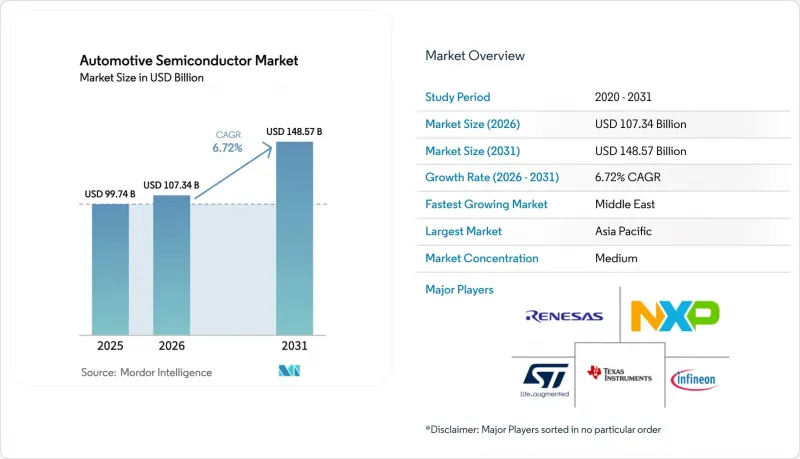
This report is Segmented by Device Type (Discrete Semiconductors, Optoelectronics, and More), Vehicle Propulsion (Internal Combustion Engine, Hybrid, and More), Application (Powertrain and Electrification, ADAS and Autonomous Driving, and More), Business Model (IDM, Fabless, and Foundry), and Geography (North America, South America, and More). The Market Forecasts are Provided in Terms of Value (USD).
Global Automotive Semiconductor Market Trends and Insights
Increasing Vehicle Production in Emerging Economies
Light-vehicle output in India reached 5.8 million units in 2025, a 9% annual rise, while Southeast Asian assembly topped 3.2 million units, pushing semiconductor demand for entry-level models that now ship with stability control and basic connectivity as standard. New assembly and test capacity under India's Production-Linked Incentive scheme is localizing supply and trimming import costs, a shift mirrored by incentive-backed investments in Mexico and the Gulf states. These moves shorten supply chains, anchor design talent regionally, and accelerate time to qualification. As emerging-market buyers demand safety features once reserved for premium segments, chip volumes per vehicle continue to climb. The result is sustained structural expansion for the automotive semiconductor market well beyond global vehicle growth rates.
Rising Demand for Advanced Safety and Comfort Systems
The European Union's General Safety Regulation mandated intelligent speed assistance, advanced emergency braking, and driver monitoring for all new type approvals after July 2024, effectively standardizing radar and camera content across mainstream models. U.S. crash-reduction data have reinforced the business case, enabling insurers to lower premiums for vehicles fitted with automated emergency braking, which, in turn, spurs consumer uptake. China's New Car Assessment Program raised its five-star standard in 2025, prompting domestic brands to incorporate higher-resolution sensors capable of detecting pedestrians up to 100 meters away. These mandates are spreading to cost-sensitive regions, lifting average semiconductor bill-of-materials values for even compact cars. Tier-one suppliers with deep functional-safety pedigrees are well positioned, as ISO 26262 barriers favor proven platforms.
High Cost of Advanced-Feature Vehicles
Equipping a mainstream vehicle with Level 2 driver assistance pushes average transaction prices above USD 48,000 in the United States, making such cars 22% costlier than segment norms. Semiconductor content for these feature packs often exceeds USD 1,000, and automakers apply significant mark-ups to recover R&D and validation costs. Emerging markets with high price elasticity feel the effect most acutely, limiting penetration to upper trims. Redundant sensor architectures raise costs further because regulators insist on fail-operational designs for pedestrian safety. Although suppliers are exploring lower-cost sensor fusion that reduces lidar reliance, functional-safety ceilings still restrain rapid cost downs.
Other drivers and restraints analyzed in the detailed report include:
- Electrification Boosting Semiconductor Content per Vehicle
- Zonal E/E Architectures and Software-Defined Vehicles Spur High-End Processors
- Persistent Supply-Chain Constraints and Chip Shortages
For complete list of drivers and restraints, kindly check the Table Of Contents.
Segment Analysis
The automotive semiconductor market size for integrated circuits stood highest in 2025, capturing 43.32% revenue thanks to microcontrollers, SoCs, and memory that underpin zonal and centralized architectures. Growing compute density, embedded hardware security, and over-the-air update readiness make these devices indispensable. Market participants note that the latest SoCs combine heterogeneous CPU clusters, graphics engines, and neural processors, allowing a single package to handle cockpit, connectivity, and low-speed autonomy workloads. Demand for embedded memory continues to surge as map data and neural network weights expand.
Sensors and microelectromechanical systems are forecast to post a 17.61% CAGR, the fastest pace among device categories. Radar, lidar, camera, ultrasonic, and inertial units now ship in redundant arrays to deliver 360-degree perception for mandated safety functions. Texas Instruments' corner-radar chip, which integrates an RF front-end and signal processing on one die, typifies this consolidation trend. Meanwhile, wide-bandgap power discretes are migrating into multichip modules, slightly tempering discrete unit growth but lifting average selling prices. The pathway ahead favors suppliers that can blend sensing, processing, and actuation into integrated platforms, reinforcing scale advantages in the automotive semiconductor market.
Battery electric vehicles still deliver the highest semiconductor value per vehicle, giving them 54.19% of 2025 semiconductor revenue. Mild-hybrid 48-volt systems add converters and controllers, nudging chip content upward even before full electrification. In contrast, the automotive semiconductor market size tied to internal-combustion vehicles will expand at a projected 17.49% CAGR, influenced by increasing electronic content even in conventional platforms. Each battery electric car carries USD 600-USD 800 of power electronics alone, dwarfing combustion counterparts.
Hybrid configurations offer a bridge solution, demanding dual power-management architectures that lift per-vehicle chip value to roughly USD 700. Fuel-cell variants remain niche but command specialized high-voltage converters, hinting at future upside should hydrogen infrastructure mature. Automakers such as BYD and Stellantis have announced standardized 400-volt and 800-volt platforms that rely heavily on silicon-carbide modules, tightening the link between propulsion choice and semiconductor bill of materials. The data confirm that value growth will hinge on electrified drivetrains, even as combustion engines dominate production counts through the near term.
Complete Report Scope:
- By Device Type
- Discrete Semiconductors
- Diodes
- Transistors
- Power Transistors
- Rectifiers and Thyristors
- Other Discrete Devices
- Optoelectronics
- Light-Emitting Diodes (LEDs)
- Laser Diodes
- Image Sensors
- Optocouplers
- Other Optoelectronic Devices
- Sensors and MEMS
- Pressure Sensors
- Magnetic Field Sensors
- Actuators
- Acceleration and Yaw-Rate Sensors
- Temperature and Other Sensors
- Integrated Circuits
- By Integrated Circuit Type
- Analog
- Micro
- Microprocessors (MPU)
- Microcontrollers (MCU)
- Digital Signal Processors
- Logic
- Memory
- By Technology Node (Shipment Volume Not Applicable)
- < 3 nm
- 3 nm
- 5 nm
- 7 nm
- 16 nm
- 28 nm
- > 28 nm
- By Integrated Circuit Type
- Discrete Semiconductors
- By Vehicle Propulsion
- Internal Combustion Engine Vehicles
- Hybrid Vehicles
- Battery Electric Vehicles
- Fuel-Cell Electric Vehicles
- By Application
- Powertrain and Electrification
- Advanced Driver-Assistance Systems (ADAS) and Autonomous Driving
- Body Electronics and Comfort
- Infotainment and Connectivity
- Safety Systems
- By Business Model
- Integrated Device Manufacturer (IDM)
- Design / Fabless Vendor
- Foundry Service Provider
- By Geography
- North America
- United States
- Canada
- Mexico
- South America
- Brazil
- Argentina
- Rest of South America
- Europe
- Germany
- United Kingdom
- France
- Italy
- Spain
- Russia
- Rest of Europe
- Asia Pacific
- China
- Japan
- South Korea
- India
- Australia
- New Zealand
- Rest of Asia Pacific
- Middle East
- United Arab Emirates
- Saudi Arabia
- Turkey
- Rest of Middle East
- Africa
- South Africa
- Nigeria
- Kenya
- Rest of Africa
- North America
Geography Analysis
Asia Pacific generated 45.87% of 2025 revenue, anchored by China's 9 million electric-vehicle sales and its 25% domestic-content mandate for new-energy vehicles. Proximity to foundries and assembly houses enables faster design-for-cost loops and the prompt qualification of custom devices, thereby strengthening the region's influence on semiconductor roadmaps. South Korea's memory giants have pledged to dedicate 15% of their 300-millimeter wafer output to automotive customers by 2027, thereby deepening the supply-chain cluster.
North America and Europe combined for roughly 35% of revenue. Aggressive safety and decarbonization targets continue to drive high semiconductor intensity, while public incentives under the United States CHIPS and Science Act and the European Union Chips Act channel billions of dollars into domestic fabs. Those plants will not fully ramp up until 2027-2028, leaving the regions reliant on Asian imports in the interim.
The Middle East, although a small base today, is expected to log an 18.12% CAGR through 2031. Sovereign funds in the United Arab Emirates and Saudi Arabia are backing electric fleet mandates and local assembly that specify advanced driver-assistance and battery-management features, pulling global tier-one suppliers into greenfield partnerships. Africa and South America remain volume markets for entry-level vehicles, yet regulatory adoption of electronic stability control and tire-pressure monitoring is gradually lifting chip demand.
- NXP Semiconductors N.V.
- Infineon Technologies AG
- Renesas Electronics Corporation
- STMicroelectronics N.V.
- Texas Instruments Inc.
- Toshiba Electronic Devices and Storage Corporation
- Micron Technology Inc.
- onsemi
- Analog Devices Inc.
- Robert Bosch GmbH, Semiconductor Division
- ROHM Co., Ltd.
- NVIDIA Corporation
- Qualcomm Technologies Inc.
- Intel Corporation (Mobileye)
- Samsung Electronics Co., Ltd., System LSI
- MediaTek Inc.
- BYD Semiconductor Co. Ltd.
- Semtech Corporation
- Diodes Incorporated
- Microchip Technology Inc.
- Melexis NV
- Elmos Semiconductor SE
- Allegro Microsystems, Inc.
- Skyworks Solutions, Inc.
- Ambarella Inc.
- Wolfspeed Inc.
Additional Benefits:
- The market estimate (ME) sheet in Excel format
- 3 months of analyst support
TABLE OF CONTENTS
1 INTRODUCTION
- 1.1 Study Assumptions and Market Definition
- 1.2 Scope of the Study
2 RESEARCH METHODOLOGY
3 EXECUTIVE SUMMARY
4 MARKET LANDSCAPE
- 4.1 Market Overview
- 4.2 Market Drivers
- 4.2.1 Increasing Vehicle Production in Emerging Economies
- 4.2.2 Rising Demand for Advanced Safety and Comfort Systems
- 4.2.3 Electrification Boosting Semiconductor Content per Vehicle
- 4.2.4 Zonal E/E Architectures and Software-Defined Vehicles Spur High-End Processors
- 4.2.5 Government Incentives for Auto-Grade Foundry Capacity Expansion
- 4.2.6 Adoption of SiC and GaN Power Devices in Electric Powertrains
- 4.3 Market Restraints
- 4.3.1 High Cost of Advanced-Feature Vehicles
- 4.3.2 Persistent Supply-Chain Constraints and Chip Shortages
- 4.3.3 Scarcity and Cost of Wide-Bandgap Substrates
- 4.3.4 Lengthy Automotive Qualification Cycles Slow Time-to-Market
- 4.4 Industry Value Chain Analysis
- 4.5 Regulatory Landscape
- 4.6 Technological Outlook
- 4.7 RF Device Demand in Autonomous Vehicles
- 4.8 Porter's Five Forces Analysis
- 4.8.1 Bargaining Power of Suppliers
- 4.8.2 Bargaining Power of Buyers
- 4.8.3 Threat of New Entrants
- 4.8.4 Threat of Substitute Products
- 4.8.5 Intensity of Competitive Rivalry
- 4.9 Investment Analysis
- 4.10 Impact of Macroeconomic Factors on the Market
5 MARKET SIZE AND GROWTH FORECASTS (VALUE)
- 5.1 By Device Type
- 5.1.1 Discrete Semiconductors
- 5.1.1.1 Diodes
- 5.1.1.2 Transistors
- 5.1.1.3 Power Transistors
- 5.1.1.4 Rectifiers and Thyristors
- 5.1.1.5 Other Discrete Devices
- 5.1.2 Optoelectronics
- 5.1.2.1 Light-Emitting Diodes (LEDs)
- 5.1.2.2 Laser Diodes
- 5.1.2.3 Image Sensors
- 5.1.2.4 Optocouplers
- 5.1.2.5 Other Optoelectronic Devices
- 5.1.3 Sensors and MEMS
- 5.1.3.1 Pressure Sensors
- 5.1.3.2 Magnetic Field Sensors
- 5.1.3.3 Actuators
- 5.1.3.4 Acceleration and Yaw-Rate Sensors
- 5.1.3.5 Temperature and Other Sensors
- 5.1.4 Integrated Circuits
- 5.1.4.1 By Integrated Circuit Type
- 5.1.4.1.1 Analog
- 5.1.4.1.2 Micro
- 5.1.4.1.2.1 Microprocessors (MPU)
- 5.1.4.1.2.2 Microcontrollers (MCU)
- 5.1.4.1.2.3 Digital Signal Processors
- 5.1.4.1.3 Logic
- 5.1.4.1.4 Memory
- 5.1.4.2 By Technology Node (Shipment Volume Not Applicable)
- 5.1.4.2.1 < 3 nm
- 5.1.4.2.2 3 nm
- 5.1.4.2.3 5 nm
- 5.1.4.2.4 7 nm
- 5.1.4.2.5 16 nm
- 5.1.4.2.6 28 nm
- 5.1.4.2.7 > 28 nm
- 5.1.4.1 By Integrated Circuit Type
- 5.1.1 Discrete Semiconductors
- 5.2 By Vehicle Propulsion
- 5.2.1 Internal Combustion Engine Vehicles
- 5.2.2 Hybrid Vehicles
- 5.2.3 Battery Electric Vehicles
- 5.2.4 Fuel-Cell Electric Vehicles
- 5.3 By Application
- 5.3.1 Powertrain and Electrification
- 5.3.2 Advanced Driver-Assistance Systems (ADAS) and Autonomous Driving
- 5.3.3 Body Electronics and Comfort
- 5.3.4 Infotainment and Connectivity
- 5.3.5 Safety Systems
- 5.4 By Business Model
- 5.4.1 Integrated Device Manufacturer (IDM)
- 5.4.2 Design / Fabless Vendor
- 5.4.3 Foundry Service Provider
- 5.5 By Geography
- 5.5.1 North America
- 5.5.1.1 United States
- 5.5.1.2 Canada
- 5.5.1.3 Mexico
- 5.5.2 South America
- 5.5.2.1 Brazil
- 5.5.2.2 Argentina
- 5.5.2.3 Rest of South America
- 5.5.3 Europe
- 5.5.3.1 Germany
- 5.5.3.2 United Kingdom
- 5.5.3.3 France
- 5.5.3.4 Italy
- 5.5.3.5 Spain
- 5.5.3.6 Russia
- 5.5.3.7 Rest of Europe
- 5.5.4 Asia Pacific
- 5.5.4.1 China
- 5.5.4.2 Japan
- 5.5.4.3 South Korea
- 5.5.4.4 India
- 5.5.4.5 Australia
- 5.5.4.6 New Zealand
- 5.5.4.7 Rest of Asia Pacific
- 5.5.5 Middle East
- 5.5.5.1 United Arab Emirates
- 5.5.5.2 Saudi Arabia
- 5.5.5.3 Turkey
- 5.5.5.4 Rest of Middle East
- 5.5.6 Africa
- 5.5.6.1 South Africa
- 5.5.6.2 Nigeria
- 5.5.6.3 Kenya
- 5.5.6.4 Rest of Africa
- 5.5.1 North America
6 COMPETITIVE LANDSCAPE
- 6.1 Market Concentration
- 6.2 Strategic Moves
- 6.3 Market Share Analysis
- 6.4 Company Profiles (includes Global Level Overview, Market Level Overview, Core Segments, Financials as Available, Strategic Information, Market Rank/Share for Key Companies, Products and Services, and Recent Developments)
- 6.4.1 NXP Semiconductors N.V.
- 6.4.2 Infineon Technologies AG
- 6.4.3 Renesas Electronics Corporation
- 6.4.4 STMicroelectronics N.V.
- 6.4.5 Texas Instruments Inc.
- 6.4.6 Toshiba Electronic Devices and Storage Corporation
- 6.4.7 Micron Technology Inc.
- 6.4.8 onsemi
- 6.4.9 Analog Devices Inc.
- 6.4.10 Robert Bosch GmbH, Semiconductor Division
- 6.4.11 ROHM Co., Ltd.
- 6.4.12 NVIDIA Corporation
- 6.4.13 Qualcomm Technologies Inc.
- 6.4.14 Intel Corporation (Mobileye)
- 6.4.15 Samsung Electronics Co., Ltd., System LSI
- 6.4.16 MediaTek Inc.
- 6.4.17 BYD Semiconductor Co. Ltd.
- 6.4.18 Semtech Corporation
- 6.4.19 Diodes Incorporated
- 6.4.20 Microchip Technology Inc.
- 6.4.21 Melexis NV
- 6.4.22 Elmos Semiconductor SE
- 6.4.23 Allegro Microsystems, Inc.
- 6.4.24 Skyworks Solutions, Inc.
- 6.4.25 Ambarella Inc.
- 6.4.26 Wolfspeed Inc.
7 MARKET OPPORTUNITIES AND FUTURE OUTLOOK
- 7.1 White-Space and Unmet-Need Assessment

