PUBLISHER: Mordor Intelligence | PRODUCT CODE: 2121505

PUBLISHER: Mordor Intelligence | PRODUCT CODE: 2121505
Asia Pacific Plastic Packaging - Market Share Analysis, Industry Trends & Statistics, Growth Forecasts (2026 - 2031)
According to Mordor Intelligence, the Asia-Pacific plastic packaging market size is expected to grow from USD 209.13 billion in 2025 to USD 218.64 billion in 2026 and is forecast to reach USD 273.09 billion by 2031 at 4.55% CAGR over 2026-2031.
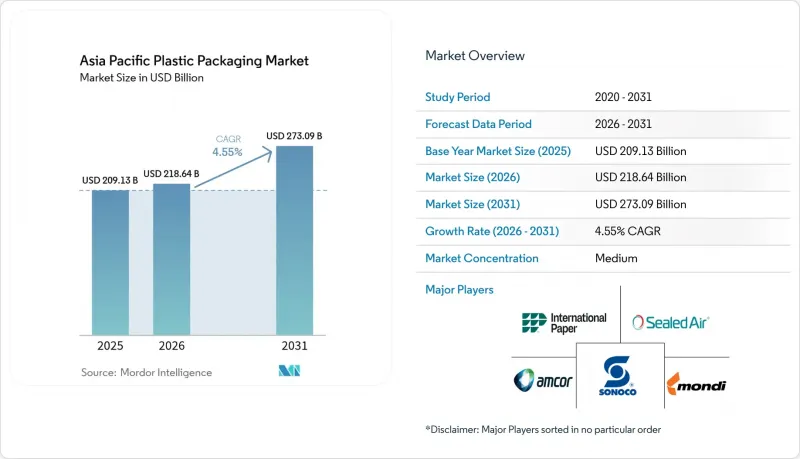
This report is Segmented by Material Type (Polyethylene, Polypropylene, and More), Packaging Type (Flexible, and Rigid), Product Form (Bottles and Jars, Trays and Containers, and More), End-User Industry (Food, Beverage, Pharmaceuticals and Healthcare, and More), Manufacturing Process (Extrusion, and More), and Country. The Market Forecasts are Provided in Terms of Value (USD).
Asia Pacific Plastic Packaging Market Trends and Insights
E-commerce boom demanding lightweight, damage-resistant packs
Rapid parcel growth obliges converters to engineer packaging that survives multiple handling points without inflating freight costs. Beverage producers in Thailand adopted label-free PET bottles during 2024 to facilitate automated sortation in fulfillment centers. Nanoclay-enhanced barrier films enable 30-50% weight reduction versus conventionally laminated formats, lowering material outlay while retaining integrity. Specialized PE and PP grades with superior impact resistance now dominate electronics shipments, whereas platform operators publish stringent drop-test standards that favor suppliers offering proven compression strength.
Growing organised retail and convenience-food penetration
Expansion of modern trade in India, Vietnam, and Indonesia lifts demand for shelf-stable, aesthetic packs calibrated for fluorescent store lighting. Vietnam's pharmaceutical investments by SK Group and Samil Pharmaceutical illustrate how formal retail elevates packaging standardization. High-barrier BOPP and metallized BOPET films replace foil, ensuring oxygen and moisture defense while improving recyclability. Portion-controlled dairy and ready meals benefit from cold-chain compatible laminates, and consolidated retailers enable converters to spread fixed costs across larger order volumes.
Escalating single-use-plastic bans and EPR fees
Singapore's beverage-container deposit scheme launching in 2026 imposes a USD 0.10 levy per unit, inflating pack costs and re-routing consumer demand toward refill options. Differing EPR fee structures across ASEAN complicate harmonized pack designs and spur compliant firms to absorb higher resin substitution and testing expenses, squeezing margins versus unregulated competitors.
Other drivers and restraints analyzed in the detailed report include:
- Shelf-life extension via advanced barrier films
- Sachet-to-refill transition programs in ASEAN
- Volatile crude-linked resin prices
For complete list of drivers and restraints, kindly check the Table Of Contents.
Segment Analysis
Polyethylene held 38.20% Asia-Pacific plastic packaging market share in 2025 through cost-effective versatility across films, bottles, and closures. PET is marching at 5.24% CAGR, buoyed by enzymatic depolymerization partnerships such as Wankai-Carbios targeting 50,000 t/y rPET output in China. PET's hot-fill capable bottles displace glass in condiments, improving logistics safety and carbon footprints. Polypropylene sustains niches demanding high-heat tolerance, while biodegradable polymers and paper laminates secure premium, regulation-driven slots armed with ISO 17088 certifications.
Continued PE price competitiveness keeps legacy lines running, yet EPR-driven design shifts favor PET mono-material loops thanks to bottle-to-bottle infrastructure. Oxygen-scavenging additives enhance PET's barrier, and bottle flake supply closes as brand recycled-content pledges trigger Tender-based purchasing. PE producers explore high-density grades blended with metallized strip layers to protect aroma-sensitive goods, seeking parity with PET while safeguarding recyclability.
Flexible formats commanded 54.30% Asia-Pacific plastic packaging market size in 2025, scaling at 6.65% CAGR as converters strip weight and move toward mono-material laminates per Huhtamaki India's Design for Recycling Guidance. Eliminating aluminum foil and PVC additives unlocks mechanical recycling streams. Rigid containers remain essential for carbonated beverages and personal-care pumps where dimensional accuracy and impact resistance outweigh material-use advantage.
Consumer gravitation to on-the-go snacks and home-delivery meals boosts stand-up pouch volumes, while rigid HDPE bottles gain traction in refill stations supporting controlled reuse cycles. Brand owners pilot QR-enabled pouches that direct consumers to collection points, closing data gaps on post-use material flow. Parallel investment in delamination tech aims to salvage high-value barrier layers, offering flexible packs a path toward parity with bottle recycling rates.
Complete Report Scope:
- By Material Type
- Polyethylene (PE)
- Polypropylene (PP)
- Polyethylene Terephthalate (PET)
- Polystyrene and EPS
- Other Material Types
- By Packaging Type
- Flexible Plastic Packaging
- Rigid Plastic Packaging
- By Product Form
- Bottles and Jars
- Trays and Containers
- Pouches and Sachets
- Bags and Sacks
- Films and Wraps
- Other Product Forms
- By End-User Industry
- Food
- Beverage
- Pharmaceuticals and Healthcare
- Cosmetics and Personal Care
- Industrial
- Other End-user Industries
- By Manufacturing Process
- Extrusion
- Injection Molding
- Blow Molding
- Thermoforming
- By Country
- China
- India
- Japan
- South Korea
- Australia
- Rest of Asia Pacific
List of Companies Covered in this Report:
- Amcor plc
- Mondi plc
- Sonoco Products Company
- International Paper Company
- Sealed Air Corporation
- Huhtamaki Oyj
- ALPLA-Werke Alwin Lehner GmbH and Co KG
- Uflex Ltd.
- Plastipak Holdings Inc.
- Pactiv Evergreen Inc.
- Winpak Ltd.
- Toyo Seikan Group Holdings Ltd.
- Nihon Yamamura Glass Co., Ltd.
- Manjushree Technopack Ltd.
- Time Technoplast Ltd.
- Greif Inc.
- IFCO Systems GmbH
- Dynapack Asia Sdn Bhd
- Cheng Loong Corp.
Additional Benefits:
- The market estimate (ME) sheet in Excel format
- 3 months of analyst support
TABLE OF CONTENTS
1 INTRODUCTION
- 1.1 Study Assumptions and Market Definition
- 1.2 Scope of the Study
2 RESEARCH METHODOLOGY
3 EXECUTIVE SUMMARY
4 MARKET LANDSCAPE
- 4.1 Market Overview
- 4.2 Market Drivers
- 4.2.1 E-commerce boom demanding lightweight, damage-resistant packs
- 4.2.2 Growing organised retail and convenience-food penetration
- 4.2.3 Shelf-life extension via advanced barrier films
- 4.2.4 Sachet-to-Refill" transition programmes in ASEAN
- 4.2.5 AI-enabled converting lines boosting small-lot customisation
- 4.2.6 Corporate green-bond funding tied to recycled-content KPIs
- 4.3 Market Restraints
- 4.3.1 Escalating single-use-plastic bans and EPR fees
- 4.3.2 Volatile crude-linked resin prices
- 4.3.3 PE and PP structural oversupply depressing converter margins
- 4.3.4 Traceability gaps limiting rPET food-grade uptake
- 4.4 Industry Value Chain Analysis
- 4.5 Regulatory Landscape
- 4.6 Technological Outlook
- 4.7 Porter's Five Forces Analysis
- 4.7.1 Bargaining Power of Suppliers
- 4.7.2 Bargaining Power of Buyers
- 4.7.3 Threat of New Entrants
- 4.7.4 Threat of Substitute Products
- 4.7.5 Intensity of Competitive Rivalry
- 4.8 Impact of Macroeconomic Factors on the Market
5 MARKET SIZE AND GROWTH FORECASTS(VALUE)
- 5.1 By Material Type
- 5.1.1 Polyethylene (PE)
- 5.1.2 Polypropylene (PP)
- 5.1.3 Polyethylene Terephthalate (PET)
- 5.1.4 Polystyrene and EPS
- 5.1.5 Other Material Types
- 5.2 By Packaging Type
- 5.2.1 Flexible Plastic Packaging
- 5.2.2 Rigid Plastic Packaging
- 5.3 By Product Form
- 5.3.1 Bottles and Jars
- 5.3.2 Trays and Containers
- 5.3.3 Pouches and Sachets
- 5.3.4 Bags and Sacks
- 5.3.5 Films and Wraps
- 5.3.6 Other Product Forms
- 5.4 By End-User Industry
- 5.4.1 Food
- 5.4.2 Beverage
- 5.4.3 Pharmaceuticals and Healthcare
- 5.4.4 Cosmetics and Personal Care
- 5.4.5 Industrial
- 5.4.6 Other End-user Industries
- 5.5 By Manufacturing Process
- 5.5.1 Extrusion
- 5.5.2 Injection Molding
- 5.5.3 Blow Molding
- 5.5.4 Thermoforming
- 5.6 By Country
- 5.6.1 China
- 5.6.2 India
- 5.6.3 Japan
- 5.6.4 South Korea
- 5.6.5 Australia
- 5.6.6 Rest of Asia Pacific
6 COMPETITIVE LANDSCAPE
- 6.1 Market Concentration
- 6.2 Strategic Moves and Investments
- 6.3 Market Share Analysis
- 6.4 Company Profiles (includes Global level Overview, Market level overview, Core Segments, Financials as available, Strategic Information, Market Rank/Share for key companies, Products and Services, and Recent Developments)
- 6.4.1 Amcor plc
- 6.4.2 Mondi plc
- 6.4.3 Sonoco Products Company
- 6.4.4 International Paper Company
- 6.4.5 Sealed Air Corporation
- 6.4.6 Huhtamaki Oyj
- 6.4.7 ALPLA-Werke Alwin Lehner GmbH and Co KG
- 6.4.8 Uflex Ltd.
- 6.4.9 Plastipak Holdings Inc.
- 6.4.10 Pactiv Evergreen Inc.
- 6.4.11 Winpak Ltd.
- 6.4.12 Toyo Seikan Group Holdings Ltd.
- 6.4.13 Nihon Yamamura Glass Co., Ltd.
- 6.4.14 Manjushree Technopack Ltd.
- 6.4.15 Time Technoplast Ltd.
- 6.4.16 Greif Inc.
- 6.4.17 IFCO Systems GmbH
- 6.4.18 Dynapack Asia Sdn Bhd
- 6.4.19 Cheng Loong Corp.
7 MARKET OPPORTUNITIES AND FUTURE OUTLOOK
- 7.1 White-Space and Unmet-Need Assessment

