PUBLISHER: Mordor Intelligence | PRODUCT CODE: 2121518

PUBLISHER: Mordor Intelligence | PRODUCT CODE: 2121518
United Kingdom Plastic Packaging - Market Share Analysis, Industry Trends & Statistics, Growth Forecasts (2026 - 2031)
According to Mordor Intelligence, the United Kingdom plastic packaging market size in 2026 is estimated at USD 23.3 billion, growing from 2025 value of USD 22.71 billion with 2031 projections showing USD 26.49 billion, growing at 2.6% CAGR over 2026-2031.
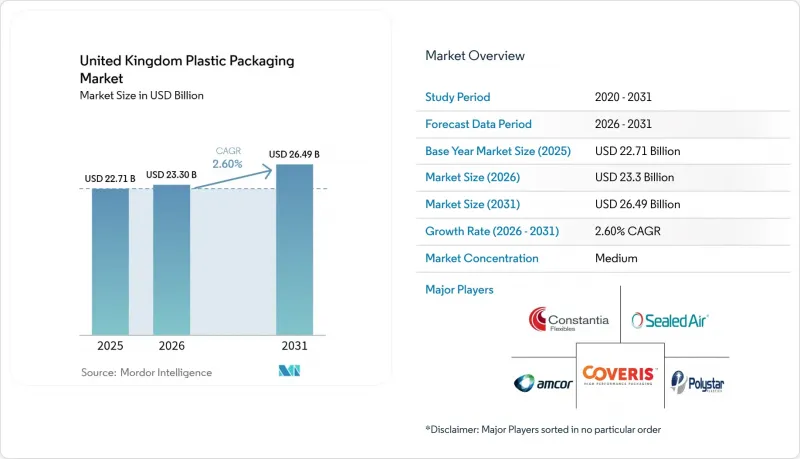
This report is Segmented by Material Type (Polyethylene, Polypropylene, and More), Packaging Type (Flexible, and Rigid), Product Form (Bottles and Jars, Trays and Containers, and More), End-User Industry (Food, Beverage, Pharmaceuticals and Healthcare, and More), Manufacturing Process (Extrusion, Injection Molding, and More). The Market Forecasts are Provided in Terms of Value (USD).
United Kingdom Plastic Packaging Market Trends and Insights
Rising Demand for Lightweight Convenience Formats
Urban consumers prioritize portability and portion control, encouraging 15-20% material reductions versus legacy rigid packs. Single-dose formats extend from snacks to pharmaceuticals, lowering contamination risk while boosting adherence. Coveris introduced its MonoFlexBP resealable tray line in September 2025, merging easy-open functionality with curbside recyclability. Aging populations and busier lifestyles sustain demand for formats that trade bulk economics for usability, supporting steady margin expansion for converters that optimize downgauging.
Growth in E-commerce Protective Packaging
Online order volumes are subject packs to high compression, puncture, and drop forces across multiple shipping cycles. Engineered films and void-fill systems balance strength with dimensional-weight savings, cutting freight costs and damage claims. TekniPlex Healthcare's March 2025 capacity boost targets temperature-controlled and tamper-evident pharma shipments, underscoring channel-specific needs. Logistics-optimized designs translate directly into customer satisfaction metrics and repeat-purchase propensity.
Volatile Resin Prices Linked to Energy Costs
Ethylene and propylene production accounts for roughly 60-70% of cracker operating costs, so swings in natural-gas inputs distort converter margins. The British Plastics Federation recorded pronounced PE and PP price turbulence in July 2025, forcing buyers to adopt hedging tools and shorter contracts that raise administrative burden. Importers face dual exposure to euro and U.S.-dollar swings against sterling, complicating cost forecasting and inventory strategies.
Other drivers and restraints analyzed in the detailed report include:
- Uptake of Recycled-Content Plastics Under 30% Tax
- Chemical Recycling Capacity Scale-Up
- Single-Use Plastics Regulations
For complete list of drivers and restraints, kindly check the Table Of Contents.
Segment Analysis
Polyethylene, spanning LDPE, LLDPE, and HDPE grades, retained 38.74 of % United Kingdom plastic packaging market share in 2025 because of processing ease and cost-performance balance in films. Polyethylene terephthalate is on course for a 3.41% CAGR with beverage lightweighting and ready-meal trays fueling demand. Converters value PET's clarity and gas barrier, paying the premium for thinner walls and hotter-fill tolerance. Mechanical recycling rates favor clear PET, catalyzing brand commitments to food-grade rPET integration. Polypropylene's colored variants lag recycling advances, limiting volume growth. Polystyrene use wanes under disposability scrutiny, while engineered resins and emerging biopolymers occupy specialized niches where functional gains justify higher costs.
Recycled-content mandates push polyolefin advancements such as odor-removal additives and compatibilizers that elevate post-consumer blend quality. Innovia Films debuted a PVC-free coater in April 2025 to eliminate halogen concerns while protecting oxygen-sensitive foods. Long term, material portfolios will reflect a disciplined trade-off between regulatory risk, circularity credentials, and application-specific performance needs within the United Kingdom plastic packaging market.
Flexible solutions delivered 55.32% revenue in 2025 and are projected to achieve a 3.71% CAGR to 2031. A single auto-form seal pouch can cut material use by up to 70% versus a comparable rigid option, reducing freight emissions and waste-handling charges. Coveris's August 2025 MonoFlex Thermoform pack for tortillas extends mono-material flexibles into categories once dominated by rigid trays.
Rigid containers remain relevant for carbonated beverages, fragrances, and heavy-duty chemicals requiring stand-up stability and tamper resistance, yet landfill levies and Extended Producer Responsibility fees constrain growth. As multilayer film recycling technologies mature, flexible adoption is expected to permeate cosmetics and household cleaners, accelerating the United Kingdom plastic packaging market transition toward leaner supply chains.
Complete Report Scope:
- By Material Type
- Polyethylene (PE)
- Polypropylene (PP)
- Polyethylene Terephthalate (PET)
- Polystyrene and EPS
- Other Material Types
- By Packaging Type
- Flexible Plastic Packaging
- Rigid Plastic Packaging
- By Product Form
- Bottles and Jars
- Trays and Containers
- Pouches and Sachets
- Bags and Sacks
- Films and Wraps
- Other Product Forms
- By End-User Industry
- Food
- Beverage
- Pharmaceuticals and Healthcare
- Cosmetics and Personal Care
- Industrial
- Other End-user Industries
- By Manufacturing Process
- Extrusion
- Injection Molding
- Blow Molding
- Thermoforming
- Other Manufacturing Processes
List of Companies Covered in this Report:
- Amcor plc
- Sealed Air Corporation
- Coveris Holdings SA
- Constantia Flexibles GmbH
- ALPLA Werke Alwin Lehner GmbH and Co KG
- Polystar Plastics Ltd
- Coda Plastics Ltd
- Charpak Ltd
- Wipak UK Ltd
- Sonoco Products Company
- Tyler Packaging Ltd (Macfarlane Group plc)
- National Flexible Ltd
- Clifton Packaging Group Ltd
- Greiner Packaging International GmbH
- Klockner Pentaplast Ltd
- International Paper Company
- Mondi plc
- Plastipak Packaging Ltd
Additional Benefits:
- The market estimate (ME) sheet in Excel format
- 3 months of analyst support
TABLE OF CONTENTS
1 INTRODUCTION
- 1.1 Study Assumptions and Market Definition
- 1.2 Scope of the Study
2 RESEARCH METHODOLOGY
3 EXECUTIVE SUMMARY
4 MARKET LANDSCAPE
- 4.1 Market Overview
- 4.2 Market Drivers
- 4.2.1 Rising demand for lightweight convenience formats
- 4.2.2 Growth in e-commerce protective packaging
- 4.2.3 Uptake of recycled-content plastics under 30 % tax
- 4.2.4 Chemical-recycling capacity scale-up
- 4.2.5 UK Plastics Packaging Tax accelerating adoption
- 4.2.6 Mono-material high-barrier films for curbside recycling
- 4.3 Market Restraints
- 4.3.1 Volatile resin prices linked to energy costs
- 4.3.2 Single-use plastics regulations
- 4.3.3 Retailer refill/re-use pilots reducing primary packs
- 4.3.4 Micro-plastics backlash impacting recycled feedstock
- 4.4 Industry Value Chain Analysis
- 4.5 Regulatory Landscape
- 4.6 Technological Outlook
- 4.7 Impact of Macroeconomic Factors on the Market
- 4.8 Porters Five Forces Analysis
- 4.8.1 Threat of New Entrants
- 4.8.2 Bargaining Power of Buyers
- 4.8.3 Bargaining Power of Suppliers
- 4.8.4 Threat of Substitutes
- 4.8.5 Intensity of Competitive Rivalry
5 MARKET SIZE AND GROWTH FORECASTS (VALUE)
- 5.1 By Material Type
- 5.1.1 Polyethylene (PE)
- 5.1.2 Polypropylene (PP)
- 5.1.3 Polyethylene Terephthalate (PET)
- 5.1.4 Polystyrene and EPS
- 5.1.5 Other Material Types
- 5.2 By Packaging Type
- 5.2.1 Flexible Plastic Packaging
- 5.2.2 Rigid Plastic Packaging
- 5.3 By Product Form
- 5.3.1 Bottles and Jars
- 5.3.2 Trays and Containers
- 5.3.3 Pouches and Sachets
- 5.3.4 Bags and Sacks
- 5.3.5 Films and Wraps
- 5.3.6 Other Product Forms
- 5.4 By End-User Industry
- 5.4.1 Food
- 5.4.2 Beverage
- 5.4.3 Pharmaceuticals and Healthcare
- 5.4.4 Cosmetics and Personal Care
- 5.4.5 Industrial
- 5.4.6 Other End-user Industries
- 5.5 By Manufacturing Process
- 5.5.1 Extrusion
- 5.5.2 Injection Molding
- 5.5.3 Blow Molding
- 5.5.4 Thermoforming
- 5.5.5 Other Manufacturing Processes
6 COMPETITIVE LANDSCAPE
- 6.1 Market Concentration
- 6.2 Strategic Moves
- 6.3 Market Share Analysis
- 6.4 Company Profiles {(includes Global level Overview, Market level overview, Core Segments, Financials as available, Strategic Information, Market Rank/Share for key companies, Products and Services, and Recent Developments)}
- 6.4.1 Amcor plc
- 6.4.2 Sealed Air Corporation
- 6.4.3 Coveris Holdings SA
- 6.4.4 Constantia Flexibles GmbH
- 6.4.5 ALPLA Werke Alwin Lehner GmbH and Co KG
- 6.4.6 Polystar Plastics Ltd
- 6.4.7 Coda Plastics Ltd
- 6.4.8 Charpak Ltd
- 6.4.9 Wipak UK Ltd
- 6.4.10 Sonoco Products Company
- 6.4.11 Tyler Packaging Ltd (Macfarlane Group plc)
- 6.4.12 National Flexible Ltd
- 6.4.13 Clifton Packaging Group Ltd
- 6.4.14 Greiner Packaging International GmbH
- 6.4.15 Klockner Pentaplast Ltd
- 6.4.16 International Paper Company
- 6.4.17 Mondi plc
- 6.4.18 Plastipak Packaging Ltd
7 MARKET OPPORTUNITIES AND FUTURE OUTLOOK
- 7.1 White-space and Unmet-need Assessment

