PUBLISHER: Mordor Intelligence | PRODUCT CODE: 2121522

PUBLISHER: Mordor Intelligence | PRODUCT CODE: 2121522
3D Printing Materials - Market Share Analysis, Industry Trends & Statistics, Growth Forecasts (2026 - 2031)
According to Mordor Intelligence, the 3D printing materials market size is estimated at USD 3.02 billion in 2026, and is expected to reach USD 8.24 billion by 2031, at a CAGR of 22.23% during the forecast period (2026-2031).
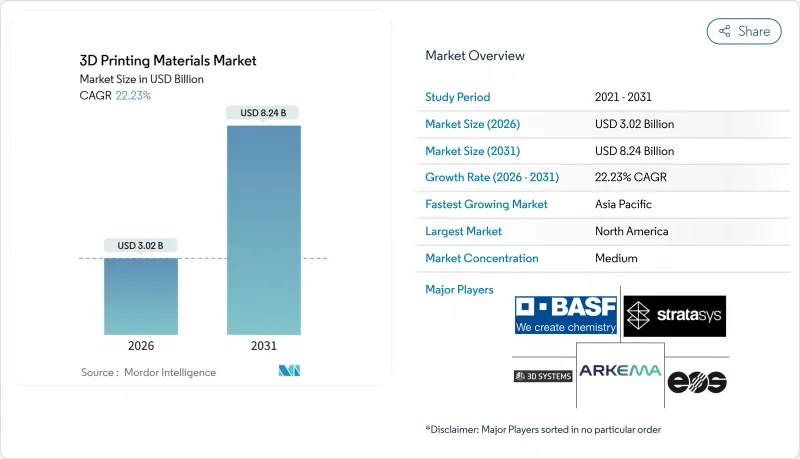
This report is Segmented by Material Type (Plastics [ABS, PLA, Nylon, Polyamide, Polycarbonate, and Other Plastics], Metals, Ceramics, and Other Materials), Form (Powder, Filament, and Liquid/Resin), End-User Industry (Aerospace and Defense, and More), and Geography (Asia-Pacific, North America, Europe, South America, and Middle-East and Africa). Market Forecasts are Provided in Terms of Value (USD).
Global 3D Printing Materials Market Trends and Insights
Surge in Metal Powder Usage for Serial Aerospace and Medical Production
Aerospace giants are now certifying flight-critical components, such as turbine blades and brackets, transitioning titanium and aluminum powders from design labs to production lines. In the medical sector, producers are ramping up their use of cobalt-chrome powders for hip and knee implants. Suppliers are prioritizing batch consistency and oxygen thresholds over price, thereby strengthening their quality-assurance edge. Printed titanium brackets, being lighter than their machined counterparts, offer lifetime fuel savings that counterbalance a material-cost premium. Meanwhile, ASTM F42's standards on particle size and purity are setting high entry barriers, confining newcomers to niche applications.
Rapid Advances in High-Performance Polymers
Polyetheretherketone (PEEK) and polyetherketoneketone (PEKK) are replacing metals in applications where sterilizability and flame resistance take precedence over weight considerations. Arkema's Kepstan PEKK can endure continuous exposure to high temperatures, making it ideal for surgical trays that can withstand repeated autoclave cycles. Victrex boosted its PEEK shipments, targeting aerospace cabins and spinal implants that comply with FAA flammability standards, all without the need for additional coatings. Material suppliers are now certifying resins directly with end-users, sidestepping printer OEMs. This approach has notably reduced the qualification process timeline. Even with a high price tag, PEEK's adoption is on the rise, driven by its long-term performance benefits that overshadow the initial cost. Meanwhile, mid-tier polymers are carving out a niche, bridging the divide between commodity nylons and premium aerospace grades, thus broadening the market's addressable demand.
High Equipment and Material Cost
Industrial metal printers are expensive, and PEEK filament is significantly more costly than commodity ABS. Despite the favorable economics for producing limited units annually, mid-tier manufacturers in emerging markets are hesitant to adopt these technologies. HP's Multi Jet Fusion has seen its uptake predominantly among contract manufacturers rather than end-users. Furthermore, subscription models that combine powders with engineering support require multi-year commitments. This poses a challenge for smaller firms, leading to a divided market: while cash-rich OEMs expand, prototypers find themselves at a standstill.
Other drivers and restraints analyzed in the detailed report include:
- Automotive Lightweighting Initiatives
- Mass-Customization Momentum in Healthcare and Consumer Goods
- Stringent Certification for Aerospace and Medical Grades
For complete list of drivers and restraints, kindly check the Table Of Contents.
Segment Analysis
Metals expanded faster than any other category, and they are set to close the gap with plastics, which held a 47.78% share in 2025. Titanium alloys dominate aerospace brackets, turbine blades, and fuel nozzles, while aluminum alloys such as AlSi10Mg underpin automotive lightweighting programs. Cobalt-chrome powders are now routine for hip and knee replacements as surgeons report reduced revision surgeries. The 3D printing materials market size for metals is forecast to grow at a 23.34% CAGR through 2031 as certifications accumulate. Plastics remain core in desktop prototyping thanks to sub-USD 30 ABS and PLA. Nevertheless, high-performance polymers like PEEK, PEKK, and nylon 12 are displacing metals in cabin interiors and surgical instruments where sterilizability and flame retardance are critical.
The long-run portfolio mix will favor suppliers that straddle commodity filaments and aerospace-grade powders. Larger vendors hold ASTM and ISO credentials across multiple geographic zones, lowering customer onboarding costs. Ceramics, still a niche, gain relevance in dental crowns and high-temperature tooling. Waxes and binder agents comprise a small volume yet remain critical for investment casting, showcasing the breadth of demand within the 3D printing materials market.
Complete Report Scope:
- By Material Type
- Plastics
- Acrylonitrile Butadiene Styrene (ABS)
- Polylactic Acid (PLA)
- Nylon
- Polyamide
- Polycarbonate
- Other Plastics (Composites, Biodegradable Polymers, etc.)
- Metals
- Ceramics
- Other Materials (Gases, Waxes)
- Plastics
- By Form
- Powder
- Filament
- Liquid / Resin
- By End-user Industry
- Aerospace and Defense
- Automotive
- Medical
- Consumer Electronics
- Other End-user Industries (Energy and Power, Industrial Machinery, etc.)
- By Geography
- Asia-Pacific
- China
- Japan
- South Korea
- India
- Singapore
- Rest of Asia-Pacific
- North America
- United States
- Canada
- Mexico
- Europe
- Germany
- United Kingdom
- France
- Italy
- Russia
- Rest of Europe
- South America
- Brazil
- Argentina
- Rest of South America
- Middle-East and Africa
- Saudi Arabia
- South Africa
- Rest of Middle-East and Africa
- Asia-Pacific
Geography Analysis
North America maintained a 39.52% share in 2025, leveraging deep aerospace and medical ecosystems and federally funded programs such as America Makes that subsidize material qualification and workforce curricula. U.S. aerospace primes, Canadian engine builders, and Mexican automotive maquiladoras collectively sustain steady demand. Growth remains positive yet slower than Asia-Pacific, hinting that first-mover advantage is plateauing.
Asia-Pacific commands the fastest trajectory with a 26.78% CAGR through 2031. China's Ministry of Industry and Information Technology invested in new titanium and aluminum powder capacity, tightening domestic supply chains and reducing reliance on Western imports. India incentivizes patient-specific orthopedic implants, placing cobalt-chrome powder within reach of regional manufacturers. Japan and South Korea incorporate high-performance polymers into electronics and shipbuilding, while Singapore positions itself as a certification and research and development hub tailor-made for tropical climates. As a result, Asia-Pacific is transitioning from a demand center to a supply powerhouse, reshaping trade flows in the 3D printing materials market.
Europe's growth is anchored by German automotive leaders and by France-based Airbus adopting printed titanium brackets in fuselages. The EU Circular Economy Action Plan accelerates recycled-powder standards and biodegradable polymers, reinforcing sustainability credentials. South America and the Middle East remain emerging, yet Brazil's Embraer and Saudi defense contractors pilot additive approaches, signaling long-term upside. Continuous investment in standards, recycling, and regional capacity will determine whether incumbents hold share or cede ground to new entrants.
- 3D Systems, Inc.
- Arkema
- BASF
- CRP TECHNOLOGY S.r.l.
- Custom Resin Solutions
- EnvisionTEC US LLC
- EOS GmbH
- Evonik Industries AG
- General Electric Company
- Henkel AG & Co. KGaA
- Hoganas AB
- HP Development Company, L.P.
- Materialise
- Renishaw plc
- Sandvik AB
- Solvay
- Stratasys
- voxeljet AG
Additional Benefits:
- The market estimate (ME) sheet in Excel format
- 3 months of analyst support
TABLE OF CONTENTS
1 Introduction
- 1.1 Study Assumptions and Market Definition
- 1.2 Scope of the Study
2 Research Methodology
3 Executive Summary
4 Market Landscape
- 4.1 Market Overview
- 4.2 Market Drivers
- 4.2.1 Surge in metal powder usage for serial aerospace and medical production
- 4.2.2 Rapid advances in high-performance polymers
- 4.2.3 Automotive lightweighting initiatives
- 4.2.4 Mass-customization momentum in healthcare and consumer goods
- 4.2.5 Regulatory push for on-demand spare-part inventories (defense, rail)
- 4.3 Market Restraints
- 4.3.1 High equipment and material cost
- 4.3.2 Stringent certification for aerospace and medical grades
- 4.3.3 Nanoparticle emission and waste-powder disposal concerns
- 4.4 Value Chain Analysis
- 4.5 Porter's Five Forces
- 4.5.1 Bargaining Power of Suppliers
- 4.5.2 Bargaining Power of Buyers
- 4.5.3 Threat of New Entrants
- 4.5.4 Threat of Substitutes
- 4.5.5 Degree of Competition
5 Market Size and Growth Forecasts (Value)
- 5.1 By Material Type
- 5.1.1 Plastics
- 5.1.1.1 Acrylonitrile Butadiene Styrene (ABS)
- 5.1.1.2 Polylactic Acid (PLA)
- 5.1.1.3 Nylon
- 5.1.1.4 Polyamide
- 5.1.1.5 Polycarbonate
- 5.1.1.6 Other Plastics (Composites, Biodegradable Polymers, etc.)
- 5.1.2 Metals
- 5.1.3 Ceramics
- 5.1.4 Other Materials (Gases, Waxes)
- 5.1.1 Plastics
- 5.2 By Form
- 5.2.1 Powder
- 5.2.2 Filament
- 5.2.3 Liquid / Resin
- 5.3 By End-user Industry
- 5.3.1 Aerospace and Defense
- 5.3.2 Automotive
- 5.3.3 Medical
- 5.3.4 Consumer Electronics
- 5.3.5 Other End-user Industries (Energy and Power, Industrial Machinery, etc.)
- 5.4 By Geography
- 5.4.1 Asia-Pacific
- 5.4.1.1 China
- 5.4.1.2 Japan
- 5.4.1.3 South Korea
- 5.4.1.4 India
- 5.4.1.5 Singapore
- 5.4.1.6 Rest of Asia-Pacific
- 5.4.2 North America
- 5.4.2.1 United States
- 5.4.2.2 Canada
- 5.4.2.3 Mexico
- 5.4.3 Europe
- 5.4.3.1 Germany
- 5.4.3.2 United Kingdom
- 5.4.3.3 France
- 5.4.3.4 Italy
- 5.4.3.5 Russia
- 5.4.3.6 Rest of Europe
- 5.4.4 South America
- 5.4.4.1 Brazil
- 5.4.4.2 Argentina
- 5.4.4.3 Rest of South America
- 5.4.5 Middle-East and Africa
- 5.4.5.1 Saudi Arabia
- 5.4.5.2 South Africa
- 5.4.5.3 Rest of Middle-East and Africa
- 5.4.1 Asia-Pacific
6 Competitive Landscape
- 6.1 Market Concentration
- 6.2 Strategic Moves
- 6.3 Market Share (%)/Ranking Analysis
- 6.4 Company Profiles (includes Global-level Overview, Market-level Overview, Core Segments, Financials as available, Strategic Information, Products and Services, and Recent Developments)
- 6.4.1 3D Systems, Inc.
- 6.4.2 Arkema
- 6.4.3 BASF
- 6.4.4 CRP TECHNOLOGY S.r.l.
- 6.4.5 Custom Resin Solutions
- 6.4.6 EnvisionTEC US LLC
- 6.4.7 EOS GmbH
- 6.4.8 Evonik Industries AG
- 6.4.9 General Electric Company
- 6.4.10 Henkel AG & Co. KGaA
- 6.4.11 Hoganas AB
- 6.4.12 HP Development Company, L.P.
- 6.4.13 Materialise
- 6.4.14 Renishaw plc
- 6.4.15 Sandvik AB
- 6.4.16 Solvay
- 6.4.17 Stratasys
- 6.4.18 voxeljet AG
7 Market Opportunities and Future Outlook
- 7.1 White-space and Unmet-Need Assessment
- 7.2 Introduction of New Materials such as Graphene Enabling New Applications
- 7.3 Adoption of 3D Printing Technology in Home Printing

