PUBLISHER: Mordor Intelligence | PRODUCT CODE: 2121560

PUBLISHER: Mordor Intelligence | PRODUCT CODE: 2121560
Acrylic Fiber - Market Share Analysis, Industry Trends & Statistics, Growth Forecasts (2026 - 2031)
According to Mordor Intelligence, the acrylic fiber market size was valued at 1.57 Million tons in 2025 and estimated to grow from 1.62 Million tons in 2026 to reach 1.88 Million tons by 2031, at a CAGR of 3.07% during the forecast period (2026-2031).
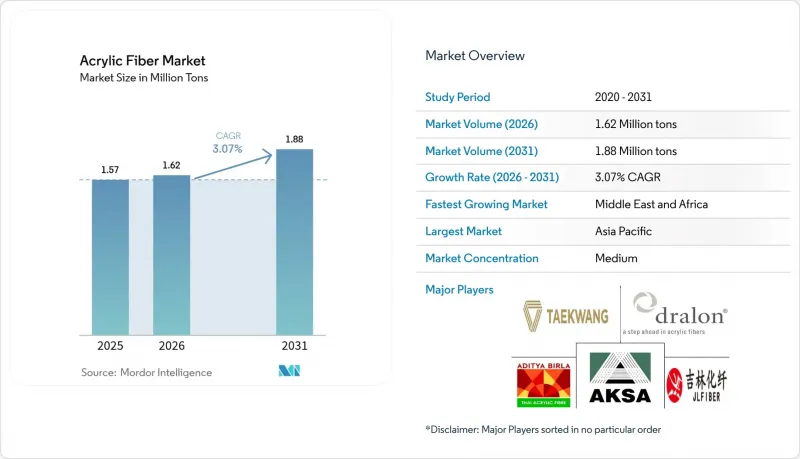
This report is Segmented by Form (Staple and Filament), Blending (Wool Blend, Cotton Blend, and Other Blendings), End-User Industry (Apparel, Household Furnishing, Industrial, and Other End-User Industries), and Geography (Asia-Pacific, North America, Europe, South America, and Middle East and Africa). The Market Forecasts are Provided in Terms of Volume (Tons).
Global Acrylic Fiber Market Trends and Insights
High Demand for Wool-Like Properties in Apparel
Fashion brands favor acrylic's ability to mimic wool's crimp, warmth, and softness while offering improved colorfastness and easy care. Bicomponent spinning now enables cashmere-like deniers that appeal to the premium casual category. Asian producers capitalize on integrated supply chains to supply finer denier yarns efficiently. In parallel, animal-welfare concerns reinforce demand for synthetic alternatives that meet the tactile expectations of knitwear consumers. The resulting pull effect underpins stable apparel volume even as competing synthetics proliferate.
Growth in Home-Furnishing and Carpeting Demand
Commercial construction rebounds and higher renovation rates sustain acrylic demand in upholstery, drapery, and contract carpeting. Built-in flame retardancy and UV stability suit hospitality and healthcare interiors that require stringent safety compliance. Solution-dyed acrylic's vivid colorfastness commands premium decorative applications, although cost-efficient polyester continues to erode share in residential broadloom. Building codes favor inherently flame-retardant fibers, supporting acrylic adoption in public spaces where natural fibers fall short.
Competition from Cost-Efficient Polyester and Blends
Solution-dyed PET carpets outcompete acrylic on stain resistance and raw-material costs, prompting major U.S. mills to convert lines to PET. Polyester's mature mechanical and chemical recycling infrastructure also strengthens its eco-profile relative to acrylic. Activewear and budget knitwear increasingly shift to polyester blends that match acrylic's thermal properties at lower cost, squeezing acrylic's share in entry-level price tiers.
Other drivers and restraints analyzed in the detailed report include:
- Increasing Industrial and Filtration Applications
- High-Bulk Acrylic Innovations for Lightweight Insulation
- Stringent Environmental Rules on ACN Emissions
For complete list of drivers and restraints, kindly check the Table Of Contents.
Segment Analysis
Staple fiber held 60.78% of the acrylic fiber market in 2025 and is forecast to grow at 3.71% CAGR through 2031. The segment benefits from widespread ring- and open-end-spinning capacity able to process a broad linear-density range, supporting large-volume apparel and home-textile orders. Finer denier advances help staple compete in cashmere-touch knitwear lines, expanding its premium footprint and cushioning price pressures.
Filament accounts for the balance of volume and serves narrow industrial and specialty-fabric niches such as outdoor awnings and flame-retardant uniforms. Although its CAGR trails staple, filament demand remains sticky where continuous-filament strength and even dye uptake are critical. Broader acceptance of solution-dyed technologies may unlock incremental growth, yet current competitiveness relies on niche differentiation rather than scale.
Complete Report Scope:
- By Form
- Staple
- Filament
- By Blending
- Wool Blend
- Cotton Blend
- Other Blendings (Cellulose)
- By End-user Industry
- Apparel
- Household Furnishing
- Industrial
- Other End-user Industries (Upholstery)
- By Geography
- Asia-Pacific
- China
- India
- Japan
- South Korea
- ASEAN Countries
- Rest of Asia-Pacific
- North America
- United States
- Canada
- Mexico
- Europe
- Germany
- United Kingdom
- France
- Italy
- Russia
- NORDIC Countries
- Rest of Europe
- South America
- Brazil
- Argentina
- Rest of South America
- Middle East and Africa
- Saudi Arabia
- South Africa
- Rest of Middle East and Africa
- Asia-Pacific
Geography Analysis
Asia-Pacific generated 68.10% of global volume in 2025, underpinned by China's integrated naphtha-to-ACN chains and a robust downstream textile cluster. Continuous capacity additions in acrylonitrile, sometimes leveraging propane dehydrogenation routes, keep regional cash costs competitive even amid volatile propylene fundamentals. Export-oriented garment hubs in Vietnam and Bangladesh further anchor regional offtake, and regional mills increasingly target recycled-content orders to satisfy Western retailer mandates.
North America and Europe together hold under one-quarter of global volume yet excel in technical-textile innovation and sustainability compliance. U.S. demand concentrates on industrial-filtration and outdoor-performance apparel, while EU mills pivot toward recycled-acrylic and specialty filament lines that fetch higher margins. High energy prices pressure European cost curves, but near-market sourcing and stringent eco-standards sustain a resilient premium-goods niche.
Middle East and Africa is projected to grow at 3.63% CAGR through 2031. Petrochemical investments in Saudi Arabia, Egypt, and the United Arab Emirates aim to monetize abundant propane and circumvent ACN import dependence. Tailored free-zone incentives encourage downstream spinning and knitting clusters, though talent gaps and supply-chain immaturity still temper ramp-up speed. South America continues as a modest consumption basin tethered to domestic textile cycles; its producers focus on capturing regional trade bloc opportunities while mitigating currency volatility.
- Aditya Birla Group (Thai Acrylic Fiber)
- Aksa Akrilik Kimya Sanayii A.S.
- Asahi Kasei Corporation
- Birlacril
- China Petrochemical Corporation
- Dolan GmbH
- Dralon GmbH
- Formosa Plastics Corporation
- Indian Acrylics Limited
- Jiangsu Zhongxin Resources Group
- Jilin Chemical Fiber Group Co., Ltd.
- Kaltex Group
- Pasupati Acrylon
- TAEKWANG INDUSTRIAL CO., LTD.
- Tong-Hwa Synthetic Fiber Co.
- Toray Industries Inc.
- Vardhman Acrylics Ltd.
Additional Benefits:
- The market estimate (ME) sheet in Excel format
- 3 months of analyst support
TABLE OF CONTENTS
1 Introduction
- 1.1 Study Assumptions and Market Definition
- 1.2 Scope of the Study
2 Research Methodology
3 Executive Summary
4 Market Landscape
- 4.1 Market Overview
- 4.2 Market Drivers
- 4.2.1 High Demand for Wool-Like Properties in Apparel
- 4.2.2 Growth in Home-Furnishing and Carpeting Demand
- 4.2.3 Increasing Industrial and Filtration Applications
- 4.2.4 High-Bulk Acrylic Innovations for Lightweight Insulation
- 4.2.5 Surge in Recycled Acrylic Fiber Under Global EPR Mandates
- 4.3 Market Restraints
- 4.3.1 Competition from Cost-Efficient Polyester and Blends
- 4.3.2 Stringent Environmental Rules on ACN Emissions
- 4.3.3 Acrylonitrile Price Volatility Tied to Propylene Supply
- 4.4 Value Chain Analysis
- 4.5 Porter's Five Forces Analysis
- 4.5.1 Bargaining Power of Suppliers
- 4.5.2 Bargaining Power of Buyers
- 4.5.3 Threat of New Entrants
- 4.5.4 Threat of Substitutes
- 4.5.5 Degree of Competition
5 Market Size and Growth Forecasts (Volume)
- 5.1 By Form
- 5.1.1 Staple
- 5.1.2 Filament
- 5.2 By Blending
- 5.2.1 Wool Blend
- 5.2.2 Cotton Blend
- 5.2.3 Other Blendings (Cellulose)
- 5.3 By End-user Industry
- 5.3.1 Apparel
- 5.3.2 Household Furnishing
- 5.3.3 Industrial
- 5.3.4 Other End-user Industries (Upholstery)
- 5.4 By Geography
- 5.4.1 Asia-Pacific
- 5.4.1.1 China
- 5.4.1.2 India
- 5.4.1.3 Japan
- 5.4.1.4 South Korea
- 5.4.1.5 ASEAN Countries
- 5.4.1.6 Rest of Asia-Pacific
- 5.4.2 North America
- 5.4.2.1 United States
- 5.4.2.2 Canada
- 5.4.2.3 Mexico
- 5.4.3 Europe
- 5.4.3.1 Germany
- 5.4.3.2 United Kingdom
- 5.4.3.3 France
- 5.4.3.4 Italy
- 5.4.3.5 Russia
- 5.4.3.6 NORDIC Countries
- 5.4.3.7 Rest of Europe
- 5.4.4 South America
- 5.4.4.1 Brazil
- 5.4.4.2 Argentina
- 5.4.4.3 Rest of South America
- 5.4.5 Middle East and Africa
- 5.4.5.1 Saudi Arabia
- 5.4.5.2 South Africa
- 5.4.5.3 Rest of Middle East and Africa
- 5.4.1 Asia-Pacific
6 Competitive Landscape
- 6.1 Market Concentration
- 6.2 Strategic Moves
- 6.3 Market Share (%)/Ranking Analysis
- 6.4 Company Profiles (includes Global level Overview, Market level overview, Core Segments, Financials as available, Strategic Information, Market Rank/Share for key companies, Products and Services, and Recent Developments)
- 6.4.1 Aditya Birla Group (Thai Acrylic Fiber)
- 6.4.2 Aksa Akrilik Kimya Sanayii A.S.
- 6.4.3 Asahi Kasei Corporation
- 6.4.4 Birlacril
- 6.4.5 China Petrochemical Corporation
- 6.4.6 Dolan GmbH
- 6.4.7 Dralon GmbH
- 6.4.8 Formosa Plastics Corporation
- 6.4.9 Indian Acrylics Limited
- 6.4.10 Jiangsu Zhongxin Resources Group
- 6.4.11 Jilin Chemical Fiber Group Co., Ltd.
- 6.4.12 Kaltex Group
- 6.4.13 Pasupati Acrylon
- 6.4.14 TAEKWANG INDUSTRIAL CO., LTD.
- 6.4.15 Tong-Hwa Synthetic Fiber Co.
- 6.4.16 Toray Industries Inc.
- 6.4.17 Vardhman Acrylics Ltd.
7 Market Opportunities and Future Outlook
- 7.1 White-space and Unmet-Need Assessment

