PUBLISHER: Mordor Intelligence | PRODUCT CODE: 2121591

PUBLISHER: Mordor Intelligence | PRODUCT CODE: 2121591
Highly Visible Packaging Solutions - Market Share Analysis, Industry Trends & Statistics, Growth Forecasts (2026 - 2031)
According to Mordor Intelligence, highly visible packaging solutions market size in 2026 is estimated at USD 40.64 billion, growing from 2025 value of USD 38.35 billion with 2031 projections showing USD 54.32 billion, growing at 5.98% CAGR over 2026-2031.
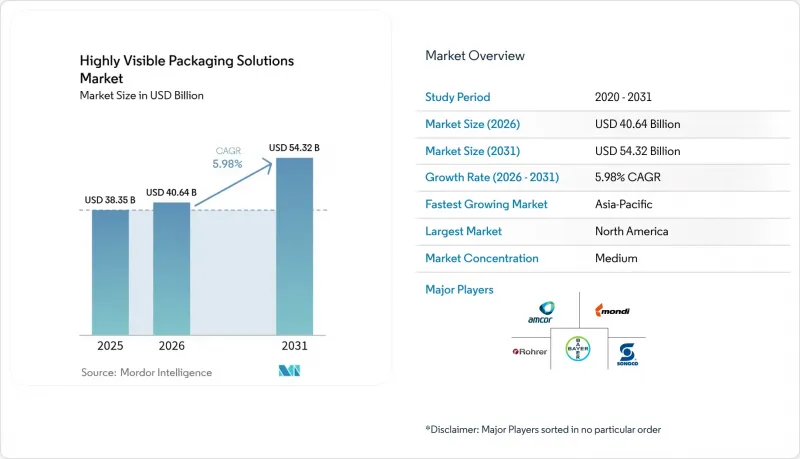
This report is Segmented by Type (Clamshell, Blister Pack, Shrink Wrap, and More), Material (Plastic, Paper and Paperboard, and More), Transparency Level (Fully Transparent, Windowed, and More), Packaging Technology (Thermoforming, Vacuum Sealing, and More), End-User Industry (Food and Beverage, Healthcare, and More), and Geography. The Market Forecasts are Provided in Terms of Value (USD).
Global Highly Visible Packaging Solutions Market Trends and Insights
Growing Demand for Tamper-Evident and Theft-Deterrent Packaging
Retail shrinkage reached USD 112 billion in 2024, and chains responded by implementing formats that clearly reveal interference at a glance. Pharmaceutical blisters now use holographic seals that fracture upon access, satisfying full Drug Supply Chain Security Act compliance as of November 2024. Electronics retailers adopted clamshells with ultrasonic welds that delaminate during forced entry, resulting in an 18% reduction in warranty fraud in pilots across Best Buy and Target. Fresh-produce trays with peel-back films changed color when compromised, trimming spoilage claims by 22% in Walmart trials. The driver also serves as a legal shield, enabling brands to demonstrate diligence during recall litigation.
Intensifying Retail Shelf Competition for Brand Differentiation
A 2024 Nielsen study found that windowed or transparent packs increased conversion by 14% compared to opaque versions in 12,000 North American stores. Subscription services, such as HelloFresh, adopted clear pouches, which reduced customer support calls by 27% year-over-year. Confectionery brands switched from foil to transparent flow wrap, resulting in a 9% increase in impulse purchases in Mondelez pilot markets. Pet-food pouches with die-cut windows allow shoppers to gauge kibble size, driving 11% volume growth at Mars Petcare. Amazon now rewards recyclable transparent packaging with higher search rank, reinforcing the shelf-visibility imperative.
High Material and Production Costs
Polyethylene terephthalate resin averaged USD 1,220 per metric ton in 2024, up 14% from 2023, due to crude volatility and Asian cracker outages. Bioplastic premiums reached 60% above those of conventional resins, limiting adoption to premium categories. Tooling for complex clamshells can top USD 150,000, straining converters that serve short-run brands. Energy costs for vacuum sealing increased by 22% in the European Union, narrowing margins by 180 basis points. Recycled polyethylene terephthalate trades at a USD 200 premium because of collection gaps, adding further cost pressure.
Other drivers and restraints analyzed in the detailed report include:
- Stringent Product Labelling and Transparency Regulations
- Integration of Smart QR Codes Enabling Augmented Reality Experiences
- Environmental Concerns About Single-Use Plastics and Waste
For complete list of drivers and restraints, kindly check the Table Of Contents.
Segment Analysis
Blister packs held a 28.05% share of the highly visible packaging solutions market in 2025, reflecting their entrenched role in drug compliance and electronic display. Windowed formats are predicted to rise at a 7.12% CAGR as subscription services favor lightweight pouches that provide tamper-evident security while still delighting consumers during unboxing. Clamshells remain the go-to choice for high-value electronics, thanks to their drop resistance and visibility, which cut return rates by 13% in Apple trials. Shrink wrap persists in bulk shipment scenarios where unit cost overrides shelf appeal, while clear plastic tubs prolong produce freshness by as many as five days, saving 19% in berry spoilage for Driscoll's.
Across premium pet food, organic snacks, and nutraceuticals, die-cut windows enable brands to showcase texture without compromising barrier performance. Revised U.S. toy-packaging guidelines now accept windowed boxes that meet ASTM F963 sight criteria, creating a USD 2.8 billion opportunity previously closed to opaque cartons. Converters capable of sub-0.5 millimeter laser precision are set to command higher prices in categories that live or die by shelf aesthetics.
Conventional plastics accounted for 61.85% of 2025 revenue, primarily due to the clarity, barrier strength, and established recycling streams of polyethylene terephthalate. Yet bioplastics are advancing at a 6.41% CAGR as brand commitments and pending European regulation push toward compostable or low-carbon options. Polylactic acid won U.S. food-contact authorization for ambient applications in March 2024, unlocking bakery and confectionery channels worth USD 4.1 billion. Polyhydroxyalkanoate resins that biodegrade in marine environments entered pilot output at Danimer Scientific's Kentucky complex.
Paper and paperboard window packs secured 18.30% of shipments in 2025 due to consumer sustainability perceptions and retailer mandates for lightweight, recyclable formats. Glass remained a niche option at 5.90%, appealing to premium cosmetics that value purity cues. Metal packs with clear over-caps took 4.10%, serving aerosol personal care where full visibility is less critical. Cellulose-acetate windows closely match the clarity of polyethylene terephthalate while composting within 90 days; however, delays in obtaining EN 13432 certification push the large-scale rollout to late 2025.
Complete Report Scope:
- By Type
- Clamshell Packaging
- Blister Pack
- Shrink Wrap
- Windowed Packaging
- Plastic Container Packaging
- Other Types
- By Material
- Plastic
- Paper and Paperboard
- Glass
- Metal
- Bioplastic
- By Transparency Level
- Fully Transparent
- Windowed
- Opaque with Cut-Outs
- By Packaging Technology
- Thermoforming
- Vacuum Sealing
- Stretch Film Wrapping
- 3D Forming and Over-Moulding
- By End-User Industry
- Food and Beverage
- Healthcare
- Manufacturing
- Agriculture
- Electronics and Appliances
- Other End-User Industries
- By Geography
- North America
- United States
- Canada
- Mexico
- South America
- Brazil
- Argentina
- Chile
- Rest of South America
- Europe
- United Kingdom
- Germany
- France
- Italy
- Spain
- Rest of Europe
- Asia-Pacific
- China
- Japan
- India
- South Korea
- Australia and New Zealand
- Rest of Asia-Pacific
- Middle East and Africa
- Middle East
- United Arab Emirates
- Saudi Arabia
- Turkey
- Rest of Middle East
- Africa
- South Africa
- Kenya
- Nigeria
- Rest of Africa
- Middle East
- North America
Geography Analysis
North America generated 39.95% of 2025 revenue, driven by established blister-pack infrastructure and Amazon's frustration-free certification, which prioritizes transparent and recyclable packs in search results. Full DSCSA enforcement in November 2024 is expected to increase demand for unit-dose blisters that provide both visual inspection and digital serialization. Canada's extended producer responsibility fees of USD 0.12 per kilogram on non-recyclable plastics accelerated the adoption of mono-material clear clamshells. Mexico's nearshore ecosystem scaled output for U.S. brand owners, expanding cross-border shipments by 19% in 2024.
The Asia-Pacific region is projected to record a 7.55% CAGR through 2031, driven by China's cold-chain upgrade and India's surge in contract manufacturing, which require tamper-evident, transparent formats. China's GB 7718-2024 rule mandates bilingual labels, a requirement that windowed packs can meet cost-effectively. India, which supplies 40% of the global generics market, is transitioning from opaque foil to transparent blisters that align with export standards, resulting in a 27% increase in polyethylene terephthalate film imports in 2024. Japan's aging demographic increased demand for larger, tactile blister apertures, with a 14% growth in 2024. Australia and New Zealand replicated European extended producer responsibility, stimulating demand for certified recyclable clear packs.
Europe contributed 28.40% of 2025 revenue as PPWR drives recyclable mono-material adoption. Germany's VerpackG imposes fees up to USD 0.15 per kilogram on non-recyclables, steering converters toward clear polyethylene terephthalate and cellulose windows. The United Kingdom plastic packaging tax of GBP 200 per metric ton on sub-30% recycled content spurred demand for post-consumer recycled polyethylene terephthalate. France prohibited single-use plastic produce packs under 1.5 kilograms, encouraging paper-based windows. South America, the Middle East, and Africa together held 12.05%, supported by Brazil's pharmaceutical demand, UAE food service, and South African electronics retail.
- Amcor Plc
- Mondi Plc
- Sonoco Products Company
- Sealed Air Corporation
- Pactiv Evergreen Inc.
- Anchor Packaging Inc.
- Visipak - Sinclair and Rush Inc.
- Reynolds Consumer Products Inc.
- Rohrer Corporation
- Bemis Company LLC (part of Amcor)
- Huhtamaki Oyj
- International Paper Company
- Plastipak Packaging Inc.
- Dordan Manufacturing Company
- Drug Package Inc.
- Imex Packaging Corp.
- Bayer AG - Consumer Health Packaging Division
Additional Benefits:
- The market estimate (ME) sheet in Excel format
- 3 months of analyst support
TABLE OF CONTENTS
1 INTRODUCTION
- 1.1 Study Assumptions and Market Definition
- 1.2 Scope of the Study
2 RESEARCH METHODOLOGY
3 EXECUTIVE SUMMARY
4 MARKET LANDSCAPE
- 4.1 Market Overview
- 4.2 Market Drivers
- 4.2.1 Growing Demand for Tamper-Evident and Theft-Deterrent Packaging
- 4.2.2 Intensifying Retail Shelf Competition for Brand Differentiation
- 4.2.3 Stringent Product Labelling and Transparency Regulations
- 4.2.4 Integration of Smart QR Codes Enabling Augmented Reality Experiences
- 4.2.5 Adoption in Direct-to-Consumer Subscription Services
- 4.2.6 Circular Economy Reverse Logistics Optimising Inspection Speed
- 4.3 Market Restraints
- 4.3.1 High Material and Production Costs
- 4.3.2 Environmental Concerns About Single-Use Plastics and Waste
- 4.3.3 Retailer-Driven Shelf-Ready Standards Limiting Custom Shapes
- 4.3.4 Counterfeiting Risks in Advanced Transparent Films
- 4.4 Industry Value Chain Analysis
- 4.5 Impact of Macroeconomic Factors on the Market
- 4.6 Regulatory Landscape
- 4.7 Technological Outlook
- 4.8 Porter's Five Forces Analysis
- 4.8.1 Threat of New Entrants
- 4.8.2 Bargaining Power of Buyers
- 4.8.3 Bargaining Power of Suppliers
- 4.8.4 Threat of Substitute Products
- 4.8.5 Intensity of Competitive Rivalry
5 MARKET SIZE AND GROWTH FORECASTS (VALUE)
- 5.1 By Type
- 5.1.1 Clamshell Packaging
- 5.1.2 Blister Pack
- 5.1.3 Shrink Wrap
- 5.1.4 Windowed Packaging
- 5.1.5 Plastic Container Packaging
- 5.1.6 Other Types
- 5.2 By Material
- 5.2.1 Plastic
- 5.2.2 Paper and Paperboard
- 5.2.3 Glass
- 5.2.4 Metal
- 5.2.5 Bioplastic
- 5.3 By Transparency Level
- 5.3.1 Fully Transparent
- 5.3.2 Windowed
- 5.3.3 Opaque with Cut-Outs
- 5.4 By Packaging Technology
- 5.4.1 Thermoforming
- 5.4.2 Vacuum Sealing
- 5.4.3 Stretch Film Wrapping
- 5.4.4 3D Forming and Over-Moulding
- 5.5 By End-User Industry
- 5.5.1 Food and Beverage
- 5.5.2 Healthcare
- 5.5.3 Manufacturing
- 5.5.4 Agriculture
- 5.5.5 Electronics and Appliances
- 5.5.6 Other End-User Industries
- 5.6 By Geography
- 5.6.1 North America
- 5.6.1.1 United States
- 5.6.1.2 Canada
- 5.6.1.3 Mexico
- 5.6.2 South America
- 5.6.2.1 Brazil
- 5.6.2.2 Argentina
- 5.6.2.3 Chile
- 5.6.2.4 Rest of South America
- 5.6.3 Europe
- 5.6.3.1 United Kingdom
- 5.6.3.2 Germany
- 5.6.3.3 France
- 5.6.3.4 Italy
- 5.6.3.5 Spain
- 5.6.3.6 Rest of Europe
- 5.6.4 Asia-Pacific
- 5.6.4.1 China
- 5.6.4.2 Japan
- 5.6.4.3 India
- 5.6.4.4 South Korea
- 5.6.4.5 Australia and New Zealand
- 5.6.4.6 Rest of Asia-Pacific
- 5.6.5 Middle East and Africa
- 5.6.5.1 Middle East
- 5.6.5.1.1 United Arab Emirates
- 5.6.5.1.2 Saudi Arabia
- 5.6.5.1.3 Turkey
- 5.6.5.1.4 Rest of Middle East
- 5.6.5.2 Africa
- 5.6.5.2.1 South Africa
- 5.6.5.2.2 Kenya
- 5.6.5.2.3 Nigeria
- 5.6.5.2.4 Rest of Africa
- 5.6.5.1 Middle East
- 5.6.1 North America
6 COMPETITIVE LANDSCAPE
- 6.1 Market Concentration
- 6.2 Strategic Moves
- 6.3 Market Share Analysis
- 6.4 Company Profiles (includes Global Level Overview, Market Level Overview, Core Segments, Financials as available, Strategic Information, Market Rank/Share for Key Companies, Products and Services, and Recent Developments)
- 6.4.1 Amcor Plc
- 6.4.2 Mondi Plc
- 6.4.3 Sonoco Products Company
- 6.4.4 Sealed Air Corporation
- 6.4.5 Pactiv Evergreen Inc.
- 6.4.6 Anchor Packaging Inc.
- 6.4.7 Visipak - Sinclair and Rush Inc.
- 6.4.8 Reynolds Consumer Products Inc.
- 6.4.9 Rohrer Corporation
- 6.4.10 Bemis Company LLC (part of Amcor)
- 6.4.11 Huhtamaki Oyj
- 6.4.12 International Paper Company
- 6.4.13 Plastipak Packaging Inc.
- 6.4.14 Dordan Manufacturing Company
- 6.4.15 Drug Package Inc.
- 6.4.16 Imex Packaging Corp.
- 6.4.17 Bayer AG - Consumer Health Packaging Division
7 MARKET OPPORTUNITIES AND FUTURE OUTLOOK
- 7.1 White-Space and Unmet-Need Assessment

