PUBLISHER: Mordor Intelligence | PRODUCT CODE: 2116051

PUBLISHER: Mordor Intelligence | PRODUCT CODE: 2116051
GCC Disposables Single Use Packaging - Market Share Analysis, Industry Trends & Statistics, Growth Forecasts (2026 - 2031)
According to Mordor Intelligence, GCC disposables single use packaging market size in 2026 is estimated at USD 2.43 billion, growing from 2025 value of USD 2.34 billion with 2031 projections showing USD 2.91 billion, growing at 3.68% CAGR over 2026-2031.
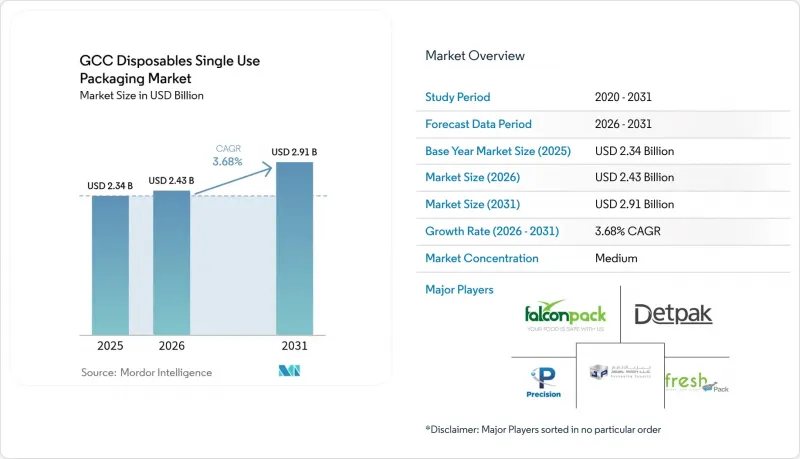
This report is Segmented by Product Type (Trays, Plates, Food Containers and Bowls, Boxes and Cartons, Bottles, Cups and Lids, Clamshell, and More), End-User Application (Quick Service Restaurants, and More), Material Type (Plastics, and More), Packaging Format (Rigid, and More), and Geography (United Arab Emirates, and More). The Market Forecasts are Provided in Terms of Value (USD).
GCC Disposables Single Use Packaging Market Trends and Insights
Regulatory-driven bans on single-use plastics
The UAE ban effective 2026 mandates food service operators to transition to recyclable or compostable substrates that meet Al Sa'fat criteria. Manufacturers are accelerating material reformulation programs, with regional PLA capacity reducing reliance on Asian imports. Multinational QSR chains are standardizing GCC-wide specifications to streamline sourcing, which is expected to amplify demand for molded fiber trays and water-based barrier coatings. Saudi Arabia's Waste Management Law is adding fee pressure on non-recyclable formats, reinforcing the competitive edge of compliant alternatives. Early adopters with credible environmental certifications are already commanding price premiums of 8-10% over legacy plastic SKUs.
Explosive growth of online food delivery apps
Food aggregators now account for a double-digit share of restaurant revenue, and their packaging specifications privilege leak-proof, thermal-retentive containers that survive desert heat profiles. Demand has surged for multi-compartment clamshells, dual-layer paper bowls, and tamper-evident lids that preserve freshness during 30-minute average transit windows. Each delivered meal generates more discrete packs than dine-in service, multiplying unit volumes sold per transaction. Platform contracts increasingly bundle service-level penalties tied to packaging failure rates, prompting converters to adopt higher-gauge laminates and QC automation. Innovations such as time-temperature labels are entering pilot trials to bolster consumer confidence in delivered food safety.
Escalating compliance cost from EPR pilots and eco-fees
EPR registration, audit, and fee payments projected at USD 200-400 per tonne for plastic packaging are squeezing manufacturer margins. Larger groups amortize these costs across diversified portfolios, but SMEs with single-line operations face price undercutting risks. When non-recyclable items incur higher multipliers, buyers renegotiate supply contracts quarterly to hedge fee volatility, creating forecasting challenges for converters. Some suppliers are shifting toward toll manufacturing models in free-trade zones to mitigate mainland fee exposure, yet the administrative burden remains. Over the medium term, the fee differentials are expected to accelerate the exit of commodity plastics in favor of substrate mixes with lower fee classes.
Other drivers and restraints analyzed in the detailed report include:
- Rapid expansion of QSR and cafe chains
- Rising demand for hygienic packaging in healthcare, Hajj and mass-event catering
- Limited commercial composting and recycling infrastructure
For complete list of drivers and restraints, kindly check the Table Of Contents.
Segment Analysis
Trays, plates, food containers, and bowls retained leadership in the GCC disposables single-use packaging market with 27.78% share in 2025, fueled by institutional catering contracts linked to mega-events and expansive hotel pipelines. The segment benefits from volume contracts that stabilize baseline plant utilization across converters. Simultaneously, cups and lids exhibit a 5.55% CAGR due to burgeoning cafe chains and premium ready-to-drink beverage launches. GCC disposables single-use packaging market size for cups is forecast to add more than 650 million additional units annually by 2031. Suppliers are responding with double-wall cups and ripple-textured sleeves that reduce heat transfer, while fiber-based lids are entering commercial production to replace polystyrene tops.
Across smaller SKUs, straws, stirrers, and cutlery confront outright bans or fee surcharges in the UAE, spurring a pivot toward bamboo and coated wood. Clamshell designs tailored for online delivery platforms now incorporate ventilated lids to release steam, preventing soggy fried foods. Rigid box formats for gourmet desserts employ PET windows laminated to kraft board for premium shelf appeal. The product mix evolution underscores a dual mandate of performance and sustainability, forcing manufacturers to balance stock-keeping complexity with economies of scale.
Quick service restaurants held the largest slice of the GCC disposables single-use packaging market size at 32.11% in 2025, supported by franchised burger, fried chicken, and pizza operators rolling out across secondary cities. Nonetheless, coffee and snack outlets are poised for the fastest 5.53% CAGR, driven by Millennials and Gen Z who frequent grab-and-go formats. The GCC disposables single-use packaging market share captured by cafes is expanding as chains demand bespoke cup graphics and seasonal, limited-edition sleeves.
Full-service restaurants, though slower growing, are upgrading to molded fiber table-ready bowls for takeout orders that preserve plating aesthetics. Retail prepared-food counters in hypermarkets now seek re-heatable trays compatible with in-store rotisseries. Institutional segments, notably hospitals and universities, specify color-coded lids to segregate dietary requirements, pushing customization depth. Overall, end-user heterogeneity compels converters to operate flexible print lines capable of short runs without cost penalties.
Complete Report Scope:
- By Product Type
- Trays, Plates, Food Containers and Bowls
- Boxes and Cartons
- Bottles
- Cups and Lids
- Clamshell
- Bags and Wraps
- Cutlery, Stirrers, Straws
- By End-user Application
- Quick Service Restaurants
- Full-Service Restaurants
- Coffee and Snack Outlets
- Retail Establishments
- Institutional and Hospitality
- Other End-User Applications
- By Material Type
- Plastics (PP, PET, PS, PE)
- Paper and Paperboard
- Bagasse and Plant-Based Fibres
- Wood and Bamboo
- Aluminium Foil
- By Packaging Format
- Rigid
- Flexible
- Hybrid (Paper-Plastic, Laminate)
- Active and Intelligent
- By Country
- United Arab Emirates
- Saudi Arabia
- Qatar
- Kuwait
- Oman
- Bahrain
List of Companies Covered in this Report:
- Jebel Pack LLC
- Detpak - Detmold Group
- Falcon Pack Industries LLC
- Precision Plastic Products Co. LLC
- Freshpack LLC
- Panache International FZ LLC
- Gulf East Paper and Plastic Industries LLC
- Al Bayader International LLC
- Hotpack Packaging LLC
- M.R.S. Packaging Limited
- Huhtamaki Oyj
- Prestige Packing Industry LLC
- International Food Services Company
- Cristal Plastic Industrial LLC
- Sabert Corporation
- Novolex Holdings LLC
- Amcor plc
- Sonoco Products Company
- Pactiv Evergreen Inc.
Additional Benefits:
- The market estimate (ME) sheet in Excel format
- 3 months of analyst support
TABLE OF CONTENTS
1 INTRODUCTION
- 1.1 Study Assumptions and Market Definition
- 1.2 Scope of the Study
2 RESEARCH METHODOLOGY
3 EXECUTIVE SUMMARY
4 MARKET LANDSCAPE
- 4.1 Market Drivers
- 4.1.1 Regulatory-driven bans on single-use plastics (UAE 2026 ban)
- 4.1.2 Explosive growth of online food delivery apps across GCC
- 4.1.3 Rapid expansion of QSR and cafe chains backed by Vision 2030 tourism push
- 4.1.4 Rising demand for hygienic packaging in healthcare, Hajj and mass-event catering
- 4.1.5 Surge in sustainable materials capacity (bagasse, molded fibre) in UAE and KSA
- 4.1.6 Logistics re-export hub advantage (Jebel Ali, King Abdullah Port) boosting packaging throughput
- 4.2 Market Restraints
- 4.2.1 Escalating compliance cost from EPR pilots and eco-fees
- 4.2.2 Limited commercial composting and recycling infrastructure in GCC
- 4.2.3 Petro-feedstock price volatility squeezing resin margins
- 4.2.4 Consumer perception shift toward reusables in premium dining
- 4.3 Industry Value Chain Analysis
- 4.4 Regulatory Landscape
- 4.5 Technological Outlook
- 4.6 Porter's Five Forces Analysis
- 4.6.1 Bargaining Power of Suppliers
- 4.6.2 Bargaining Power of Buyers
- 4.6.3 Threat of New Entrants
- 4.6.4 Threat of Substitute Products
- 4.6.5 Intensity of Competitive Rivalry
- 4.7 Post-Pandemic Impact Analysis
- 4.7.1 Market Demand Shift (COVID-19)
- 4.7.2 Reusable vs Single-Use Safety Evidence
- 4.7.3 Regulations vs Material Safety
- 4.7.4 Impact on Recycling Streams
5 MARKET SIZE AND GROWTH FORECASTS (VALUE)
- 5.1 By Product Type
- 5.1.1 Trays, Plates, Food Containers and Bowls
- 5.1.2 Boxes and Cartons
- 5.1.3 Bottles
- 5.1.4 Cups and Lids
- 5.1.5 Clamshell
- 5.1.6 Bags and Wraps
- 5.1.7 Cutlery, Stirrers, Straws
- 5.2 By End-user Application
- 5.2.1 Quick Service Restaurants
- 5.2.2 Full-Service Restaurants
- 5.2.3 Coffee and Snack Outlets
- 5.2.4 Retail Establishments
- 5.2.5 Institutional and Hospitality
- 5.2.6 Other End-User Applications
- 5.3 By Material Type
- 5.3.1 Plastics (PP, PET, PS, PE)
- 5.3.2 Paper and Paperboard
- 5.3.3 Bagasse and Plant-Based Fibres
- 5.3.4 Wood and Bamboo
- 5.3.5 Aluminium Foil
- 5.4 By Packaging Format
- 5.4.1 Rigid
- 5.4.2 Flexible
- 5.4.3 Hybrid (Paper-Plastic, Laminate)
- 5.4.4 Active and Intelligent
- 5.5 By Country
- 5.5.1 United Arab Emirates
- 5.5.2 Saudi Arabia
- 5.5.3 Qatar
- 5.5.4 Kuwait
- 5.5.5 Oman
- 5.5.6 Bahrain
6 COMPETITIVE LANDSCAPE
- 6.1 Market Concentration
- 6.2 Strategic Moves
- 6.3 Market Share Analysis
- 6.4 Company Profiles (includes Global level Overview, Market level overview, Core Segments, Financials as available, Strategic Information, Market Rank/Share, Products and Services, Recent Developments)
- 6.4.1 Jebel Pack LLC
- 6.4.2 Detpak - Detmold Group
- 6.4.3 Falcon Pack Industries LLC
- 6.4.4 Precision Plastic Products Co. LLC
- 6.4.5 Freshpack LLC
- 6.4.6 Panache International FZ LLC
- 6.4.7 Gulf East Paper and Plastic Industries LLC
- 6.4.8 Al Bayader International LLC
- 6.4.9 Hotpack Packaging LLC
- 6.4.10 M.R.S. Packaging Limited
- 6.4.11 Huhtamaki Oyj
- 6.4.12 Prestige Packing Industry LLC
- 6.4.13 International Food Services Company
- 6.4.14 Cristal Plastic Industrial LLC
- 6.4.15 Sabert Corporation
- 6.4.16 Novolex Holdings LLC
- 6.4.17 Amcor plc
- 6.4.18 Sonoco Products Company
- 6.4.19 Pactiv Evergreen Inc.
7 MARKET OPPORTUNITIES AND FUTURE OUTLOOK
- 7.1 White-Space and Unmet-Need Assessment

