PUBLISHER: Mordor Intelligence | PRODUCT CODE: 2121658

PUBLISHER: Mordor Intelligence | PRODUCT CODE: 2121658
Artillery Ammunition - Market Share Analysis, Industry Trends & Statistics, Growth Forecasts (2026 - 2031)
According to Mordor Intelligence, the artillery ammunition market size stood at USD 5.70 billion in 2026 and is projected to reach USD 7.51 billion by 2031, expanding at a 5.67% CAGR during the forecast period.
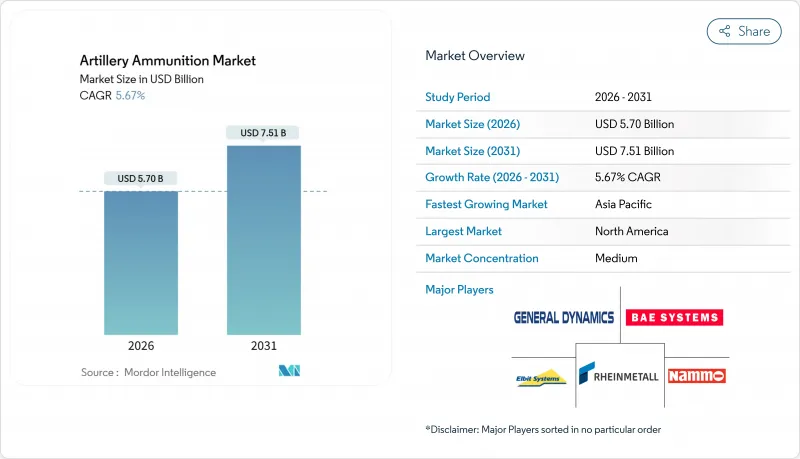
This report is Segmented by Shell Type (High-Explosive, Smoke and Illumination, and More), Guidance Mechanism (Unguided, GPS-Guided, and More), Propulsion/Charge Type (Legacy Charges, Modular Artillery Charge System, and More), Platform Type (Towed Howitzers, Self-Propelled Howitzers, and More), and Geography (North America, Europe, and More). The Market Forecasts are Provided in Terms of Value (USD).
Global Artillery Ammunition Market Trends and Insights
Escalating Great-Power Competition and High-Tempo Munitions Expenditure
Russia's output reaching 250,000 shells per month by mid-2024 and NATO's pledge to deliver 2 million 155 mm rounds to Ukraine by March 2025 exposed historic stockpile gaps that now dictate procurement priorities. The US alone appropriated USD 3 billion to expand facilities in Scranton and Lake City, increasing monthly production from 28,000 rounds in early 2023 to a target of 100,000 rounds by late 2025. EU instruments such as the USD 117 million ASAP fund co-finance new lines in member states, while Taiwan and South Korea ramp up budgets to buffer against regional flashpoints. Long-term, multiyear contracts now underwrite capital-intensive propellant and fuze investments that would have been commercially unviable under peacetime consumption patterns. The artillery ammunition market, therefore, benefits from unprecedented demand certainty across at least one complete planning cycle, anchoring the current 5-year capacity-build trend.
Surge in Long-Range Precision-Fire Programs
The US Extended Range Cannon Artillery effort, re-branded in 2024, integrates XM1113 rocket-assisted and XM1155-SC precision rounds to reach 70 kilometers, with IOC slated for 2027. BAE Systems shipped Excalibur S lots featuring semi-active laser seekers, while Leonardo's Vulcano family secured USD 235 million in domestic orders after NATO qualification. General Atomics demonstrated a ramjet-assisted 150-kilometer shell costing under USD 100,000, eroding the cost-per-target advantage of tactical missiles. These programs collectively cut rounds-per-effect ratios, shifting value from metalwork to guidance subsystems and stimulating hybrid-guidance R&D against GPS denial. Suppliers able to internalize fuze and seeker production capture higher margins and face lower exposure to export controls.
Stringent ITAR/Wassenaar Controls on Fuzes and Base-Bleed Assemblies
Category I controls lengthen license cycles up to 18 months, delaying Turkish and South Korean exports that embed US-origin GPS fuzes. Roketsan redesigned its HE-ERFB projectile to circumvent ITAR parts, sacrificing range, while Bharat Electronics invested USD 85 million in Pune to localize artillery fuzes, extending NATO-compliance testing into 2027. Export-control frictions fragment the supply base and incentivize second-tier producers to field lower-performance but license-free alternatives, limiting unit-value upside for premium suppliers.
Other drivers and restraints analyzed in the detailed report include:
- Modernization of 155 mm Logistics Chains and Modular Charge Systems
- Rising Defense Budgets in Asia-Pacific and Eastern Europe
- Volatile Nitrocellulose and Copper Prices Pressuring Margins
For complete list of drivers and restraints, kindly check the Table Of Contents.
Segment Analysis
High-explosive (HE) rounds accounted for 51.74% of the artillery ammunition market share in 2025 as they remain indispensable for suppression, area denial, and quick-response missions. Precision-guided shells, though still a minority, are forecast to grow at a 5.58% CAGR as doctrinal shifts emphasize first-round effects and ammunition conservation. The United States Army's USD 1.2 billion purchase of 36,000 Excalibur rounds between 2024 and 2026 illustrates the budgetary swing toward GPS-guided options that replace multiple unguided rounds per target. Smoke, illumination, and practice rounds continue to support combined-arms training cycles, while DPICM sales shrink under the Convention on Cluster Munitions. Base-bleed and rocket-assisted projectiles are attracting Asia-Pacific users, such as India, which cleared its 48-kilometer base-bleed round for serial production in 2027.
Precision-guided munitions (PGMs) expand manufacturer margins due to the high value of embedded sensors, but they also intensify ITAR exposure and supply-chain complexity. Budget-constrained militaries in Africa and Latin America continue to favor high-explosive bulk orders, ensuring that legacy production lines run in parallel with smart-munition assembly. The dual-speed dynamic keeps the artillery ammunition market diversified across price points and technologies, reducing total demand volatility.
Unguided projectiles represented 59.05% of 2025 revenue, reflecting fleet compatibility and unit cost below USD 1,200 per shell. GPS-guided shells are expected to grow 6.41% CAGR through 2031 on the back of Raytheon's Arizona line expansion and XM1155-SC adoption. Laser-guided variants offer moving-target engagement but require line-of-sight (LOS) illumination, which complicates their use in contested electromagnetic environments. Hybrid GPS-INS solutions mitigate jamming, evidenced by Elbit's SIGMA contract with a European NATO member. Electronic warfare in Ukraine highlights the need for redundancy, prompting suppliers to adopt multi-mode guidance despite increased costs.
Unguided rounds keep relevance for saturation and suppression fire, particularly against soft targets where precision provides marginal benefit. Nevertheless, interoperability rules, such as STANAG 4425, push even value-tier buyers toward at least partially GPS-friendly inventories, ensuring a steady erosion of the unguided share over time, despite ongoing volume purchases.
Complete Report Scope:
- By Shell Type
- High-Explosive (HE)
- Smoke and Illumination
- Dual-Purpose Improved Conventional Munition (DPICM)
- Base-Bleed/Rocket-Assisted Projectile (RAP)
- Sensor-Fuzed/Cluster
- Precision-Guided
- Practice/Blank
- By Guidance Mechanism
- Unguided
- GPS-Guided
- Laser-Guided
- Inertial/Hybrid
- By Propulsion/Charge Type
- Legacy Charges
- Modular Artillery Charge System (MACS)
- Extended Range and Submunition Rounds
- By Platform Type
- Towed Howitzers
- Self-Propelled Howitzers
- Mortars (Greater than 81 mm)
- Rocket Artillery (MRL)
- Naval Guns
- By Geography
- North America
- United States
- Canada
- Mexico
- Europe
- United Kingdom
- France
- Germany
- Russia
- Rest of Europe
- Asia-Pacific
- China
- India
- Japan
- South Korea
- Rest of Asia-Pacific
- South America
- Brazil
- Rest of South America
- Middle East and Africa
- Middle East
- Saudi Arabia
- United Arab Emirates
- Rest of Middle East
- Africa
- South Africa
- Rest of Africa
- Middle East
- North America
Geography Analysis
North America generated 37.61% of 2025 revenue, primarily driven by the US Department of Defense's (DoD's) USD 3 billion initiative to increase monthly 155 mm output to 100,000 by late 2025. Transfers exceeding 2 million shells to Ukraine by the end of 2024 create backfill orders that sustain high output rates even after the immediate conflict phase. The artillery ammunition market size within the US pre-positioned stocks in Guam, Japan, and Australia is expected to grow as Pacific defense planning matures. Canada's CAD 850 million (USD 621.83 million) M777A2 buy embeds a decade-long ammunition stream, whereas Mexico's budget keeps its M101 and M114 fleets operational but static.
Asia-Pacific is forecasted to grow at a 5.17% CAGR, buoyed by India's commitment to double 155 mm shell capacity to 240,000 rounds by 2027 and South Korea's KRW 1.2 trillion (USD 836.50 million) ammunition contract portfolio extending to 2030. Japan's 16% budget increase funds Type 19 howitzer ammunition, and China's Norinco operates six dedicated artillery-rocket plants that feed export orders, which, although opaque, intensify competition across Africa and Latin America. Deterrence-driven budgets in Taiwan and Australia implicitly lock in long-term shell requisitions, adding resilience to regional demand even under shifting political coalitions.
Europe's resurgence is underpinned by the USD 51.44 billion SAFE loan and Rheinmetall's Bundeswehr framework, positioning the bloc to rival North America in volume output by 2028. Poland's partnership plant aims for 150,000 shells annually by 2027, Germany's 200,000-round MACS order stimulates subcontracting across the region, and the UK invests GBP 300 million (USD 404.89 million) in Glascoed for 152 mm lines. France, Sweden, and Norway each tie national funding to Ukrainian resupply, creating predictable multi-year order books while distributing capacity to mitigate the risk of single-facility reliance. Russian production continues at scale, targeting a narrow export club that limits overlap with NATO buyer pools.
- Rheinmetall AG
- General Dynamics Corporation
- BAE Systems plc
- Nammo AS
- Elbit Systems Ltd.
- KNDS N.V.
- Saab AB
- Thales Group
- MESKO S.A.
- Hanwha Corporation
- Northrop Grumman Corporation
- Poongsan Corporation
- Singapore Technologies Engineering Ltd.
- JUNGHANS Microtec GmbH
- Kaman Corporation
- L3Harris Technologies, Inc.
- Directorate of Ordnance (Coordination & Services)
- Leonardo S.p.A.
Additional Benefits:
- The market estimate (ME) sheet in Excel format
- 3 months of analyst support
TABLE OF CONTENTS
1 INTRODUCTION
- 1.1 Study Assumptions and Market Definition
- 1.2 Scope of the Study
2 RESEARCH METHODOLOGY
3 EXECUTIVE SUMMARY AND KEY FINDINGS
4 MARKET LANDSCAPE
- 4.1 Market Overview
- 4.2 Market Drivers
- 4.2.1 Escalating great-power competition and high-tempo munitions expenditure
- 4.2.2 Surge in long-range precision-fire programs
- 4.2.3 Modernization of 155 mm logistics chains and modular charge systems
- 4.2.4 Rising defense budgets in Asia-Pacific and Eastern Europe
- 4.2.5 NATO qualification of insensitive-munitions propellants unlocking new suppliers
- 4.2.6 Additive-manufactured driving bands lowering barrel wear and shell cost
- 4.3 Market Restraints
- 4.3.1 Stringent ITAR/Wassenaar controls on fuzes and base-bleed assemblies
- 4.3.2 Volatile nitrocellulose and copper prices pressuring margins
- 4.3.3 Chronic shortage of triple-base propellant mixing capacity (M31)
- 4.3.4 Fire-safety insurance premiums for ageing ECM magazines
- 4.4 Value Chain Analysis
- 4.5 Regulatory Landscape
- 4.6 Technological Outlook
- 4.7 Porter's Five Forces Analysis
- 4.7.1 Bargaining Power of Suppliers
- 4.7.2 Bargaining Power of Buyers
- 4.7.3 Threat of New Entrants
- 4.7.4 Threat of Substitutes
- 4.7.5 Intensity of Competitive Rivalry
5 MARKET SIZE AND GROWTH FORECASTS (VALUE)
- 5.1 By Shell Type
- 5.1.1 High-Explosive (HE)
- 5.1.2 Smoke and Illumination
- 5.1.3 Dual-Purpose Improved Conventional Munition (DPICM)
- 5.1.4 Base-Bleed/Rocket-Assisted Projectile (RAP)
- 5.1.5 Sensor-Fuzed/Cluster
- 5.1.6 Precision-Guided
- 5.1.7 Practice/Blank
- 5.2 By Guidance Mechanism
- 5.2.1 Unguided
- 5.2.2 GPS-Guided
- 5.2.3 Laser-Guided
- 5.2.4 Inertial/Hybrid
- 5.3 By Propulsion/Charge Type
- 5.3.1 Legacy Charges
- 5.3.2 Modular Artillery Charge System (MACS)
- 5.3.3 Extended Range and Submunition Rounds
- 5.4 By Platform Type
- 5.4.1 Towed Howitzers
- 5.4.2 Self-Propelled Howitzers
- 5.4.3 Mortars (Greater than 81 mm)
- 5.4.4 Rocket Artillery (MRL)
- 5.4.5 Naval Guns
- 5.5 By Geography
- 5.5.1 North America
- 5.5.1.1 United States
- 5.5.1.2 Canada
- 5.5.1.3 Mexico
- 5.5.2 Europe
- 5.5.2.1 United Kingdom
- 5.5.2.2 France
- 5.5.2.3 Germany
- 5.5.2.4 Russia
- 5.5.2.5 Rest of Europe
- 5.5.3 Asia-Pacific
- 5.5.3.1 China
- 5.5.3.2 India
- 5.5.3.3 Japan
- 5.5.3.4 South Korea
- 5.5.3.5 Rest of Asia-Pacific
- 5.5.4 South America
- 5.5.4.1 Brazil
- 5.5.4.2 Rest of South America
- 5.5.5 Middle East and Africa
- 5.5.5.1 Middle East
- 5.5.5.1.1 Saudi Arabia
- 5.5.5.1.2 United Arab Emirates
- 5.5.5.1.3 Rest of Middle East
- 5.5.5.2 Africa
- 5.5.5.2.1 South Africa
- 5.5.5.2.2 Rest of Africa
- 5.5.5.1 Middle East
- 5.5.1 North America
6 COMPETITIVE LANDSCAPE
- 6.1 Market Concentration
- 6.2 Strategic Moves
- 6.3 Market Share Analysis
- 6.4 Company Profiles (includes Global level Overview, Market level overview, Core Segments, Financials as available, Strategic Information, Market Rank/Share for key companies, Products and Services, and Recent Developments)
- 6.4.1 Rheinmetall AG
- 6.4.2 General Dynamics Corporation
- 6.4.3 BAE Systems plc
- 6.4.4 Nammo AS
- 6.4.5 Elbit Systems Ltd.
- 6.4.6 KNDS N.V.
- 6.4.7 Saab AB
- 6.4.8 Thales Group
- 6.4.9 MESKO S.A.
- 6.4.10 Hanwha Corporation
- 6.4.11 Northrop Grumman Corporation
- 6.4.12 Poongsan Corporation
- 6.4.13 Singapore Technologies Engineering Ltd.
- 6.4.14 JUNGHANS Microtec GmbH
- 6.4.15 Kaman Corporation
- 6.4.16 L3Harris Technologies, Inc.
- 6.4.17 Directorate of Ordnance (Coordination & Services)
- 6.4.18 Leonardo S.p.A.
7 MARKET OPPORTUNITIES AND FUTURE OUTLOOK
- 7.1 White-space and Unmet-need Assessment

