PUBLISHER: Mordor Intelligence | PRODUCT CODE: 2121673

PUBLISHER: Mordor Intelligence | PRODUCT CODE: 2121673
Supply Chain Big Data Analytics - Market Share Analysis, Industry Trends & Statistics, Growth Forecasts (2026 - 2031)
According to Mordor Intelligence, the supply chain big data analytics market size is expected to grow from USD 11.10 billion in 2025 to USD 13.20 billion in 2026 and is forecast to reach USD 31.44 billion by 2031 at 18.95% CAGR over 2026-2031.
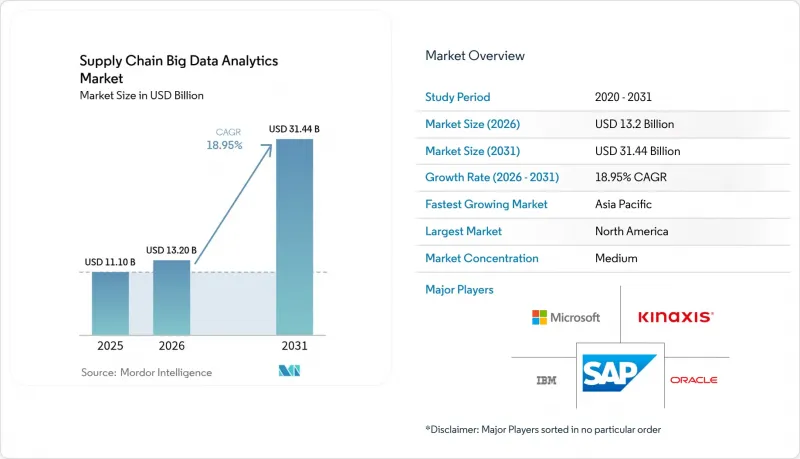
This report is Segmented by Component (Solution, Service), End User Industry (Retail, Transportation and Logistics, Manufacturing, Healthcare, Other End-User Industries), Deployment Model (On-Premise, Cloud), and Geography. The Market Forecasts are Provided in Terms of Value (USD).
Global Supply Chain Big Data Analytics Market Trends and Insights
Surging Omni-Channel Complexity
Retailers manage store, e-commerce, marketplace, and direct-to-consumer flows simultaneously, generating multi-petabyte data volumes that require real-time inventory algorithms. Walmart and Target each process more than 2.5 petabytes of supply data daily, prompting adoption of integrated planning platforms that synchronize demand signals and cut out-of-stock incidents by 30-40% .
Proliferation of IoT Telemetry in Logistics
Logistics operators deployed more than 1.2 billion IoT devices in 2024, each sending 25-30 data points per minute. Advanced analytics predicts equipment failures, optimizes fuel through live routing, and assures cold-chain integrity, delivering 20-30% maintenance cost cuts and 95% compliance for temperature-sensitive freight.
Integration and Data-Quality Hurdles
Enterprises juggle 15-25 legacy systems with incompatible schemas, leading to six-to-twelve-month integration delays and forcing teams to spend up to 60% of analytics budgets on data cleansing before realizing value . Data quality issues, such as duplicate records, missing values, inconsistent naming conventions, and outdated information, can diminish analytics accuracy by 20-30%. This undermines confidence in both predictive models and prescriptive recommendations.
Other drivers and restraints analyzed in the detailed report include:
- Falling Cloud Data-Warehouse Costs
- Regulatory Push for Supply-Chain Traceability
- Shortage of Analytics Talent
For complete list of drivers and restraints, kindly check the Table Of Contents.
Segment Analysis
Solutions captured 61.55% of the supply chain big data analytics market share in 2025 by bundling procurement planning, manufacturing analytics, and transportation optimization into unified suites. Manufacturing analytics modules gain traction as Industry 4.0 initiatives link shop-floor sensors to predictive models. Transportation tools are equally in demand as e-commerce growth multiplies last-mile deliveries.
The services segment grows at a 19.32% CAGR as enterprises call on system integrators for data migration, model calibration, and round-the-clock support. Hybrid cloud and generative-AI workloads amplify complexity, widening the gap between packaged software and client customization needs.
Complete Report Scope:
- By Component
- Solution
- Supply-Chain Procurement and Planning Tools
- Sales and Operations Planning
- Manufacturing Analytics
- Transportation and Logistics Analytics
- Inventory Planning and Optimization
- Service
- Professional Services
- Support and Maintenance
- Solution
- By End User Industry
- Retail
- Transportation and Logistics
- Manufacturing
- Healthcare
- Other end-user Industries (Consumer-Packaged Goods, Energy and Ultilities, etc.)
- By Deployment Model
- On-premise
- Cloud
- By Geography
- North America
- United States
- Canada
- Mexico
- South America
- Brazil
- Argentina
- Rest of South America
- Europe
- United Kingdom
- Germany
- France
- Italy
- Rest of Europe
- Asia Pacific
- China
- Japan
- South Korea
- India
- Rest of Asia Pacific
- Middle East and Africa
- United Arab Emirates
- Saudi Arabia
- South Africa
- Rest of Middle East and Africa
- North America
Geography Analysis
North America led with 42.40% of the supply chain big data analytics market share in 2025, owing to early digital-twin pilots and a mature cloud landscape. US manufacturers extend analytics into nearshored Mexican plants to improve quality yields, while Canadian energy operators optimize pipeline maintenance through predictive models.
Asia Pacific is growing at a 21.15% CAGR. China funds smart-factory roll-outs and cross-border e-commerce corridors that demand high-speed analytics. India accelerates retail and pharma use cases, whereas Japan and South Korea refine automotive and electronics supply chains through AI-powered scheduling. Government incentives and cloud-native startups make adoption cost-effective.
Europe maintains steady uptake under stringent sustainability and data-privacy rules. German auto and machinery exporters rely on plant-level analytics to protect global competitiveness. UK retailers integrate AI demand-planning tools to navigate volatile consumer sentiment, while EU-wide traceability laws spur investment in blockchain-enabled visibility platforms.
- SAP SE
- IBM Corporation
- Oracle Corporation
- Microsoft Corporation
- Amazon Web Services, Inc.
- Google LLC (Looker)
- Salesforce Inc. (Tableau Software Inc.)
- SAS Institute Inc.
- MicroStrategy Inc.
- Kinaxis Inc.
- Genpact Ltd.
- Blue Yonder Inc.
- Manhattan Associates
- Infor Inc.
- Qlik Techology Inc.
- Alteryx Inc.
- Snowflake Inc.
- Sage Clarity Systems
- Capgemini SE
- Birst Inc.
Additional Benefits:
- The market estimate (ME) sheet in Excel format
- 3 months of analyst support
TABLE OF CONTENTS
1 INTRODUCTION
- 1.1 Study Assumptions and Market Definition
- 1.2 Scope of the Study
2 RESEARCH METHODOLOGY
3 EXECUTIVE SUMMARY
4 MARKET LANDSCAPE
- 4.1 Market Overview
- 4.2 Market Drivers
- 4.2.1 Surging omni-channel complexity
- 4.2.2 Proliferation of IoT telemetry in logistics
- 4.2.3 Falling cloud-data-warehouse costs
- 4.2.4 Regulatory push for supply-chain traceability
- 4.2.5 Rise of digital twin control towers
- 4.2.6 Carbon-credit-linked freight optimization
- 4.3 Market Restraints
- 4.3.1 Integration and data-quality hurdles
- 4.3.2 Shortage of analytics talent
- 4.3.3 High TCO for real-time streaming stacks
- 4.3.4 Cyber-insurance exclusions for data-lake breaches
- 4.4 Value Chain Analysis
- 4.5 Regulatory Landscape
- 4.6 Technological Outlook
- 4.7 Porter's Five Forces Analysis
- 4.7.1 Threat of New Entrants
- 4.7.2 Bargaining Power of Buyers
- 4.7.3 Bargaining Power of Suppliers
- 4.7.4 Threat of Substitutes
- 4.7.5 Intensity of Competitive Rivalry
- 4.8 An Assessment of Macroeconomic Impact on the Market
5 MARKET SIZE AND GROWTH FORECASTS (VALUE)
- 5.1 By Component
- 5.1.1 Solution
- 5.1.1.1 Supply-Chain Procurement and Planning Tools
- 5.1.1.2 Sales and Operations Planning
- 5.1.1.3 Manufacturing Analytics
- 5.1.1.4 Transportation and Logistics Analytics
- 5.1.1.5 Inventory Planning and Optimization
- 5.1.2 Service
- 5.1.2.1 Professional Services
- 5.1.2.2 Support and Maintenance
- 5.1.1 Solution
- 5.2 By End User Industry
- 5.2.1 Retail
- 5.2.2 Transportation and Logistics
- 5.2.3 Manufacturing
- 5.2.4 Healthcare
- 5.2.5 Other end-user Industries (Consumer-Packaged Goods, Energy and Ultilities, etc.)
- 5.3 By Deployment Model
- 5.3.1 On-premise
- 5.3.2 Cloud
- 5.4 By Geography
- 5.4.1 North America
- 5.4.1.1 United States
- 5.4.1.2 Canada
- 5.4.1.3 Mexico
- 5.4.2 South America
- 5.4.2.1 Brazil
- 5.4.2.2 Argentina
- 5.4.2.3 Rest of South America
- 5.4.3 Europe
- 5.4.3.1 United Kingdom
- 5.4.3.2 Germany
- 5.4.3.3 France
- 5.4.3.4 Italy
- 5.4.3.5 Rest of Europe
- 5.4.4 Asia Pacific
- 5.4.4.1 China
- 5.4.4.2 Japan
- 5.4.4.3 South Korea
- 5.4.4.4 India
- 5.4.4.5 Rest of Asia Pacific
- 5.4.5 Middle East and Africa
- 5.4.5.1 United Arab Emirates
- 5.4.5.2 Saudi Arabia
- 5.4.5.3 South Africa
- 5.4.5.4 Rest of Middle East and Africa
- 5.4.1 North America
6 COMPETITIVE LANDSCAPE
- 6.1 Market Concentration
- 6.2 Strategic Moves
- 6.3 Market Share Analysis
- 6.4 Company Profiles (includes Global level Overview, Market level overview, Core Segments, Financials as available, Strategic Information, Market Rank/Share for key companies, Products and Services, and Recent Developments)
- 6.4.1 SAP SE
- 6.4.2 IBM Corporation
- 6.4.3 Oracle Corporation
- 6.4.4 Microsoft Corporation
- 6.4.5 Amazon Web Services, Inc.
- 6.4.6 Google LLC (Looker)
- 6.4.7 Salesforce Inc. (Tableau Software Inc.)
- 6.4.8 SAS Institute Inc.
- 6.4.9 MicroStrategy Inc.
- 6.4.10 Kinaxis Inc.
- 6.4.11 Genpact Ltd.
- 6.4.12 Blue Yonder Inc.
- 6.4.13 Manhattan Associates
- 6.4.14 Infor Inc.
- 6.4.15 Qlik Techology Inc.
- 6.4.16 Alteryx Inc.
- 6.4.17 Snowflake Inc.
- 6.4.18 Sage Clarity Systems
- 6.4.19 Capgemini SE
- 6.4.20 Birst Inc.
7 MARKET OPPORTUNITIES AND FUTURE OUTLOOK
- 7.1 White-space and Unmet-need Assessment

