PUBLISHER: Mordor Intelligence | PRODUCT CODE: 2154897

PUBLISHER: Mordor Intelligence | PRODUCT CODE: 2154897
South America Big Data Analytics - Market Share Analysis, Industry Trends & Statistics, Growth Forecasts (2026 - 2031)
According to Mordor Intelligence, the South America big data analytics market size is expected to increase from USD 7.18 billion in 2025 to USD 8.49 billion in 2026 and reach USD 18.16 billion by 2031, growing at a CAGR of 16.42% over 2026-2031.
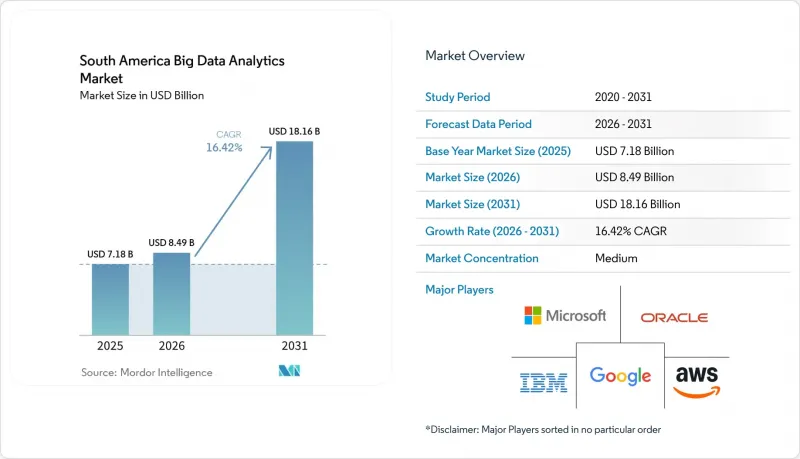
South America Big Data Analytics Market Trends and Insights
Expansion of Cloud and Hyperscale Data-Center Infrastructure
Cloud investment is reducing a core infrastructure constraint for the South America big data analytics market. AWS has committed substantial investments to expand its Brazilian data center operations through the next decade. AWS has also announced significant funding for the AWS South America Chile Region, which is scheduled to begin operating by the end of 2026. Microsoft announced significant investment in Brazilian cloud and AI infrastructure over several years. Ascenty began building a large-scale AI data center campus in Brazil with substantial investment. Greater local capacity can support workloads that are sensitive to latency or subject to data-residency requirements, including banking and public-sector applications. The South America big data analytics market can therefore reach buyers that previously found local hosting capacity inadequate for enterprise service commitments.
Growing Enterprise Demand for Data-Driven Decision-Making
Organizations are placing more emphasis on measurable results from analytics programs. Many large enterprises in the region have at least one AI or analytics project in production, while a smaller share reports measurable impact on business metrics. However, many South American enterprise respondents struggle to translate AI investment into measurable value. This gap supports demand for data governance, model monitoring, and AI operations tools that can improve production performance. Banco de Bogota migrated several analytical models to Google Cloud BigQuery and substantially reduced processing time, showing how operational priorities can shape technology decisions. The South America big data analytics market is likely to favor platforms and service providers that can connect deployments to visible business outcomes, rather than only adding new models.
Shortage of Data Engineering and Analytics Talent
The supply of data engineering and analytics talent remains a material constraint on the South America big data analytics market. The World Economic Forum reported that a large share of employers in South America planned to upskill their workforces for data and digital roles because external talent availability was not expected to improve over the coming years. The supplied material also stated that many companies in Brazil faced difficulty hiring data engineers. Competition from North American technology contracts can further increase retention pressure for regional employers. Large organizations can address part of the issue through platform-based self-service tools and internal training. Smaller organizations remain more exposed because they have less capacity to fund specialized teams, data governance functions, and extended implementation work.
Other drivers and restraints analyzed in the detailed report include:
- Increasing AI and Machine Learning Integration
- Rising Digital Commerce and Connected-Device Data Generation
- Data-Privacy Compliance and Cross-Border Data Governance
For complete list of drivers and restraints, kindly check the Table Of Contents.
Segment Analysis
Small and medium-scale organizations are expected to expand at a 16.77% CAGR through 2031. This outlook reflects the wider availability of cloud-native and low-code tools that reduce the need for large internal engineering teams. TOTVS processes more than 1 billion new data records each day across an installed base led by small and medium-sized businesses. The company is embedding analytics and AI agents into Protheus and retail intelligence products. LYNN was designed for B2B and SME use cases, which may help users adopt AI-enabled functions within familiar business systems. Regional ERP-linked products can reduce the professional-services burden that previously limited adoption by small manufacturers, retailers, and logistics operators.
Large-scale organizations held 62.34% of the South America big data analytics market size in 2025. Banks, telecommunications groups, and state-owned enterprises have the data infrastructure, governance processes, and budgets needed for full platform deployments. Databricks expanded its Brazil presence across major cloud platforms, giving large buyers a multi-cloud option. The supplied material indicated that its Brazil revenue grew significantly over a recent period and that it substantially expanded its Sao Paulo office space. SAP uses migration cycles to connect SAP Analytics Cloud and SAP Datasphere to existing ERP environments. Riachuelo's recent deployment significantly reduced analytics extractor development time. The capability gap between large organizations and mid-market users may narrow as cloud pricing and consolidated platforms lower the minimum investment needed for deployment.
Complete Report Scope:
- By Organization Size
- Small and Medium Scale
- Large Scale Organization
- By End-User Vertical
- IT and Telecommunication
- BFSI
- Retail and Consumer Goods
- Manufacturing
- Healthcare and Lifesciences
- Government
- Rest of End-User Verticals
- By Geography
- Brazil
- Argentina
- Colombia
- Rest of South America
List of Companies Covered in this Report:
- International Business Machines Corporation
- Microsoft Corporation
- Amazon Web Services, Inc.
- Google LLC
- Oracle Corporation
- SAP SE
- SAS Institute Inc.
- Teradata Corporation
- Salesforce, Inc.
- Snowflake Inc.
- Databricks, Inc.
- Cloudera, Inc.
- QlikTech International AB
- Alteryx, Inc.
- Accenture plc
- Capgemini SE
- Globant S.A.
- TOTVS S.A.
- TIVIT Terceirizacao de Processos, Servicos e Tecnologia S.A.
- Sonda S.A.
- Baufest S.A.
- NeuralMind Tecnologia Ltda.
- Involves Tecnologia Ltda.
- Axur Tecnologia Ltda.
- Nubank S.A.
Additional Benefits:
- The market estimate (ME) sheet in Excel format
- 3 months of analyst support
TABLE OF CONTENTS
1 INTRODUCTION
- 1.1 Study Assumptions and Market Definition
- 1.2 Scope of the Study
2 RESEARCH METHODOLOGY
3 EXECUTIVE SUMMARY
4 MARKET LANDSCAPE
- 4.1 Market Overview
- 4.2 Impact of Macroeconomic Factors on the Market
- 4.3 Market Drivers
- 4.3.1 Expansion of Cloud and Hyperscale Data-Center Infrastructure
- 4.3.2 Growing Enterprise Demand for Data-Driven Decision-Making
- 4.3.3 Increasing AI and Machine Learning Integration
- 4.3.4 Rising Digital Commerce and Connected-Device Data Generation
- 4.3.5 Localization of Spanish and Portuguese Language Analytics
- 4.3.6 Analytics Adoption Across Brownfield Industrial Assets
- 4.4 Market Restraints
- 4.4.1 Shortage of Data Engineering and Analytics Talent
- 4.4.2 Data-Privacy Compliance and Cross-Border Data Governance
- 4.4.3 Fragmented Data Architectures Across Countries and Industries
- 4.4.4 High Integration Costs for Legacy Industrial Equipment
- 4.5 Industry Value-Chain Analysis
- 4.6 Regulatory Landscape
- 4.7 Technological Outlook
- 4.8 Porter's Five Forces Analysis
- 4.8.1 Bargaining Power of Suppliers
- 4.8.2 Bargaining Power of Buyers
- 4.8.3 Threat of New Entrants
- 4.8.4 Threat of Substitutes
- 4.8.5 Competitive Rivalry
5 MARKET SIZE AND GROWTH FORECASTS (VALUE)
- 5.1 By Organization Size
- 5.1.1 Small and Medium Scale
- 5.1.2 Large Scale Organization
- 5.2 By End-User Vertical
- 5.2.1 IT and Telecommunication
- 5.2.2 BFSI
- 5.2.3 Retail and Consumer Goods
- 5.2.4 Manufacturing
- 5.2.5 Healthcare and Lifesciences
- 5.2.6 Government
- 5.2.7 Rest of End-User Verticals
- 5.3 By Geography
- 5.3.1 Brazil
- 5.3.2 Argentina
- 5.3.3 Colombia
- 5.3.4 Rest of South America
6 COMPETITIVE LANDSCAPE
- 6.1 Market Concentration
- 6.2 Strategic Moves
- 6.3 Market Share Analysis
- 6.4 Company Profiles (includes Global Level Overview, Market Level Overview, Core Segments, Financials as available, Strategic Information, Market Rank/Share, Products and Services, Recent Developments)
- 6.4.1 International Business Machines Corporation
- 6.4.2 Microsoft Corporation
- 6.4.3 Amazon Web Services, Inc.
- 6.4.4 Google LLC
- 6.4.5 Oracle Corporation
- 6.4.6 SAP SE
- 6.4.7 SAS Institute Inc.
- 6.4.8 Teradata Corporation
- 6.4.9 Salesforce, Inc.
- 6.4.10 Snowflake Inc.
- 6.4.11 Databricks, Inc.
- 6.4.12 Cloudera, Inc.
- 6.4.13 QlikTech International AB
- 6.4.14 Alteryx, Inc.
- 6.4.15 Accenture plc
- 6.4.16 Capgemini SE
- 6.4.17 Globant S.A.
- 6.4.18 TOTVS S.A.
- 6.4.19 TIVIT Terceirizacao de Processos, Servicos e Tecnologia S.A.
- 6.4.20 Sonda S.A.
- 6.4.21 Baufest S.A.
- 6.4.22 NeuralMind Tecnologia Ltda.
- 6.4.23 Involves Tecnologia Ltda.
- 6.4.24 Axur Tecnologia Ltda.
- 6.4.25 Nubank S.A.
7 MARKET OPPORTUNITIES AND FUTURE OUTLOOK
- 7.1 White-Space and Unmet-Need Assessment

