PUBLISHER: Mordor Intelligence | PRODUCT CODE: 2121701

PUBLISHER: Mordor Intelligence | PRODUCT CODE: 2121701
Europe Thermoplastic Elastomers - Market Share Analysis, Industry Trends & Statistics, Growth Forecasts (2026 - 2031)
According to Mordor Intelligence, the Europe thermoplastic elastomers market size was valued at USD 6.19 billion in 2025 and estimated to grow from USD 6.41 billion in 2026 to reach USD 7.59 billion by 2031, at a CAGR of 3.44% during the forecast period (2026-2031).
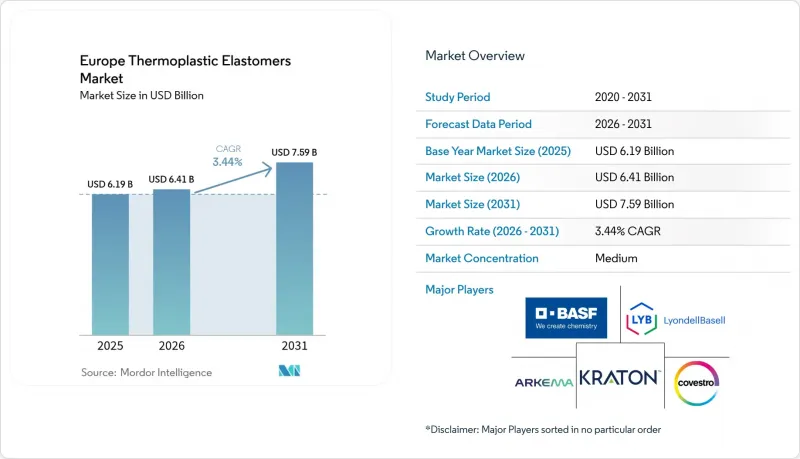
This report is Segmented by Product Type (Styrenic Block Copolymer, Thermoplastic Olefin, Thermoplastic Polyurethane, and More), Application (Automotive and Transportation, Building and Construction, Footwear and Sporting Goods, Electrical and Electronics, Medical, and More), and Geography (Germany, United Kingdom, France, and More). The Market Forecasts are Provided in Terms of Value (USD).
Europe Thermoplastic Elastomers Market Trends and Insights
EV-Driven Lightweighting Boom in European Auto Parts
Electric-vehicle architectures must shed 15-20% of their mass to counterbalance the weight of the battery, so OEMs are revising their material lists to favor recyclable thermoplastic elastomers over die-cast metal and vulcanized rubber. Volkswagen specifies Santoprene TPV engine covers that save 30% versus EPDM while handling 120°C oil exposure. Continental AG co-developed foam-injection TPE door seals, weighing 200 g less per vehicle. This seemingly small figure translates to 400 t of annual weight reduction at Wolfsburg volumes. In France and Spain, Stellantis and Renault source localized TPE gaskets to meet EU Battery Regulation carbon footprint thresholds of below 50 kg CO2e/kWh by 2027. ISO 14040 life-cycle audits now influence sourcing decisions, prompting smaller compounders to consider mergers that can finance traceability systems.
Rapid Substitution of PVC and EPDM in Building Seals
Window and door makers across Germany and the Nordics are transitioning to TPE profiles to meet the requirements of DGNB Gold and BREEAM Excellent labels, which penalize the use of halogenated polymers. TPE-S and TPE-V retain elongation above 200% after 5,000 hours of xenon-arc testing per ISO 4892-2, matching the weatherability of PVC without plasticizer bleed. The UK Future Homes Standard, effective from 2025, requires airtightness of below 5 m3/h/m2 at 50 Pa; co-extruded TPE corner keys meet this target while reducing installation time by 15 minutes per unit. Rehau and Deceuninck incorporate 40-50% post-industrial regrind, adding circularity that cushions EPDM price swings. The forthcoming EU Construction Products Regulation Annex ZA will require Environmental Product Declarations, thereby accelerating the uptake of TPE among facade contractors in Frankfurt and Amsterdam.
Volatile Crude-Linked Styrene and Isocyanate Prices
When Brent shifts more than USD 20/bbl inside a quarter, styrene and butadiene follow naphtha spreads almost in lockstep, driving feedstock costs that represent up to 60% of TPE-S production. Spot styrene in Northwest Europe slid 21% from USD 1,400/t in January 2024 to USD 1,100/t by October, pinching margins for integrated players such as INEOS Styrolution, which idled lines at Antwerp during summer maintenance. A BASF force-majeure event on MDI in Q2 2024 inflated isocyanate prices by 18% and left TPU extruders with six-week lead times. Smaller compounders that lack hedge tools or captive feedstocks surrendered 200-300 bps margin, pushing more family-owned plants into private-equity roll-ups.
Other drivers and restraints analyzed in the detailed report include:
- Medical-Grade TPU Demand from Catheter Extruders
- Foam-Injection TPE for Low-Density Interior Trims
- Tight EU REACH Limits on Phthalates and Styrene Monomer
For complete list of drivers and restraints, kindly check the Table Of Contents.
Segment Analysis
Styrenic block copolymers held 38.92% of the Europe thermoplastic elastomers market in 2025, underpinning formulations for adhesives, footwear, and soft-touch appliance parts. Thermoplastic polyurethanes are projected to post a 3.56% CAGR to 2031, increasing their share of the European thermoplastic elastomers market size as medical and premium automotive customers value abrasion and oil resistance at 80+ Shore A hardness levels. Thermoplastic olefins remain staples for exterior fascias due to their paintability without primers; however, Asian imports price them 10-15% below European output, thereby trimming margins for local producers.
Elastomeric alloys, positioned as TPVs, dominate under-hood seals that must limit oil swell to 15% per ASTM D471; however, silicone rivals are eroding their share in e-powertrain gaskets that require continuous use above 150 °C. Copolyesters and polyamide elastomers address high-temperature tubing niches, but they face hurdles related to moisture sensitivity and processing costs. ISO 1629 labeling has stripped away trade-name lock-in, letting procurement teams switch suppliers rapidly and sparking price pressure across the Europe thermoplastic elastomers market.
Complete Report Scope:
- By Product Type
- Styrenic Block Copolymer (TPE-S)
- Thermoplastic Olefin (TPE-O)
- Elastomeric Alloy (TPE-V / TPV)
- Thermoplastic Polyurethane (TPU)
- Thermoplastic Copolyester
- Thermoplastic Polyamide
- By Application
- Automotive and Transportation
- Building and Construction
- Footwear and Sporting Goods
- Electrical and Electronics
- Medical
- Household Appliances
- HVAC
- Adhesives, Sealants and Coatings
- Others
- By Geography
- Germany
- United Kingdom
- France
- Italy
- Spain
- Rest of Europe
List of Companies Covered in this Report:
- Apar Industries Ltd.
- Arkema
- Avient Corporation
- BASF
- Celanese Corporation
- Covestro AG
- Covestro AG
- DSM
- DuPont
- Evonik Industries AG
- Exxon Mobil Corporation
- Grupo Dynasol
- Huntsman International LLC
- KRATON CORPORATION
- KURARAY CO. LTD.
- LANXESS
- LG Chem
- LyondellBasell Industries Holdings BV
- Mitsubishi Chemical Corporation
- Mitsui Chemicals Inc.
- SABIC
- Sirmax SpA
- Sumitomo Chemical Co. Ltd.
- The Lubrizol Corporation
Additional Benefits:
- The market estimate (ME) sheet in Excel format
- 3 months of analyst support
TABLE OF CONTENTS
1 Introduction
- 1.1 Study Assumptions & Market Definition
- 1.2 Scope of the Study
2 Research Methodology
3 Executive Summary
4 Market Landscape
- 4.1 Market Overview
- 4.2 Market Drivers
- 4.2.1 EV-driven lightweighting boom in European auto parts
- 4.2.2 Rapid substitution of Polyvinyl Chloride and EPDM in building seals
- 4.2.3 Medical-grade Thermoplastic-Urethane demand from catheter extruders
- 4.2.4 Foam-injection TPE for low-density interior trims
- 4.2.5 OEM take-back mandates fueling PCR-blend TPE usage
- 4.3 Market Restraints
- 4.3.1 Volatile crude-linked styrene and isocyanate prices
- 4.3.2 Tight EU REACH limits on phthalates and styrene monomer
- 4.3.3 Competition from high-temp silicones in e-mobility
- 4.4 Value Chain Analysis
- 4.5 Porter's Five Forces
- 4.5.1 Bargaining Power of Suppliers
- 4.5.2 Bargaining Power of Consumers
- 4.5.3 Threat of New Entrants
- 4.5.4 Threat of Substitute Products and Services
- 4.5.5 Degree of Competition
5 Market Size and Growth Forecasts (Value)
- 5.1 By Product Type
- 5.1.1 Styrenic Block Copolymer (TPE-S)
- 5.1.2 Thermoplastic Olefin (TPE-O)
- 5.1.3 Elastomeric Alloy (TPE-V / TPV)
- 5.1.4 Thermoplastic Polyurethane (TPU)
- 5.1.5 Thermoplastic Copolyester
- 5.1.6 Thermoplastic Polyamide
- 5.2 By Application
- 5.2.1 Automotive and Transportation
- 5.2.2 Building and Construction
- 5.2.3 Footwear and Sporting Goods
- 5.2.4 Electrical and Electronics
- 5.2.5 Medical
- 5.2.6 Household Appliances
- 5.2.7 HVAC
- 5.2.8 Adhesives, Sealants and Coatings
- 5.2.9 Others
- 5.3 By Geography
- 5.3.1 Germany
- 5.3.2 United Kingdom
- 5.3.3 France
- 5.3.4 Italy
- 5.3.5 Spain
- 5.3.6 Rest of Europe
6 Competitive Landscape
- 6.1 Market Concentration
- 6.2 Strategic Moves
- 6.3 Market Share (%)/ Ranking Analysis
- 6.4 Company Profiles (includes Global level Overview, Market level overview, Core Segments, Financials as available, Strategic Information, Market Rank/Share for key companies, Products & Services, and Recent Developments)
- 6.4.1 Apar Industries Ltd.
- 6.4.2 Arkema
- 6.4.3 Avient Corporation
- 6.4.4 BASF
- 6.4.5 Celanese Corporation
- 6.4.6 Covestro AG
- 6.4.7 Covestro AG
- 6.4.8 DSM
- 6.4.9 DuPont
- 6.4.10 Evonik Industries AG
- 6.4.11 Exxon Mobil Corporation
- 6.4.12 Grupo Dynasol
- 6.4.13 Huntsman International LLC
- 6.4.14 KRATON CORPORATION
- 6.4.15 KURARAY CO. LTD.
- 6.4.16 LANXESS
- 6.4.17 LG Chem
- 6.4.18 LyondellBasell Industries Holdings BV
- 6.4.19 Mitsubishi Chemical Corporation
- 6.4.20 Mitsui Chemicals Inc.
- 6.4.21 SABIC
- 6.4.22 Sirmax SpA
- 6.4.23 Sumitomo Chemical Co. Ltd.
- 6.4.24 The Lubrizol Corporation
7 Market Opportunities and Future Outlook
- 7.1 White-space and Unmet-Need Assessment

