PUBLISHER: Mordor Intelligence | PRODUCT CODE: 2121766

PUBLISHER: Mordor Intelligence | PRODUCT CODE: 2121766
North America Diabetes Drugs - Market Share Analysis, Industry Trends & Statistics, Growth Forecasts (2026 - 2031)
According to Mordor Intelligence, the North America diabetes drugs market size was valued at USD 42.08 billion in 2025 and estimated to grow from USD 44.28 billion in 2026 to reach USD 57.08 billion by 2031, at a CAGR of 5.22% during the forecast period (2026-2031).
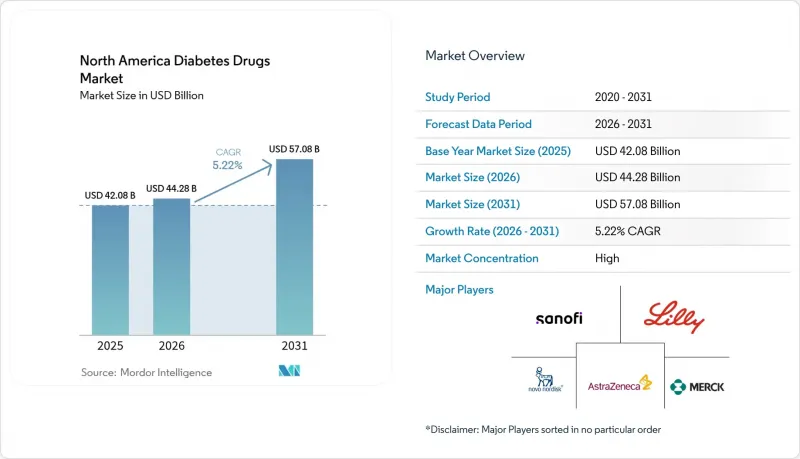
This report is Segmented by Drug Class (Insulins [Biosimilar Insulin and More], Non-Insulin Injectable, Oral Anti-Diabetic and Combination Drugs), Diabetes Type (Type 1 Diabetes and Type 2 Diabetes), Drug Origin (Branded and Generic/Biosimilar), Distribution Channel (Hospital Pharmacies, Retail Pharmacies and More) and Geography. The Market Forecasts are Provided in Terms of Value (USD).
North America Diabetes Drugs Market Trends and Insights
Increasing adoption of GLP-1 agonists in obese T2DM
GLP-1 receptor agonists unify obesity and diabetes management, a nexus relevant to more than 88% of people with Type 2 diabetes. Tirzepatide reached roughly 12% prescription share of glucose-lowering drugs by end-2023, and its popularity among non-diabetic weight-management users underscores the therapeutic blur between metabolic indications. Dual GLP-1/GIP activity delivers greater body-weight and HbA1c reductions than single-target drugs, while emerging triple-agonists such as retatrutide have posted 24% weight loss at 48 weeks, setting new clinical benchmarks. Fast-tracked FDA approvals for wider cardiometabolic indications are expanding reimbursement horizons and encouraging prescribers to adopt these therapies earlier in care pathways.
Reimbursement expansion for dual & triple incretins
Payers are recalibrating formularies to recognize the cardiovascular and renal benefits of dual and triple incretins. Medicare's price negotiations apply greater pressure on legacy oral agents, while newer GLP-1s gain Tier-preferred coverage, thus lowering out-of-pocket costs for seniors.Commercial insurers now classify obesity as a medical condition, unlocking pharmacotherapy budgets previously reserved for diabetes. Employer health plans are bundling obesity and diabetes care contracts tied to outcome metrics, reinforcing utilization growth.
Payer prior-authorization throttles GLP-1 volumes
US payers continue to impose multi-step therapy rules that delay or deny GLP-1 initiation despite favorable clinical profiles, leading to patient drop-out and slower overall market penetration. Medicare Advantage plans remain especially cautious in approving weight-management uses, preserving utilization caps that curb early growth.
Other drivers and restraints analyzed in the detailed report include:
- Biosimilar insulin price wars accelerate uptake
- CGM-linked dosing algorithms spur drug adherence
- API tariff risk from China supply concentration
For complete list of drivers and restraints, kindly check the Table Of Contents.
Segment Analysis
Oral agents secured 67.72% of the North America diabetes drugs market in 2025 and are projected to expand at 4.87% CAGR through 2031, sustaining leadership despite injectable breakthroughs. SGLT-2 inhibitors such as canagliflozin continue to gain based on cardio-renal outcome data and Health Canada labeling updates.
Non-insulin injectables are climbing rapidly on the back of GLP-1, dual GIP/GLP-1, and emerging triple-agonist classes. Triple-mechanism drugs are positioned as premium therapies offering weight, cardiovascular, and renal benefits, thereby lifting value per prescription within the North America diabetes drugs market. Alpha-glucosidase inhibitors retain a niche among geriatric cohorts, and combination pills that merge multiple mechanisms aim to simplify dosing and boost adherence.
Therapies for Type 2 diabetes continue to dominate revenue, yet Type 1 options are showing the strongest incremental gains. Integration of weekly semaglutide with automated insulin delivery lifted time-in-range metrics from 69.4% to 74.2%, a meaningful clinical advance. The resulting enthusiasm is expanding the North America diabetes drugs market size for Type 1 adjuncts. Gene-therapy programs aimed at beta-cell regeneration are still pre-commercial but underscore the pipeline depth.
Complete Report Scope:
- By Drug Class
- Insulins
- Basal / Long-acting
- Bolus / Fast-acting
- Traditional Human Insulin
- Biosimilar Insulin
- Non-Insulin Injectables
- GLP-1 Receptor Agonists
- Dual / Triple Agonists (e.g., Tirzepatide, Retatrutide)
- Amylin Analogues
- Oral Anti-Diabetics
- Biguanides
- SGLT-2 Inhibitors
- DPP-4 Inhibitors
- Alpha-Glucosidase Inhibitors
- Sulfonylureas
- Meglitinides
- Thiazolidinediones
- Combination Drugs
- Insulins
- By Diabetes Type
- Type 1 Diabetes
- Type 2 Diabetes
- By Drug Origin
- Branded
- Generic / Biosimilar
- By Distribution Channel
- Hospital Pharmacies
- Retail Pharmacies
- Online Pharmacies
- By Geography
- United States
- Canada
- Mexico
List of Companies Covered in this Report:
- Novo Nordisk
- Eli Lilly and Company
- Sanofi
- AstraZeneca
- Merck
- Boehringer Ingelheim
- Bristol-Myers Squibb
- Pfizer
- Johnson & Johnson
- Takeda Pharmaceuticals
- Teva Pharmaceutical Industries
- Astellas Pharma
- GlaxoSmithKline
- Amgen
- Viatris
- MannKind
- Adocia SA
- Innovent Biologics
- Sun Pharmaceuticals Industries
Additional Benefits:
- The market estimate (ME) sheet in Excel format
- 3 months of analyst support
TABLE OF CONTENTS
1 Introduction
- 1.1 Study Assumptions and Market Definition
- 1.2 Scope of the Study
2 Research Methodology
3 Executive Summary
4 Market Landscape
- 4.1 Market Overview
- 4.2 Market Drivers
- 4.2.1 Increasing Adoption of GLP-1 Agonists in Obese T2DM
- 4.2.2 Reimbursement Expansion for Dual & Triple Incretins
- 4.2.3 Biosimilar Insulin Price Wars Accelerate Uptake
- 4.2.4 CGM-linked Dosing Algorithms Spur Drug Adherence
- 4.2.5 Employer Obesity-Diabetes Bundled Contracts
- 4.2.6 US-Mexico Near-shoring of Pen-fill Finish Lines
- 4.3 Market Restraints
- 4.3.1 Payer Orior-authorization Throttles GLP-1 Volumes
- 4.3.2 API Tariff Risk from China Supply Concentration
- 4.3.3 Litigation Over Pancreatitis & Thyroid C-cell Tumors
- 4.3.4 Rising State Drug Price-cap Legislation
- 4.4 Value / Supply-Chain Analysis
- 4.5 Regulatory Landscape
- 4.6 Technology Outlook
- 4.7 Porter's Five Forces Analysis
- 4.7.1 Bargaining Power of Suppliers
- 4.7.2 Bargaining Power of Buyers
- 4.7.3 Threat of New Entrants
- 4.7.4 Threat of Substitutes
- 4.7.5 Intensity of Competitive Rivalry
5 Market Size and Growth Forecasts (Value-USD)
- 5.1 By Drug Class
- 5.1.1 Insulins
- 5.1.1.1 Basal / Long-acting
- 5.1.1.2 Bolus / Fast-acting
- 5.1.1.3 Traditional Human Insulin
- 5.1.1.4 Biosimilar Insulin
- 5.1.2 Non-Insulin Injectables
- 5.1.2.1 GLP-1 Receptor Agonists
- 5.1.2.2 Dual / Triple Agonists (e.g., Tirzepatide, Retatrutide)
- 5.1.2.3 Amylin Analogues
- 5.1.3 Oral Anti-Diabetics
- 5.1.3.1 Biguanides
- 5.1.3.2 SGLT-2 Inhibitors
- 5.1.3.3 DPP-4 Inhibitors
- 5.1.3.4 Alpha-Glucosidase Inhibitors
- 5.1.3.5 Sulfonylureas
- 5.1.3.6 Meglitinides
- 5.1.3.7 Thiazolidinediones
- 5.1.4 Combination Drugs
- 5.1.1 Insulins
- 5.2 By Diabetes Type
- 5.2.1 Type 1 Diabetes
- 5.2.2 Type 2 Diabetes
- 5.3 By Drug Origin
- 5.3.1 Branded
- 5.3.2 Generic / Biosimilar
- 5.4 By Distribution Channel
- 5.4.1 Hospital Pharmacies
- 5.4.2 Retail Pharmacies
- 5.4.3 Online Pharmacies
- 5.5 By Geography
- 5.5.1 United States
- 5.5.2 Canada
- 5.5.3 Mexico
6 Competitive Landscape
- 6.1 Market Concentration
- 6.2 Market Share Analysis
- 6.3 Company profiles (includes Global level Overview, Market level overview, Core Segments, Financials as available, Strategic Information, Market Rank/Share for key companies, Products and Services, and Recent Developments)
- 6.3.1 Novo Nordisk A/S
- 6.3.2 Eli Lilly & Co.
- 6.3.3 Sanofi S.A.
- 6.3.4 AstraZeneca plc
- 6.3.5 Merck & Co.
- 6.3.6 Boehringer Ingelheim
- 6.3.7 Bristol Myers Squibb
- 6.3.8 Pfizer Inc.
- 6.3.9 Johnson & Johnson (Janssen)
- 6.3.10 Takeda Pharmaceutical
- 6.3.11 Teva Pharmaceuticals
- 6.3.12 Astellas Pharma
- 6.3.13 GSK plc
- 6.3.14 Amgen Inc.
- 6.3.15 Viatris Inc.
- 6.3.16 MannKind Corporation
- 6.3.17 Adocia SA
- 6.3.18 Innovent Biologics
- 6.3.19 Sun Pharma
7 Market Opportunities and Future Outlook
- 7.1 White-Space and Unmet-Need Assessment

