PUBLISHER: Mordor Intelligence | PRODUCT CODE: 2121781

PUBLISHER: Mordor Intelligence | PRODUCT CODE: 2121781
Europe Activated Carbon - Market Share Analysis, Industry Trends & Statistics, Growth Forecasts (2026 - 2031)
According to Mordor Intelligence, the Europe activated carbon market size is projected to be USD 1.06 billion in 2025, USD 1.12 billion in 2026, and reach USD 1.46 billion by 2031, growing at a CAGR of 5.39% from 2026 to 2031.
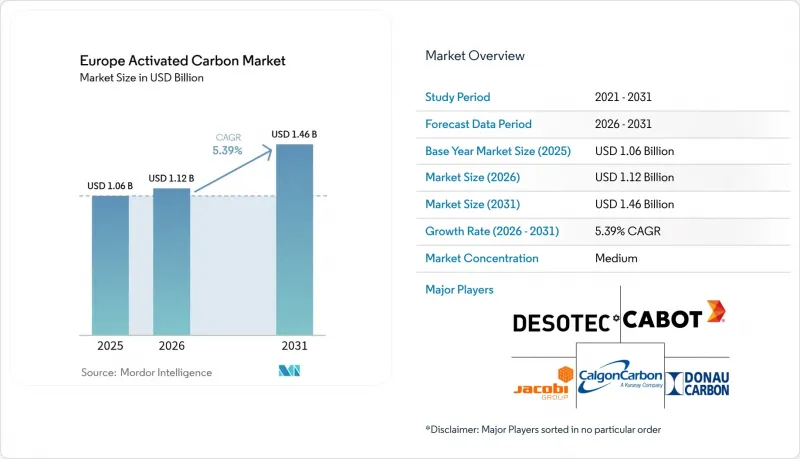
This report is Segmented by Type (Powdered Activated Carbons, Granular Activated Carbons, and Extruded or Pelletized Activated Carbons), Application (Gas Purification, Water Purification, Metal Extraction, Medicine, and Other Industrial Processes), and Geography (Germany, United Kingdom, France, Italy, Spain, and Rest of Europe). The Market Forecasts are Provided in Terms of Value (USD).
Europe Activated Carbon Market Trends and Insights
Surging Demand From Municipal Water Utilities
Utility buyers are front-loading orders to comply with the 2026 Drinking Water Directive, which fixes a binding deadline of January 2029 for PFAS monitoring and removal. Germany's Federal Environment Agency disclosed in December 2025 that 23% of sampled groundwater wells already exceed the 0.10 µg/L ceiling, prompting emergency tenders across Bavaria and Hesse. French operator Veolia committed EUR 85 million to retrofit 14 plants with fresh GAC beds and PAC-dosing skids, explicitly citing the inability of legacy media to meet short-chain PFAS targets. Supply-chain lead times have lengthened into Q3 2026, and product specifications now emphasize mesoporous carbons derived from coconut shell, which show higher uptake for four-carbon PFBA molecules. The ripple effect is a measurable uplift in spot pricing for both PAC and GAC, yet utilities appear willing to pay the premium because regulatory penalties for non-compliance can reach EUR 500,000 per incident. This dynamic injects near-term momentum into the Europe activated carbon market while foregrounding the importance of agile dosing technologies.
Mercury-Emissions Cap in Coal & Biomass Co-Firing
The 2024 BAT conclusions slashed mercury limits for large combustion plants above 300 MW th, compelling operators to double or even triple PAC injection rates. Poland's PGE Energia is now consuming 1,200 t of brominated PAC annually across Belchatow and Turow to hold stack concentrations below 1 µg/Nm3. RWE's Neurath lignite complex followed a similar path, scaling injection equipment and entering multi-year supply contracts with specialty carbon vendors. Bromination raises unit prices by 30%-40%, but life-cycle cost models still favor PAC over catalytic sorbents when carbon-allowance expenses under the EU-ETS are factored in. Smaller biomass co-firing units confront the same threshold; their inherently lower baseline mercury is offset by wide variability in feedstock, forcing continuous PAC dosing as a guardrail. The upshot is sustained, moderately counter-cyclical demand that shores up revenue diversity inside the Europe activated carbon market.
Price Volatility of Coconut-Shell & Coal Feedstocks
Typhoon Mawar and Cyclone Mocha disrupted coconut-shell supply chains in 2025, slashing Sri Lankan charcoal exports by 24% and sending Rotterdam PAC spot prices from EUR 2,100/t in January to EUR 2,480/t by September. Parallel spikes in anthracite followed TTF gas futures upward; when gas touched EUR 45/MWh in December 2025, anthracite climbed 14% month on month. Because coconut and coal markets are uncorrelated and lack hedging instruments, suppliers had little room to offset squeezes, narrowing gross margins across the Europe activated carbon industry. Utilities on fixed-price tenders bore the brunt, occasionally invoking force-majeure clauses to recover costs.
Other drivers and restraints analyzed in the detailed report include:
- Rising PFAS Removal Mandates in Groundwater
- Regenerative Carbon-Reactivation Service Contracts Gaining Traction
- Carbon Border Adjustment Mechanism Cost on Coal-Based Grades
For complete list of drivers and restraints, kindly check the Table Of Contents.
Segment Analysis
Powdered activated carbon controlled 47.65% of revenue in 2025, and its share of the Europe activated carbon market size is projected to increase steadily at a 5.67% CAGR to 2031. Water utilities value the ability to spike PAC directly into clarifiers within hours of detecting river-borne PFAS or geosmin episodes, a flexibility unattainable with fixed-bed GAC systems. Veolia's 2025 tender demanded 48-hour delivery for 3,200 t of PAC, underscoring how supply-chain responsiveness has become a procurement criterion. GAC, although slower growing, remains the backbone for continuous remediation and industrial reuse loops; Netherlands-based Waternet cut annual carbon consumption by 35% after switching a major plant to GAC despite paying EUR 4 million in upfront capex. Extruded and pelletized grades retain a smaller share but are indispensable in gas-phase VOC recovery where low pressure drop matters. Cabot's launch of a wood-based pellet with 1,100 m2/g surface area offered a CBAM-friendly alternative and illustrates feedstock migration trends. This product mix evolution reinforces the depth of the Europe activated carbon market.
Complete Report Scope:
- By Product Type
- Powdered Activated Carbon (PAC)
- Granular Activated Carbon (GAC)
- Extruded / Pelletized Activated Carbon
- By Application
- Water Purification
- Gas Purification
- Metal Purification
- Medicine
- Other Industrial Processes (solvent recovery and energy storage)
- By Geography
- Germany
- United Kingdom
- France
- Italy
- Spain
- Rest of Europe
List of Companies Covered in this Report:
- AdFiS products GmbH
- Albemarle Corporation
- Cabot Corporation
- Calgon Carbon Corporation (Kuraray)
- Carbon Activated Corporation
- CarboTech Group
- Desotec
- Donau Carbon GmbH
- Haycarb PLC
- Ingevity
- JACOBI CARBONS GROUP
- KUREHA CORPORATION
- Norit
- Puragen
Additional Benefits:
- The market estimate (ME) sheet in Excel format
- 3 months of analyst support
TABLE OF CONTENTS
1 Introduction
- 1.1 Study Assumptions & Market Definition
- 1.2 Scope of the Study
2 Research Methodology
3 Executive Summary
4 Market Landscape
- 4.1 Market Overview
- 4.2 Market Drivers
- 4.2.1 Surging demand from municipal water utilities
- 4.2.2 Mercury-emissions cap in coal & biomass co-firing
- 4.2.3 Rising PFAS removal mandates in groundwater
- 4.2.4 Regenerative carbon-reactivation service contracts gaining traction
- 4.2.5 Expansion of European beer & hard-seltzer filtration lines
- 4.3 Market Restraints
- 4.3.1 Price volatility of coconut-shell & coal feedstocks
- 4.3.2 Availability of engineered biochar substitutes
- 4.3.3 Carbon Border Adjustment Mechanism cost on coal-based grades
- 4.4 Value Chain Analysis
- 4.5 Porter's Five Forces
- 4.5.1 Bargaining Power of Suppliers
- 4.5.2 Bargaining Power of Buyers
- 4.5.3 Threat of New Entrants
- 4.5.4 Threat of Substitutes
- 4.5.5 Degree of Rivalry
5 Market Size & Growth Forecasts (Value)
- 5.1 By Product Type
- 5.1.1 Powdered Activated Carbon (PAC)
- 5.1.2 Granular Activated Carbon (GAC)
- 5.1.3 Extruded / Pelletized Activated Carbon
- 5.2 By Application
- 5.2.1 Water Purification
- 5.2.2 Gas Purification
- 5.2.3 Metal Purification
- 5.2.4 Medicine
- 5.2.5 Other Industrial Processes (solvent recovery and energy storage)
- 5.3 By Geography
- 5.3.1 Germany
- 5.3.2 United Kingdom
- 5.3.3 France
- 5.3.4 Italy
- 5.3.5 Spain
- 5.3.6 Rest of Europe
6 Competitive Landscape
- 6.1 Market Concentration
- 6.2 Strategic Moves
- 6.3 Market Share(%)/Ranking Analysis
- 6.4 Company Profiles (includes Global level Overview, Market level overview, Core Segments, Financials as available, Strategic Information, Products & Services, and Recent Developments)
- 6.4.1 AdFiS products GmbH
- 6.4.2 Albemarle Corporation
- 6.4.3 Cabot Corporation
- 6.4.4 Calgon Carbon Corporation (Kuraray)
- 6.4.5 Carbon Activated Corporation
- 6.4.6 CarboTech Group
- 6.4.7 Desotec
- 6.4.8 Donau Carbon GmbH
- 6.4.9 Haycarb PLC
- 6.4.10 Ingevity
- 6.4.11 JACOBI CARBONS GROUP
- 6.4.12 KUREHA CORPORATION
- 6.4.13 Norit
- 6.4.14 Puragen
7 Market Opportunities & Future Outlook
- 7.1 White-Space & Unmet-Need Assessment

