PUBLISHER: Mordor Intelligence | PRODUCT CODE: 2121908

PUBLISHER: Mordor Intelligence | PRODUCT CODE: 2121908
Respiratory Devices - Market Share Analysis, Industry Trends & Statistics, Growth Forecasts (2026 - 2031)
According to Mordor Intelligence, the respiratory devices market size is projected to be USD 28.40 billion in 2025, USD 30.20 billion in 2026, and reach USD 41.09 billion by 2031, growing at a CAGR of 6.35% from 2026 to 2031.
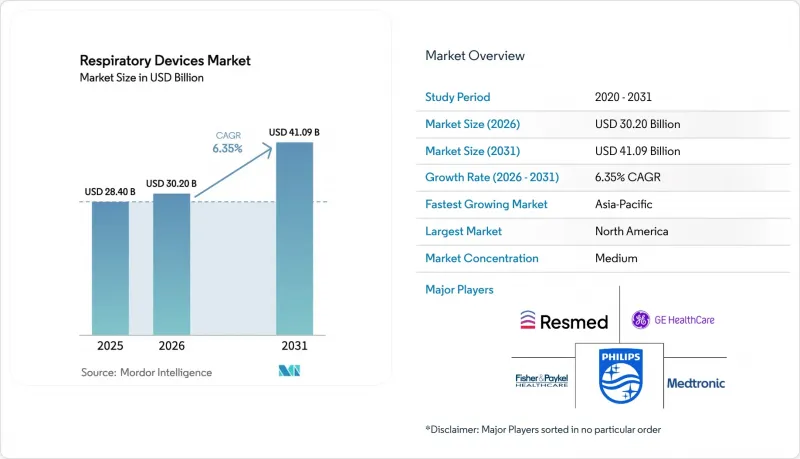
This report is Segmented by Device Type (Diagnostic and Monitoring Devices [Spirometers, and More], Therapeutic Devices, and Consumables and Disposables), Indication (COPD, Asthma, and More), Patient Age Group (Adult and Pediatric/Neonatal), End User (Hospitals, Respiratory and Sleep Clinics and More), and Geography (North America, and More). The Market Forecasts are Provided in Terms of Value (USD).
Global Respiratory Devices Market Trends and Insights
Surge in Prevalence of Respiratory Disorders
More than 545 million people live with chronic respiratory diseases, and COPD caused 3.2 million deaths in 2024. Dual-exposure patterns magnify the burden: older adults in wealthy countries experience age-linked lung decline, whereas low-income settings face indoor biomass combustion and severe outdoor particulate pollution. India's National Health Profile noted a 23% jump in asthma admissions among urban children under 15 during 2025 winter spikes of PM2.5 to 89 µg/m3. In the United States, sleep apnea prevalence reached 38% among adults over 50 in 2025, a trend tied to obesity plateaus and broader use of home sleep tests. Infectious diseases add to the load: tuberculosis recorded 10.8 million new cases in 2024, many requiring long nebulized regimens. These epidemiological realities keep demand high for diagnostic spirometers and therapeutic systems across the respiratory devices market.
Technological Advancements in Diagnostic & Therapeutic Devices
Miniaturization and connectivity shift sophisticated pulmonary testing from the lab to primary care. In 2025, the FDA cleared 14 AI-enabled spirometry platforms with 91% sensitivity for early COPD detection. Philips launched the DreamStation 3 CPAP in late 2024, integrating leak-compensation algorithms that reduced therapy abandonment by 19%. Mesh nebulizers attained 85% lung-deposit efficiency in 2025 trials, trimming medication waste. Portable oxygen concentrators now run eight hours at 2 l/min on lithium-iron-phosphate power packs. Ventilators featuring closed-loop automation cut ventilator-induced injury 27% in ICU environments, closing the performance gap between hospital and home devices.
High Cost of Advanced Devices
A hospital ICU ventilator lists for USD 25,000-50,000, while a home CPAP system ranges from USD 800-2,500-figures far above annual per-capita health budgets in many low-income nations. Only 18% of Indian COPD patients prescribed oxygen therapy actually acquire concentrators, underscoring affordability gaps. Tiered product lines aim to bridge the divide; ResMed's USD 650 AirMini CPAP omits cellular connectivity to hit cash-pay price points. Pay-per-use leasing via Kenya's M-TIBA lowers the barrier to USD 3 per day but still reaches less than 5% of potential users.
Other drivers and restraints analyzed in the detailed report include:
- Rapid Penetration of Home-Healthcare Respiratory Equipment
- Government Initiatives & Reimbursement Expansion
- Stringent Multi-Jurisdiction Regulatory Clearance
For complete list of drivers and restraints, kindly check the Table Of Contents.
Segment Analysis
Therapeutic platforms held 47.56% of revenue in 2025, and the segment is projected to grow at an 11.25% CAGR through 2031. The respiratory devices market size attributed to CPAP and BiPAP systems continues to swell on the back of rising obstructive sleep apnea diagnoses among adults over 50. Portable oxygen concentrators, now able to support eight-hour outdoor use, are also expanding access for ambulatory COPD patients. Home ventilators benefit from CMS reimbursement changes, while smart inhalers with Bluetooth dose logging reached 12% penetration in 2025.
Diagnostic and Monitoring systems captured 32% of 2025 revenue with a slower 5.8% CAGR as commoditization pressures margins. The respiratory devices market share for handheld, AI-guided spirometry is increasing, but average selling prices fell for pulse oximeters due to Chinese competition. Consumables such as single-use masks and tubing represented 20.45% of 2025 revenue and will track overall procedure volumes, especially as infection-control protocols remain stringent.
COPD generated 35.53% of 2025 sales, anchored by lifelong oxygen and bronchodilator needs. Yet Infectious Diseases-led by tuberculosis and pandemic preparedness spending-show the fastest 10.85% CAGR, lifting the respiratory devices market size allocated to mesh nebulizers and portable ventilators. Asthma retains a strong 28% share, with adherence-tracking inhalers now a payer focus. Sleep apnea remains significant in developed economies, while Other Respiratory Disorders, including cystic fibrosis, secure steady growth as survival rates improve.
Complete Report Scope:
- By Device Type
- Diagnostic & Monitoring Devices
- Spirometers
- Sleep Test Devices
- Peak Flow Meters
- Pulse Oximeters
- Capnographs
- Other Diagnostic & Monitoring Devices
- Therapeutic Devices
- CPAP Devices
- BiPAP Devices
- Humidifiers
- Nebulizers
- Oxygen Concentrators
- Ventilators
- Inhalers
- Other Therapeutic Devices
- Consumables & Disposables
- Masks
- Breathing Circuits & Tubing
- Other Disposables
- Diagnostic & Monitoring Devices
- By Indication
- COPD
- Asthma
- Sleep Apnea
- Infectious Diseases
- Other Respiratory Disorders
- By Patient Age Group
- Adult
- Pediatric / Neonatal
- By End User
- Hospitals
- Respiratory & Sleep Clinics
- Ambulatory Surgical & Emergency Centers
- Home Settings
- By Geography
- North America
- United States
- Canada
- Mexico
- Europe
- Germany
- United Kingdom
- France
- Italy
- Spain
- Rest of Europe
- Asia-Pacific
- China
- India
- Japan
- Australia
- South Korea
- Rest of Asia-Pacific
- Middle East and Africa
- GCC
- South Africa
- Rest of Middle East and Africa
- South America
- Brazil
- Argentina
- Rest of South America
- North America
Geography Analysis
North America generated 39.13% of 2025 revenue, with the United States alone spending USD 9.8 billion on respiratory equipment. Growth moderates to 6.2% as CPAP penetration approaches saturation, but software-enabled upgrades and home ventilator adoption still lift value. Canada's Assistive Devices Program added portable concentrators, and Mexico's social security institute widened CPAP coverage, adding incremental volumes.
Asia-Pacific is the fastest-growing region at a 10.51% CAGR. China's provincial reimbursement for home oxygen aims at 100 million COPD patients, while India's Ayushman Bharat subsidizes nebulizers for 500 million citizens. Japan's subsidy covering 70% of device costs for seniors accelerates the move to home ventilation, and South Korea broadened CPAP coverage to mild cases. Australia's expedited pathway for connected monitors further catalyzes product launches.
Europe accounted for 28% of 2025 revenue but grows at a muted 5.9% as CE-MDR bottlenecks slow new device rollouts. Germany remains the largest national market after approving home CPAP for mild cases. The United Kingdom boosted home respiratory allocations under its NHS Long Term Plan, and France raised monthly reimbursements for home ventilators, improving supplier economics.
Middle East and Africa held 6% of sales, powered by GCC hospital investments and South Africa's public-sector purchase of concentrators. South America contributed 5.87% as Brazil's SUS added home CPAP coverage for 1.2 million patients, offering fresh demand in a historically under-penetrated market.
- AirLife
- Asahi Kasei Corp. (ZOLL Medical)
- Baxter
- Beijing Aeonmed Co.
- Dragerwerk
- Fisher & Paykel Healthcare
- Flexicare (Group) Ltd
- GE Healthcare
- Getinge
- Hamilton Medical
- ICU Medical
- Koninklijke Philips
- Medical Depot Inc. (Drive DeVilbiss)
- Medikro Oy
- Medtronic
- Mindray Bio-Medical Electronics
- OMRON Healthcare
- React Health
- Resmed
- Teleflex
- Vyaire Medical
Additional Benefits:
- The market estimate (ME) sheet in Excel format
- 3 months of analyst support
TABLE OF CONTENTS
1 Introduction
- 1.1 Study Assumptions & Market Definition
- 1.2 Scope of the Study
2 Research Methodology
3 Executive Summary
4 Market Landscape
- 4.1 Market Overview
- 4.2 Market Drivers
- 4.2.1 Surge in prevalence of respiratory disorders
- 4.2.2 Technological advancements in diagnostic & therapeutic devices
- 4.2.3 Rapid penetration of home-healthcare respiratory equipment
- 4.2.4 Government initiatives & reimbursement expansion
- 4.2.5 Tele-connected respiratory care platforms enabling remote calibration
- 4.2.6 Demand for ultra-portable, low-noise oxygen concentrators post-COVID
- 4.3 Market Restraints
- 4.3.1 High cost of advanced devices
- 4.3.2 Stringent multi-jurisdiction regulatory clearance
- 4.3.3 Lithium-ion battery supply constraints for portable devices
- 4.3.4 Data-privacy concerns in connected respiratory monitors
- 4.4 Supply-Chain Analysis
- 4.5 Regulatory Outlook
- 4.6 Technological Outlook
- 4.7 Porter's Five Forces Analysis
- 4.7.1 Threat of New Entrants
- 4.7.2 Bargaining Power of Buyers
- 4.7.3 Bargaining Power of Suppliers
- 4.7.4 Threat of Substitutes
- 4.7.5 Competitive Rivalry
5 Market Size & Growth Forecasts (Value, USD)
- 5.1 By Device Type
- 5.1.1 Diagnostic & Monitoring Devices
- 5.1.1.1 Spirometers
- 5.1.1.2 Sleep Test Devices
- 5.1.1.3 Peak Flow Meters
- 5.1.1.4 Pulse Oximeters
- 5.1.1.5 Capnographs
- 5.1.1.6 Other Diagnostic & Monitoring Devices
- 5.1.2 Therapeutic Devices
- 5.1.2.1 CPAP Devices
- 5.1.2.2 BiPAP Devices
- 5.1.2.3 Humidifiers
- 5.1.2.4 Nebulizers
- 5.1.2.5 Oxygen Concentrators
- 5.1.2.6 Ventilators
- 5.1.2.7 Inhalers
- 5.1.2.8 Other Therapeutic Devices
- 5.1.3 Consumables & Disposables
- 5.1.3.1 Masks
- 5.1.3.2 Breathing Circuits & Tubing
- 5.1.3.3 Other Disposables
- 5.1.1 Diagnostic & Monitoring Devices
- 5.2 By Indication
- 5.2.1 COPD
- 5.2.2 Asthma
- 5.2.3 Sleep Apnea
- 5.2.4 Infectious Diseases
- 5.2.5 Other Respiratory Disorders
- 5.3 By Patient Age Group
- 5.3.1 Adult
- 5.3.2 Pediatric / Neonatal
- 5.4 By End User
- 5.4.1 Hospitals
- 5.4.2 Respiratory & Sleep Clinics
- 5.4.3 Ambulatory Surgical & Emergency Centers
- 5.4.4 Home Settings
- 5.5 By Geography
- 5.5.1 North America
- 5.5.1.1 United States
- 5.5.1.2 Canada
- 5.5.1.3 Mexico
- 5.5.2 Europe
- 5.5.2.1 Germany
- 5.5.2.2 United Kingdom
- 5.5.2.3 France
- 5.5.2.4 Italy
- 5.5.2.5 Spain
- 5.5.2.6 Rest of Europe
- 5.5.3 Asia-Pacific
- 5.5.3.1 China
- 5.5.3.2 India
- 5.5.3.3 Japan
- 5.5.3.4 Australia
- 5.5.3.5 South Korea
- 5.5.3.6 Rest of Asia-Pacific
- 5.5.4 Middle East and Africa
- 5.5.4.1 GCC
- 5.5.4.2 South Africa
- 5.5.4.3 Rest of Middle East and Africa
- 5.5.5 South America
- 5.5.5.1 Brazil
- 5.5.5.2 Argentina
- 5.5.5.3 Rest of South America
- 5.5.1 North America
6 Competitive Landscape
- 6.1 Market Concentration
- 6.2 Market Share Analysis
- 6.3 Company Profiles (includes Global level Overview, Market level overview, Core Segments, Financials as available, Strategic Information, Market Rank/Share for key companies, Products & Services, and Recent Developments)
- 6.3.1 AirLife
- 6.3.2 Asahi Kasei Corp. (ZOLL Medical)
- 6.3.3 Baxter
- 6.3.4 Beijing Aeonmed Co.
- 6.3.5 Dragerwerk AG
- 6.3.6 Fisher & Paykel Healthcare Ltd
- 6.3.7 Flexicare (Group) Ltd
- 6.3.8 GE HealthCare
- 6.3.9 Getinge
- 6.3.10 Hamilton Medical
- 6.3.11 ICU Medical Inc.
- 6.3.12 Koninklijke Philips N.V.
- 6.3.13 Medical Depot Inc. (Drive DeVilbiss)
- 6.3.14 Medikro Oy
- 6.3.15 Medtronic plc
- 6.3.16 Mindray Bio-Medical Electronics
- 6.3.17 OMRON Healthcare
- 6.3.18 React Health
- 6.3.19 ResMed
- 6.3.20 Teleflex Inc.
- 6.3.21 Vyaire Medical
7 Market Opportunities & Future Outlook
- 7.1 White-space & Unmet-Need Assessment

