PUBLISHER: Mordor Intelligence | PRODUCT CODE: 2122033

PUBLISHER: Mordor Intelligence | PRODUCT CODE: 2122033
Europe Fuel Cell - Market Share Analysis, Industry Trends & Statistics, Growth Forecasts (2026 - 2031)
According to Mordor Intelligence, the Europe fuel cell market size is estimated at USD 3.86 billion in 2026, and is expected to reach USD 17.25 billion by 2031, at a CAGR of 34.91% during the forecast period (2026-2031).
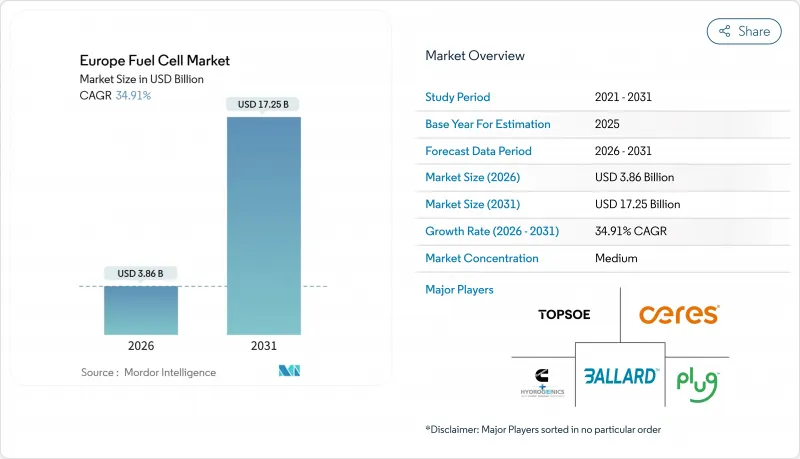
This report is Segmented by Technology (PEMFC, SOFC, AFC, and Others), Fuel Type (Hydrogen, Natural Gas/Methane, Ammonia, and Others), Application (Vehicular and Non-Vehicular), End-User Industry (Transportation, Utilities, Commercial and Industrial, and Others), and Geography (Germany, France, United Kingdom, Italy, Spain, NORDIC Countries, Netherlands, Russia, and Rest of Europe).
Europe Fuel Cell Market Trends and Insights
EU Green Deal & Fit-for-55 Hydrogen Targets
The Fit-for-55 package requires 42% of industrial hydrogen to come from renewable sources by 2030, rising to 60% by 2035, anchoring demand for fuel-cell applications across mobility and distributed power. Germany's 2024 National Hydrogen Strategy sets aside EUR 3.5 billion for 10 gigawatts of domestic electrolysers, while France's Plan Hydrogene 2.0 allocates EUR 5.4 billion for 6.5 gigawatts and 1,000 heavy-duty refueling points by 2030. The REPowerEU initiative targets 20 million tonnes of hydrogen consumption by 2030, stabilizing long-term offtake for the European fuel cell market. Renewable Fuel of Non-Biological Origin standards finalized in 2024 demand 70% lifecycle emissions savings versus fossil hydrogen, driving green-hydrogen projects. These policy anchors reduce regulatory risk for fleet operators evaluating multi-year investment horizons.
Rapid Build-Out of Electrolyser & H2-Refuelling Infrastructure
Operating electrolyser capacity climbed to 6.1 gigawatts by end-2025, with another 12 gigawatts in construction or committed financing. Germany's H2Global awarded EUR 900 million in import contracts, while the Netherlands completed 52 heavy-duty stations that close the Rotterdam-Lower Saxony corridor. Denmark's HySynergy couples a 250-megawatt electrolyser with offshore wind at Esbjerg, delivering hydrogen at EUR 3.20 per kilogram. TotalEnergies will retrofit 600 European service stations with hydrogen dispensers by 2028, accelerating network density. Infrastructure coverage is now sufficient for logistics managers to route long-haul trucks without detours, addressing a critical European fuel cell market adoption barrier.
High Platinum Content & Upfront CAPEX
PEMFCs require 0.3-0.5 grams of platinum per kilowatt, translating to USD 150-200 per kilowatt in catalyst cost at 2025 spot prices, roughly 25-30% of stack expense. Spain and Italy, where subsidies cover 40-50% of incremental cost, see payback periods stretching beyond typical fleet refresh cycles. Platinum supply is concentrated in South Africa and Russia, exposing European buyers to geopolitical risk. Recycling covers only 15-20% of end-of-life stacks versus 95% for catalytic converters, forcing reliance on virgin metal. Horizon Europe projects aim to commercialize PGM-free cathodes, but durability remains below the 10,000-hour target for heavy-duty trucks, constraining near-term cost reduction.
Other drivers and restraints analyzed in the detailed report include:
- Corporate Fleet Decarbonization Commitments (Buses & Trucks)
- IPCEI-Backed Fuel-Cell Gigafactories Reducing Stack Costs
- Sparse Heavy-Duty H2 Corridor Coverage
For complete list of drivers and restraints, kindly check the Table Of Contents.
Segment Analysis
Solid Oxide Fuel Cells are scaling at a 47.5% CAGR during 2026-2031, driven by an 85-90% combined heat-and-power efficiency at industrial sites. Ceres Power's Steel Cell operates at 500-650 °C, avoiding precious-metal catalysts and accepting natural gas, biogas, or hydrogen feeds, lowering fuel-switching risk. Bloom Energy installed 240 megawatts of SOFCs across European data centers in 2024-2025, providing 99.9% uptime. In contrast, Polymer Electrolyte Membrane Fuel Cells retained 59.9% market share in 2025 as rapid start-up and compact packaging underpin bus and truck applications. Within stationary power, phosphoric-acid and molten-carbonate technologies now account for less than 5% of the European fuel cell market size and continue to decline.
SOFC vendors benefit from policies that count high-temperature cogeneration toward industrial decarbonization targets. The European Commission's 2024 study projected SOFC total-cost-of-ownership undercutting gas engines by 2028 if hydrogen prices drop below EUR 4.00 per kilogram. Bosch's cellcentric venture is also integrating PEMFCs with battery-electric drivetrains for a 1,000-kilometer truck range, showing how multi-technology portfolios can hedge regulatory and material-cost risk. Consequently, technology choice is fragmenting along application lines inside the European fuel cell market.
Hydrogen held a 61.3% share in 2025 due to established 700-bar standards that mirror diesel refueling times. However, ammonia is outstripping all other fuels with a 51.1% CAGR through 2031 as maritime and island grids seek higher energy density and simpler logistics. Siemens Energy and Alfa Laval's 2-megawatt direct-ammonia SOFC aboard a Maersk vessel reached 60% efficiency without onboard cracking, meeting IMO Tier III NOx rules. Spain's Balearic Islands contracted AFC Energy for a 20-megawatt ammonia plant that displaces diesel gensets. Natural-gas-fed SOFCs captured a 12-15% share but face growth limits because fossil-derived fuels lack green-finance alignment.
IMO's mid-term GHG strategy mandates a 20% intensity cut by 2030 and 70% by 2040, making ammonia fuel cells central to transoceanic compliance. Methanol remains confined to regional fleets near production hubs, while biogas fuel cells occupy a negative-carbon-intensity niche at wastewater plants. Consequently, fuel diversification is reshaping supply chains and refueling infrastructure within the European fuel cell market.
Complete Report Scope:
- By Technology
- Polymer Electrolyte Membrane Fuel Cell (PEMFC)
- Solid Oxide Fuel Cell (SOFC)
- Alkaline Fuel Cell (AFC)
- Others [Phosphoric Acid Fuel Cell (PAFC), Molten Carbonate Fuel Cell (MCFC), Direct Methanol Fuel Cell (DMFC)]
- By Fuel Type
- Hydrogen
- Natural Gas/Methane
- Ammonia
- Others (Methanol, Biogas)
- By Application
- Vehicular (Passenger Cars, Buses & Coaches, Trucks, Material Handling Equipment, Rail, Marine Vessels)
- Non-Vehicular (Stationary Power, Portable Power, Micro-Combined Heat & Power)
- By End-User Industry
- Transportation
- Utilities
- Commercial and Industrial
- Others (Defense, Residential)
- By Geography
- Germany
- France
- United Kingdom
- Italy
- Spain
- NORDIC Countries
- Netherlands
- Russia
- Rest of Europe
List of Companies Covered in this Report:
- Ballard Power Systems
- Plug Power
- Cummins Inc.
- Topsoe
- Ceres Power
- PowerCell Sweden
- Bosch (cellcentric)
- ElringKlinger / EKPO
- Symbio
- Intelligent Energy
- Nedstack
- SFC Energy
- AFC Energy
- Bloom Energy
- Doosan Fuel Cell
- ITM Power
- Proton Motor Fuel Cell
- Nuvera Fuel Cells
- Alstom
- Siemens Energy
- Toyota Motor Europe
Additional Benefits:
- The market estimate (ME) sheet in Excel format
- 3 months of analyst support
TABLE OF CONTENTS
1 Introduction
- 1.1 Study Assumptions & Market Definition
- 1.2 Scope of the Study
2 Research Methodology
3 Executive Summary
4 Market Landscape
- 4.1 Market Overview
- 4.2 Market Drivers
- 4.2.1 EU Green Deal & Fit-for-55 hydrogen targets
- 4.2.2 Rapid build-out of electrolyser & H2-refuelling infrastructure
- 4.2.3 Corporate fleet decarbonisation commitments (buses & trucks)
- 4.2.4 Surplus North-Sea wind-to-hydrogen projects lowering LCOH
- 4.2.5 IPCEI-backed fuel-cell gigafactories reducing stack costs
- 4.2.6 EU sustainable-finance taxonomy unlocking low-cost capital
- 4.3 Market Restraints
- 4.3.1 High platinum content & upfront CAPEX
- 4.3.2 Sparse heavy-duty H2 corridor coverage
- 4.3.3 Impending PFAS restrictions on PEM membranes
- 4.3.4 Grid-congestion delays to renewable powered electrolysers
- 4.4 Supply-Chain Analysis
- 4.5 Regulatory Landscape
- 4.6 Technological Outlook
- 4.7 Porter's Five Forces
- 4.7.1 Bargaining Power of Suppliers
- 4.7.2 Bargaining Power of Consumers
- 4.7.3 Threat of New Entrants
- 4.7.4 Threat of Substitutes
- 4.7.5 Competitive Rivalry
5 Market Size & Growth Forecasts
- 5.1 By Technology
- 5.1.1 Polymer Electrolyte Membrane Fuel Cell (PEMFC)
- 5.1.2 Solid Oxide Fuel Cell (SOFC)
- 5.1.3 Alkaline Fuel Cell (AFC)
- 5.1.4 Others [Phosphoric Acid Fuel Cell (PAFC), Molten Carbonate Fuel Cell (MCFC), Direct Methanol Fuel Cell (DMFC)]
- 5.2 By Fuel Type
- 5.2.1 Hydrogen
- 5.2.2 Natural Gas/Methane
- 5.2.3 Ammonia
- 5.2.4 Others (Methanol, Biogas)
- 5.3 By Application
- 5.3.1 Vehicular (Passenger Cars, Buses & Coaches, Trucks, Material Handling Equipment, Rail, Marine Vessels)
- 5.3.2 Non-Vehicular (Stationary Power, Portable Power, Micro-Combined Heat & Power)
- 5.4 By End-User Industry
- 5.4.1 Transportation
- 5.4.2 Utilities
- 5.4.3 Commercial and Industrial
- 5.4.4 Others (Defense, Residential)
- 5.5 By Geography
- 5.5.1 Germany
- 5.5.2 France
- 5.5.3 United Kingdom
- 5.5.4 Italy
- 5.5.5 Spain
- 5.5.6 NORDIC Countries
- 5.5.7 Netherlands
- 5.5.8 Russia
- 5.5.9 Rest of Europe
6 Competitive Landscape
- 6.1 Market Concentration
- 6.2 Strategic Moves (M&A, Partnerships, PPAs)
- 6.3 Market Share Analysis (Market Rank/Share for key companies)
- 6.4 Company Profiles (includes Global level Overview, Market level overview, Core Segments, Financials as available, Strategic Information, Products & Services, and Recent Developments)
- 6.4.1 Ballard Power Systems
- 6.4.2 Plug Power
- 6.4.3 Cummins Inc.
- 6.4.4 Topsoe
- 6.4.5 Ceres Power
- 6.4.6 PowerCell Sweden
- 6.4.7 Bosch (cellcentric)
- 6.4.8 ElringKlinger / EKPO
- 6.4.9 Symbio
- 6.4.10 Intelligent Energy
- 6.4.11 Nedstack
- 6.4.12 SFC Energy
- 6.4.13 AFC Energy
- 6.4.14 Bloom Energy
- 6.4.15 Doosan Fuel Cell
- 6.4.16 ITM Power
- 6.4.17 Proton Motor Fuel Cell
- 6.4.18 Nuvera Fuel Cells
- 6.4.19 Alstom
- 6.4.20 Siemens Energy
- 6.4.21 Toyota Motor Europe
7 Market Opportunities & Future Outlook
- 7.1 White-space & Unmet-Need Assessment

