PUBLISHER: Mordor Intelligence | PRODUCT CODE: 2122171

PUBLISHER: Mordor Intelligence | PRODUCT CODE: 2122171
Food Packaging Testing - Market Share Analysis, Industry Trends & Statistics, Growth Forecasts (2026 - 2031)
According to Mordor Intelligence, food packaging testing market size in 2026 is estimated at USD 5.62 billion, growing from 2025 value of USD 5.22 billion with 2031 projections showing USD 8.14 billion, growing at 7.69% CAGR over 2026-2031.
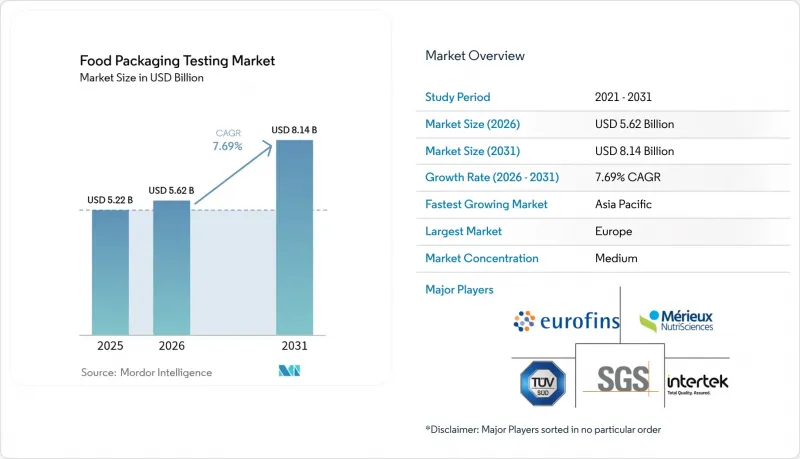
This report is Segmented by Type (Physical Tests, and Chemical Tests), Material (Plastic, Glass, Metal, Paper and Board, and Layer Packaging), and Geography (North America, Europe, Asia-Pacific, South America, and Middle East and Africa). The Market Forecasts are Provided in Terms of Value (USD).
Global Food Packaging Testing Market Trends and Insights
Consumer Awareness Drives Advanced Safety Testing Protocols
Consumer awareness regarding food safety and health concerns has undergone a significant transformation, moving beyond traditional pathogen detection methods to incorporate sophisticated chemical migration analysis and comprehensive endocrine disruptor screening. The European Union's decisive action to ban bisphenol A (BPA) in food contact materials, which takes effect in July 2026 with minimal exceptions, illustrates the growing emphasis on preventive regulation driven by public health considerations. Testing laboratories have observed a substantial increase in demand for NIAS (Non-Intentionally Added Substances) identification services, with research revealing that 61 out of 68 detected PFAS compounds in food contact materials were identified as non-intentionally added substances not currently included in regulatory inventories . This industry-wide development has necessitated substantial investments in sophisticated analytical equipment, particularly high-resolution mass spectrometry systems and comprehensive non-target screening methodologies. The regulatory landscape continues to evolve, with the FDA providing detailed guidance on chemistry recommendations while EFSA works to establish more comprehensive NIAS assessment protocols to ensure consumer safety.
Processed Food Sector Expansion Accelerates Packaging Innovation Testing
The continuous expansion of the global processed and packaged food market creates increasing demand for sophisticated packaging solutions. These solutions must effectively maintain product quality and safety across complex international supply chains while meeting stringent regulatory standards across different regions. For ready-to-eat food products, manufacturers must conduct comprehensive shelf-life validation studies that include detailed microbiological challenge testing, with particular emphasis on Listeria monocytogenes risk assessment as mandated by Regulation (EC) 2073/2005 . The industry has widely adopted accelerated shelf-life testing protocols, as research demonstrates their successful implementation for short-shelf-life products through controlled thermal abuse conditions and Q10 calculations in kinetic modeling. The investment in these critical testing procedures varies significantly, with basic six-month shelf-stable studies ranging from USD 400-800, while more complex high-risk challenge studies can cost between USD 900-2,000 or more, reflecting both the technical sophistication required and the comprehensive regulatory compliance measures .
High Technology Costs Create Market Access Barriers
The substantial investment required for advanced testing technologies and facilities poses a significant barrier to market expansion, particularly impacting laboratories in developing regions and smaller testing facilities. The specialized nature of PFAS analysis demands sophisticated high-resolution mass spectrometry systems, while conducting migration tests requires dedicated environmental chambers and precise analytical instruments. The stringent regulatory landscape, exemplified by the EU's strict PFAS detection requirements of 25 ppb for individual substances and 250 ppb for total measurements, necessitates laboratories to make considerable financial commitments in highly sensitive analytical equipment. In response to these cost challenges, industry leaders such as SGS, Eurofins, and Merieux NutriSciences are pursuing strategic acquisitions to create larger laboratory networks, enabling them to spread their infrastructure investments across a broader testing volume base and achieve operational efficiencies.
Other drivers and restraints analyzed in the detailed report include:
- E-commerce Growth Transforms Packaging Performance Requirements
- Sustainability Focus Drives Advanced Material Testing and Circular Economy Validation
- Regulatory Fragmentation Challenges Global Harmonization
For complete list of drivers and restraints, kindly check the Table Of Contents.
Segment Analysis
The chemical testing segment maintains its strong market position with a substantial 62.10% share in 2025. This dominance stems from its comprehensive capabilities in migration analysis, PFAS detection, and NIAS identification. The segment has experienced significant growth following the implementation of expanded regulations, particularly the EU 2025/351, which now encompasses substances found in adhesives, coatings, and printing inks applied to plastics. Testing laboratories have responded to these requirements by implementing sophisticated GC-MS and LC-MS methodologies for specific migration testing, while also investing in high-resolution mass spectrometry equipment to conduct thorough non-target screening procedures.
The physical testing segment demonstrates remarkable market momentum, achieving the highest growth rate at 8.32% CAGR. This growth is primarily fueled by the increasing demands of e-commerce packaging validation requirements and the implementation of accelerated shelf-life testing protocols. The segment has evolved to meet industry needs by incorporating comprehensive thermal shock testing in accordance with EN 1183:1997 standards. Additionally, testing facilities have enhanced their capabilities in barrier efficiency assessment through the implementation of surrogate compound breakthrough methods, reflecting the industry's shift toward more performance-based validation approaches.
Complete Report Scope:
- By Type
- Physical Tests
- Durability Testing
- Heat Resistance Testing
- Water Vapor /Gas Permeability Testing
- Chemical Tests
- Migration Testing
- Extractable Testing
- Leachable Testing
- Others
- Physical Tests
- By Material
- Plastic
- Glass
- Metal
- Paper and Board
- Layer Packaging
- By Geography
- North America
- United States
- Canada
- Mexico
- Rest of North America
- Europe
- Germany
- United Kingdom
- Italy
- France
- Spain
- Rest of Europe
- Asia-Pacific
- China
- India
- Japan
- Australia
- Rest of Asia-Pacific
- South America
- Brazil
- Argentina
- Rest of South America
- Middle East and Africa
- South Africa
- Saudi Arabia
- United Arab Emirates
- Rest of Middle East and Africa
- North America
Geography Analysis
The European market demonstrates its dominance in the global landscape, commanding a substantial 30.78% market share in 2025. This leadership position stems from the region's well-established regulatory infrastructure, anchored by the Framework Regulation (EC) 1935/2004 and various material-specific directives. The sophisticated regulatory environment has created a robust demand for advanced testing services, with particular emphasis on PFAS analysis and NIAS assessment following EFSA guidelines. The implementation of the EU's PPWR in August 2026 further strengthens this framework by introducing stringent PFAS limits and recyclability requirements, which in turn necessitates expanded testing capabilities. The region's technical prowess is exemplified by Germany's specialized expertise in mineral oil migration testing and the Netherlands' sophisticated PFAS analytical capabilities.
The Asia-Pacific region has emerged as the most dynamic market segment, achieving an impressive growth rate of 9.06% CAGR. This remarkable expansion is primarily attributed to China's ongoing regulatory modernization efforts and the rapid development of its food processing industries. The region's growth trajectory is further reinforced by China's National Health Commission's upcoming implementation of five new testing method standards in September 2025, which will generate substantial testing requirements. Additionally, Japan's comprehensive positive list system for synthetic resins mandates thorough substance validation, contributing to the region's expanding market presence.
The North American market maintains a stable growth pattern, supported by the FDA's comprehensive regulatory oversight and increasingly stringent state-level PFAS restrictions. Several states, including California, Connecticut, and Maine, have taken proactive measures by implementing PFAS prohibitions in food packaging. The market's development is further influenced by the FDA's voluntary industry phase-out of PFAS grease-proofing agents, which necessitates continuous monitoring and compliance measures across the industry.
- SGS Societe Generale de Surveillance SA
- Eurofins Scientific
- Intertek Group plc
- Merieux NutriSciences
- TUV SUD
- ALS Limited
- UL Solutions
- NSF International
- TUV Rheinland Group
- Element Materials Technology
- Smithers (Group)
- Labthink Instruments
- Microbac Laboratories Inc.
- AGQ Labs
- LGC Group
- QIMA Limited
- IFP Institute for Product Quality
- Tentamus Group
- EMSL Analytical Inc.
- Campden BRI
Additional Benefits:
- The market estimate (ME) sheet in Excel format
- 3 months of analyst support
TABLE OF CONTENTS
1 INTRODUCTION
- 1.1 Study Assumptions and Market Definition
- 1.2 Scope of the Study
2 RESEARCH METHODOLOGY
3 EXECUTIVE SUMMARY
4 MARKET LANDSCAPE
- 4.1 Market Overview
- 4.2 Market Drivers
- 4.2.1 Increasing consumer awareness about food safety and health concerns
- 4.2.2 Growing demand for processed and packaged food sectors
- 4.2.3 Expansion of e-commerce and online grocery shopping
- 4.2.4 Rising focus on sustainable and eco-friendly packaging solutions
- 4.2.5 Fueling demand for longer shelf-life and ready-to-eat food products
- 4.2.6 Development of testing laboratories and service providers globally
- 4.3 Market Restraints
- 4.3.1 High cost of advanced testing technologies and facilities
- 4.3.2 Lack of standardized and uniform testing methods globally
- 4.3.3 Complexity and variation in regulatory requirements across regions
- 4.3.4 Shortage of skilled personnel qualified for specialized testing
- 4.4 Technology Outlook
- 4.5 Regulatory Outlook
- 4.6 Porter's Five Forces
- 4.6.1 Threat of New Entrants
- 4.6.2 Bargaining Power of Buyers/Consumers
- 4.6.3 Bargaining Power of Suppliers
- 4.6.4 Threat of Substitute Products
- 4.6.5 Intensity of Competitive Rivalry
5 MARKET SIZE AND GROWTH FORECASTS (VALUE)
- 5.1 By Type
- 5.1.1 Physical Tests
- 5.1.1.1 Durability Testing
- 5.1.1.2 Heat Resistance Testing
- 5.1.1.3 Water Vapor /Gas Permeability Testing
- 5.1.2 Chemical Tests
- 5.1.2.1 Migration Testing
- 5.1.2.2 Extractable Testing
- 5.1.2.3 Leachable Testing
- 5.1.2.4 Others
- 5.1.1 Physical Tests
- 5.2 By Material
- 5.2.1 Plastic
- 5.2.2 Glass
- 5.2.3 Metal
- 5.2.4 Paper and Board
- 5.2.5 Layer Packaging
- 5.3 By Geography
- 5.3.1 North America
- 5.3.1.1 United States
- 5.3.1.2 Canada
- 5.3.1.3 Mexico
- 5.3.1.4 Rest of North America
- 5.3.2 Europe
- 5.3.2.1 Germany
- 5.3.2.2 United Kingdom
- 5.3.2.3 Italy
- 5.3.2.4 France
- 5.3.2.5 Spain
- 5.3.2.6 Rest of Europe
- 5.3.3 Asia-Pacific
- 5.3.3.1 China
- 5.3.3.2 India
- 5.3.3.3 Japan
- 5.3.3.4 Australia
- 5.3.3.5 Rest of Asia-Pacific
- 5.3.4 South America
- 5.3.4.1 Brazil
- 5.3.4.2 Argentina
- 5.3.4.3 Rest of South America
- 5.3.5 Middle East and Africa
- 5.3.5.1 South Africa
- 5.3.5.2 Saudi Arabia
- 5.3.5.3 United Arab Emirates
- 5.3.5.4 Rest of Middle East and Africa
- 5.3.1 North America
6 COMPETITIVE LANDSCAPE
- 6.1 Market Concentration
- 6.2 Strategic Moves
- 6.3 Market Ranking Analysis
- 6.4 Company Profiles (includes Global-level Overview, Market-level Overview, Core Segments, Financials (if available), Strategic Information, Market Rank/Share, Products and Services, Recent Developments)
- 6.4.1 SGS Societe Generale de Surveillance SA
- 6.4.2 Eurofins Scientific
- 6.4.3 Intertek Group plc
- 6.4.4 Merieux NutriSciences
- 6.4.5 TUV SUD
- 6.4.6 ALS Limited
- 6.4.7 UL Solutions
- 6.4.8 NSF International
- 6.4.9 TUV Rheinland Group
- 6.4.10 Element Materials Technology
- 6.4.11 Smithers (Group)
- 6.4.12 Labthink Instruments
- 6.4.13 Microbac Laboratories Inc.
- 6.4.14 AGQ Labs
- 6.4.15 LGC Group
- 6.4.16 QIMA Limited
- 6.4.17 IFP Institute for Product Quality
- 6.4.18 Tentamus Group
- 6.4.19 EMSL Analytical Inc.
- 6.4.20 Campden BRI
7 MARKET OPPORTUNITIES AND FUTURE OUTLOOK

