PUBLISHER: Mordor Intelligence | PRODUCT CODE: 2122225

PUBLISHER: Mordor Intelligence | PRODUCT CODE: 2122225
Advanced Authentication - Market Share Analysis, Industry Trends & Statistics, Growth Forecasts (2026 - 2031)
According to Mordor Intelligence, the advanced authentication market size is expected to increase from USD 17.71 billion in 2025 to USD 20.56 billion in 2026 and reach USD 38.23 billion by 2031, growing at a CAGR of 13.21% over 2026-2031.
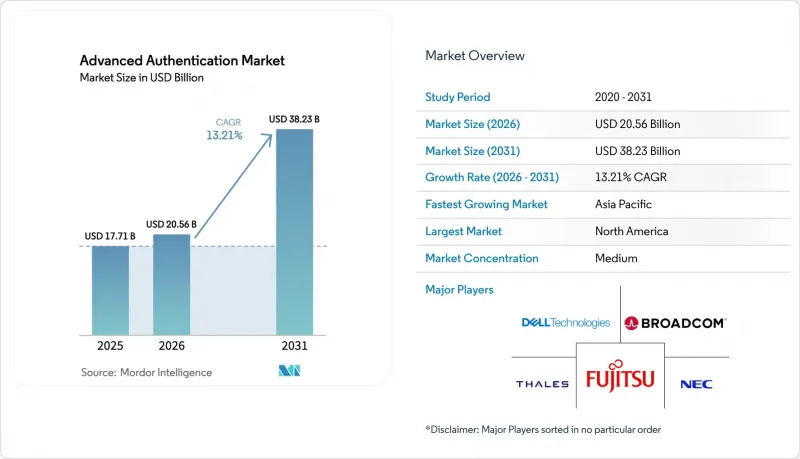
This report is Segmented by Component (Hardware, Software, Services), Authentication Method (Smart Cards, Biometrics, and More), Authentication Model (Two-Factor Authentication (2FA), Risk-Based Authentication, and More), Deployment Mode (On-Premise, and Cloud), End-User Industry (Government (Civil), Defense, and More), and Geography. The Market Forecasts are Provided in Terms of Value (USD).
Global Advanced Authentication Market Trends and Insights
Surging Cloud Adoption Driving Zero-Trust Architectures
Enterprises shifting workloads into public clouds discovered that traditional network perimeter defenses no longer apply, so identity verification became the primary control point. The U.S. Cybersecurity and Infrastructure Security Agency issued a zero-trust maturity model in 2024, positioning phishing-resistant credentials and continuous validation as foundational pillars. Cloud providers expose authentication through gateways that trigger step-up challenges whenever sensitive resources are requested, trimming lateral movement in breaches by 70% according to Microsoft's 2025 Digital Defense Report. Multi-tenant software-as-a-service applications further amplify demand, as each tenant requires granular, policy-driven authentication without bespoke configuration. Integration between authentication platforms and cloud access security brokers is becoming mainstream, creating a unified view of user context across identity and network layers. As a result, purchase decisions increasingly favor vendors that can embed risk signals directly into cloud application workflows rather than rely on separate on-premise gateways.
Rising Security Breach Costs and Cyber-Insurance Premiums
The average data breach cost hit USD 4.88 million in 2024, with compromised credentials implicated in 16% of incidents. Cyber-insurance underwriters reacted by mandating multi-factor authentication on privileged and remote accounts before issuing or renewing policies, transforming authentication from an optional enhancement into a prerequisite for coverage. Enterprises now weigh authentication investments against potential premium surcharges and regulatory fines, the latter totaling EUR 1.6 billion (USD 1.7 billion) under the General Data Protection Regulation in 2024. The financial calculus is clear: failing to modernize authentication not only elevates breach risk but also drives direct cost increases. Consequently, mid-market organizations that once delayed upgrades due to budget limitations are accelerating adoption to maintain insurability and compliance.
High Upgrade and Token Replacement Costs
Replacing legacy one-time-password tokens with modern credentials can cost USD 50-100 per user when procurement, enrollment, and support are factored in. Migration often requires consulting engagements priced at around USD 200,000 for mid-sized deployments, putting pressure on budgets in cost-sensitive sectors. Survey data from the Identity Defined Security Alliance showed that 38% of enterprises cited cost as the main barrier to adoption, despite recognizing breach risks. Subscription cloud services offset some capital outlay, yet the initial transition still weighs on short-term budgets, particularly in emerging economies where IT spend is tightly constrained.
Other drivers and restraints analyzed in the detailed report include:
- Accelerated Remote Workforce After 2025
- Mandatory Multi-Factor Authentication Compliance in Regulated Sectors
- Interoperability Gaps Across Legacy Infrastructure
For complete list of drivers and restraints, kindly check the Table Of Contents.
Segment Analysis
Services revenue within the advanced authentication market is projected to expand at 13.83% annually through 2031, reflecting buyers' preference for outsourced policy design, integration, and 24/7 monitoring that relieve internal teams of the complexity. Software still accounted for 47.89% of 2025 revenue because cloud identity suites embed authentication, governance, and analytics into a single console. Hardware, including smart-card readers and biometric scanners, remains essential for air-gapped defense and critical infrastructure, yet its growth lags as passwordless mobile credentials proliferate. Hospitals illustrate the pivot toward services: consultants map intricate clinical roles to least-privilege access rules, then run managed operations that guarantee audit-ready reporting. As enterprises mature, they see incremental value in continuous optimization rather than in the initial technology license, shifting wallet share to managed security service providers.
This tilt underscores how the advanced authentication market share for value-added services will keep widening. Cloud vendors encourage the shift by offering modular subscriptions that bundle support hours, compliance templates, and orchestration playbooks, blurring the line between product and service. Systems integrators also package authentication with broader zero-trust rollouts, further accelerating demand for services. Meanwhile, hardware refreshes stay cyclical and narrowly scoped, sustaining but not expanding their portion of total spend. The competitive edge, therefore, lies in domain expertise and outcome-based contracts rather than point features.
Biometrics accounted for 55.72% of 2025 revenue, yet growth is decelerating as regional privacy constraints and market saturation curb new deployments. Behavioral analytics adds momentum, recording the fastest 14.47% CAGR, as passive keystroke, mouse movement, and navigation analysis authenticate users continuously without interrupting workflow. Banks integrate behavioral risk scores into fraud engines, preventing account takeover in real time and improving customer retention. Fingerprint sensors remain ubiquitous on smartphones, but gloves, moisture, and ambient light reduce accuracy in industrial and healthcare settings, prompting interest in multimodal or behavioral options. Facial recognition divides markets, enjoying favorable regulation in parts of the Asia-Pacific while meeting resistance under Europe's General Data Protection Regulation.
Behavioral analytics, therefore, captures a growing share of the advanced authentication market as enterprises seek frictionless security that minimizes helpdesk calls. Vendors differentiate through proprietary machine-learning models that quickly personalize baselines and adapt to subtle user shifts, enhancing both security and the user experience. As adoption climbs, pricing pressure on commodity biometric hardware intensifies, nudging suppliers to bundle analytics and orchestration services. The long-term trajectory suggests coexistence, with biometrics anchoring high-assurance use cases and behavior filling continuous verification gaps.
Complete Report Scope:
- By Component
- Hardware
- Software
- Services
- By Authentication Method
- Smart Cards
- Biometrics
- Fingerprint Recognition
- Iris and Retina Recognition
- Facial Recognition
- Voice Recognition
- Mobile Smart Credentials
- Tokens
- User-based Public Key Infrastructure
- Behavioral Analytics
- By Authentication Model
- Two-Factor Authentication (2FA)
- Multi-Factor Authentication (MFA)
- Continuous and Adaptive Authentication
- Risk-Based Authentication
- By Deployment Mode
- On-Premise
- Cloud
- By End-user Industry
- Banking, Financial Services and Insurance (BFSI)
- Healthcare and Life Sciences
- Government (Civil)
- Defense
- IT and Telecom
- Retail and eCommerce
- Energy and Utilities
- Transportation and Logistics
- Other End-user Industries
- By Geography
- North America
- United States
- Canada
- Mexico
- Europe
- Germany
- United Kingdom
- France
- Russia
- Rest of Europe
- Asia-Pacific
- China
- Japan
- India
- South Korea
- Australia
- Rest of Asia-Pacific
- Middle East and Africa
- Middle East
- Saudi Arabia
- United Arab Emirates
- Rest of Middle East
- Africa
- South Africa
- Egypt
- Rest of Africa
- Middle East
- South America
- Brazil
- Argentina
- Rest of South America
- North America
Geography Analysis
North America contributed 38.91% of 2025 revenue as early zero-trust initiatives rippled from federal agencies to commercial enterprises. The Office of Management and Budget memorandum M-22-09 required government entities to deploy phishing-resistant authentication, and state and local administrations soon mirrored federal procurement practices. Canada updated its privacy law in 2024, introducing punitive breach fines that boosted enterprise investment in multi-factor and passwordless solutions. Although Mexico's fintech regulations accelerated adoption in banking, budget constraints slowed rollouts in other sectors despite rising breach activity.
Europe maintains a meaningful presence as the General Data Protection Regulation's accountability principle obliges the implementation of demonstrable technical controls, and the Digital Operational Resilience Act explicitly prescribes adaptive authentication for financial services. Germany's technical guidelines for critical infrastructure and the United Kingdom's push toward passwordless verification further anchor demand. Russia enforces local-server requirements for credential storage, complicating multinationals' cloud adoption.
Asia-Pacific is projected to grow at 14.24% through 2031, the highest regional rate. China's Cybersecurity Law amendments mandate multi-factor authentication for critical information infrastructure operators, while India's Aadhaar program processes over 2 billion biometric verifications monthly, normalizing passwordless login across public and private sectors. Japan's privacy amendments and South Korea's financial guidelines intensify local compliance requirements, driving enterprises toward adaptive solutions. Australia's Essential Eight framework upgraded multi-factor authentication from recommended to mandatory, influencing government and critical-infrastructure spending.
The Middle East and Africa show uneven adoption. The United Arab Emirates imposed authentication standards for government portals, while Saudi Arabia's Essential Cybersecurity Controls require multi-factor authentication in critical sectors. South Africa enforces reasonable security measures under the Protection of Personal Information Act, yet implementation varies across industries. South America centers on Brazil, where open banking regulations mandate strong customer authentication, while other economies lag due to fiscal headwinds.
- Thales S.A.
- NEC Corporation
- Broadcom Inc.
- Fujitsu Limited
- Dell Technologies Inc.
- Cisco Systems, Inc.
- Microsoft Corporation
- Google LLC
- Okta, Inc.
- Ping Identity Holding Corp.
- OneSpan Inc.
- Yubico AB
- IDEMIA Identity & Security France SAS
- HID Global Corporation
- Entrust Corporation
- ForgeRock, Inc.
- SecureAuth Corporation
- CyberArk Software Ltd.
- ValidSoft (Ireland) Limited
- SecurEnvoy Limited
- PistolStar, Inc.
- BioCatch Ltd.
Additional Benefits:
- The market estimate (ME) sheet in Excel format
- 3 months of analyst support
TABLE OF CONTENTS
1 INTRODUCTION
- 1.1 Study Assumptions and Market Definition
- 1.2 Scope of the Study
2 RESEARCH METHODOLOGY
3 EXECUTIVE SUMMARY
4 MARKET LANDSCAPE
- 4.1 Market Overview
- 4.2 Market Drivers
- 4.2.1 Surging Cloud Adoption Driving Zero-Trust Architectures
- 4.2.2 Rising Security Breach Costs and Cyber-Insurance Premiums
- 4.2.3 Accelerated Remote Workforce After 2025
- 4.2.4 Mandatory Multi-Factor Authentication Compliance in Regulated Sectors
- 4.2.5 Device-Embedded Hardware Roots of Trust in Consumer Electronics
- 4.2.6 Quantum-Resistant Cryptography Investments by Governments
- 4.3 Market Restraints
- 4.3.1 High Upgrade and Token Replacement Costs
- 4.3.2 Interoperability Gaps Across Legacy Infrastructure
- 4.3.3 User Friction Leading to Authentication Fatigue
- 4.3.4 Shortage of Skilled IAM Professionals
- 4.4 Industry Value Chain Analysis
- 4.5 Impact of Macroeconomic Factors on the Market
- 4.6 Regulatory Landscape
- 4.7 Technological Outlook
- 4.8 Porter's Five Forces Analysis
- 4.8.1 Threat of New Entrants
- 4.8.2 Bargaining Power of Buyers
- 4.8.3 Bargaining Power of Suppliers
- 4.8.4 Threat of Substitute Products
- 4.8.5 Intensity of Competitive Rivalry
5 MARKET SIZE AND GROWTH FORECASTS (VALUE)
- 5.1 By Component
- 5.1.1 Hardware
- 5.1.2 Software
- 5.1.3 Services
- 5.2 By Authentication Method
- 5.2.1 Smart Cards
- 5.2.2 Biometrics
- 5.2.2.1 Fingerprint Recognition
- 5.2.2.2 Iris and Retina Recognition
- 5.2.2.3 Facial Recognition
- 5.2.2.4 Voice Recognition
- 5.2.3 Mobile Smart Credentials
- 5.2.4 Tokens
- 5.2.5 User-based Public Key Infrastructure
- 5.2.6 Behavioral Analytics
- 5.3 By Authentication Model
- 5.3.1 Two-Factor Authentication (2FA)
- 5.3.2 Multi-Factor Authentication (MFA)
- 5.3.3 Continuous and Adaptive Authentication
- 5.3.4 Risk-Based Authentication
- 5.4 By Deployment Mode
- 5.4.1 On-Premise
- 5.4.2 Cloud
- 5.5 By End-user Industry
- 5.5.1 Banking, Financial Services and Insurance (BFSI)
- 5.5.2 Healthcare and Life Sciences
- 5.5.3 Government (Civil)
- 5.5.4 Defense
- 5.5.5 IT and Telecom
- 5.5.6 Retail and eCommerce
- 5.5.7 Energy and Utilities
- 5.5.8 Transportation and Logistics
- 5.5.9 Other End-user Industries
- 5.6 By Geography
- 5.6.1 North America
- 5.6.1.1 United States
- 5.6.1.2 Canada
- 5.6.1.3 Mexico
- 5.6.2 Europe
- 5.6.2.1 Germany
- 5.6.2.2 United Kingdom
- 5.6.2.3 France
- 5.6.2.4 Russia
- 5.6.2.5 Rest of Europe
- 5.6.3 Asia-Pacific
- 5.6.3.1 China
- 5.6.3.2 Japan
- 5.6.3.3 India
- 5.6.3.4 South Korea
- 5.6.3.5 Australia
- 5.6.3.6 Rest of Asia-Pacific
- 5.6.4 Middle East and Africa
- 5.6.4.1 Middle East
- 5.6.4.1.1 Saudi Arabia
- 5.6.4.1.2 United Arab Emirates
- 5.6.4.1.3 Rest of Middle East
- 5.6.4.2 Africa
- 5.6.4.2.1 South Africa
- 5.6.4.2.2 Egypt
- 5.6.4.2.3 Rest of Africa
- 5.6.4.1 Middle East
- 5.6.5 South America
- 5.6.5.1 Brazil
- 5.6.5.2 Argentina
- 5.6.5.3 Rest of South America
- 5.6.1 North America
6 COMPETITIVE LANDSCAPE
- 6.1 Market Concentration
- 6.2 Strategic Moves
- 6.3 Market Share Analysis
- 6.4 Company Profiles (includes Global Level Overview, Market Level Overview, Core Segments, Financials as available, Strategic Information, Market Rank/Share for key companies, Products and Services, and Recent Developments)
- 6.4.1 Thales S.A.
- 6.4.2 NEC Corporation
- 6.4.3 Broadcom Inc.
- 6.4.4 Fujitsu Limited
- 6.4.5 Dell Technologies Inc.
- 6.4.6 Cisco Systems, Inc.
- 6.4.7 Microsoft Corporation
- 6.4.8 Google LLC
- 6.4.9 Okta, Inc.
- 6.4.10 Ping Identity Holding Corp.
- 6.4.11 OneSpan Inc.
- 6.4.12 Yubico AB
- 6.4.13 IDEMIA Identity & Security France SAS
- 6.4.14 HID Global Corporation
- 6.4.15 Entrust Corporation
- 6.4.16 ForgeRock, Inc.
- 6.4.17 SecureAuth Corporation
- 6.4.18 CyberArk Software Ltd.
- 6.4.19 ValidSoft (Ireland) Limited
- 6.4.20 SecurEnvoy Limited
- 6.4.21 PistolStar, Inc.
- 6.4.22 BioCatch Ltd.
7 MARKET OPPORTUNITIES AND FUTURE OUTLOOK
- 7.1 White-Space and Unmet-Need Assessment

