PUBLISHER: Mordor Intelligence | PRODUCT CODE: 2122264

PUBLISHER: Mordor Intelligence | PRODUCT CODE: 2122264
GaN RF Semiconductor Devices - Market Share Analysis, Industry Trends & Statistics, Growth Forecasts (2026 - 2031)
According to Mordor Intelligence, the GaN RF semiconductor devices market size in 2026 is estimated at USD 1.75 billion, growing from 2025 value of USD 1.60 billion with 2031 projections showing USD 2.77 billion, growing at 9.55% CAGR over 2026-2031.
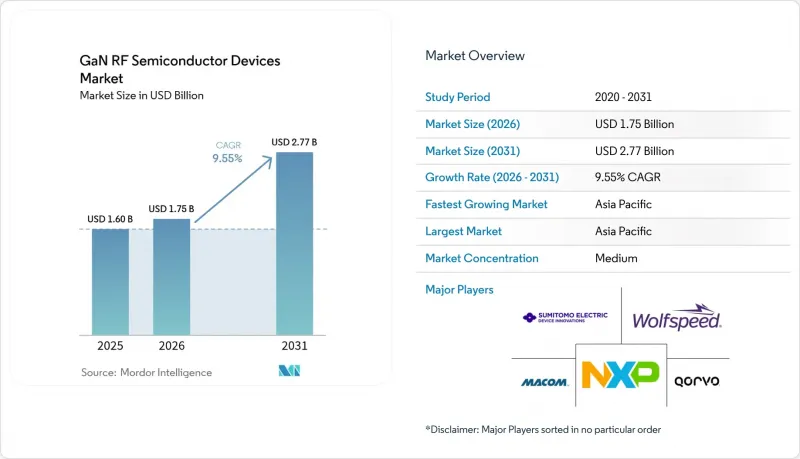
This report is Segmented by Application (Defense and Aerospace, Telecom Infrastructure, and More), Device Type (Discrete RF Power Transistors, MMIC / Monolithic Power Amplifiers, and More), Substrate Technology (GaN-On-SiC, GaN-On-Si, and More), Frequency Band (VHF / UHF (<1 GHz), L / S-Band (1-4 GHz), and More), and Geography (North America, South America, Europe, Asia-Pacific, and Middle East and Africa).
Global GaN RF Semiconductor Devices Market Trends and Insights
5G macro- and small-cell roll-outs accelerate GaN adoption
Massive-MIMO base-station architectures installed across China, Korea, and Japan relied on up to 64 power-amplifier channels, where gallium nitride delivered a 15-20% energy-efficiency uplift versus LDMOS, cutting site-level operating costs. Open-RAN standardization further decoupled radio hardware from system vendors, enabling specialist GaN suppliers to win sockets for remote-radio-head upgrades. Record deployments by China Mobile validated field reliability, while Qorvo's 0.013% failure rate reinforced operator confidence. Progressive reductions in USD/W output through 200 mm wafer migration positioned the GaN RF semiconductor devices market for broader penetration of rural and deep-indoor small-cell layers. Telecom carriers' energy-saving targets aligned with GaN's lower heat dissipation, catalyzing procurement frameworks that rewarded efficiency metrics over component price.
U.S./EU AESA radar modernization drives high-power demand
The U.S. Department of Defense elevated GaN to Manufacturing Readiness Level 10 and allocated more than USD 3 billion for next-generation radar programs between 2024-2025, triggering multi-year production ramps for high-power monolithic microwave integrated circuits (MMICs). European ministries mirrored this trajectory through long-range surveillance and electronic-warfare refresh cycles, where GaN's superior power density increased detection range and jamming effectiveness. Honeywell's USD 29.9 million contract to retrofit Navy low-band transmitters with GaN exemplified obsolescence mitigation and spectrum agility priorities. Packaging breakthroughs that survived 200 W/mm heat flux migrated downstream to commercial telecom radios, expanding the GaN RF semiconductor devices market beyond defense silos.
Cost premium tempers penetration in price-sensitive deployments
In 2024, GaN power amplifiers carried a 40% price delta over LDMOS for sub-6 GHz radios, delaying transitions in emerging markets, even though energy savings absorbed the gap within 18 months of operation. Texas Instruments' move to 8-inch GaN-on-Si fabrication lowered die cost by more than 10%, but macroeconomic pressures still constrained carrier capex, especially in India and parts of Southeast Asia. Telecom OEMs, therefore, maintained dual-sourcing strategies, sustaining LDMOS volume and limiting near-term upside for the GaN RF semiconductor devices market.
Other drivers and restraints analyzed in the detailed report include:
- LEO/MEO sat-com constellation payload demand
- mmWave automotive imaging radar adoption in China and South Korea
- Epi-wafer and substrate shortages create production chokepoints
For complete list of drivers and restraints, kindly check the Table Of Contents.
Segment Analysis
Telecom infrastructure accounted for 42.65% of 2025 revenue, anchoring the GaN RF semiconductor devices market. Base-station vendors adopted GaN to unlock smaller footprints and a 55.2% drain efficiency benchmark in macro radio units. This translates to reduced cooling loads and lower tower-top weight, critical for dense 5G rollouts. Open-RAN disaggregation encouraged independent power-amplifier specialists to capture design wins, while Soitec's engineered substrates reduced insertion losses, boosting coverage per site. The GaN RF semiconductor devices market retained momentum through 2025 as operators trialed 6 G sub-THz pilots that presupposed GaN front ends.Automotive radar remained a modest slice in 2024 but is forecast to expand at an 17.95% CAGR to 2031. China's mandatory advanced-driver-assistance mandates and South Korea's connected-car ecosystem spurred demand for 79 GHz imaging radar, where GaN handled millimeter-wave power density without compromising reliability. V2X communication pilots incorporating GaN PA-LNA modules amplify volume prospects. Cost-down roadmaps tied to 200 mm GaN-on-Si wafers promised alignment with mainstream vehicle electronics, creating scale for the wider GaN RF semiconductor devices market.Across defense and aerospace, radar, electronic warfare, and sat-com payloads drew on GaN's radiation tolerance and output power. Consumer electronics adopted GaN PAs for Wi-Fi 7 routers and handset front ends, validating smaller-signal opportunities. Industrial robotics embraced 6.78 MHz wireless-charging transmitters powered by GaN HEMTs, underscoring cross-sector breadth that diversified revenue streams.
Discrete power transistors captured 45.75% share in 2025, reflecting entrenched design-in cycles across radar, broadcast, and macro-cell radios. MACOM's portfolio spanned 2 W to 7 kW, illustrating scalability that underpinned the GaN RF semiconductor devices market. Thermal-enhanced bolt-down packages supported >80% drain efficiency, extending device lifetimes in harsh duty cycles.Monolithic microwave integrated-circuit power amplifiers delivered the fastest growth, projected at 18.65% CAGR through 2031. Phased-array modules, space-constrained sat-com terminals, and mmWave backhaul radios favored MMICs that collapsed gain stages and bias networks into compact dies. Qorvo's wideband QPA2210D exemplified this trend, offering 6 dB higher power-added efficiency versus discrete alternatives. RF switches and front-end modules employed enhancement-mode GaN transistors to handle hot-switching stresses, while low-noise amplifiers began displacing GaAs in C-Band satellite links, broadening the GaN RF semiconductor devices industry landscape.
Complete Report Scope:
- By Application
- Defense and Aerospace
- Telecom Infrastructure
- Consumer Electronics
- Automotive (ADAS, V2X)
- Industrial and Energy
- Data Centers and High-Efficiency Power Links
- By Device Type
- Discrete RF Power Transistors
- MMIC / Monolithic Power Amplifiers
- RF Switches and Front-End Modules
- Low-Noise and Driver Amplifiers
- By Substrate Technology
- GaN-on-SiC
- GaN-on-Si
- GaN-on-Diamond and Advanced Composites
- By Frequency Band
- VHF / UHF (<1 GHz)
- L / S-Band (1-4 GHz)
- C / X-Band (4-12 GHz)
- Ku / Ka-Band (12-40 GHz)
- mmWave (>40 GHz, incl. 5G FR2)
- By Geography
- North America
- United States
- Canada
- Mexico
- South America
- Brazil
- Argentina
- Rest of South America
- Europe
- Germany
- United Kingdom
- France
- Italy
- Spain
- Rest of Europe
- Asia-Pacific
- China
- Japan
- South Korea
- India
- Taiwan
- Rest of Asia-Pacific
- Middle East and Africa
- Middle East
- Saudi Arabia
- United Arab Emirates
- Turkey
- Rest of Middle East
- Africa
- South Africa
- Rest of Africa
- Middle East
- North America
Geography Analysis
Asia-Pacific led with 33.80% of 2025 revenue and is projected to advance at an 17.80% CAGR through 2031. China's 5 G base-station surge, local GaN foundry build-outs, and policy support under the "third semiconductor wave" catalyzed regional self-reliance. Korea focused on AI-centers and automotive radar, while Japan leveraged consumer-electronics legacy and SiC substrate supply. Taiwan's advanced backend services accelerated GaN-on-Si cost optimization, reinforcing the GaN RF semiconductor devices market growth loop.
North America ranked second, buoyed by the U.S. defense budget and satellite-internet mega constellations. Government funding for domestic fabs, such as Polar Semiconductor's Minnesota GaN-on-Si project, supported supply-chain resiliency. Canada's telecom revamps and Mexico's automotive-electronics clusters created continental demand diversity that insulated the regional GaN RF semiconductor devices market from single-sector volatility.
Europe combined automotive radar leadership with energy-efficient industrial drives. Germany spearheaded 79 GHz vehicle sensor roll-outs, France emphasized aerospace payloads, and the United Kingdom prioritized spectrum-dominated electronic-warfare upgrades. EU strategic autonomy packages channelled grants to joint ventures such as IQE-X-FAB's 650 V GaN platform, nurturing a localized value chain that underpinned the GaN RF semiconductor devices market size expansion in the bloc.
Emerging adoption across Brazil, Gulf Cooperation Council smart-city rollouts, and Australia's low-Earth-orbit backhaul trials showcased the technology's global diffusion trajectory.
- Wolfspeed, Inc.
- Qorvo, Inc.
- Sumitomo Electric Device Innovations
- NXP Semiconductors N.V.
- MACOM Technology Solutions - GaN-on-SiC
- Broadcom Inc.
- Infineon Technologies AG
- RFHIC Corp.
- Ampleon Netherlands B.V.
- Mitsubishi Electric Corporation
- Fujitsu Ltd. (GaN RF)
- Northrop Grumman Microelectronics
- Integra Technologies, Inc.
- Analog Devices Inc.
- WIN Semiconductors Corp.
- Finwave Semiconductor Inc.
- Tagore Technology Inc.
- Guerrilla RF
- SEDI - Silent-Solutions Engineering (EU)
- Teledyne e2v HiRel
Additional Benefits:
- The market estimate (ME) sheet in Excel format
- 3 months of analyst support
TABLE OF CONTENTS
1 INTRODUCTION
- 1.1 Study Assumptions and Market Definition
- 1.2 Scope of the Study
2 RESEARCH METHODOLOGY
3 EXECUTIVE SUMMARY
4 MARKET LANDSCAPE
- 4.1 Market Overview
- 4.2 Market Drivers
- 4.2.1 5G Macro- and Small-Cell Roll-outs across Asia-Pacific
- 4.2.2 U.S./EU AESA Radar Modernization Funding
- 4.2.3 LEO / MEO Sat-Com Constellation Payload Demand
- 4.2.4 mmWave Automotive Imaging Radar Adoption in China and South Korea
- 4.2.5 High-Power Wireless Charging for Industrie 4.0 Robotics
- 4.2.6 Rapid Proliferation of Open-RAN Remote Radio Heads
- 4.3 Market Restraints
- 4.3.1 Cost Premium vs. LDMOS in Sub-6 GHz Base-Stations
- 4.3.2 SiC Encroachment in >3 kW Tactical Radar Blocks
- 4.3.3 Epi-wafer and Sub-strate Supply Bottlenecks (150 and 200 mm)
- 4.3.4 Thermal Management and Reliability at >200 W/mm
- 4.4 Value Chain Analysis
- 4.5 Technological Outlook
- 4.5.1 GaN-on-Si Mass-Production and 200 mm Transition
- 4.6 Regulatory Outlook
- 4.6.1 ITU and FCC Spectrum Releases for 5G/6G and Radar
- 4.7 Porter's Five Forces Analysis
- 4.7.1 Bargaining Power of Buyers
- 4.7.2 Bargaining Power of Suppliers
- 4.7.3 Threat of New Entrants
- 4.7.4 Threat of Substitutes
- 4.7.5 Intensity of Competitive Rivalry
- 4.8 RF-GaN Patent Landscape
- 4.9 Imapct of Macroeconomic Factors on the Market
5 MARKET SIZE AND GROWTH FORECASTS (VALUE)
- 5.1 By Application
- 5.1.1 Defense and Aerospace
- 5.1.2 Telecom Infrastructure
- 5.1.3 Consumer Electronics
- 5.1.4 Automotive (ADAS, V2X)
- 5.1.5 Industrial and Energy
- 5.1.6 Data Centers and High-Efficiency Power Links
- 5.2 By Device Type
- 5.2.1 Discrete RF Power Transistors
- 5.2.2 MMIC / Monolithic Power Amplifiers
- 5.2.3 RF Switches and Front-End Modules
- 5.2.4 Low-Noise and Driver Amplifiers
- 5.3 By Substrate Technology
- 5.3.1 GaN-on-SiC
- 5.3.2 GaN-on-Si
- 5.3.3 GaN-on-Diamond and Advanced Composites
- 5.4 By Frequency Band
- 5.4.1 VHF / UHF (<1 GHz)
- 5.4.2 L / S-Band (1-4 GHz)
- 5.4.3 C / X-Band (4-12 GHz)
- 5.4.4 Ku / Ka-Band (12-40 GHz)
- 5.4.5 mmWave (>40 GHz, incl. 5G FR2)
- 5.5 By Geography
- 5.5.1 North America
- 5.5.1.1 United States
- 5.5.1.2 Canada
- 5.5.1.3 Mexico
- 5.5.2 South America
- 5.5.2.1 Brazil
- 5.5.2.2 Argentina
- 5.5.2.3 Rest of South America
- 5.5.3 Europe
- 5.5.3.1 Germany
- 5.5.3.2 United Kingdom
- 5.5.3.3 France
- 5.5.3.4 Italy
- 5.5.3.5 Spain
- 5.5.3.6 Rest of Europe
- 5.5.4 Asia-Pacific
- 5.5.4.1 China
- 5.5.4.2 Japan
- 5.5.4.3 South Korea
- 5.5.4.4 India
- 5.5.4.5 Taiwan
- 5.5.4.6 Rest of Asia-Pacific
- 5.5.5 Middle East and Africa
- 5.5.5.1 Middle East
- 5.5.5.1.1 Saudi Arabia
- 5.5.5.1.2 United Arab Emirates
- 5.5.5.1.3 Turkey
- 5.5.5.1.4 Rest of Middle East
- 5.5.5.2 Africa
- 5.5.5.2.1 South Africa
- 5.5.5.2.2 Rest of Africa
- 5.5.5.1 Middle East
- 5.5.1 North America
6 COMPETITIVE LANDSCAPE
- 6.1 Market Concentration
- 6.2 Strategic Moves
- 6.3 Market Share Analysis
- 6.4 Company Profiles (includes Global level Overview, Market level overview, Core Segments, Financials as available, Strategic Information, Market Rank/Share for key companies, Products and Services, and Recent Developments)
- 6.4.1 Wolfspeed, Inc.
- 6.4.2 Qorvo, Inc.
- 6.4.3 Sumitomo Electric Device Innovations
- 6.4.4 NXP Semiconductors N.V.
- 6.4.5 MACOM Technology Solutions - GaN-on-SiC
- 6.4.6 Broadcom Inc.
- 6.4.7 Infineon Technologies AG
- 6.4.8 RFHIC Corp.
- 6.4.9 Ampleon Netherlands B.V.
- 6.4.10 Mitsubishi Electric Corporation
- 6.4.11 Fujitsu Ltd. (GaN RF)
- 6.4.12 Northrop Grumman Microelectronics
- 6.4.13 Integra Technologies, Inc.
- 6.4.14 Analog Devices Inc.
- 6.4.15 WIN Semiconductors Corp.
- 6.4.16 Finwave Semiconductor Inc.
- 6.4.17 Tagore Technology Inc.
- 6.4.18 Guerrilla RF
- 6.4.19 SEDI - Silent-Solutions Engineering (EU)
- 6.4.20 Teledyne e2v HiRel
7 MARKET OPPORTUNITIES AND FUTURE OUTLOOK
- 7.1 White-Space and Unmet-Need Assessment

