PUBLISHER: Mordor Intelligence | PRODUCT CODE: 2122309

PUBLISHER: Mordor Intelligence | PRODUCT CODE: 2122309
Residential Routers - Market Share Analysis, Industry Trends & Statistics, Growth Forecasts (2026 - 2031)
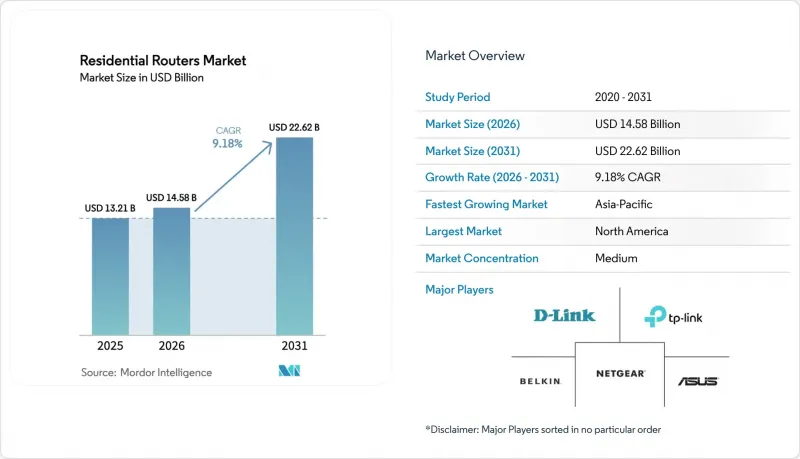
According to Mordor Intelligence, the residential routers market size was valued at USD 13.21 billion in 2025, USD 14.58 billion in 2026, and is projected to attain USD 22.62 billion by 2031, translating into a 9.18% CAGR during the 2026-2031 period.
This report is Segmented by Connectivity Type (Wired, and Wireless), Wi-Fi Standard Generation (Wi-Fi 4, Wi-Fi 5, and More), Product Form Factor (Stand-Alone Routers, Mesh Wi-Fi Systems, and More), Distribution Channel (Retail, Online/E-commerce, and More), End-User Household Type (Single-Family Homes, Multi-Dwelling Units, and More), and Geography. The Market Forecasts are Provided in Terms of Value (USD).
Global Residential Routers Market Trends and Insights
Proliferation of Smart-Home and IoT Devices
Connected-device density climbed to 17 units per household in North America and 12 in Europe by 2025. This saturation forces legacy routers, originally designed for fewer than 10 concurrent links, into obsolescence. Households facing latency during simultaneous 4K streaming, smart-thermostat polling, and security-camera uploads now view tri-band or mesh systems as utilities rather than luxuries. ISPs exploit the pain point by bundling Wi-Fi 6E and Wi-Fi 7 gateways with new fiber installations, locking subscribers into managed Wi-Fi ecosystems at USD 10-15 per month. Matter interoperability has become baseline, compelling manufacturers to embed Thread border-router functionality that fragments competition between platform-centric entrants and traditional hardware brands.
Surging Global IP Traffic and High-Speed Broadband Uptake
Global IP traffic reached 4.8 zettabytes in 2024 and will exceed 7.5 zettabytes by 2028. Fiber penetration surpassed 52% in China and 48% in South Korea during 2025, creating pull for routers with 2.5 Gbps or 10 Gbps WAN ports. North American cable operators responded by integrating Wi-Fi 7 radios into DOCSIS 4.0 gateways, shifting profit pools from hardware to recurring managed-service fees. In India, BharatNet extended backbone capacity to 250,000 villages, but the absence of firmware-update infrastructure in sub-USD 25 routers leaves rural users exposed to botnets. These dynamics polarize the residential routers market between ISP-controlled gateways and premium enthusiast gear.
Escalating Cybersecurity and Privacy Risks
Routers represented 75% of successful IoT botnet compromises in 2024. The EU Cyber Resilience Act now mandates five-year security-update commitments, adding USD 3-5 to bill of materials and squeezing low-margin brands. In the United States, a voluntary FCC cybersecurity label remains underused because most consumers cannot interpret technical badges. Privacy advocacy intensified after revelations that some ISP gateways harvest browsing metadata for ad targeting, pressuring operators to adopt opt-in frameworks. As households wait for regulatory clarity, upgrade cycles slow and OEMs divert budgets from feature innovation to compliance.
Other drivers and restraints analyzed in the detailed report include:
- Migration to Wi-Fi 6/6E/7 Standards Fueling Replacement Cycles
- ISP Fiber Roll-Outs Bundling Wi-Fi 7 Gateways at Scale
- Price Sensitivity in Emerging Markets
For complete list of drivers and restraints, kindly check the Table Of Contents.
Segment Analysis
Wireless routers held 78.46% residential routers market share in 2025 and are set to grow at a 10.17% CAGR, reflecting their ability to manage simultaneous streams and remote-work loads. Households that host three or more concurrent video sessions favor tri-band units over wired alternatives that require costly structured cabling. ISPs accelerate wireless adoption by bundling mesh-capable gateways that erase dead zones, moving the residential routers market toward subscription models. The wired segment persists in latency-sensitive niches such as high-frequency trading, yet its contraction will continue as Wi-Fi 7 delivers near-wired performance.
Mesh ecosystems and AI-assisted roaming now define the wireless value proposition. The EU Radio Equipment Directive's standardization on USB-C chargers lowers e-waste objections and shortens router replacement deliberations. Markets like Germany and Japan, which integrate Ethernet jacks in every room, still end sessions on Wi-Fi endpoints for flexibility. The residential routers market will therefore remain decisively wireless as IoT density rises.
Wi-Fi 6 and 6E accounted for 47.82% of shipments in 2025, yet Wi-Fi 7 is poised for the fastest growth at 10.88% CAGR. Multi-link operation aggregates 2.4 GHz, 5 GHz, and 6 GHz bands to deliver deterministic latency for cloud gaming and augmented reality. ISPs distribute 802.11be gateways during service activation, cutting the adoption lag that historically separates new standards from mass uptake. China's restriction of 6 GHz to indoor use forces dual-SKU strategies, but volume pricing will normalize by 2027.
Enthusiast-grade Wi-Fi 7 routers priced above USD 400 serve as brand halo products and constitute less than 8% of unit volume. As client devices arrive, the performance gulf will motivate replacements of Wi-Fi 5 units, further propelling the residential routers market size.
Complete Report Scope:
- By Connectivity Type
- Wired
- Wireless
- By WiFi Standard Generation
- Wi-Fi 4 (802.11n)
- Wi-Fi 5 (802.11ac)
- Wi-Fi 6 / 6E (802.11ax)
- Wi-Fi 7 (802.11be)
- By Product Form Factor
- Stand-alone Routers
- Mesh Wi-Fi Systems
- Modem- Router Gateways (IADs)
- 5G/ FWA Home Gateways
- By Distribution Channel
- Retail (In-store)
- Online/ E-commerce
- ISP Bundled/ Leased
- Direct-to-Consumer Brands
- By End-User Household Type
- Single- Family Homes
- Multi- Dwelling Units (MDUs)
- Small Office/ Home Office (SOHO)
- By Geography
- North America
- United States
- Canada
- Mexico
- South America
- Brazil
- Argentina
- Rest of South America
- Europe
- Germany
- United Kingdom
- France
- Italy
- Spain
- Rest of Europe
- Asia-Pacific
- China
- Japan
- India
- South Korea
- ASEAN
- Rest of Asia-Pacific
- Middle East
- Saudi Arabia
- United Arab Emirates
- Rest of Middle East
- Africa
- South Africa
- Nigeria
- Rest of Africa
- North America
Geography Analysis
North America generated 41.58% of residential router revenue in 2025, propelled by ISP bundling that embeds Wi-Fi 7 gateways into fiber and cable tiers. Comcast's xFi platform serves 32 million households and monetizes AI-driven optimization at USD 14 per month. AT&T and Verizon adopted similar tactics, cutting truck-roll costs by 28% through remote diagnostics. Average selling prices remain high at USD 140-200 for mesh systems. Regulatory moves such as the FCC cybersecurity label add compliance overhead without visibly shifting consumer choices.
Asia-Pacific is forecast to deliver the fastest regional expansion at a 10.62% CAGR through 2031. China's 580 million fiber households require multi-gig routers, while India's BharatNet backbone highlights security gaps in low-cost hardware. ASEAN nations remain price sensitive, with 72% of routers priced below USD 35. Japan and South Korea lead Wi-Fi 7 adoption as operators bundle 10 Gbps services.
Europe held 22% of global revenue in 2025, shaped by the EU Cyber Resilience Act and Ecodesign mandates that favor brands with established certification pipelines. BeFibre and EE priced AI-powered Wi-Fi 7 tiers at USD 15 per month, trimming churn by 18%. Germany's structured wiring norms slow mesh proliferation, yet fiber penetration reached 48% in 2025, creating latent demand for multi-gig routers. South America, the Middle East, and Africa combined for 18% of revenue, constrained by import tariffs and currency volatility.
- NETGEAR Inc.
- TP-LINK Technologies Co., Ltd.
- D-Link Corporation
- Belkin International, Inc. (Linksys)
- ASUSTeK Computer Inc.
- Google LLC (Nest Wi-Fi, eero)
- Cisco Systems, Inc.
- Huawei Technologies Co., Ltd.
- Xiaomi Inc.
- Synology Inc.
- TRENDnet, Inc.
- Buffalo Inc.
- Ubiquiti Inc.
- CommScope Holding Company, Inc. (ARRIS)
- Zyxel Communications Corp.
- Amazon.com, Inc. (eero LLC)
- Sercomm Corporation
- Qualcomm Incorporated (Networking Pro platforms)
- Tenda Technology Co., Ltd.
- Mercusys Technologies Co., Ltd.
- Amped Wireless (Newo Corporation)
- Nokia Corporation (Fixed Networks CPE)
Additional Benefits:
- The market estimate (ME) sheet in Excel format
- 3 months of analyst support
TABLE OF CONTENTS
1 INTRODUCTION
- 1.1 Study Assumptions and Market Definition
- 1.2 Scope of the Study
2 RESEARCH METHODOLOGY
3 EXECUTIVE SUMMARY
4 MARKET LANDSCAPE
- 4.1 Market Overview
- 4.2 Market Drivers
- 4.2.1 Proliferation of Smart-Home and IoT Devices
- 4.2.2 Surging Global IP Traffic and High-speed Broadband Uptake
- 4.2.3 Migration to Wi-Fi 6/6E/7 Standards Fueling Replacement Cycles
- 4.2.4 ISP Fiber Roll-outs Bundling Wi-Fi 7 Gateways at Scale
- 4.2.5 AI-driven Managed-Wi-Fi Subscriptions Boosting Premium Router Demand
- 4.2.6 Energy-efficiency Mandates Prompting Low-power Router Upgrades
- 4.3 Market Restraints
- 4.3.1 Escalating Cybersecurity and Privacy Risks
- 4.3.2 Price Sensitivity in Emerging Markets
- 4.3.3 User Skill Gaps Causing Feature Under-Utilization, Delaying Upgrades
- 4.3.4 Chipset Supply-chain Volatility Creating Product Shortages and Price Spikes
- 4.4 Industry Value Chain Analysis
- 4.5 Regulatory Landscape
- 4.6 Technological Outlook
- 4.7 Porter's Five Forces Analysis
- 4.7.1 Bargaining Power of Suppliers
- 4.7.2 Bargaining Power of Buyers
- 4.7.3 Threat of New Entrants
- 4.7.4 Threat of Substitutes
- 4.7.5 Intensity of Competitive Rivalry
5 MARKET SIZE AND GROWTH FORECASTS (VALUE)
- 5.1 By Connectivity Type
- 5.1.1 Wired
- 5.1.2 Wireless
- 5.2 By WiFi Standard Generation
- 5.2.1 Wi-Fi 4 (802.11n)
- 5.2.2 Wi-Fi 5 (802.11ac)
- 5.2.3 Wi-Fi 6 / 6E (802.11ax)
- 5.2.4 Wi-Fi 7 (802.11be)
- 5.3 By Product Form Factor
- 5.3.1 Stand-alone Routers
- 5.3.2 Mesh Wi-Fi Systems
- 5.3.3 Modem- Router Gateways (IADs)
- 5.3.4 5G/ FWA Home Gateways
- 5.4 By Distribution Channel
- 5.4.1 Retail (In-store)
- 5.4.2 Online/ E-commerce
- 5.4.3 ISP Bundled/ Leased
- 5.4.4 Direct-to-Consumer Brands
- 5.5 By End-User Household Type
- 5.5.1 Single- Family Homes
- 5.5.2 Multi- Dwelling Units (MDUs)
- 5.5.3 Small Office/ Home Office (SOHO)
- 5.6 By Geography
- 5.6.1 North America
- 5.6.1.1 United States
- 5.6.1.2 Canada
- 5.6.1.3 Mexico
- 5.6.2 South America
- 5.6.2.1 Brazil
- 5.6.2.2 Argentina
- 5.6.2.3 Rest of South America
- 5.6.3 Europe
- 5.6.3.1 Germany
- 5.6.3.2 United Kingdom
- 5.6.3.3 France
- 5.6.3.4 Italy
- 5.6.3.5 Spain
- 5.6.3.6 Rest of Europe
- 5.6.4 Asia-Pacific
- 5.6.4.1 China
- 5.6.4.2 Japan
- 5.6.4.3 India
- 5.6.4.4 South Korea
- 5.6.4.5 ASEAN
- 5.6.4.6 Rest of Asia-Pacific
- 5.6.5 Middle East
- 5.6.5.1 Saudi Arabia
- 5.6.5.2 United Arab Emirates
- 5.6.5.3 Rest of Middle East
- 5.6.6 Africa
- 5.6.6.1 South Africa
- 5.6.6.2 Nigeria
- 5.6.6.3 Rest of Africa
- 5.6.1 North America
6 COMPETITIVE LANDSCAPE
- 6.1 Market Concentration
- 6.2 Strategic Moves
- 6.3 Market Share Analysis
- 6.4 Company Profiles (includes Global level Overview, Market Level Overview, Core Segments, Financials as Available, Strategic Information, Market Rank/Share for Key Companies, Products and Services, and Recent Developments)
- 6.4.1 NETGEAR Inc.
- 6.4.2 TP-LINK Technologies Co., Ltd.
- 6.4.3 D-Link Corporation
- 6.4.4 Belkin International, Inc. (Linksys)
- 6.4.5 ASUSTeK Computer Inc.
- 6.4.6 Google LLC (Nest Wi-Fi, eero)
- 6.4.7 Cisco Systems, Inc.
- 6.4.8 Huawei Technologies Co., Ltd.
- 6.4.9 Xiaomi Inc.
- 6.4.10 Synology Inc.
- 6.4.11 TRENDnet, Inc.
- 6.4.12 Buffalo Inc.
- 6.4.13 Ubiquiti Inc.
- 6.4.14 CommScope Holding Company, Inc. (ARRIS)
- 6.4.15 Zyxel Communications Corp.
- 6.4.16 Amazon.com, Inc. (eero LLC)
- 6.4.17 Sercomm Corporation
- 6.4.18 Qualcomm Incorporated (Networking Pro platforms)
- 6.4.19 Tenda Technology Co., Ltd.
- 6.4.20 Mercusys Technologies Co., Ltd.
- 6.4.21 Amped Wireless (Newo Corporation)
- 6.4.22 Nokia Corporation (Fixed Networks CPE)
7 MARKET OPPORTUNITIES AND FUTURE OUTLOOK
- 7.1 White-space and Unmet-Need Assessment

