PUBLISHER: Mordor Intelligence | PRODUCT CODE: 2122367

PUBLISHER: Mordor Intelligence | PRODUCT CODE: 2122367
Diesel Power Engine - Market Share Analysis, Industry Trends & Statistics, Growth Forecasts (2026 - 2031)
According to Mordor Intelligence, the diesel power engine market size is estimated at USD 12.87 billion in 2026, and is expected to reach USD 16.69 billion by 2031, at a CAGR of 5.33% during the forecast period (2026-2031).
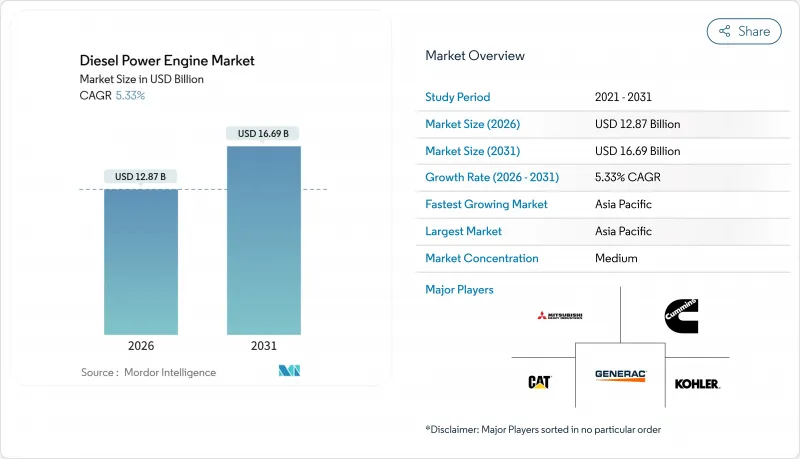
This report is Segmented by Capacity Range (Up To 75 KVA, 75 To 375 KVA, 375 To 750 KVA, 750 To 2, 000 KVA, and Above 2, 000 KVA), Application (Stand-By, Prime/Continuous, and Peak-Shaving), End User (Industrial, Commercial, and Residential), and Geography (North America, Europe, Asia-Pacific, South America, and Middle East and Africa). The Market Sizes and Forecasts are Provided in Terms of Value (USD).
Global Diesel Power Engine Market Trends and Insights
Grid-Hardening Investments in Emerging Markets
Utilities in Sub-Saharan Africa and South Asia are adopting diesel-solar mini-grids as an interim solution while long-distance transmission lines and substations catch up with electrification targets. In 2025, the World Bank allocated USD 2.3 billion for rural projects pairing 50-150 kW engines with photovoltaic arrays, lowering delivered power costs to USD 0.18-0.25 per kWh in 18 African nations. India's Saubhagya program completed household connections yet still recorded sub-12-hour daily reliability in 40% of rural districts, prompting state utilities to order 15,000 standby gensets last year. These sets often run 6-10 hours per day, driving faster wear and replacement cycles. The African Development Bank confirms similar economics, noting that mini-grids can undercut regulated tariffs without direct subsidies in Kenya, Tanzania, and Nigeria.
Boom in Data-Center Construction Across Asia
Hyperscale operators installed 1.2 GW of new diesel standby capacity in Asia-Pacific during 2025, with India and China representing 68% of the total build-out. Microsoft and AWS committed USD 6.5 billion to campuses in Hyderabad requiring N+1 diesel redundancy for 72-hour operation, while China's Ministry of Industry and Information Technology obliges all new Tier-3 sites to store three days of fuel on-site. NREL's latest density models suggest battery systems will not match diesel's energy storage efficiency at the multi-megawatt scale until after 2029.
Rapid Fall in Battery-Storage LCOE
Lithium-ion battery pack prices fell to USD 139 per kWh in 2024, a 14% drop from 2023, making four-hour storage viable for commercial buildings previously reliant on diesel. California's Self-Generation Incentive Program distributed USD 320 million in 2025, allowing hospitals and data centers to substitute battery systems for short-duration outages. Lazard's 2025 analysis shows a 1 MW/4 h battery delivers backup at USD 0.18 per kWh over 15 years, versus USD 0.22 for a diesel set running 50 hours per year. Yet providing 72-hour autonomy for a 5 MW load still requires a 360 MWh battery system costing about USD 50 million, compared to USD 3 million for diesel hardware and fuel.
Other drivers and restraints analyzed in the detailed report include:
- Industrial Automation Demand for Mission-Critical Backup
- Military Mobile-Power Modernization Programs
- Tighter NOx & Particulate Limits in OECD Markets
For complete list of drivers and restraints, kindly check the Table Of Contents.
Segment Analysis
The diesel power engine market size for 375-750 kVA units is expanding at 7.5% per year during 2026-2031, outpacing every other band as hospitals, telecom hubs, and factories upgrade to higher reliability specifications. Sets up to 75 kVA retained 43.3% of the diesel power engine market share in 2025 by serving residential and small-commercial loads, yet growth moderates to 4.8% as affluent consumers migrate toward solar-battery solutions. Mid-range 75-375 kVA engines equip retail centers and food-processing sites where automatic transfer within 10 seconds is now a standard bid requirement. At 500-750 kVA, Caterpillar's C18 and Rolls-Royce's mtu 12V 2000 capture healthcare and telecom orders by coupling variable-geometry turbochargers with 6% lower fuel burn. Units above 2,000 kVA continue to serve hyperscale campuses, though operators now favor multiple 1,500-2,000 kVA modules for redundancy rather than single 4 MW blocks, tempering procurement cycles but not eliminating demand.
Telecom carriers in India and Indonesia are retiring 250 kVA gensets in favor of 500-600 kVA models to feed 5G radio units that consume 40% more power than 4G. PwC's 2025 telecom-energy audit found that 600 kVA machines cut carbon intensity 12% on a per-subscriber basis by reducing runtime through improved efficiency. Hospital administrators similarly specify 600-750 kVA arrays to cover expanded ICU and imaging loads, and these orders are bundled with eight-hour load-bank tests to secure insurance certification. Small sets under 75 kVA will still permeate rural Africa and South Asia, aided by micro-financing programs that spread payments over five years.
Complete Report Scope:
- By Capacity Range
- Up to 75 kVA
- 75 to 375 kVA
- 375 to 750 kVA
- 750 to 2,000 kVA
- Above 2,000 kVA
- By Application
- Stand-by
- Prime/Continuous
- Peak-shaving
- By End User
- Industrial
- Commercial
- Residential
- By Geography
- North America
- United States
- Canada
- Mexico
- Europe
- United Kingdom
- Germany
- France
- Spain
- NORDIC Countries
- Russia
- Rest of Europe
- Asia-Pacific
- China
- India
- Japan
- South Korea
- ASEAN Countries
- Australia and New Zealand
- Rest of Asia-Pacific
- South America
- Brazil
- Argentina
- Colombia
- Rest of South America
- Middle East and Africa
- Saudi Arabia
- United Arab Emirates
- South Africa
- Egypt
- Rest of Middle East and Africa
- North America
Geography Analysis
Asia-Pacific booked 38.1% of 2025 turnover and is set to deliver a 6.6% CAGR, backed by China's mandate for 72-hour reserves at all new Tier-3 data centers and India's USD 1.3 trillion infrastructure roadmap. ASEAN's telecom tower boom under unreliable grids spurred Yanmar to place 2,500 gensets in rural India and Indonesia during 2025. Middle-East-Africa clocks a robust 6.4% CAGR: Saudi Arabia's NEOM ordered 400 MW of standby power using Wartsila 31 engines, and Kenya, Tanzania, and Nigeria scale mini-grid programs with World Bank backing. North America posts a mature 4.1% trajectory, limited by battery incentives and stricter emissions but buoyed by military contracts and semiconductor reshoring. Europe's 3.8% clip reflects parallel pressures, especially with the pending Industrial Emissions Directive that may require live emissions telemetry on engines over 1 MW.
Across the diesel power engine market, Asia-Pacific's sustained investment pipeline and looser emissions rules offset headwinds in developed economies. The Middle East leverages petro-financed megaprojects to offset rising gas-turbine adoption, while Sub-Saharan Africa relies on hybrid diesel-solar mini-grids to bridge electrification gaps through 2035.
- Caterpillar Inc.
- Cummins Inc.
- Generac Holdings Inc.
- Kohler Co.
- Mitsubishi Heavy Industries Ltd.
- Volvo Penta (AB Volvo)
- Wartsila Oyj Abp
- Rolls-Royce plc (mtu)
- MAN Energy Solutions SE
- Yanmar Holdings Co. Ltd.
- Hyundai Doosan Infracore
- Atlas Copco AB
- FG Wilson (Caterpillar)
- Perkins Engines Co. Ltd.
- Himoinsa S.L.
- Kirloskar Oil Engines Ltd.
- Guangxi Yuchai Machinery Group
- Mahindra Powerol
- Stamford-AvK (Cummins Generator Technologies)
- SDMO Industries (Kohler)
Additional Benefits:
- The market estimate (ME) sheet in Excel format
- 3 months of analyst support
TABLE OF CONTENTS
1 Introduction
- 1.1 Study Assumptions & Market Definition
- 1.2 Scope of the Study
2 Research Methodology
3 Executive Summary
4 Market Landscape
- 4.1 Market Overview
- 4.2 Market Drivers
- 4.2.1 Grid-hardening investments in emerging markets
- 4.2.2 Boom in data-centre construction across Asia
- 4.2.3 Industrial automation demand for mission-critical backup
- 4.2.4 Military mobile power modernisation programmes
- 4.2.5 Micro-utility growth in rural Africa (mini-grids)
- 4.2.6 Maritime IMO III retrofit wave (aux. engines)
- 4.3 Market Restraints
- 4.3.1 Rapid fall in battery-storage LCOE
- 4.3.2 Tighter NOx & particulate limits in OECD markets
- 4.3.3 LNG-to-power small-scale deployments
- 4.3.4 OEM supply-chain exposure to Tier-1 chip shortages
- 4.4 Supply-Chain Analysis
- 4.5 Regulatory Landscape
- 4.6 Technological Outlook
- 4.7 Porter's Five Forces
- 4.7.1 Bargaining Power of Suppliers
- 4.7.2 Bargaining Power of Consumers
- 4.7.3 Threat of New Entrants
- 4.7.4 Threat of Substitute Products & Services
- 4.7.5 Intensity of Competitive Rivalry
5 Market Size & Growth Forecasts
- 5.1 By Capacity Range
- 5.1.1 Up to 75 kVA
- 5.1.2 75 to 375 kVA
- 5.1.3 375 to 750 kVA
- 5.1.4 750 to 2,000 kVA
- 5.1.5 Above 2,000 kVA
- 5.2 By Application
- 5.2.1 Stand-by
- 5.2.2 Prime/Continuous
- 5.2.3 Peak-shaving
- 5.3 By End User
- 5.3.1 Industrial
- 5.3.2 Commercial
- 5.3.3 Residential
- 5.4 By Geography
- 5.4.1 North America
- 5.4.1.1 United States
- 5.4.1.2 Canada
- 5.4.1.3 Mexico
- 5.4.2 Europe
- 5.4.2.1 United Kingdom
- 5.4.2.2 Germany
- 5.4.2.3 France
- 5.4.2.4 Spain
- 5.4.2.5 NORDIC Countries
- 5.4.2.6 Russia
- 5.4.2.7 Rest of Europe
- 5.4.3 Asia-Pacific
- 5.4.3.1 China
- 5.4.3.2 India
- 5.4.3.3 Japan
- 5.4.3.4 South Korea
- 5.4.3.5 ASEAN Countries
- 5.4.3.6 Australia and New Zealand
- 5.4.3.7 Rest of Asia-Pacific
- 5.4.4 South America
- 5.4.4.1 Brazil
- 5.4.4.2 Argentina
- 5.4.4.3 Colombia
- 5.4.4.4 Rest of South America
- 5.4.5 Middle East and Africa
- 5.4.5.1 Saudi Arabia
- 5.4.5.2 United Arab Emirates
- 5.4.5.3 South Africa
- 5.4.5.4 Egypt
- 5.4.5.5 Rest of Middle East and Africa
- 5.4.1 North America
6 Competitive Landscape
- 6.1 Market Concentration
- 6.2 Strategic Moves (M&A, Partnerships, PPAs)
- 6.3 Market Share Analysis (Market Rank/Share for key companies)
- 6.4 Company Profiles (includes Global level Overview, Market level overview, Core Segments, Financials as available, Strategic Information, Products & Services, and Recent Developments)
- 6.4.1 Caterpillar Inc.
- 6.4.2 Cummins Inc.
- 6.4.3 Generac Holdings Inc.
- 6.4.4 Kohler Co.
- 6.4.5 Mitsubishi Heavy Industries Ltd.
- 6.4.6 Volvo Penta (AB Volvo)
- 6.4.7 Wartsila Oyj Abp
- 6.4.8 Rolls-Royce plc (mtu)
- 6.4.9 MAN Energy Solutions SE
- 6.4.10 Yanmar Holdings Co. Ltd.
- 6.4.11 Hyundai Doosan Infracore
- 6.4.12 Atlas Copco AB
- 6.4.13 FG Wilson (Caterpillar)
- 6.4.14 Perkins Engines Co. Ltd.
- 6.4.15 Himoinsa S.L.
- 6.4.16 Kirloskar Oil Engines Ltd.
- 6.4.17 Guangxi Yuchai Machinery Group
- 6.4.18 Mahindra Powerol
- 6.4.19 Stamford-AvK (Cummins Generator Technologies)
- 6.4.20 SDMO Industries (Kohler)
7 Market Opportunities & Future Outlook
- 7.1 White-space & Unmet-need Assessment

