PUBLISHER: Mordor Intelligence | PRODUCT CODE: 2122387

PUBLISHER: Mordor Intelligence | PRODUCT CODE: 2122387
Air Compressor - Market Share Analysis, Industry Trends & Statistics, Growth Forecasts (2026 - 2031)
According to Mordor Intelligence, the air compressor market size is projected to be USD 33.45 billion in 2025, USD 35.21 billion in 2026, and reach USD 44.11 billion by 2031, growing at a CAGR of 4.61% from 2026 to 2031.
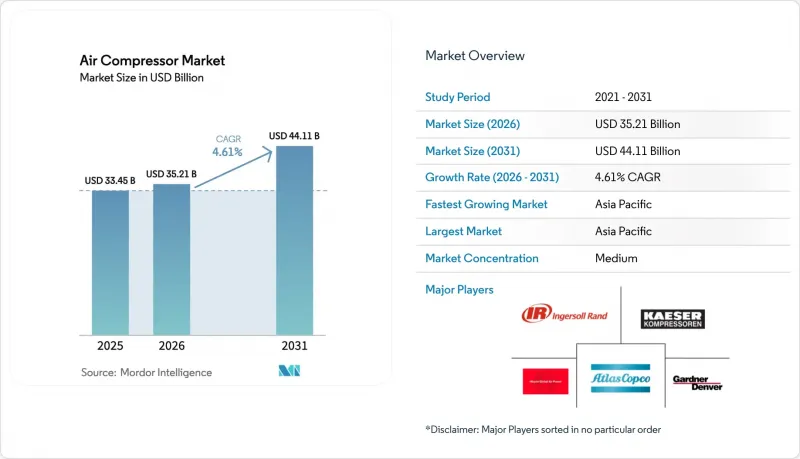
This report is Segmented by Operating Principle (Positive Displacement and Dynamic), Technology (Oil-Flooded and Oil-Free), Portability (Stationary and Portable), Cooling Method (Air-Cooled and Water-Cooled), Power Rating (101-300 KW, Above 500 KW, and More), End-User Industry (Manufacturing, Oil and Gas, Power Generation, Healthcare, and More), and Geography (North America, Europe, Asia-Pacific, and More).
Global Air Compressor Market Trends and Insights
Electrification-driven demand for oil-free compressors
Tightening ISO 8573-1 purity rules in pharmaceuticals, semiconductors, and food packaging shift specifications from oil-flooded to oil-free designs, curbing lubricant disposal costs and aligning with lifecycle-carbon pledges. Cost-sensitive retrofits rely on upgraded filtration, creating a dual-speed adoption path. Battery-electric and hydrogen vehicle lines mandate Class Zero air, propelling oil-free growth above the overall 4.61% market CAGR. OEMs bundle oil-free hardware with energy-management software, strengthening service lock-in.
Surging CAPEX in LNG & hydrogen infrastructure
Global announcements exceed 230 GW of committed electrolyzer capacity by 2030, each gigawatt requiring sizable hydrogen compression for storage, pipeline, and ammonia synthesis. LNG export terminals likewise order multi-megawatt centrifugal trains. Honeywell's USD 1.81 billion purchase of Air Products' LNG equipment business reinforces an integrated compression-plus-liquefaction play. Specialized materials for high-pressure hydrogen create a profitable niche despite longer project gestation.
High Initial Cost of Variable-Speed & Oil-Free Systems
Variable-speed and oil-free compressors carry capital premiums of 25-50%, discouraging SME buyers in India, Southeast Asia, and Latin America. Although lifecycle savings offset cost for large users, financing gaps and weak leasing ecosystems slow diffusion. Component prices are easing with scale, yet mass-market transition remains beyond the forecast horizon.
Other drivers and restraints analyzed in the detailed report include:
- Post-COVID Re-Shoring of Manufacturing in North America & Europe
- Mandatory Energy-Efficiency Regulations for Industrial Equipment
- Volatility in Raw-Material Prices (Steel, Rare-Earth Magnets)
For complete list of drivers and restraints, kindly check the Table Of Contents.
Segment Analysis
Dynamic compressors are set to capture greater air compressor market share as LNG, hydrogen, and CCUS projects prefer their high throughput and oil-free profiles. Positive-displacement designs still dominated the air compressor market size in 2025, but centrifugal and axial units posted a 5.3% CAGR through 2031. Reciprocating machines remain vital for pressures above 300 bar, especially in hydrogen refueling. Hybrid architectures blending rotary screw and centrifugal stages illustrate the ongoing convergence.
The shift manifests geographically: Gulf LNG export terminals order multi-stage centrifugal trains, while Chinese hydrogen integrators favor oil-free screws for mid-pressure electrolyzer balance-of-plant. Reciprocating demand endures in North American CNG stations and European industrial gases. OEMs expand modular platforms that let customers scale from 5 bar to 350 bar with shared parts inventories, lowering lifecycle cost.
Oil-free units, growing at a 5.2% CAGR, make inroads into pharmaceuticals, food and beverage, and semiconductors as regulatory and liability pressures tighten. Oil-flooded equipment still delivers the bulk of air across the general industry thanks to favorable capex and easy maintenance.
Advances such as water-injected screws and magnetic bearings cut lifecycle friction and expand capacity beyond 500 kW. Semiconductor cleanrooms in Taiwan and Korea now specify oil-free centrifugal machines with air bearings, while European beverage bottlers retrofit with water-sealed screws to eliminate downstream filtration. The coexistence of both technologies will persist as mining and construction continue accepting oil mist with post-filters.
Complete Report Scope:
- By Operating Principle
- Positive Displacement
- Reciprocating
- Rotary Screw
- Rotary Vane
- Dynamic
- Centrifugal
- Axial
- Positive Displacement
- By Technology
- Oil-Flooded
- Oil-Free
- By Portability
- Stationary
- Portable
- By Cooling Method
- Air-Cooled
- Water-Cooled
- By Power Rating
- Up to 100 kW
- 101 to 300 kW
- 301 to 500 kW
- Above 500 kW
- By End-User Industry
- Manufacturing
- Oil and Gas
- Power Generation
- Chemicals and Petrochemicals
- Mining and Construction
- Food and Beverage
- Healthcare
- Others
- By Geography
- North America
- United States
- Canada
- Mexico
- Europe
- Germany
- United Kingdom
- France
- Italy
- NORDIC Countries
- Russia
- Rest of Europe
- Asia Pacific
- China
- India
- Japan
- South Korea
- ASEAN Countries
- Rest of Asia Pacific
- South America
- Brazil
- Argentina
- Rest of South America
- Middle East and Africa
- Saudi Arabia
- United Arab Emirates
- South Africa
- Egypt
- Rest of Middle East and Africa
- North America
Geography Analysis
Asia-Pacific anchored 43.7% of the air compressor market in 2025 and is forecast to log a 5.0% CAGR through 2031 on China's hydrogen build-out and India's infrastructure blitz. China scales electrolyzer output toward 165 GW per year, embedding vast centrifugal and screw demand, while India's highways and metro rail drive portable rentals. Japan and South Korea emphasize ultra-clean oil-free compressors for chips and fuel-cell vehicles, paying a premium for magnetic bearings and silicon-carbide VSD drives.
North America controlled about one-quarter of 2025 revenue as re-shoring, LNG terminals on the Gulf Coast, and hyperscale data centers multiply stationary installations. Section 45Q tax credits stimulate CCUS projects in the U.S. Midwest, pulling orders for multi-stage CO2 compression. Canada leverages hydrogen strategy funding to retrofit Alberta oil-sands operations with low-carbon hydrogen, requiring high-pressure reciprocating units. Mexico's nearshoring inflows spur mid-size stationary purchases and diesel portables for rapid plant construction.
Europe held a roughly 20% share, led by Germany, France, and the Nordics, pushing green-hydrogen and CCUS pilots. EU ISO 50001 procurement rules accelerate VSD adoption. Eastern Europe attracts EV battery production, embedding oil-free specifications into gigafactory designs. The region also pioneers water-cooled compressors linked to district-heating loops, improving project ROI.
South America, plus the Middle East and Africa, made up about 10% of the 2025 spend. Brazil's pre-salt fields and Argentina's lithium mines underpin heavy-duty portable demand, while Qatar and UAE LNG export expansions specify large centrifugal trains. Africa's grid unreliability sustains diesel portables for mining and construction. Weak IIoT coverage delays AI-based maintenance adoption in these regions.
- Atlas Copco AB
- Ingersoll Rand Inc.
- Hitachi Global Air Power (Sullair)
- Gardner Denver Industries
- Siemens Energy Compressor Business
- Kaeser Kompressoren SE
- Elgi Equipments Ltd
- Kobe Steel (Kobelco Compressors)
- Mitsubishi Heavy Industries Compressor Corp.
- Doosan Portable Power
- Kaishan Compressor Co. Ltd
- BOGE Kompressoren
- Aerzen Maschinenfabrik GmbH
- Quincy Compressor
- Chicago Pneumatic
- Bauer Kompressoren GmbH
- Hanwha Power Systems
- Danfoss Turbocor Compressors
- Sulzer Ltd
- General Electric (GE Aero-Derivatives)
Additional Benefits:
- The market estimate (ME) sheet in Excel format
- 3 months of analyst support
TABLE OF CONTENTS
1 Introduction
- 1.1 Study Assumptions & Market Definition
- 1.2 Scope of the Study
2 Research Methodology
3 Executive Summary
4 Market Landscape
- 4.1 Market Overview
- 4.2 Market Drivers
- 4.2.1 Electrification-driven demand for oil-free compressors
- 4.2.2 Surging CAPEX in LNG & hydrogen infrastructure
- 4.2.3 Post-COVID re-shoring of manufacturing in North America & Europe
- 4.2.4 Mandatory energy-efficiency regulations for industrial equipment
- 4.2.5 Rapid adoption of AI-enabled predictive maintenance modules
- 4.2.6 Emerging carbon-capture compression skids
- 4.3 Market Restraints
- 4.3.1 High initial cost of variable-speed & oil-free systems
- 4.3.2 Volatility in raw-material prices (steel, rare-earth magnets)
- 4.3.3 Grid-power unreliability in emerging economies boosting diesel rentals
- 4.3.4 OEM talent crunch for advanced rotor-profile design
- 4.4 Supply-Chain Analysis
- 4.5 Regulatory Landscape
- 4.6 Technological Outlook
- 4.7 Porter's Five Forces
- 4.7.1 Bargaining Power of Suppliers
- 4.7.2 Bargaining Power of Consumers
- 4.7.3 Threat of New Entrants
- 4.7.4 Threat of Substitutes
- 4.7.5 Intensity of Competitive Rivalry
5 Market Size & Growth Forecasts
- 5.1 By Operating Principle
- 5.1.1 Positive Displacement
- 5.1.1.1 Reciprocating
- 5.1.1.2 Rotary Screw
- 5.1.1.3 Rotary Vane
- 5.1.2 Dynamic
- 5.1.2.1 Centrifugal
- 5.1.2.2 Axial
- 5.1.1 Positive Displacement
- 5.2 By Technology
- 5.2.1 Oil-Flooded
- 5.2.2 Oil-Free
- 5.3 By Portability
- 5.3.1 Stationary
- 5.3.2 Portable
- 5.4 By Cooling Method
- 5.4.1 Air-Cooled
- 5.4.2 Water-Cooled
- 5.5 By Power Rating
- 5.5.1 Up to 100 kW
- 5.5.2 101 to 300 kW
- 5.5.3 301 to 500 kW
- 5.5.4 Above 500 kW
- 5.6 By End-User Industry
- 5.6.1 Manufacturing
- 5.6.2 Oil and Gas
- 5.6.3 Power Generation
- 5.6.4 Chemicals and Petrochemicals
- 5.6.5 Mining and Construction
- 5.6.6 Food and Beverage
- 5.6.7 Healthcare
- 5.6.8 Others
- 5.7 By Geography
- 5.7.1 North America
- 5.7.1.1 United States
- 5.7.1.2 Canada
- 5.7.1.3 Mexico
- 5.7.2 Europe
- 5.7.2.1 Germany
- 5.7.2.2 United Kingdom
- 5.7.2.3 France
- 5.7.2.4 Italy
- 5.7.2.5 NORDIC Countries
- 5.7.2.6 Russia
- 5.7.2.7 Rest of Europe
- 5.7.3 Asia Pacific
- 5.7.3.1 China
- 5.7.3.2 India
- 5.7.3.3 Japan
- 5.7.3.4 South Korea
- 5.7.3.5 ASEAN Countries
- 5.7.3.6 Rest of Asia Pacific
- 5.7.4 South America
- 5.7.4.1 Brazil
- 5.7.4.2 Argentina
- 5.7.4.3 Rest of South America
- 5.7.5 Middle East and Africa
- 5.7.5.1 Saudi Arabia
- 5.7.5.2 United Arab Emirates
- 5.7.5.3 South Africa
- 5.7.5.4 Egypt
- 5.7.5.5 Rest of Middle East and Africa
- 5.7.1 North America
6 Competitive Landscape
- 6.1 Market Concentration
- 6.2 Strategic Moves (M&A, Partnerships, PPAs)
- 6.3 Market Share Analysis (Market Rank/Share for key companies)
- 6.4 Company Profiles (includes Global level Overview, Market level overview, Core Segments, Financials as available, Strategic Information, Products & Services, and Recent Developments)
- 6.4.1 Atlas Copco AB
- 6.4.2 Ingersoll Rand Inc.
- 6.4.3 Hitachi Global Air Power (Sullair)
- 6.4.4 Gardner Denver Industries
- 6.4.5 Siemens Energy Compressor Business
- 6.4.6 Kaeser Kompressoren SE
- 6.4.7 Elgi Equipments Ltd
- 6.4.8 Kobe Steel (Kobelco Compressors)
- 6.4.9 Mitsubishi Heavy Industries Compressor Corp.
- 6.4.10 Doosan Portable Power
- 6.4.11 Kaishan Compressor Co. Ltd
- 6.4.12 BOGE Kompressoren
- 6.4.13 Aerzen Maschinenfabrik GmbH
- 6.4.14 Quincy Compressor
- 6.4.15 Chicago Pneumatic
- 6.4.16 Bauer Kompressoren GmbH
- 6.4.17 Hanwha Power Systems
- 6.4.18 Danfoss Turbocor Compressors
- 6.4.19 Sulzer Ltd
- 6.4.20 General Electric (GE Aero-Derivatives)
7 Market Opportunities & Future Outlook
- 7.1 White-space & Unmet-Need Assessment

