PUBLISHER: Mordor Intelligence | PRODUCT CODE: 2122397

PUBLISHER: Mordor Intelligence | PRODUCT CODE: 2122397
Camera Lens - Market Share Analysis, Industry Trends & Statistics, Growth Forecasts (2026 - 2031)
According to Mordor Intelligence, the camera lens market size is projected to be USD 6.35 billion in 2025, USD 6.76 billion in 2026, and reach USD 9.23 billion by 2031, growing at a CAGR of 6.40% from 2026 to 2031.
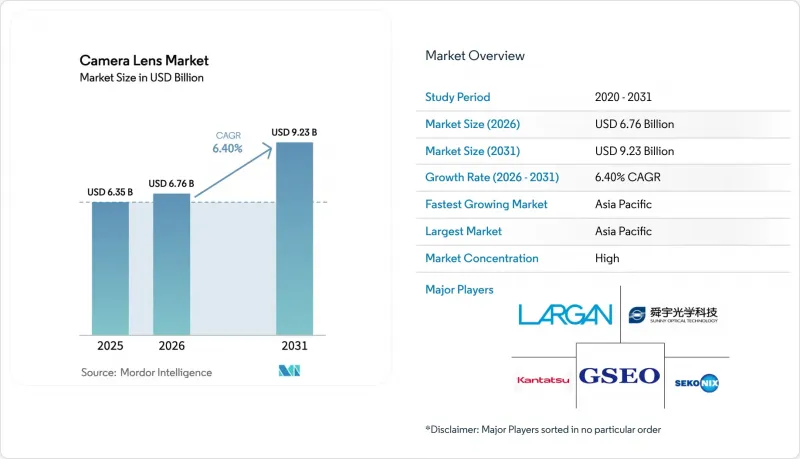
This report is Segmented by Application (Consumer Electronics [Mobile, AR/VR/MR, Other Consumer Electronics], Automotive, and More), Lens Type (Built-In Lens, Interchangeable Lens, and More), Mount/Compatibility (DSLR Mount, and More), End-User (Professional, and More), Focal Length (Ultra-Wide [<16 Mm], Wide [16-35 Mm], and More), and Geography. The Market Forecasts are Provided in Terms of Value (USD).
Global Camera Lens Market Trends and Insights
Proliferation of High-Resolution Multi-Camera Smartphones
Flagship phones in 2025 adopted 200-megapixel sensors, which increased optical design demands and drove lens stacks toward tighter tolerances and enhanced coatings. Sony entered this tier with the Lytia LYT-901, a 1/1.12-inch, 200-megapixel mobile sensor that integrates an AI learning-based remosaicing circuit to sustain high-resolution zoom and 4K video at 30 frames per second, thereby reducing the on-device processing load and favoring optical modules that resolve more detail at the sensor plane. Smartphone makers are also compressing telephoto modules for premium zoom in slimmer flagships, which aligns with Samsung Electro-Mechanics' All Lenses on Prism concept that aims to shrink the telephoto footprint by 50% without compromising optical reach. These shifts tighten specifications for periscope assemblies, which require precise alignment of prisms, mirrors, and multi-element lens stacks to control stray light and maintain contrast. As camera counts per device remain high across tiers, the camera lenses market benefits from consistent unit pull-through and higher ASPs on telephoto modules. Accessory ecosystems that extend focal length and improve stabilization work best when optics deliver clean detail to the sensor, which sustains differentiation for advanced lenses even as computational processing improves.
Rising Adoption of ADAS and Autonomous Vehicles
Automotive imaging is moving from optional add-ons to integrated perception systems with stringent performance and reliability needs. Sony's IMX828 automotive image sensor integrates a built-in MIPI A-PHY interface, which reduces bill-of-materials complexity by eliminating an external serializer chip and delivers 150-decibel dynamic range to handle harsh lighting transitions that are common in traffic scenes. Mobileye reference platforms use multiple camera configurations, from one to six or more cameras per vehicle depending on the ADAS level, which raises demand for wide field-of-view lenses, long-range front cameras, and robust thermal and vibration performance in the optical stack. Nikon and Mitsubishi Fuso showcased a single-lens approach that merges telephoto and wide-angle capture within one optical path to prevent parallax, which reduces camera count, lowers system cost, and simplifies calibration. As design-wins shift to solutions that pack more performance per module, the camera lenses market benefits from specifications that value dynamic range, minimal distortion, and reliable operation across automotive temperature ranges. Regulatory pressure and safety objectives continue to advance adoption across trims and regions, improving visibility for lens suppliers that meet automotive-grade quality targets.
Supply-Chain Volatility in Optical Materials and Rare Earths
Geopolitical constraints, export controls, and tariffs on key optical materials such as germanium, zinc sulfide, and zinc selenide are adding risk to production planning for infrared and specialty lenses. Industry forums highlighted these vulnerabilities during 2025, with conference discussions pointing to constrained supply and longer lead times for critical materials that underpin thermal imaging and other advanced optics. Precision optics manufacturers also flagged extended lead times for specialty glass substrates and rare-earth doped materials, which can stretch procurement cycles from weeks to months. Larger companies can buffer volatility with multi-sourcing and inventory strategies, but smaller module assemblers face sharper price and availability swings. As optical designs trend toward hybrid glass-plastic constructions and new formats like metalenses, the dependence on niche materials could increase exposure. The camera lenses market is therefore rewarding suppliers that integrate supply-chain resilience into product planning and sourcing decisions.
Other drivers and restraints analyzed in the detailed report include:
- Growing Demand for Machine Vision and Industrial Automation Imaging
- Rapid Uptake of Mirrorless Cameras Among Professionals and Enthusiasts
- Digital Substitution From Computational Photography
For complete list of drivers and restraints, kindly check the Table Of Contents.
Segment Analysis
Consumer electronics accounted for 58% share of the camera lenses market size in 2025, supported by multi-camera smartphone designs that keep unit demand strong. Robust demand for optical zoom in thin devices is encouraging periscope module adoption, which increases the share of high-ASP lenses within premium phones. Fixed-lens compact cameras experienced renewed attention among creators who value simple controls and color science, which helps broaden the use base for lenses beyond smartphones. The camera lenses market retains balanced exposure because consumer segments provide scale, while enterprise and public-sector uses add stability. As buyers compare results across devices, optics that resolve more detail at the sensor continue to matter for overall system performance.
Industrial and machine vision is the fastest-growing application, projected at 10.3% annually through 2031, because vision has become central to digital transformation in factories. Smart cameras now embed AI inference to perform complex inspection and guidance tasks, which raises the bar for lenses that hold clarity across the frame and under non-uniform lighting. Automotive use continues to scale as ADAS levels move up and as camera-based features span more vehicle trims and regions, which supports demand for wide-angle, long-range, and surround-view lens formats. Medical imaging requires tightly controlled distortion and coatings that handle operating-room lighting, which sustains premium pricing. Across applications, the camera lenses market benefits from a mix of volume in consumer gear and higher margins where imaging drives safety and quality.
Standard and prime lenses held 49% market share in 2025, underscoring their role as the workhorses of interchangeable-lens systems and smartphone main cameras. Brand roadmaps continue to emphasize versatile zoom ranges that pair with compact bodies and stabilization, which helps creators who alternate between photo and video. In smartphones, periscope modules are reshaping expectations for reach and clarity from thin devices, and developers are compressing the optical path while controlling internal reflections. Samsung's All Lenses on Prism approach is an example of how optical packaging innovation can reduce telephoto module size by 50%, which opens room for larger sensors or batteries in the same device volume. These changes support the camera lenses market as design wins hinge on who can fit longer focal length capability into premium phones without bulk.
Periscope lenses are projected to grow at 11.3% annually through 2031, which reflects user demand for clear 5x to 10x optical zoom from pocketable hardware. As mainstream camera stacks become saturated, device makers differentiate with long-reach telephotos and better low-light capture at zoom. In parallel, wide-angle lenses keep gaining in automotive surround-view and in creative uses where edge-to-edge sharpness and controlled distortion are critical. The camera lenses industry is adapting by honing multi-element designs, coatings, and tighter assembly tolerances to balance size, weight, and performance across lens types. These adjustments reinforce the camera lenses market because they increase the value captured by advanced optical modules that enable new features users can see and measure.
Complete Report Scope:
- By Application
- Consumer Electronics
- Mobile
- AR / VR / MR
- Other Consumer Electronics
- Automotive
- Medical
- Industrial And Machine Vision
- Other Applications
- Consumer Electronics
- By Lens Type
- Built-In Lens
- Interchangeable Lens
- Prime Lens
- Zoom Lens
- Macro Lens
- Telephoto Lens
- Wide-Angle Lens
- Periscope Lens
- By Mount / Compatibility
- DSLR Mount
- Mirrorless Mount
- C-Mount
- F-Mount
- CS-Mount
- Other Mount Types
- By End-User
- Professional
- Enthusiast
- Consumer
- OEM / Module Suppliers
- Research And Industrial
- By Focal Length
- Ultra-Wide (<16 mm)
- Wide (16-35 mm)
- Standard (35-70 mm)
- Short Telephoto (70-135 mm)
- Long Telephoto (>135 mm)
- By Geography
- North America
- United States
- Canada
- Mexico
- South America
- Brazil
- Argentina
- Rest Of South America
- Europe
- Germany
- United Kingdom
- France
- Italy
- Spain
- Russia
- Rest Of Europe
- Asia Pacific
- China
- Japan
- India
- South Korea
- ASEAN
- Oceania
- Rest Of Asia Pacific
- Middle East
- Turkey
- Israel
- GCC
- Rest Of Middle East
- Africa
- North Africa
- South Africa
- Rest Of Africa
- North America
Geography Analysis
Asia Pacific led the camera lenses market with 62% share in 2025 and is projected to grow at 18% through 2031, supported by concentrated manufacturing clusters and expanding end-market demand in smartphones and vehicles. Production networks across China, South Korea, Japan, and Southeast Asia coordinate optics, sensors, and modules at scale, which shortens development cycles and improves cost positions. Samsung's All Lenses on Prism telephoto packaging concept reflects the region's focus on squeezing more optical reach into thinner devices, which can reset competitive benchmarks for premium phones. Canon's milestone of 170 million RF and EF lenses underscores Japan's strength in high-end optical ecosystems that serve creators and professionals. As AR and automation use broaden, the camera lenses market size in the Asia Pacific benefits from both volume and diversified application growth.
North America and Europe together accounted for a 28% share in 2025, with growth supported by automotive safety systems, industrial automation, and premium imaging. Automotive lens demand aligns with sensor advancements, such as Sony's IMX828, which incorporates an A-PHY interface on-chip to reduce complexity and enhance dynamic range under harsh lighting conditions. These features improve total system reliability for ADAS use cases. Mobileye platform designs with multi-camera arrays illustrate how perception stacks rely on lenses that cover both near-range and long-range scenes, which lifts demand for varied optical configurations across trims. In factories across the United States and Europe, embedded-AI smart cameras are spreading beyond pilot projects, which place a premium on optics that sustain clarity for model inference at the edge. These regional dynamics support a steady mix of B2B and prosumer demand in the camera lenses market.
The rest of the world accounted for the remaining share and is poised for selective growth tied to logistics, infrastructure, and agriculture. In the Middle East and Africa, construction and logistics projects are incorporating vision systems to enhance safety and throughput, which rely on ruggedized optics that withstand dust and extreme temperatures. In South America, agricultural monitoring and inspection utilize drones equipped with specialized lenses for crop analysis and mapping, creating a demand for light, high-contrast optics that integrate seamlessly with gimbals. As supply-chain risks for specialty materials persist, companies that secure multiregional sourcing for optical glass and coatings will have a competitive edge, which is particularly important in constrained markets. Across regions, the camera lenses market benefits from stable B2B use cases that value reliability, as well as consumer upgrades that bring advanced optics into more devices.
- Largan Precision Co. Ltd
- Sunny Optical Technology (Group) Company Limited
- Genius Electronic Optical Co. Ltd
- AAC Technologies Holdings Inc.
- Samsung Electro-Mechanics Co. Ltd
- Kantatsu Co. Ltd
- Sekonix Co. Ltd
- Canon Inc.
- Sony Corporation
- Nikon Corporation
- Tamron Co. Ltd
- Sigma Corporation
- Ability Opto-Electronics Technology Co. Ltd
- Sunex Inc.
- Haesung Optics Co. Ltd
- O-Film Group Co. Ltd
- Newmax Technology Co. Ltd
- Q Technology (Group) Co. Ltd
- Asia Optical Co. Inc.
Additional Benefits:
- The market estimate (ME) sheet in Excel format
- 3 months of analyst support
TABLE OF CONTENTS
1 INTRODUCTION
- 1.1 Study Assumptions And Market Definition
- 1.2 Scope Of The Study
- 1.2.1 camera lenses market
2 RESEARCH METHODOLOGY
3 EXECUTIVE SUMMARY
4 MARKET LANDSCAPE
- 4.1 Market Overview
- 4.2 Market Drivers
- 4.2.1 Proliferation Of High-Resolution Multi-Camera Smartphones
- 4.2.2 Rising Adoption Of ADAS And Autonomous Vehicles
- 4.2.3 Growing Demand For Machine Vision And Industrial Automation Imaging
- 4.2.4 Rapid Uptake Of Mirrorless Cameras Among Professionals And Enthusiasts
- 4.2.5 Emergence Of AR / VR Devices With Advanced Lens Modules
- 4.2.6 Integration Of Liquid And Freeform Optics Enabling Slimmer Designs
- 4.3 Market Restraints
- 4.3.1 Margin Compression From Intense Supplier Competition
- 4.3.2 Manufacturing Yield Challenges For Complex Multi-Element Lenses
- 4.3.3 Supply-Chain Volatility In Optical Materials And Rare Earths
- 4.3.4 Digital Substitution From Computational Photography
- 4.4 Industry Value / Supply-Chain Analysis
- 4.5 Regulatory Landscape
- 4.6 Technological Outlook
- 4.7 Porter's Five Forces Analysis
- 4.7.1 Threat Of New Entrants
- 4.7.2 Bargaining Power Of Buyers
- 4.7.3 Bargaining Power Of Suppliers
- 4.7.4 Threat Of Substitute Products
- 4.7.5 Intensity Of Competitive Rivalry
- 4.8 Impact Of Macroeconomic Factors On The Market
5 MARKET SIZE AND GROWTH FORECASTS
- 5.1 By Application
- 5.1.1 Consumer Electronics
- 5.1.1.1 Mobile
- 5.1.1.2 AR / VR / MR
- 5.1.1.3 Other Consumer Electronics
- 5.1.2 Automotive
- 5.1.3 Medical
- 5.1.4 Industrial And Machine Vision
- 5.1.5 Other Applications
- 5.1.1 Consumer Electronics
- 5.2 By Lens Type
- 5.2.1 Built-In Lens
- 5.2.2 Interchangeable Lens
- 5.2.3 Prime Lens
- 5.2.4 Zoom Lens
- 5.2.5 Macro Lens
- 5.2.6 Telephoto Lens
- 5.2.7 Wide-Angle Lens
- 5.2.8 Periscope Lens
- 5.3 By Mount / Compatibility
- 5.3.1 DSLR Mount
- 5.3.2 Mirrorless Mount
- 5.3.3 C-Mount
- 5.3.4 F-Mount
- 5.3.5 CS-Mount
- 5.3.6 Other Mount Types
- 5.4 By End-User
- 5.4.1 Professional
- 5.4.2 Enthusiast
- 5.4.3 Consumer
- 5.4.4 OEM / Module Suppliers
- 5.4.5 Research And Industrial
- 5.5 By Focal Length
- 5.5.1 Ultra-Wide (<16 mm)
- 5.5.2 Wide (16-35 mm)
- 5.5.3 Standard (35-70 mm)
- 5.5.4 Short Telephoto (70-135 mm)
- 5.5.5 Long Telephoto (>135 mm)
- 5.6 By Geography
- 5.6.1 North America
- 5.6.1.1 United States
- 5.6.1.2 Canada
- 5.6.1.3 Mexico
- 5.6.2 South America
- 5.6.2.1 Brazil
- 5.6.2.2 Argentina
- 5.6.2.3 Rest Of South America
- 5.6.3 Europe
- 5.6.3.1 Germany
- 5.6.3.2 United Kingdom
- 5.6.3.3 France
- 5.6.3.4 Italy
- 5.6.3.5 Spain
- 5.6.3.6 Russia
- 5.6.3.7 Rest Of Europe
- 5.6.4 Asia Pacific
- 5.6.4.1 China
- 5.6.4.2 Japan
- 5.6.4.3 India
- 5.6.4.4 South Korea
- 5.6.4.5 ASEAN
- 5.6.4.6 Oceania
- 5.6.4.7 Rest Of Asia Pacific
- 5.6.5 Middle East
- 5.6.5.1 Turkey
- 5.6.5.2 Israel
- 5.6.5.3 GCC
- 5.6.5.4 Rest Of Middle East
- 5.6.6 Africa
- 5.6.6.1 North Africa
- 5.6.6.2 South Africa
- 5.6.6.3 Rest Of Africa
- 5.6.1 North America
6 COMPETITIVE LANDSCAPE
- 6.1 Market Concentration
- 6.2 Strategic Moves
- 6.3 Market Share Analysis
- 6.4 Company Profiles (includes Global Level Overview, Market Level Overview, Core Segments, Financials As Available, Strategic Information, Market Rank / Share, Products And Services, And Recent Developments)
- 6.4.1 Largan Precision Co. Ltd
- 6.4.2 Sunny Optical Technology (Group) Company Limited
- 6.4.3 Genius Electronic Optical Co. Ltd
- 6.4.4 AAC Technologies Holdings Inc.
- 6.4.5 Samsung Electro-Mechanics Co. Ltd
- 6.4.6 Kantatsu Co. Ltd
- 6.4.7 Sekonix Co. Ltd
- 6.4.8 Canon Inc.
- 6.4.9 Sony Corporation
- 6.4.10 Nikon Corporation
- 6.4.11 Tamron Co. Ltd
- 6.4.12 Sigma Corporation
- 6.4.13 Ability Opto-Electronics Technology Co. Ltd
- 6.4.14 Sunex Inc.
- 6.4.15 Haesung Optics Co. Ltd
- 6.4.16 O-Film Group Co. Ltd
- 6.4.17 Newmax Technology Co. Ltd
- 6.4.18 Q Technology (Group) Co. Ltd
- 6.4.19 Asia Optical Co. Inc.
7 MARKET OPPORTUNITIES AND FUTURE OUTLOOK
- 7.1 White-Space And Unmet-Need Assessment

