PUBLISHER: Mordor Intelligence | PRODUCT CODE: 2122399

PUBLISHER: Mordor Intelligence | PRODUCT CODE: 2122399
India Luxury Car - Market Share Analysis, Industry Trends & Statistics, Growth Forecasts (2026 - 2031)
According to Mordor Intelligence, the indian luxury car market size is expected to grow from USD 1.44 billion in 2025 to USD 1.52 billion in 2026 and is forecast to reach USD 1.96 billion by 2031, growing at a 5.16% CAGR over the forecast period (2026-2031).
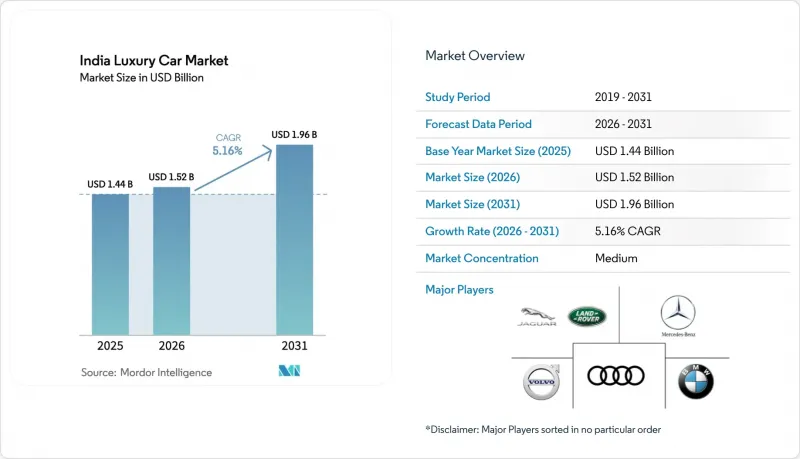
This report is Segmented by Vehicle Type (SUV, Sedan, Hatchback), Drive Type (IC Engine, Hybrid, Battery Electric), Price Range (INR 20 To 50 Lakh, INR 50 To 80 Lakh, Above INR 80 Lakh), Sales Channel (Company-Owned Showrooms, Authorized Dealerships/Franchise, Online), and Geography (North India, West India, South India, and More). The Market Forecasts are Provided in Terms of Value (USD) and Volume (Units).
India Luxury Car Market Trends and Insights
Premiumization of Upper-middle-class Households
India now has an estimated 8.71 lakh millionaire households (defined as households with a net worth of INR 8.7 crore or more), marking a 90 % increase compared with 2021 (from about INR 4.58 lakh). These affluent households represent roughly 0.31 % of all Indian households and reflect strong wealth creation in the country amid economic growth. Nuclear families now account for 62% of luxury purchases, up from 48% in 2020, as dual-income couples increasingly favor personal mobility. Liquidity is evident in UPI transfers above INR 1 lakh, which have surged 34% year over year. Slowing real-estate appreciation redirects status signaling toward automobile ownership.
Rising Availability of Entry-level Models (CKD)
Local assembly cut the entry point for German sedans to INR 48.9 lakh, with BMW's X1 sDrive18i M Sport priced INR 6.5 lakh lower than the prior CBU version. CKD economics avoids 100% CBU duties, preserves 28-32% gross margins, and trims delivery lead times to six weeks. Mercedes-Benz sold 19,565 units in India in 2024. Audi's Aurangabad plant will accommodate BEV platforms by late 2026, extending CKD savings to electric models below INR 80 lakh.
Scarcity of Trained Technicians for ADAS and High-Voltage Systems
The Automotive Skills Development Council estimates a 2.4 million technician shortfall by 2026, with only 50,000 of the 500,000 required EV-certified technicians currently available, resulting in a 10% fill rate. This shortfall extends warranty-claim resolution from 4 days in metros to 18 days in tier-2 cities like Coimbatore and Jaipur. The skills gap manifests in customer dissatisfaction; a 2024 J.D. Power study found that 42% of luxury EV owners in tier-2 markets rated aftersales service below expectations, citing technician unfamiliarity with battery thermal management diagnostics and over-the-air software updates, factors that depress brand Net Promoter Scores by 18 points relative to metro areas.
Other drivers and restraints analyzed in the detailed report include:
- EV Incentives by State Governments
- Rapid Rollout of 150 kW+ Public DC Chargers on Inter-city Corridors
- Slow Build-out of Certified Pre-owned Luxury Networks
For complete list of drivers and restraints, kindly check the Table Of Contents.
Segment Analysis
Sport Utility Vehicles (SUVs) captured 47.43% of India's luxury car market share in 2025, while sedans are expected to resurge with a forecast 10.12% CAGR through 2031. Rear-seat entertainment uptake exceeds 2/3, indicating a shift in value toward ride quality. SUVs remain indispensable in tier-2 markets with poor road surfaces; the ultra-luxury SUV niche, priced above INR 2 crore, is advancing on the back of models like the Rolls-Royce Cullinan.
Hatchbacks remain a negligible segment, constrained by the absence of premium offerings priced below INR 40 lakh (approximately USD 48,000). The discontinuation of the Mercedes A-Class in 2023 left a void that no competitor has filled, ceding the entry-luxury space to mass-premium brands like the Skoda Octavia. Hybrid powertrains further propel the sedan revival - BMW's 530e and Mercedes E 300e - which benefit from the September 2025 GST reduction to 38%, trimming prices by INR 9-11 lakh (approximately USD 10,800-13,200) and compressing the premium over equivalent petrol variants to just INR 4 lakh (approximately USD 4,800), a gap that buyers recover within 60,000 kilometers given petrol prices averaging INR 105 per liter (approximately USD 1.26) in metros.
Internal combustion engines still held 74.68% of India's luxury car market share in 2025; however, BEVs are expected to expand at a 21.98% CAGR through 2031, thereby quadrupling the overall pace of the Indian luxury car market. Mercedes-Benz EQS SUV buyers can leverage a 40% first-year depreciation under India's tax code, thereby narrowing the payback horizon. Plug-in hybrids gained momentum from the September 2025 GST cut to 38%, resulting in a 28% surge in month-on-month registrations. Residual-value anxiety keeps some buyers in petrol variants, where refueling convenience and lower sticker prices remain essential considerations.
The ICE segment's resilience stems from three factors: established refueling infrastructure (85,000 petrol pumps versus 12,000 public EV chargers), faster refueling (3 minutes versus 25 minutes for fast-charging), and lower upfront cost - the BMW 530i at INR 72.9 lakh (approximately USD 87,500) undercuts the i4 eDrive40 by INR 18 lakh (approximately USD 21,600), a gap that buyers with annual mileage under 15,000 kilometers cannot justify. The BMW 530e and Mercedes E 300e are leading the uptake in Bangalore and Pune, cities where buyers prioritize tax efficiency over outright performance.
Complete Report Scope:
- By Vehicle Type
- Sport Utility Vehicles (SUVs)
- Sedan
- Hatchback
- By Drive Type
- Internal Combustion Engine (ICE)
- Hybrid
- Battery Electric
- By Price Range
- INR 20 to 50 Lakh
- INR 50 to 80 Lakh
- Above INR 80 Lakh
- By Sales Channel
- Company-owned Showrooms
- Authorized Dealerships/Franchise
- Online (Direct-to-Consumer)
- By Region
- North India
- West India
- South India
- East and North-East India
List of Companies Covered in this Report:
- Mercedes-Benz Group AG
- BMW AG
- AUDI AG
- Jaguar Land Rover Automotive PLC
- AB Volvo
- Lexus
- Porsche AG
- Rolls-Royce plc
- Bentley Motors Limited
- Automobili Lamborghini S.p.A.
- Ferrari S.p.A.
- Maserati S.p.A
- Aston Martin Lagonda Global Holdings PLC
Additional Benefits:
- The market estimate (ME) sheet in Excel format
- 3 months of analyst support
TABLE OF CONTENTS
1 Introduction
- 1.1 Study Assumptions and Market Definition
- 1.2 Scope of the Study
2 Research Methodology
3 Executive Summary
4 Market Landscape
- 4.1 Market Overview
- 4.2 Market Drivers
- 4.2.1 Premiumization of Upper-Middle-Class Households
- 4.2.2 Rising Availability of Entry-Level Models (CKD)
- 4.2.3 EV Incentives by State Governments
- 4.2.4 Rapid Rollout of 150 kW+ Public DC Chargers on Inter-City Corridors
- 4.2.5 OEM-Financed Subscription and Leasing Schemes
- 4.2.6 Chinese Ultra-Luxury EV Brands Eyeing India as Next Launch Pad
- 4.3 Market Restraints
- 4.3.1 High GST and Cess Structure
- 4.3.2 Import Duty Uncertainty on CBUs
- 4.3.3 Slow Build-Out of Certified Pre-Owned Luxury Networks
- 4.3.4 Scarcity of Trained Technicians for ADAS and High-Voltage Systems
- 4.4 Value/Supply-Chain Analysis
- 4.5 Regulatory Landscape
- 4.6 Technological Outlook
- 4.7 Porter's Five Forces Analysis
- 4.7.1 Bargaining Power of Buyers/Consumers
- 4.7.2 Bargaining Power of Suppliers
- 4.7.3 Threat of New Entrants
- 4.7.4 Threat of Substitute Products
- 4.7.5 Intensity of Competitive Rivalry
5 Market Size and Growth Forecasts (Value (USD) and Volume (Units))
- 5.1 By Vehicle Type
- 5.1.1 Sport Utility Vehicles (SUVs)
- 5.1.2 Sedan
- 5.1.3 Hatchback
- 5.2 By Drive Type
- 5.2.1 Internal Combustion Engine (ICE)
- 5.2.2 Hybrid
- 5.2.3 Battery Electric
- 5.3 By Price Range
- 5.3.1 INR 20 to 50 Lakh
- 5.3.2 INR 50 to 80 Lakh
- 5.3.3 Above INR 80 Lakh
- 5.4 By Sales Channel
- 5.4.1 Company-owned Showrooms
- 5.4.2 Authorized Dealerships/Franchise
- 5.4.3 Online (Direct-to-Consumer)
- 5.5 By Region
- 5.5.1 North India
- 5.5.2 West India
- 5.5.3 South India
- 5.5.4 East and North-East India
6 Competitive Landscape
- 6.1 Market Concentration
- 6.2 Strategic Moves
- 6.3 Market Share Analysis
- 6.4 Company Profiles (Includes Global level Overview, Market level overview, Core Segments, Financials as available, Strategic Information, Market Rank/Share for key companies, Products and Services, and Recent Developments)
- 6.4.1 Mercedes-Benz Group AG
- 6.4.2 BMW AG
- 6.4.3 AUDI AG
- 6.4.4 Jaguar Land Rover Automotive PLC
- 6.4.5 AB Volvo
- 6.4.6 Lexus
- 6.4.7 Porsche AG
- 6.4.8 Rolls-Royce plc
- 6.4.9 Bentley Motors Limited
- 6.4.10 Automobili Lamborghini S.p.A.
- 6.4.11 Ferrari S.p.A.
- 6.4.12 Maserati S.p.A
- 6.4.13 Aston Martin Lagonda Global Holdings PLC
7 Market Opportunities and Future Outlook
- 7.1 White-space and Unmet-need Assessment

