PUBLISHER: Mordor Intelligence | PRODUCT CODE: 2122423

PUBLISHER: Mordor Intelligence | PRODUCT CODE: 2122423
Rail Coatings - Market Share Analysis, Industry Trends & Statistics, Growth Forecasts (2026 - 2031)
According to Mordor Intelligence, the rail coatings market size is expected to grow from 211.47 kilotons in 2025 to 218.6 kilotons in 2026 and is forecast to reach 258.14 kilotons by 2031 at 3.37% CAGR over 2026-2031.
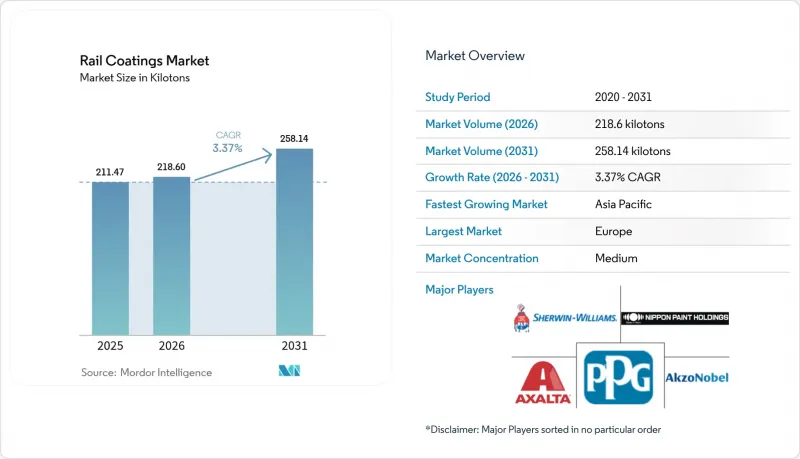
This report is Segmented by Resin Type (Acrylic, Epoxy, Polyurethane, Polyester, and Other Resins), Technology (Water-Based, Solvent-Based, and More), Type (New Build and Refurbishment), Usage Area (Interior and Exterior), Application (Locomotives, Passenger, Freight, and Below Solebar), and Geography (Asia-Pacific, North America, and More). The Market Forecasts are Provided in Terms of Volume (Tons).
Global Rail Coatings Market Trends and Insights
Expansion of High-Speed Rail Networks
European Union funding for cross-border corridors, combined with Thailand's first 250 km/h line, underpins long-term premium-grade demand. High-velocity operation subjects car bodies to elevated wind load, stone-chip abrasion, and heat, so specifiers mandate fluoropolymer topcoats that resist erosion. Norway's full network electrification intensifies this requirement because electric rolling stock operates at a cooler temperature, yet carries more sensitive wiring that requires insulation from coatings. These factors raise per-car coating spend even as overall rail coatings market volume stabilizes. Vendors that certify aerodynamic, low-drag finishes secure inclusion in master specifications. The shift also micro-segments demand: tunnel sections require smoke-suppressant layers, while roof zones demand higher UV blockers, pushing the use of multi-coat systems.
Surge in Metro and Light-Rail Investments
Indian federal allocations for metros in fifteen cities translate into immediate purchase orders for intumescent primers and anti-microbial interiors. European regulators mandate smoke-toxicity tests after metro incidents, so fire-resistive films move from optional to baseline. North American transit agencies add silver-ion additives to combat surface pathogens, a post-pandemic response guided by APTA's hygiene charter. Because carriage downtime inflates operator costs, contractors specify rapid-cure polyurethane clearcoats, replacing older alkyd maintenance paints. Lifecycle-cost tenders increasingly score solutions on day-one price and ten-year cleanability, rewarding suppliers that publish audited total-cost models. These pressures keep the rail coatings market centered on value rather than sheer liters sold.
Stringent VOC-Emission Regulations
The EU Industrial Emissions Directive caps rail-coating VOC content at 50 g/L, forcing many legacy solvent systems off spec sheets. Formulating compliant lines costs suppliers USD 5 million for each chemistry family, straining research and development budgets and widening the gap between global majors and small regionals. Transitional dual-stock strategies raise inventory charges because projects are bid two years ahead under older formulas. North America is expected to follow a similar rule set by 2027, creating phased compliance waves. Contractors must now invest in air-handling and waste-capture equipment, which pushes service prices up and slows the uptake of rail coatings in retrofit cycles.
Other drivers and restraints analyzed in the detailed report include:
- Refurbishment of Ageing Rolling Stock
- Adoption of Self-Cleaning Anti-Graffiti Nanocoatings
- Raw-Material Price Volatility
For complete list of drivers and restraints, kindly check the Table Of Contents.
Segment Analysis
Epoxy resins accounted for 40.78% of the 2025 rail coatings market share due to their unmatched adhesion and chemical resistance, particularly in primers applied to steel bogies and aluminum car bodies. Polyurethane topcoats follow for UV and gloss retention, and their 3.62% growth rate signals accelerating switchovers on the roof and side-panel zones. Hybrid epoxy-polyurethane systems now dominate depot refurb lines because one supplier delivers matched cure profiles, slashing spray-booth turns. Fluoropolymers, though niche in volume, are seeing steady uptake on high-speed sets. Silicone-modified acrylics remain a small but growing class for non-stick ice-shedding on Nordic locomotives. Regulatory VOC limits pressure all resin classes, propelling water-dilutable epoxy dispersions into primer roles without abandoning corrosion resistance.
Continued research and development convergence of epoxy crosslinkers with low-temperature polyaspartic urethane hardeners enables single-shift overcoating even at 5 °C winter depot conditions. Suppliers that certify such chemistries against ISO 9466:2025 earn preferred-vendor status. These advances expand the rail coatings market opportunity for functional hybrids that combine chemical toughness with environmental compliance, shifting the competitive focus from resin type to lifecycle value.
Solvent-borne platforms still held 48.72% of the 2025 rail coatings market share, primarily because they atomize reliably under variable conditions. Yet water-based growth outpaces at 3.71%, driven by exemption pressures in Europe and copycat policies in Japan and South Korea. Resin suppliers incorporate coalescent-free latexes that meet VOC caps while matching 1,000-hour salt-spray benchmarks. Powder coatings are advancing in OEM car-body shells, aided by recent breakthroughs in low-bake polyester-epoxy hybrids that cure at 150 °C, a temperature achievable for aluminum components. UV-cure oligomer systems carve out niches in interior panels where instant cure enhances production flow.
Equipment outlays still slow wholesale migration: water-borne lines require stainless spray trunks, and powder booths need reclaimed airflow loops. As leading rail operators shift to carbon-pricing tender models, however, water-borne and powder options score higher lifecycle points, nudging total rail coatings market share toward low-emission paths. Suppliers partner with equipment makers to bundle turnkey upgrades into coating contracts, easing capex hurdles for rolling-stock builders.
Complete Report Scope:
- By Resin Type
- Acrylic
- Epoxy
- Polyurethane
- Polyester
- Other Resins (Fluoropolymers and silicone)
- By Technology
- Water-based
- Solvent-based
- Powder Coatings
- UV-Cured
- By Type
- New Build
- Refurbishment
- By Usage Area
- Interior
- Exterior
- By Application
- Locomotives
- Passenger
- Freight
- Below Solebar
- By Geography
- Asia-Pacific
- China
- India
- Japan
- South Korea
- Malaysia
- Thailand
- Indonesia
- Vietnam
- Rest of Asia-Pacific
- North America
- United States
- Canada
- Mexico
- Europe
- Germany
- United Kingdom
- France
- Italy
- Spain
- Nordic Countries
- Turkey
- Russia
- Rest of Europe
- South America
- Brazil
- Argentina
- Colombia
- Rest of South America
- Middle-East and Africa
- Saudi Arabia
- Qatar
- United Arab Emirates
- Nigeria
- Egypt
- South Africa
- Rest of Middle-East and Africa
- Asia-Pacific
Geography Analysis
Europe maintained a 38.72% rail coatings market share in 2025, thanks to its mature networks, strict VOC rules, and multi-billion-euro rolling-stock renewal programs by SNCF and Deutsche Bahn. The resurgence of high-speed and night trains further stokes premium coating demand, particularly for fluoropolymer top layers that promise 15-year warranties. Cross-border interoperability prompts OEMs to standardize coatings that withstand varying climate zones, fueling pan-regional approved product lists that lock in established suppliers.
Asia-Pacific leads growth at 4.02% CAGR to 2031 on the back of India's modernization plan and China's metro expansions into second-tier cities. Rapid urbanization drives mid-range polyurethane demand for commuter EMUs, while Southeast Asian high-speed corridors adopt imported nano-silica topcoats to meet aerodynamic and humidity challenges. ESG standards lag behind those in Europe, but Japan's green-procurement rules are nudging its neighbors to adopt low-VOC thresholds, thereby accelerating waterborne sales.
North America's freight-heavy operators invest in track and equipment upkeep, resulting in steady demand for protective coatings. Metro refurbishments in New York and Toronto specify intumescent layers, sustaining niche high-margin sales. South America focuses on bulk-freight corridors and cost-efficient zinc-rich primers, whereas the Middle East's desert railways require silicones that resist sand erosion and 50°C ambient heat. Africa remains nascent; yet as financing clears for transnational corridors, it represents a long-tail opportunity for the rail coatings market.
- Akzo Nobel N.V.
- Axalta Coating Systems LLC
- BASF SE
- Berger Paints India
- Carboline Company
- GLS Coatings Ltd
- Hempel A/S
- Jotun
- Kansai Paint Co. Ltd
- Mader Group
- Nippon Paint Company Limited
- PPG Industries Inc.
- RPM International Inc.
- T & R Williamson
- The Sherwin-Williams Company
- WEILBURGER Coatings GmbH
- Williams Hayward Protective Coatings Inc.
Additional Benefits:
- The market estimate (ME) sheet in Excel format
- 3 months of analyst support
TABLE OF CONTENTS
1 Introduction
- 1.1 Study Assumptions and Market Definition
- 1.2 Scope of the Study
2 Research Methodology
3 Executive Summary
4 Market Landscape
- 4.1 Market Overview
- 4.2 Market Drivers
- 4.2.1 Expansion of high-speed rail networks
- 4.2.2 Surge in metro and light-rail investments
- 4.2.3 Refurbishment of ageing rolling stock
- 4.2.4 Adoption of self-cleaning anti-graffiti nanocoatings
- 4.2.5 ESG-linked shift to low-VOC waterborne and powder systems
- 4.3 Market Restraints
- 4.3.1 Stringent VOC-emission regulations
- 4.3.2 Raw-material price volatility
- 4.3.3 Limited maintenance windows for coating application
- 4.4 Value Chain Analysis
- 4.5 Porter's Five Forces
- 4.5.1 Bargaining Power of Suppliers
- 4.5.2 Bargaining Power of Buyers
- 4.5.3 Threat of New Entrants
- 4.5.4 Threat of Substitutes
- 4.5.5 Degree of Competition
5 Market Size and Growth Forecasts (Volume)
- 5.1 By Resin Type
- 5.1.1 Acrylic
- 5.1.2 Epoxy
- 5.1.3 Polyurethane
- 5.1.4 Polyester
- 5.1.5 Other Resins (Fluoropolymers and silicone)
- 5.2 By Technology
- 5.2.1 Water-based
- 5.2.2 Solvent-based
- 5.2.3 Powder Coatings
- 5.2.4 UV-Cured
- 5.3 By Type
- 5.3.1 New Build
- 5.3.2 Refurbishment
- 5.4 By Usage Area
- 5.4.1 Interior
- 5.4.2 Exterior
- 5.5 By Application
- 5.5.1 Locomotives
- 5.5.2 Passenger
- 5.5.3 Freight
- 5.5.4 Below Solebar
- 5.6 By Geography
- 5.6.1 Asia-Pacific
- 5.6.1.1 China
- 5.6.1.2 India
- 5.6.1.3 Japan
- 5.6.1.4 South Korea
- 5.6.1.5 Malaysia
- 5.6.1.6 Thailand
- 5.6.1.7 Indonesia
- 5.6.1.8 Vietnam
- 5.6.1.9 Rest of Asia-Pacific
- 5.6.2 North America
- 5.6.2.1 United States
- 5.6.2.2 Canada
- 5.6.2.3 Mexico
- 5.6.3 Europe
- 5.6.3.1 Germany
- 5.6.3.2 United Kingdom
- 5.6.3.3 France
- 5.6.3.4 Italy
- 5.6.3.5 Spain
- 5.6.3.6 Nordic Countries
- 5.6.3.7 Turkey
- 5.6.3.8 Russia
- 5.6.3.9 Rest of Europe
- 5.6.4 South America
- 5.6.4.1 Brazil
- 5.6.4.2 Argentina
- 5.6.4.3 Colombia
- 5.6.4.4 Rest of South America
- 5.6.5 Middle-East and Africa
- 5.6.5.1 Saudi Arabia
- 5.6.5.2 Qatar
- 5.6.5.3 United Arab Emirates
- 5.6.5.4 Nigeria
- 5.6.5.5 Egypt
- 5.6.5.6 South Africa
- 5.6.5.7 Rest of Middle-East and Africa
- 5.6.1 Asia-Pacific
6 Competitive Landscape
- 6.1 Market Concentration
- 6.2 Strategic Moves
- 6.3 Market Share (%)/Ranking Analysis
- 6.4 Company Profiles (includes Global level Overview, Market level overview, Core Segments, Financials as available, Strategic Information, Market Rank/Share for key companies, Products and Services, and Recent Developments)
- 6.4.1 Akzo Nobel N.V.
- 6.4.2 Axalta Coating Systems LLC
- 6.4.3 BASF SE
- 6.4.4 Berger Paints India
- 6.4.5 Carboline Company
- 6.4.6 GLS Coatings Ltd
- 6.4.7 Hempel A/S
- 6.4.8 Jotun
- 6.4.9 Kansai Paint Co. Ltd
- 6.4.10 Mader Group
- 6.4.11 Nippon Paint Company Limited
- 6.4.12 PPG Industries Inc.
- 6.4.13 RPM International Inc.
- 6.4.14 T & R Williamson
- 6.4.15 The Sherwin-Williams Company
- 6.4.16 WEILBURGER Coatings GmbH
- 6.4.17 Williams Hayward Protective Coatings Inc.
7 Market Opportunities and Future Outlook
- 7.1 White-space and Unmet-need Assessment

