PUBLISHER: Mordor Intelligence | PRODUCT CODE: 2122426

PUBLISHER: Mordor Intelligence | PRODUCT CODE: 2122426
Finished Steel Products - Market Share Analysis, Industry Trends & Statistics, Growth Forecasts (2026 - 2031)
According to Mordor Intelligence, finished steel products market size in 2026 is estimated at 1.89 billion tons, growing from 2025 value of 1.79 billion tons with 2031 projections showing 2.47 billion tons, growing at 5.50% CAGR over 2026-2031.
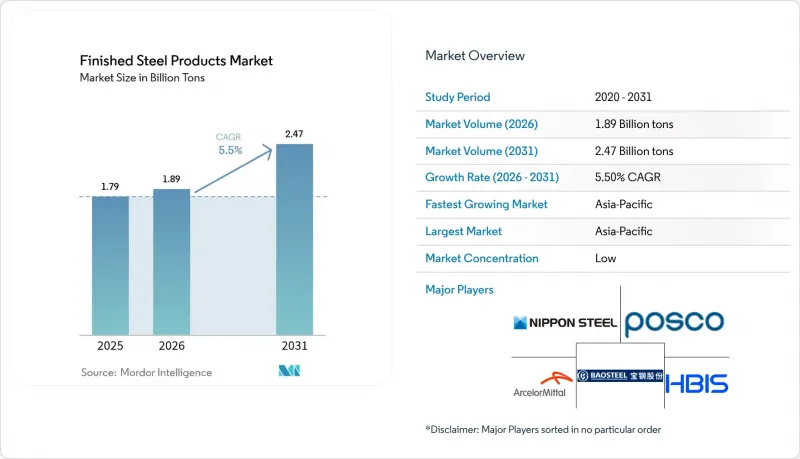
This report is Segmented by Form (Plate, Strip, Rod and Bar, Profile, Tube, Wire, Other Forms), Process (Hot-Rolling, Cold-Rolling, Forging, Casting, and More), End-User Industry (Construction and Infrastructure, Transportation, Energy, Containers and Packaging, Electrical and Electronics, and More), and Geography (Asia-Pacific, North America, Europe, South America, Middle-East and Africa).
Global Finished Steel Products Market Trends and Insights
Infrastructure boom in Asia and Africa
Annual infrastructure needs of USD 1.7 trillion in Asia and USD 67.6-107.5 billion in Africa are expanding demand for structural bars, beams, and rebar. China's Belt and Road Initiative spans 140 countries, funneling large tonnage orders to regional mills. India's National Infrastructure Pipeline, valued at USD 1.4 trillion through 2025, continues to stimulate domestic capacity additions. Major producers are therefore establishing downstream finishing hubs nearer to project locations, shortening lead times and strengthening the finished steel products market. Intensified localization is also helping reduce CO2 emissions tied to long-haul shipping.
EV-driven demand for AHSS and electrical steels
Advanced high-strength steel (AHSS) presently constitutes 35-40% of a typical EV body, up from 20% in conventional models. Tesla's 2 million-unit capacity and BYD's aggressive scaling point toward automotive steel consumption reaching 25-30 million tons by 2030. Grain-oriented electrical steels required for 800-volt traction motors are growing 15-20% annually, fetching premium price differentials. Suppliers are responding with rapid alloy-development cycles, hot-stamping expansions, and coating upgrades to safeguard market share against aluminum and composite alternatives. These investments enhance the finished steel products market as automakers recalibrate material balances for weight, safety, and cost.
Raw-material cost volatility pressuring margins
Iron ore and coking coal prices fluctuated sharply during 2024 and 2025 as supply disruptions and currency changes intersected with uneven demand recovery. Vale, Rio Tinto, and BHP collectively control a significant share of seaborne ore, magnifying price swings during outages or weather events. Elevated power prices in Europe-often two to three times those in Asia or the United States-erode local mill competitiveness. These dynamics compel steelmakers to pursue long-term supply contracts, hedging programs, and vertical integration to shield EBITDA margins in the finished steel products market.
Other drivers and restraints analyzed in the detailed report include:
- Renewable-energy build-out driving steel intensity
- Scrap-availability surge enabling EAF capacity growth
- Lightweight substitutes challenging traditional applications
For complete list of drivers and restraints, kindly check the Table Of Contents.
Segment Analysis
Strip products generated the highest volume, capturing a 31.78% share in 2025 on the strength of automotive panels, appliance casings, and construction cladding. Robust demand from unibody vehicle platforms and standardized building components keeps mill utilization high. The finished steel products market size for strip products is forecast to maintain steady growth as surface-quality requirements rise. Tube products, although smaller in volume, are projected to achieve the fastest 6.24% CAGR through 2031, supported by pipeline expansions, renewable-energy towers, and HVAC installations. Precision tubes for automotive fuel lines and aerospace hydraulics command premium margins, encouraging investment in advanced welding and inspection systems.
Ongoing infrastructure spending in emerging markets supports heavy-section plate sales, whereas rod and bar benefit from reinforced-concrete demand. Profile and wire forms secure niche positions in engineered structures and electronic applications. Producers continue to optimize line flexibility to shift between strip and tube output as end-market signals evolve, preserving competitiveness within the finished steel products market.
Complete Report Scope:
- By Form
- Plate
- Strip
- Rod and Bar
- Profile
- Tube
- Wire
- Other Forms
- By Process
- Hot-Rolling
- Cold-Rolling
- Forging
- Casting
- Extrusion and Drawing
- Additive Manufacturing of Steel
- By End-user Industry
- Construction and Infrastructure
- Transportation
- Energy
- Containers and Packaging
- Electrical and Electronics
- Machinery and Equipment
- Defence and Security
- By Geography
- Asia-Pacific
- China
- India
- Japan
- South Korea
- ASEAN Countries
- Australia and New Zealand
- North America
- United States
- Canada
- Mexico
- Europe
- Germany
- United Kingdom
- Italy
- France
- Spain
- Russia
- Rest of Europe
- South America
- Brazil
- Argentina
- Rest of South America
- Middle-East and Africa
- Saudi Arabia
- South Africa
- Turkey
- Rest of Middle-East and Africa
- Asia-Pacific
Geography Analysis
Asia-Pacific generated the largest share at 60.88% in 2025 and is forecast to expand at a 6.12% CAGR, combining massive domestic consumption with export capability. China's crude-steel output exceeded 1 billion tons in 2024, though carbon-pricing trials and capacity-swap regulations are nudging mills toward high-quality finishing and green-steel projects. India's USD 1.4 trillion National Infrastructure Pipeline accelerates domestic demand, while Southeast Asia benefits from rising electronics and appliance manufacturing. Policy incentives for hydrogen-based direct-reduced-iron (DRI) and scrap-based EAFs aim to balance growth with emission commitments, thereby sustaining the finished steel products market.
North America is reorganizing around supply-chain security after the March 2025 imposition of 25% import tariffs. EAF expansions, such as Hyundai Steel's Louisiana project, exploit abundant scrap and inexpensive energy. Regional OEMs increasingly favor local sourcing to mitigate tariff costs and geopolitical risk, supporting the finished steel products market despite cyclical construction softness.
Europe faces decarbonization and import-safeguard challenges under its Steel Action Plan, targeting a 15% reduction in non-EU inflows by 2026. Power-price differentials and carbon taxes pressure margins, yet hydrogen-driven DRI pilots and circular-economy scrap programs are positioning European mills as early movers in low-carbon premium grades. South America leverages abundant iron-ore reserves and renewable power to court green-steel investments, while Middle East and Africa, responsible for 45% of global DRI, aim to serve emerging green-iron corridors linking resource-rich regions with demand centers in Europe and Asia. These regional strategies collectively support long-term resilience in the finished steel products market.
- ArcelorMittal
- Baosteel Group
- BMWIL
- China Ansteel Group Corporation Limited
- Gerdau S/A
- HBIS Group
- Hyundai Steel
- JFE Steel Corporation
- Jiangsu Shagang Group
- JSW Steel Ltd
- Nippon Steel Corporation
- Nucor
- Outokumpu
- POSCO
- Shougang Group
- SSAB AB
- Steel Authority of India Limited (SAIL)
- Tata Steel
- ThyssenKrupp AG
- United States Steel
- Voestalpine AG
Additional Benefits:
- The market estimate (ME) sheet in Excel format
- 3 months of analyst support
TABLE OF CONTENTS
1 Introduction
- 1.1 Study Assumptions and Market Definition
- 1.2 Scope of the Study
2 Research Methodology
3 Executive Summary
4 Market Landscape
- 4.1 Market Drivers
- 4.1.1 Infrastructure Boom in Asia and Africa
- 4.1.2 EV-driven demand for AHSS and electrical steels
- 4.1.3 Renewable-energy build-out (wind-tower, solar-frame plate)
- 4.1.4 Scrap-availability surge powering EAF capacity growth
- 4.1.5 Defence re-armament boosting Q&T armour plate
- 4.2 Market Restraints
- 4.2.1 Raw-material cost volatility
- 4.2.2 Lightweight substitutes (Al, CFRP) in transport
- 4.2.3 EU-CBAM and green-premium cost divergence
- 4.2.4 Structural over-capacity in China and GCC
- 4.3 Value Chain Analysis
- 4.4 Regulatory Landscape
- 4.5 Porter's Five Forces
- 4.5.1 Bargaining Power of Suppliers
- 4.5.2 Bargaining Power of Buyers
- 4.5.3 Threat of New Entrants
- 4.5.4 Threat of Substitutes
- 4.5.5 Degree of Competition
5 Market Size and Growth Forecasts (Volume)
- 5.1 By Form
- 5.1.1 Plate
- 5.1.2 Strip
- 5.1.3 Rod and Bar
- 5.1.4 Profile
- 5.1.5 Tube
- 5.1.6 Wire
- 5.1.7 Other Forms
- 5.2 By Process
- 5.2.1 Hot-Rolling
- 5.2.2 Cold-Rolling
- 5.2.3 Forging
- 5.2.4 Casting
- 5.2.5 Extrusion and Drawing
- 5.2.6 Additive Manufacturing of Steel
- 5.3 By End-user Industry
- 5.3.1 Construction and Infrastructure
- 5.3.2 Transportation
- 5.3.3 Energy
- 5.3.4 Containers and Packaging
- 5.3.5 Electrical and Electronics
- 5.3.6 Machinery and Equipment
- 5.3.7 Defence and Security
- 5.4 By Geography
- 5.4.1 Asia-Pacific
- 5.4.1.1 China
- 5.4.1.2 India
- 5.4.1.3 Japan
- 5.4.1.4 South Korea
- 5.4.1.5 ASEAN Countries
- 5.4.1.6 Australia and New Zealand
- 5.4.2 North America
- 5.4.2.1 United States
- 5.4.2.2 Canada
- 5.4.2.3 Mexico
- 5.4.3 Europe
- 5.4.3.1 Germany
- 5.4.3.2 United Kingdom
- 5.4.3.3 Italy
- 5.4.3.4 France
- 5.4.3.5 Spain
- 5.4.3.6 Russia
- 5.4.3.7 Rest of Europe
- 5.4.4 South America
- 5.4.4.1 Brazil
- 5.4.4.2 Argentina
- 5.4.4.3 Rest of South America
- 5.4.5 Middle-East and Africa
- 5.4.5.1 Saudi Arabia
- 5.4.5.2 South Africa
- 5.4.5.3 Turkey
- 5.4.5.4 Rest of Middle-East and Africa
- 5.4.1 Asia-Pacific
6 Competitive Landscape
- 6.1 Market Concentration
- 6.2 Strategic Moves
- 6.3 Market Share/Ranking Analysis
- 6.4 Company Profiles (includes Global level Overview, Market level overview, Core Segments, Financials as available, Strategic Information, Market Rank/Share for key companies, Products and Services, and Recent Developments)
- 6.4.1 ArcelorMittal
- 6.4.2 Baosteel Group
- 6.4.3 BMWIL
- 6.4.4 China Ansteel Group Corporation Limited
- 6.4.5 Gerdau S/A
- 6.4.6 HBIS Group
- 6.4.7 Hyundai Steel
- 6.4.8 JFE Steel Corporation
- 6.4.9 Jiangsu Shagang Group
- 6.4.10 JSW Steel Ltd
- 6.4.11 Nippon Steel Corporation
- 6.4.12 Nucor
- 6.4.13 Outokumpu
- 6.4.14 POSCO
- 6.4.15 Shougang Group
- 6.4.16 SSAB AB
- 6.4.17 Steel Authority of India Limited (SAIL)
- 6.4.18 Tata Steel
- 6.4.19 ThyssenKrupp AG
- 6.4.20 United States Steel
- 6.4.21 Voestalpine AG
7 Market Opportunities and Future Outlook
- 7.1 White-space and Unmet-need Assessment

