PUBLISHER: Mordor Intelligence | PRODUCT CODE: 2122448

PUBLISHER: Mordor Intelligence | PRODUCT CODE: 2122448
Used Truck - Market Share Analysis, Industry Trends & Statistics, Growth Forecasts (2026 - 2031)
According to Mordor Intelligence, the used truck market size is expected to increase from USD 52.73 billion in 2025 to USD 55.38 billion in 2026 and reach USD 70.74 billion by 2031, growing at a CAGR of 5.02% over 2026-2031.
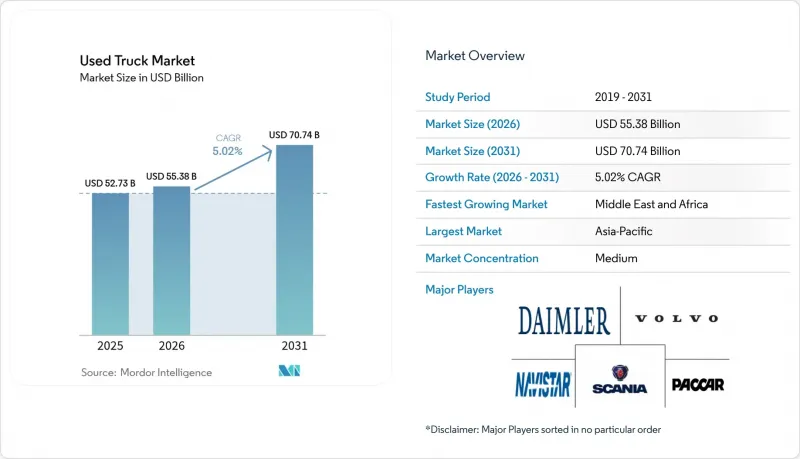
This report is Segmented by Vehicle Type (Light Trucks, Medium-Duty Trucks, and More), Fuel Type (Diesel, Gasoline, and More), Age Bracket (Up To 3 Years, 4-7 Years, and More), Vehicle Class (Class 3 and More), End-Use Industry (Construction and Infrastructure and More), Sales Channel (Independent Dealer and More), and Geography. The Market Forecasts are Provided in Terms of Value (USD) and Volume (Units).
Global Used Truck Market Trends and Insights
Infrastructure-Led Construction Booms in India and ASEAN Stimulating Heavy Used-Truck Turnover
The National Infrastructure Pipeline earmarks more than USD 1.4 trillion to transport and logistics projects, which is raising heavy-duty registrations that later flow into the used truck market. Large projects such as highway corridors and port expansions shorten ownership cycles because contractors prefer asset-light balance sheets once projects end. Resulting mid-life trucks enter secondary channels in good condition, attracting small builders that cannot finance new equipment. India's 2024 scrappage policy, offering registration-fee waivers for retiring trucks aged over 15 years, removes aged assets and supports unit values in the 4-to-7-year window. Comparable public works agendas in Indonesia and Vietnam have similar knock-on effects, ensuring a stable pipeline of compliant, late-model heavy dumpers and tractors.
E-commerce Last-Mile Expansion in North America Triggering Demand for Used Light-Duty Trucks
Rapid parcel growth led carriers to open micro-hubs that rely on Class 3-5 box trucks for same-day delivery. Compliance deadlines under the U.S. Environmental Protection Agency's Clean Truck Plan, finalized in 2024, encourage fleets to retire diesel models before 2027 NOx ceilings take hold. Turnover raises the supply of low-mileage units that owner-operators can afford. In parallel, zero-emission pilot zones in several U.S. metros spur early adopters to remarket first-generation electric vans, broadening fuel mix in the secondary channel without sacrificing range for urban drops. Light-truck absorption remains robust because these vehicles require modest capital and deliver quick payback.
Tightening Euro-VII/Phase-3 NOx Rules Discouraging Older Diesel Imports in EU
Starting in 2027, the Euro VII framework will prohibit many pre-Euro VI trucks from accessing low-emission corridors, effectively dampening the demand for older diesel vehicles. In Germany and the UK, municipal clean-air zones are penalizing heavy vehicles that don't meet compliance standards, further dissuading potential buyers. Importers are shifting their focus to Eastern Europe and North Africa for liquidating these vehicles. This shift is narrowing the pool of buyers within the EU and driving up prices for compliant Euro VI vehicles.
Other drivers and restraints analyzed in the detailed report include:
- OEM Certified Pre-Owned Programs in Europe Enhancing Trust and Residual Values
- Digital Wholesale Auctions Broadening Buyer Pool, Especially in Middle East
- Low-Cost New Chinese Trucks Compressing Used Price Premiums in Africa
For complete list of drivers and restraints, kindly check the Table Of Contents.
Segment Analysis
Heavy-duty trucks captured 43.57% of the used-truck market share in 2025, underscoring their entrenched role in long-haul freight and infrastructure hauling. They remain the preferred choice for fleets that prioritize payload capacity, durability, and an extensive service network. Yet tightening emission rules and shifting delivery patterns are prompting operators to reassess fleet composition, opening space for lighter formats that better suit urban corridors. Manufacturers are responding by broadening certified pre-owned programs that include turnkey maintenance bundles, raising buyer confidence in previously owned heavy rigs. Against this backdrop, residual values for well-maintained heavy-duty units stay resilient even as buyers diversify into smaller classes.
Light trucks in the Class 3-5 band are projected to expand at a 7.69% CAGR through 2031, the fastest pace among all weight classes. This surge reflects last-mile e-commerce growth, municipal clean-air initiatives, and lower capital hurdles for independent owner-operators. Fleets cycling out of first-generation electric vans are releasing late-model diesel and battery-electric light trucks into secondary channels, offering budget-minded buyers multiple propulsion choices. Urban delivery contracts often specify tight turning radii and low curb weights, making light trucks the logical selection for same-day routes. Digital auction houses expand access to these assets by publishing telematics data and inspection reports, thereby shortening due diligence cycles.
Diesel engines retained 93.36% of the used truck market share in 2025, supported by ubiquitous fueling infrastructure and proven reliability in high-torque duty cycles. Operators value the established parts ecosystem and the predictable maintenance intervals associated with diesel powertrains. Even as zero-emission mandates tighten, many carriers hedge compliance risk by refreshing to newer, cleaner diesel models rather than switching to propulsion entirely. Certified pre-owned channels reinforce this trend by bundling extended engine warranties and advanced telematics for mileage verification. Consequently, diesel continues to anchor price discovery across dealer lots and digital platforms alike.
Hybrid and battery-electric trucks are scaling at a 22.55% CAGR through 2031, the swiftest rate across the fuel type spectrum. Early adopters who trialed first-wave electric rigs now release them into resale pools, creating an emerging inventory stream for smaller fleets eager to test zero-tailpipe technology. Government incentives, such as scrappage credits or clean-transport rebates, further tilt economics in favor of electrified options. Buyers weigh the lower operating costs of electricity against the uncertainty of battery health, making OEM-issued battery-warranty transfers a critical differentiator. Over time, improved charging networks and standardized diagnostics are expected to normalize valuation models for used electric trucks.
Complete Report Scope:
- By Vehicle Type
- Light Trucks (Class 3-5)
- Medium-Duty Trucks (Class 6-7)
- Heavy-Duty Trucks (Class 8 and Over 15 t)
- By Fuel Type
- Diesel
- Gasoline
- Natural Gas and LPG
- Hybrid and Battery-Electric
- By Age Bracket
- Up to 3 Years
- 4 to 7 Years
- 8 to 12 Years
- Above 12 Years
- By Vehicle Class
- Class 3
- Class 4
- Class 5
- Class 6
- Class 7
- Class 8
- By End-use Industry
- Construction and Infrastructure
- Logistics and E-commerce Delivery
- Mining and Quarrying
- Agriculture and Forestry
- Municipal and Utilities
- Others
- By Sales Channel
- Independent Dealer
- Franchised Dealer
- OEM-Backed Certified Pre-Owned
- Online Peer-to-Peer and Auction
- By Geography
- North America
- United States
- Canada
- Rest of North America
- South America
- Brazil
- Argentina
- Chile
- Rest of South America
- Europe
- Germany
- United Kingdom
- France
- Italy
- Spain
- Russia
- Rest of Europe
- Asia-Pacific
- China
- India
- Japan
- South Korea
- Rest of Asia-Pacific
- Middle East and Africa
- United Arab Emirates
- Saudi Arabia
- Qatar
- South Africa
- Rest of Middle East and Africa
- North America
Geography Analysis
Asia-Pacific accounted for 47.92% of global volume in 2025, cementing its position as the nucleus of the used truck market. Infrastructure megaprojects in India and Southeast Asia keep heavy-duty units circulating swiftly between primary and secondary owners. China's electrification trajectory is prompting fleets to sell diesel stock earlier in the lifecycle, enriching export pipelines across the region. Digital auction hubs in Singapore and Bangkok simplify cross-border trade, tightening regional price spreads. Collectively, these factors reinforce Asia-Pacific's standing as both the largest demand center and an increasingly sophisticated supply hub.
North America sustains steady activity as e-commerce networks grow denser and carriers pre-empt stricter EPA rules by refreshing assets. The easing of semiconductor bottlenecks improves new-truck availability, but many smaller fleets still gravitate toward used alternatives to conserve capital. State-level incentives for low-emission trucks create a selective appetite for late-model diesel and emerging electric units. Auction facilities across the Midwest and Southeast now livestream events, attracting buyers well beyond local markets. The region's mature financing infrastructure further lubricates transaction velocity.
The Middle East and Africa region is poised for the fastest expansion, with a 7.41% CAGR through 2031. Gulf logistics visions emphasize multimodal freight corridors, driving appetite for heavy tractors that meet Euro V and Euro VI benchmarks. Online auctions connect regional buyers with surplus inventory in Europe and North America, compressing historical supply gaps. In Africa, the influx of competitively priced trucks strengthens trade routes that serve mining and agriculture. These dynamics collectively elevate the region from a peripheral participant to a focal growth frontier.
- Daimler AG (SelecTrucks)
- PACCAR Inc.
- Volvo Group
- Scania AB
- MAN Truck and Bus SE
- Navistar International Corp.
- Tata Motors
- Ashok Leyland
- Isuzu Motors
- Hino Motors
- Mitsubishi Fuso Truck and Bus Corp.
- Eicher Motors (VECV)
- Iveco Group N.V.
- Ford Otosan
- Sinotruk (CNHTC)
- FAW Jiefang
- Dongfeng Commercial Vehicles
- UD Trucks
- Penske Used Trucks
- Enterprise Truck Rental
- Ryder Used Vehicle Sales
- AmeriQuest Used Trucks
- Copart Inc.
- Ritchie Bros. Auctioneers
- Mascus
- TruckPlanet (IronPlanet)
- AutoNation USA
- OLX Autos Commercial
Additional Benefits:
- The market estimate (ME) sheet in Excel format
- 3 months of analyst support
TABLE OF CONTENTS
1 Introduction
- 1.1 Study Assumptions and Market Definition
- 1.2 Scope of the Study
2 Research Methodology
3 Executive Summary
4 Market Landscape
- 4.1 Market Overview
- 4.2 Market Drivers
- 4.2.1 Infrastructure-Led Construction Booms in India and ASEAN Stimulating Heavy Used-Truck Turnover
- 4.2.2 E-commerce Last-Mile Expansion in North America Triggering Demand for Used Light-Duty Trucks
- 4.2.3 OEM Certified Pre-Owned Programs in Europe Enhancing Trust and Residual Values
- 4.2.4 Digital Wholesale Auctions Broadening Buyer Pool, Especially in Middle East
- 4.2.5 Fleet Electrification Targets in China Pushing Diesel Fleet Liquidation
- 4.2.6 Tax Incentives on Used Commercial Vehicles in Brazil Supporting Owner-Operators
- 4.3 Market Restraints
- 4.3.1 Tightening Euro-VII/Phase-3 NOx Rules Discouraging Older Diesel Imports in EU
- 4.3.2 Low-Cost New Chinese Trucks Compressing Used Price Premiums in Africa
- 4.3.3 Limited Financing Options for Aged Heavy-Duty Assets in ASEAN Rural Regions
- 4.3.4 Chip Shortages Easing New-Truck Lead Times, Reducing Used-Vehicle Scarcity
- 4.4 Value / Supply-Chain Analysis
- 4.5 Regulatory or Technological Outlook
- 4.5.1 Emission-Norm Transition Timelines
- 4.5.2 Digital Title and Telematics-Enabled Inspection Technologies
- 4.6 Porter's Five Forces Analysis
- 4.6.1 Threat of New Entrants
- 4.6.2 Bargaining Power of Buyers
- 4.6.3 Bargaining Power of Suppliers
- 4.6.4 Threat of Substitutes
- 4.6.5 Intensity of Competitive Rivalry
5 Market Size and Growth Forecasts (Value (USD) and Volume (Units))
- 5.1 By Vehicle Type
- 5.1.1 Light Trucks (Class 3-5)
- 5.1.2 Medium-Duty Trucks (Class 6-7)
- 5.1.3 Heavy-Duty Trucks (Class 8 and Over 15 t)
- 5.2 By Fuel Type
- 5.2.1 Diesel
- 5.2.2 Gasoline
- 5.2.3 Natural Gas and LPG
- 5.2.4 Hybrid and Battery-Electric
- 5.3 By Age Bracket
- 5.3.1 Up to 3 Years
- 5.3.2 4 to 7 Years
- 5.3.3 8 to 12 Years
- 5.3.4 Above 12 Years
- 5.4 By Vehicle Class
- 5.4.1 Class 3
- 5.4.2 Class 4
- 5.4.3 Class 5
- 5.4.4 Class 6
- 5.4.5 Class 7
- 5.4.6 Class 8
- 5.5 By End-use Industry
- 5.5.1 Construction and Infrastructure
- 5.5.2 Logistics and E-commerce Delivery
- 5.5.3 Mining and Quarrying
- 5.5.4 Agriculture and Forestry
- 5.5.5 Municipal and Utilities
- 5.5.6 Others
- 5.6 By Sales Channel
- 5.6.1 Independent Dealer
- 5.6.2 Franchised Dealer
- 5.6.3 OEM-Backed Certified Pre-Owned
- 5.6.4 Online Peer-to-Peer and Auction
- 5.7 By Geography
- 5.7.1 North America
- 5.7.1.1 United States
- 5.7.1.2 Canada
- 5.7.1.3 Rest of North America
- 5.7.2 South America
- 5.7.2.1 Brazil
- 5.7.2.2 Argentina
- 5.7.2.3 Chile
- 5.7.2.4 Rest of South America
- 5.7.3 Europe
- 5.7.3.1 Germany
- 5.7.3.2 United Kingdom
- 5.7.3.3 France
- 5.7.3.4 Italy
- 5.7.3.5 Spain
- 5.7.3.6 Russia
- 5.7.3.7 Rest of Europe
- 5.7.4 Asia-Pacific
- 5.7.4.1 China
- 5.7.4.2 India
- 5.7.4.3 Japan
- 5.7.4.4 South Korea
- 5.7.4.5 Rest of Asia-Pacific
- 5.7.5 Middle East and Africa
- 5.7.5.1 United Arab Emirates
- 5.7.5.2 Saudi Arabia
- 5.7.5.3 Qatar
- 5.7.5.4 South Africa
- 5.7.5.5 Rest of Middle East and Africa
- 5.7.1 North America
6 Competitive Landscape
- 6.1 Market Concentration
- 6.2 Strategic Moves
- 6.3 Market Share Analysis
- 6.4 Company Profiles (Includes Global Level Overview, Market Level Overview, Core Segments, Financials as Available, Strategic Information, Market Rank/Share for Key Companies, Products and Services, SWOT Analysis, and Recent Developments)
- 6.4.1 Daimler AG (SelecTrucks)
- 6.4.2 PACCAR Inc.
- 6.4.3 Volvo Group
- 6.4.4 Scania AB
- 6.4.5 MAN Truck and Bus SE
- 6.4.6 Navistar International Corp.
- 6.4.7 Tata Motors
- 6.4.8 Ashok Leyland
- 6.4.9 Isuzu Motors
- 6.4.10 Hino Motors
- 6.4.11 Mitsubishi Fuso Truck and Bus Corp.
- 6.4.12 Eicher Motors (VECV)
- 6.4.13 Iveco Group N.V.
- 6.4.14 Ford Otosan
- 6.4.15 Sinotruk (CNHTC)
- 6.4.16 FAW Jiefang
- 6.4.17 Dongfeng Commercial Vehicles
- 6.4.18 UD Trucks
- 6.4.19 Penske Used Trucks
- 6.4.20 Enterprise Truck Rental
- 6.4.21 Ryder Used Vehicle Sales
- 6.4.22 AmeriQuest Used Trucks
- 6.4.23 Copart Inc.
- 6.4.24 Ritchie Bros. Auctioneers
- 6.4.25 Mascus
- 6.4.26 TruckPlanet (IronPlanet)
- 6.4.27 AutoNation USA
- 6.4.28 OLX Autos Commercial
7 Market Opportunities and Future Outlook
- 7.1 Digital Inspection-as-a-Service for Cross-Border Buyers
- 7.2 Subscription and Pay-per-mile Financing Models for SMEs
- 7.3 Electrified Truck After-market and Second-life Batteries

