PUBLISHER: Mordor Intelligence | PRODUCT CODE: 2122518

PUBLISHER: Mordor Intelligence | PRODUCT CODE: 2122518
Enterprise Metadata Management - Market Share Analysis, Industry Trends & Statistics, Growth Forecasts (2026 - 2031)
According to Mordor Intelligence, enterprise metadata management market size in 2026 is estimated at USD 15.86 billion, growing from 2025 value of USD 13.11 billion with 2031 projections showing USD 41.09 billion, growing at 20.95% CAGR over 2026-2031.
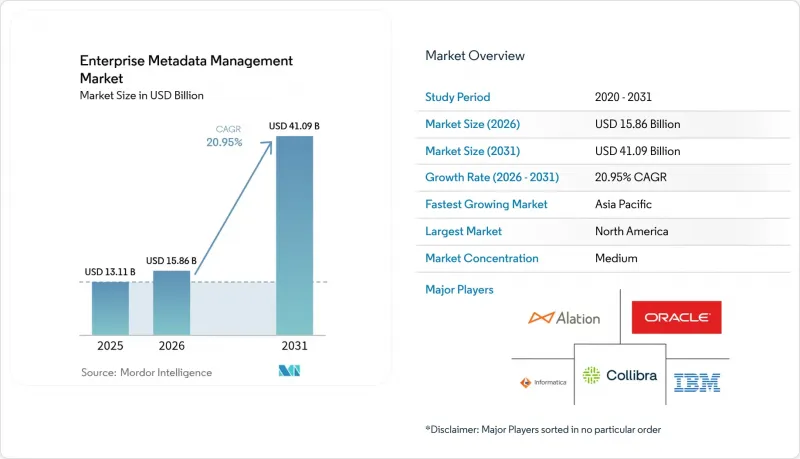
This report is Segmented by Component (Solutions and Services), Deployment Mode (Cloud, On-Premises, and Hybrid), Metadata Type (Technical Metadata, Business Metadata, and Operational/Process Metadata), Organization Size (Large Enterprises and Small and Medium Enterprises), End-User Industry (BSFI, Healthcare and Life Sciences, and More), and Geography.
Global Enterprise Metadata Management Market Trends and Insights
Explosion of enterprise data volumes
IoT rollouts, 5G connectivity, and omnichannel commerce are swelling corporate data troves, pushing metadata management to board agendas. AT&T used Snowflake to consolidate metadata across legacy and cloud assets, accelerating analytics while cutting infrastructure costs. Similar initiatives are multiplying in telecom and e-commerce, where high-velocity data flows demand automated lineage and cataloging to sustain agility and compliance.
Regulatory compliance and data-governance mandates
Fresh regulations are tightening oversight. Malaysia now obliges firms with more than 20,000 data subjects to nominate Data Protection Officers and notify breaches, a step that is enlarging the enterprise metadata management market. India's Digital Personal Data Protection Act and China's Interim AI Measures act likewise raise expectations for granular lineage and consent tracking. Singapore's banking regulator mandates AI model risk governance, reinforcing the need for transparent metadata.
High implementation cost and integration complexity
Legacy sprawl inflates deployment timelines and budgets. Citigroup's fragmented data stack incurred USD 1.5 billion in fines, illustrating the risk of retrofitting modern metadata onto heritage systems. SMEs, with leaner resources, hesitate to invest without near-term returns, dampening uptake.
Other drivers and restraints analyzed in the detailed report include:
- Cloud and hybrid migration requires unified metadata
- Self-service analytics adoption spurs data-catalog demand
- ROI uncertainty and skills shortage
For complete list of drivers and restraints, kindly check the Table Of Contents.
Segment Analysis
Solutions produced 67.45% of revenue in 2025. The enterprise metadata management market expects services to grow at a 23.52% CAGR to 2031 as firms need consulting for hybrid integration, AI enablement, and regulatory readiness. Deutsche Telekom partnered with Capgemini for a TMForum-aligned model that shortened product-launch cycles, highlighting service value.
Enterprises also outsource managed metadata operations to navigate ever-changing privacy laws and cloud tooling, fueling annuity revenues for system integrators and MSPs. As cloud estates scale, outcome-based service contracts expand, reinforcing a healthy pipeline for advisory, implementation, and support.
Cloud remains the default, holding 58.10% market share in 2025. However, hybrid configurations are projected to post a 22.55% CAGR because regulated entities must localize sensitive data while exploiting cloud analytics. Malaysia's new privacy guidelines and Singapore's sovereign cloud framework intensify this pattern.
Hybrid tooling unites on-prem and cloud catalogs into a single control plane. TELUS proved the model by maintaining critical data hubs on-site while orchestrating analytics in Google Cloud, safeguarding residency obligations without impeding AI development.
Complete Report Scope:
- By Component
- Solutions
- Services
- By Deployment Mode
- Cloud
- On-Premises
- Hybrid
- By Metadata Type
- Technical Metadata
- Business Metadata
- Operational/Process Metadata
- By Organization Size
- Large Enterprises
- Small and Medium Enterprises (SMEs)
- By End-user Industry
- BFSI
- Healthcare and Life Sciences
- Retail and E-commerce
- IT and Telecom
- Government and Public Sector
- Manufacturing
- Media and Entertainment
- Other End-user Industries
- By Geography
- North America
- United States
- Canada
- Mexico
- South America
- Brazil
- Argentina
- Chile
- Rest of South America
- Europe
- Germany
- United Kingdom
- France
- Italy
- Spain
- Russia
- Rest of Europe
- Asia-Pacific
- China
- India
- Japan
- South Korea
- Malaysia
- Singapore
- Australia
- Rest of Asia-Pacific
- Middle East and Africa
- Middle East
- United Arab Emirates
- Saudi Arabia
- Turkey
- Rest of Middle East
- Africa
- South Africa
- Nigeria
- Rest of Africa
- Middle East
- North America
Geography Analysis
North America commands 35.72% of revenue, underpinned by the CCPA, sector-specific mandates, and a deep ecosystem of vendors and integrators. Enterprises capitalize on mature cloud infrastructure and robust venture funding, driving early experiments with AI-guided stewardship. Patent activity from Snowflake and Palantir reinforces the region's innovation edge.
Asia-Pacific is the fastest-growing theater, rising at 24.05% CAGR. Malaysia's mandatory DPO policy, India's DPDPA, and China's AI rules oblige enterprises to implement granular lineage, swelling demand. Telecommunications, retail, and manufacturing players in Indonesia and Vietnam adopt catalogs to meet new fintech and personal-data laws. The enterprise metadata management market size in Asia-Pacific is projected to more than triple by 2031.
Europe retains momentum through GDPR enforcement and the forthcoming AI Act, which emphasizes consent management and cross-border processing safeguards. Manufacturers embrace data mesh to coordinate multi-plant supply chains, while financial institutions strengthen lineage to satisfy supervisory reviews.
Smaller Latin American, Middle Eastern, and African markets are nascent but observe global precedents, gradually instituting metadata programs to shore up resilience.
- Informatica LLC
- Collibra NV
- Alation Inc.
- IBM Corporation
- Oracle Corporation
- SAP SE
- Microsoft Corporation
- Talend S.A.
- Snowflake Inc.
- Data.world, Inc.
- Atlan Pte. Ltd.
- Quest Software Inc.
- Precisely Software Incorporated
- Erwin Inc. (Quest)
- MANTA Software, Inc.
- Solidatus Ltd.
- Global IDs Inc.
- Smartlogic Semaphore Ltd.
- ASG Technologies Group, Inc.
- Alex Solutions Pty Ltd.
- Denodo Technologies Inc.
- Syniti (Capgemini SE)
- Octopai Ltd.
- Cloudera, Inc.
- Cambridge Semantics Inc.
Additional Benefits:
- The market estimate (ME) sheet in Excel format
- 3 months of analyst support
TABLE OF CONTENTS
1 INTRODUCTION
- 1.1 Study Assumptions and Market Definition
- 1.2 Scope of the Study
2 RESEARCH METHODOLOGY
3 EXECUTIVE SUMMARY
4 MARKET LANDSCAPE
- 4.1 Market Overview
- 4.2 Market Drivers
- 4.2.1 Explosion of enterprise data volumes
- 4.2.2 Regulatory compliance and data-governance mandates
- 4.2.3 Cloud and hybrid migration require unified metadata
- 4.2.4 Self-service analytics adoption spurs data-catalog demand
- 4.2.5 Generative-AI-driven auto-classification unlocks ROI
- 4.2.6 Data-mesh architectures need federated metadata services
- 4.3 Market Restraints
- 4.3.1 High implementation cost and integration complexity
- 4.3.2 ROI uncertainty and skills shortage
- 4.3.3 Multi-cloud metadata silos limit lineage completeness
- 4.3.4 Data-sovereignty limits cross-border metadata hosting
- 4.4 Industry Value Chain Analysis
- 4.5 Regulatory Landscape
- 4.6 Technological Outlook
- 4.7 Industry Attractiveness - Porter's Five Forces Analysis
- 4.7.1 Threat of New Entrants
- 4.7.2 Bargaining Power of Buyers
- 4.7.3 Bargaining Power of Suppliers
- 4.7.4 Threat of Substitutes
- 4.7.5 Intensity of Competitive Rivalry
- 4.8 Impact of Macroeconomic Factors on the Market
5 MARKET SIZE AND GROWTH FORECASTS (VALUES)
- 5.1 By Component
- 5.1.1 Solutions
- 5.1.2 Services
- 5.2 By Deployment Mode
- 5.2.1 Cloud
- 5.2.2 On-Premises
- 5.2.3 Hybrid
- 5.3 By Metadata Type
- 5.3.1 Technical Metadata
- 5.3.2 Business Metadata
- 5.3.3 Operational/Process Metadata
- 5.4 By Organization Size
- 5.4.1 Large Enterprises
- 5.4.2 Small and Medium Enterprises (SMEs)
- 5.5 By End-user Industry
- 5.5.1 BFSI
- 5.5.2 Healthcare and Life Sciences
- 5.5.3 Retail and E-commerce
- 5.5.4 IT and Telecom
- 5.5.5 Government and Public Sector
- 5.5.6 Manufacturing
- 5.5.7 Media and Entertainment
- 5.5.8 Other End-user Industries
- 5.6 By Geography
- 5.6.1 North America
- 5.6.1.1 United States
- 5.6.1.2 Canada
- 5.6.1.3 Mexico
- 5.6.2 South America
- 5.6.2.1 Brazil
- 5.6.2.2 Argentina
- 5.6.2.3 Chile
- 5.6.2.4 Rest of South America
- 5.6.3 Europe
- 5.6.3.1 Germany
- 5.6.3.2 United Kingdom
- 5.6.3.3 France
- 5.6.3.4 Italy
- 5.6.3.5 Spain
- 5.6.3.6 Russia
- 5.6.3.7 Rest of Europe
- 5.6.4 Asia-Pacific
- 5.6.4.1 China
- 5.6.4.2 India
- 5.6.4.3 Japan
- 5.6.4.4 South Korea
- 5.6.4.5 Malaysia
- 5.6.4.6 Singapore
- 5.6.4.7 Australia
- 5.6.4.8 Rest of Asia-Pacific
- 5.6.5 Middle East and Africa
- 5.6.5.1 Middle East
- 5.6.5.1.1 United Arab Emirates
- 5.6.5.1.2 Saudi Arabia
- 5.6.5.1.3 Turkey
- 5.6.5.1.4 Rest of Middle East
- 5.6.5.2 Africa
- 5.6.5.2.1 South Africa
- 5.6.5.2.2 Nigeria
- 5.6.5.2.3 Rest of Africa
- 5.6.5.1 Middle East
- 5.6.1 North America
6 COMPETITIVE LANDSCAPE
- 6.1 Market Concentration
- 6.2 Strategic Moves
- 6.3 Market Share Analysis
- 6.4 Company Profiles (includes Global level Overview, Market level overview, Core Segments, Financials as available, Strategic Information, Market Rank/Share for key companies, Products and Services, and Recent Developments)
- 6.4.1 Informatica LLC
- 6.4.2 Collibra NV
- 6.4.3 Alation Inc.
- 6.4.4 IBM Corporation
- 6.4.5 Oracle Corporation
- 6.4.6 SAP SE
- 6.4.7 Microsoft Corporation
- 6.4.8 Talend S.A.
- 6.4.9 Snowflake Inc.
- 6.4.10 Data.world, Inc.
- 6.4.11 Atlan Pte. Ltd.
- 6.4.12 Quest Software Inc.
- 6.4.13 Precisely Software Incorporated
- 6.4.14 Erwin Inc. (Quest)
- 6.4.15 MANTA Software, Inc.
- 6.4.16 Solidatus Ltd.
- 6.4.17 Global IDs Inc.
- 6.4.18 Smartlogic Semaphore Ltd.
- 6.4.19 ASG Technologies Group, Inc.
- 6.4.20 Alex Solutions Pty Ltd.
- 6.4.21 Denodo Technologies Inc.
- 6.4.22 Syniti (Capgemini SE)
- 6.4.23 Octopai Ltd.
- 6.4.24 Cloudera, Inc.
- 6.4.25 Cambridge Semantics Inc.
7 MARKET OPPORTUNITIES AND FUTURE TRENDS
- 7.1 White-Space and Unmet-Need Assessment

