PUBLISHER: Mordor Intelligence | PRODUCT CODE: 2122537

PUBLISHER: Mordor Intelligence | PRODUCT CODE: 2122537
Europe Hair Colorants - Market Share Analysis, Industry Trends & Statistics, Growth Forecasts (2026 - 2031)
According to Mordor Intelligence, the Europe hair colorant market size was valued at USD 4.90 billion in 2025 and estimated to grow from USD 5.08 billion in 2026 to reach USD 6.11 billion by 2031, at a CAGR of 3.75% during the forecast period (2026-2031).
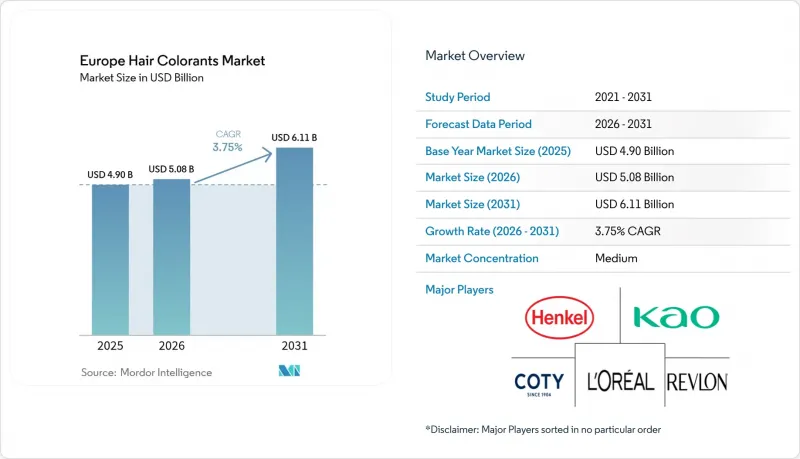
This report is Segmented by Product Type (Bleachers, Highlighters, Permanent Colorants, and More), Category (Conventional, Organic), Price (Mass, Premium), Distribution Channels (Supermarkets/Hypermarkets, Convenience Stores, Specialist Retailers, and More), and Geography (United Kingdom, Germany, France, Italy, Spain, Russia, and More). The Market Forecasts are Provided in Terms of Value (USD).
Europe Hair Colorants Market Trends and Insights
Growing consumer focus on personal grooming
European consumers are increasingly prioritizing appearance-enhancing products, showcasing a stronger inclination to invest in beauty solutions. This trend extends beyond clinical treatments to include premium hair colorants designed to deliver salon-quality results in the comfort of home. It reflects a broader transformation in consumer behavior, where personal grooming has evolved into a form of self-expression and a way to boost confidence, moving beyond its traditional role of basic upkeep. The growing influence of social media has further normalized beauty treatments, creating a psychological shift that encourages higher spending on appearance-related products. This trend is particularly evident among the 19-34 age group, which has recorded the highest increase in the adoption of aesthetic treatments. In 2024, 16% of Europe's population was under 15 years old, as reported by the Population Reference Bureau. This young demographic's growth is set to drive a steady demand for these products. Recognizing this opportunity, European brands are innovating to bridge the gap between professional and consumer markets. A notable example is L'Oreal's Colorsonic device, which automates the mixing and application process, enabling users to achieve salon-like precision and results at home.
Rising demand for natural and organic formulations
European consumers are placing greater emphasis on natural ingredients, influenced by regulatory frameworks such as the European Green Deal and the Corporate Sustainability Due Diligence Directive, which require supply-chain traceability and environmental accountability. Consequently, the EU's natural cosmetics segment is growing faster than conventional formulations, reflecting consumers' preference for products that align with sustainability values. Regulatory pressures further reinforce this trend. For example, the ECHA's classification of tea tree oil as a reproductive toxicant Category 1B demonstrates how safety scrutiny can restrict traditional natural ingredients, prompting reformulation toward botanicals verified as safe. In 2024, European importers purchased natural cosmetic ingredients valued at EUR 2.221 million, with developing countries contributing 33% of this value. This highlights significant supply-chain investments in sustainable sourcing. Suppliers providing certified organic, fair-trade, or UEBT-verified ingredients are gaining competitive advantages, while conventional manufacturers are being pushed to reformulate their products. Companies like Kemon are responding by offering products containing up to 70% natural-origin ingredients, calculated according to ISO 16128 standards, positioning natural content as a key differentiator.
Allergic reactions and tighter European Union chemical rules
European hair colorant manufacturers face increasing compliance costs and restricted ingredient options due to stricter regulations. From September 2025, the EU will enforce a ban on 20 new CMR substances, requiring widespread reformulation across the industry. For example, trimethylbenzoyl diphenylphosphine oxide will transition from permitted use to a complete ban. The Scientific Committee on Consumer Safety continues to review hair dye substances, with HC Yellow No. 16 now subject to concentration limits of 1% in oxidative dyes and 1.5% in non-oxidative formulations, reflecting ongoing regulatory oversight. These regulations disproportionately affect smaller manufacturers, who may lack the resources for extensive reformulations, potentially leading to market consolidation favoring larger, well-funded companies. Additionally, the regulatory framework includes stricter packaging and labeling requirements, with enhanced traceability mandates increasing operational complexity and costs throughout the supply chain.
Other drivers and restraints analyzed in the detailed report include:
- Aging population boosting grey-coverage demand
- Social media and influencer impact
- Presence of counterfeit and substandard products
For complete list of drivers and restraints, kindly check the Table Of Contents.
Segment Analysis
Permanent colorants hold a 48.35% market share in 2025, highlighting European consumers' preference for durable solutions that deliver complete grey coverage and vibrant color changes. For many mature consumers, particularly women, covering grey hair is crucial to maintaining a youthful and natural appearance, with studies showing significantly higher adoption rates among women than men. However, temporary colorants are the fastest-growing segment, with a projected 4.67% CAGR through 2031. This growth is driven by a desire for experimentation and a low-commitment approach to hair coloring, reflecting the influence of fast-changing social media trends. This divergence in growth trends indicates a shift in consumer behavior: while traditional permanent solutions remain popular, there is increasing demand for flexible and reversible color options. Semi-permanent colorants offer a middle ground, providing moderate longevity without the commitment of permanent formulations. Meanwhile, bleachers and highlighters cater to specialized needs, enabling bold color transformations and accent techniques.
Schwarzkopf Professional's Chroma ID launch exemplifies the industry's response to the growing temporary segment. This product features a semi-permanent system designed for both salon express services and at-home maintenance, with a 5-15 wash cycle and a quick 3-10 minute development time. Meeting modern consumer demands for gentler yet effective solutions, the product incorporates a vegan formulation and FibreBond technology. The rapid growth of the temporary segment reflects a broader cultural shift, where consumers, inspired by social media, increasingly embrace experimentation and self-expression, normalizing frequent color transformations and changes in appearance.
Conventional formulations hold an 85.12% market share in 2025, benefiting from well-established performance attributes and cost advantages that appeal to price-sensitive consumers across Europe. These conventional ingredients provide consistent coloration, reliable grey coverage, and durability, essential features for mass-market consumers. At the same time, organic alternatives are growing at a 4.40% CAGR (2026-2031), driven by regulatory pressures and increasing consumer demand for natural ingredients aligned with sustainability values. As organic formulations improve their performance and regulations further restrict synthetic options, the dominance of conventional products is expected to decline. This category split reflects the broader European consumer landscape: affluent demographics prioritize premium purchases influenced by health and environmental concerns, while cost-conscious consumers in the mass market continue to favor conventional products.
European regulations are increasingly supporting organic formulations by imposing restrictions on synthetic substances and implementing stricter labeling requirements to emphasize natural content. The European Unions classification of several substances into CMR categories 1A, 1B, or 2 adds pressure on conventional manufacturers to reformulate their products or face market exclusion. This evolving market dynamic also creates opportunities for hybrid formulations. By combining synthetic performance with natural positioning, manufacturers can cater to both segments while ensuring compliance with regulatory requirements.
Complete Report Scope:
- By Product Type
- Bleachers
- Highlighters
- Permanent Colorants
- Semi-Permanent Colorants
- Temporary Colorants
- By Category
- Conventional
- Organic
- By Price
- Mass
- Premium
- By Distribution Channels
- Supermarkets/Hypermarkets
- Convenience Stores
- Specialist Retailers
- Online Retail Stores
- Other Distribution Channels
- By Geography
- United Kingdom
- Germany
- France
- Italy
- Spain
- Russia
- Sweden
- Belgium
- Poland
- Netherlands
- Rest of Europe
List of Companies Covered in this Report:
- L'Oreal S.A.
- Henkel AG and Co. KGaA
- Coty Inc.
- Revlon, Inc.
- Kao Corporation
- Procter and Gamble Company
- Unilever Plc
- Amorepacific Corporation
- LVMH
- Crazy Color Ltd
- Lush Cosmetics
- Davines Group
- Paul Mitchell
- Naturtint
- Colortrak
- Demertzi
- Jerome Russell
- Splat
- Pravana
- Ion Color
Additional Benefits:
- The market estimate (ME) sheet in Excel format
- 3 months of analyst support
TABLE OF CONTENTS
1 INTRODUCTION
- 1.1 Study Assumptions and Market Definition
- 1.2 Scope of the Study
2 RESEARCH METHODOLOGY
3 EXECUTIVE SUMMARY
4 MARKET LANDSCAPE
- 4.1 Market Overview
- 4.2 Market Drivers
- 4.2.1 Growing consumer focus on personal grooming
- 4.2.2 Rising demand for natural and organic formulations
- 4.2.3 Aging population boosting grey-coverage demand
- 4.2.4 Social media and influencer impact
- 4.2.5 Increasing popularity of DIY at-home hair coloring
- 4.2.6 Product innovation and customization
- 4.3 Market Restraints
- 4.3.1 Allergic reactions and tighter European Union chemical rules
- 4.3.2 Presence of counterfeit and substandard products
- 4.3.3 Pigment supply-chain volatility
- 4.3.4 Price sensitivity in certain markets
- 4.4 Consumer Behaviour Analysis
- 4.5 Regulatory Landscape
- 4.6 Technological Outlook
- 4.7 Porter's Five Forces
- 4.7.1 Threat of New Entrants
- 4.7.2 Bargaining Power of Buyers
- 4.7.3 Bargaining Power of Suppliers
- 4.7.4 Threat of Substitutes
- 4.7.5 Competitive Rivalry
5 MARKET SIZE AND GROWTH FORECASTS (VALUE)
- 5.1 By Product Type
- 5.1.1 Bleachers
- 5.1.2 Highlighters
- 5.1.3 Permanent Colorants
- 5.1.4 Semi-Permanent Colorants
- 5.1.5 Temporary Colorants
- 5.2 By Category
- 5.2.1 Conventional
- 5.2.2 Organic
- 5.3 By Price
- 5.3.1 Mass
- 5.3.2 Premium
- 5.4 By Distribution Channels
- 5.4.1 Supermarkets/Hypermarkets
- 5.4.2 Convenience Stores
- 5.4.3 Specialist Retailers
- 5.4.4 Online Retail Stores
- 5.4.5 Other Distribution Channels
- 5.5 By Geography
- 5.5.1 United Kingdom
- 5.5.2 Germany
- 5.5.3 France
- 5.5.4 Italy
- 5.5.5 Spain
- 5.5.6 Russia
- 5.5.7 Sweden
- 5.5.8 Belgium
- 5.5.9 Poland
- 5.5.10 Netherlands
- 5.5.11 Rest of Europe
6 COMPETITIVE LANDSCAPE
- 6.1 Market Concentration
- 6.2 Strategic Moves
- 6.3 Market Share Analysis
- 6.4 Company Profiles (includes Global level Overview, Market level overview, Core Segments, Financials as available, Strategic Information, Market Rank/Share for key companies, Products and Services, and Recent Developments)
- 6.4.1 L'Oreal S.A.
- 6.4.2 Henkel AG and Co. KGaA
- 6.4.3 Coty Inc.
- 6.4.4 Revlon, Inc.
- 6.4.5 Kao Corporation
- 6.4.6 Procter and Gamble Company
- 6.4.7 Unilever Plc
- 6.4.8 Amorepacific Corporation
- 6.4.9 LVMH
- 6.4.10 Crazy Color Ltd
- 6.4.11 Lush Cosmetics
- 6.4.12 Davines Group
- 6.4.13 Paul Mitchell
- 6.4.14 Naturtint
- 6.4.15 Colortrak
- 6.4.16 Demertzi
- 6.4.17 Jerome Russell
- 6.4.18 Splat
- 6.4.19 Pravana
- 6.4.20 Ion Color
7 MARKET OPPORTUNITIES AND FUTURE OUTLOOK

