PUBLISHER: Mordor Intelligence | PRODUCT CODE: 2122555

PUBLISHER: Mordor Intelligence | PRODUCT CODE: 2122555
Eyewear - Market Share Analysis, Industry Trends & Statistics, Growth Forecasts (2026 - 2031)
According to Mordor Intelligence, the eyewear market reached USD 172.92 billion in 2026 and is forecast to climb to USD 226.15 billion by 2031, reflecting a 5.51% CAGR and confirming a sturdy growth runway for the global market size.
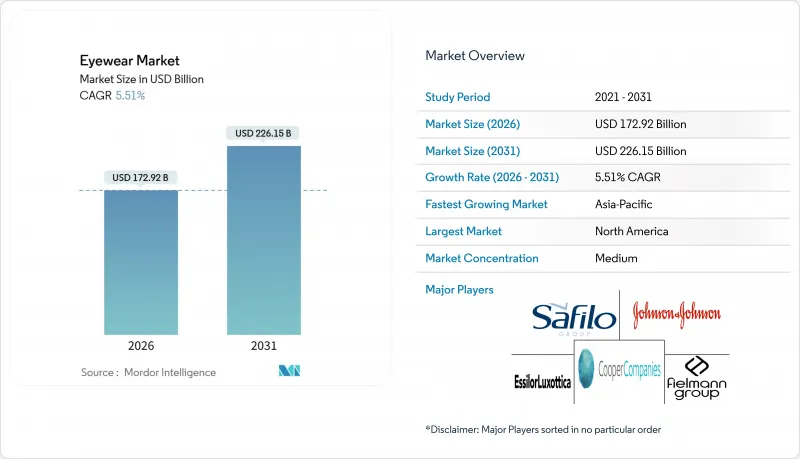
This report is Segmented by Product Type (Spectacles, Sunglasses, Contact Lenses, and Other Product Types), Category (Mass and Premium), End User (Men, Women, and Unisex), Distribution Channel (Offline Stores and Online Stores), and Geography (North America, South America, Europe, Asia-Pacific, Middle East and Africa). The Market Forecasts are Provided in Terms of Value (USD) and Volume (Units).
Global Eyewear Market Trends and Insights
Growing demand for luxury and premium sunglasses
Premium sunglasses are increasingly marketed as a lifestyle choice, emphasizing UV protection not just as a necessity but as a statement. This trend is underscored by EssilorLuxottica's USD 1.5 billion acquisition of Supreme in July 2024, a move that melds streetwear's allure with optical retail. LVMH's November 2023 acquisition of Barton Perreira further underscores the industry's tilt towards vertical integration. Established players, equipped with in-house testing labs, find an advantage in navigating regulatory hurdles like ISO 12312-1:2022, which sets stringent UV transmittance and impact resistance standards for sunglasses. As disposable incomes rise, a broader swath of consumers can now indulge in premium and luxury sunglasses, transcending mere functionality. Data from the U.S. Bureau of Economic Analysis, accessed via FRED, highlighted that the Real Disposable Personal Income in the U.S. reached USD 18,040.2 in September 2025 . With this financial flexibility, consumers are leaning towards quality craftsmanship, exclusivity, and brand prestige. This shift fuels a heightened demand for limited-edition collections, sustainable materials, and technologically advanced lenses, sidelining mass-market alternatives.
Increasing prevalence of vision problems
The global rise in refractive errors, including myopia, hyperopia, and astigmatism, is fueling the demand for prescription sunglasses that provide both vision correction and UV protection. According to the World Health Organization, at least 2.2 billion people worldwide experience near or distance vision impairments, emphasizing the substantial market potential for vision correction solutions . Myopia, in particular, has surged dramatically, especially in Asia. In nations such as China, Japan, Singapore, and South Korea, 80-90% of teenagers and young adults are now myopic, making it a significant public health concern . Advancements in photochromic lens technology are driving growth in the prescription sunglasses market by improving functionality. In April 2024, Indizen Optical Technologies of America (IOT America) introduced Neochromes FT-28 flat-top polycarbonate photochromic lenses, enhancing the bifocal lens segment with improved light-adaptive features and durability. Increasing screen time has led to a rise in digital eye strain, boosting the adoption of blue light filtering lenses. Additionally, aging populations in developed markets are sustaining demand for specialized vision correction products in the eyewear market.
Proliferation of counterfeit products
In 2024, the European Union seized 112 million counterfeit items with an estimated value of EUR 3.8 billion, emphasizing the persistent challenges in combating counterfeiting activities. The European Union's Regulation 608/2013 grants member states the authority to detain suspected counterfeit goods at borders; however, enforcement practices differ significantly across the region, leading to varying levels of effectiveness. The World Intellectual Property Organization's 2024 report highlights that eyewear ranks as the fourth most valuable category among seized counterfeit goods, following pharmaceuticals, electronics, and apparel. This ranking reflects counterfeiters' strategic exploitation of low manufacturing costs to produce and distribute fake products. To address this issue, EssilorLuxottica has implemented an e-Recordation program in collaboration with U.S. Customs and Border Protection. This program facilitates real-time alerts whenever shipments matching registered trademarks are detected entering the U.S., thereby reducing the infiltration of counterfeit goods. Nonetheless, this initiative requires substantial investments in legal frameworks and compliance infrastructure to ensure its success.
Other drivers and restraints analyzed in the detailed report include:
- Technological advancements and smart eyewear
- Growing awareness of UV protection and eye health
- Vision correction surgeries
For complete list of drivers and restraints, kindly check the Table Of Contents.
Segment Analysis
In 2025, spectacles dominated the market with a substantial 66.28% share. This dominance is primarily driven by the global need for distance-vision correction and the increasing demand for presbyopia lenses. The rising prevalence of myopia, presbyopia, and digital eye strain, largely caused by prolonged exposure to screens, has significantly boosted the demand for prescription lenses. Additionally, contact lenses are witnessing growth due to the Food and Drug Administration approvals aimed at controlling myopia, further diversifying the eyewear market. Other product categories, such as sports eyewear and safety goggles, remain niche, catering to specific consumer needs. The updated ISO 12870:2024 standard for spectacle frames has introduced durability testing for bio-based acetate materials. This advancement enables brands like Warby Parker and Fielmann to highlight their sustainability efforts while maintaining price competitiveness with traditional petroleum-based alternatives.
The sunglasses segment, however, is projected to grow at a robust 6.72% CAGR through 2031. This growth is largely attributed to the consolidation of luxury brands within the market. Key developments include EssilorLuxottica's USD 1.5 billion acquisition of Supreme in July 2024 and LVMH's USD 80 million purchase of Barton Perreira in November 2023. These strategic acquisitions underscore the profitability of the premium sunglasses segment, which boasts gross margins of 50-70%, significantly higher than the 30-40% margins associated with prescription spectacles. The trend of premiumization, driven by the appeal of designer brands, the influence of social media, and technological innovations such as polarized and smart lenses, has encouraged frequent upgrades. This is particularly evident among younger demographics and affluent consumers, who are drawn to the combination of functionality and luxury offered by these products.
In 2025, the mass segment secures a dominant 67.54% share of the market. This segment thrives on the high-volume production of standardized eyewear designs, which allows for cost-efficient manufacturing. The resulting affordability appeals strongly to price-sensitive consumers across both urban and rural regions, making it the primary driver of global demand. The mass segment primarily serves emerging markets, addressing the needs of a broad consumer base that relies on essential prescription glasses for conditions such as myopia and presbyopia, as well as for daily use. In these regions, middle- and lower-income groups often prioritize functionality and affordability over aesthetic appeal, further solidifying the segment's position in the market.
Conversely, premium eyewear is projected to grow at a 6.12% CAGR through 2031. This growth is fueled by EssilorLuxottica's strategic licensing agreements with luxury brands such as Prada, Chanel, and Versace. These collaborations capitalize on red-carpet exposure, supporting retail prices ranging from USD 300-800 for frames that cost USD 30-80 to produce. Additionally, LVMH's Thelios division, following its November 2023 acquisition of Barton Perreira, now manufactures eyewear for high-end brands like Dior, Fendi, and Celine. This shift eliminates royalty payments, previously 8-12% of wholesale revenue, and accelerates design-to-market timelines from 18 months to 12 months. Furthermore, compliance with ISO 12312-1:2022 standards, which incurs costs of USD 50,000-200,000 per product line for UV transmittance and impact resistance testing, poses a significant challenge for mass-market players. Premium brands, equipped with in-house laboratories, easily meet these regulatory requirements, creating a substantial barrier for new entrants.
Complete Report Scope:
- By Product Type
- Spectacles
- Sunglasses
- Contact Lenses
- Other Product Types
- By Category
- Mass
- Premium
- By End User
- Men
- Women
- Unisex
- By Distribution Channel
- Offline Stores
- Online Stores
- By Geography
- North America
- United States
- Canada
- Mexico
- Rest of North America
- South America
- Brazil
- Argentina
- Colombia
- Chile
- Rest of South America
- Europe
- United Kingdom
- Germany
- France
- Italy
- Spain
- Russia
- Sweden
- Belgium
- Poland
- Netherlands
- Rest of Europe
- Asia-Pacific
- China
- Japan
- India
- Thailand
- Singapore
- Indonesia
- South Korea
- Australia
- New Zealand
- Rest of Asia-Pacific
- Middle East and Africa
- United Arab Emirates
- South Africa
- Saudi Arabia
- Nigeria
- Egypt
- Morocco
- Turkey
- Rest of Middle East and Africa
- North America
Geography Analysis
In 2025, North America accounted for 32.96% of the revenue, supported by Food and Drug Administration mandates on impact resistance that increased the costs of imported lenses. Strong enforcement against counterfeiting further protected premium pricing. In Canada, provincial subsidies, along with Mexico's growth in developing markets, contributed to volume growth. Although LASIK demand moderated growth, it did not hinder it entirely. High disposable incomes, extensive vision insurance coverage, and a preference for premium brands like Ray-Ban and Oakley drove higher per-capita spending, strengthening the region's value share compared to volume-driven regions.
Asia-Pacific is projected to achieve the fastest regional CAGR of 6.67%. India's policy changes increasingly support local production, while China's accelerated approval processes create opportunities for new market entrants. Japan's aging population continues to fuel repeat purchases, particularly for presbyopia-related products. Lenskart's rapid store expansions underscore the growing success of omnichannel retailing. Europe shows consistent growth despite uneven enforcement against counterfeiting. In the United Kingdom, NHS voucher programs support demand for basic spectacles. Germany's Fielmann differentiates itself with same-day fulfillment services. Meanwhile, medical device companies like Carl Zeiss focus on high-margin diagnostic equipment, intensifying competition in the consumer eyewear market.
South America is progressing, with Brazil's ANVISA registration rules protecting established brands. In Argentina, inflation is pushing consumers toward mass-market frames, but installment plans help sustain sales volumes. Chile's free school spectacle programs are building brand familiarity that persists into adulthood. The Middle East and Africa present growth opportunities, driven by Saudi Arabia's healthcare funding and the United Arab Emirates's ISO 13485 import regulations that ensure quality. Despite ongoing fragmentation in South Africa and Nigeria, chain expansions and local sourcing are beginning to reduce consumer prices. These varied geographical trends not only mitigate risks in the eyewear market but also ensure diversified revenue streams across regions.
- EssilorLuxottica SA
- Johnson and Johnson AG
- Alcon Inc.
- The Cooper Companies Inc.
- Bausch + Lomb Corp.
- Safilo Group SpA
- Fielmann AG
- Carl Zeiss AG
- De Rigo Vision SpA
- Charmant Group
- Hoya Corporation
- Warby Parker Inc.
- Lenskart Solutions Pvt. Ltd.
- Marchon Eyewear (VSP Global)
- Maui Jim Inc.
- Zenni Optical Inc.
- Marcolin SpA
- Inspecs Group PLC
- Meta Platforms Inc. (Ray-Ban Meta)
- Snap Inc. (Spectacles)
Additional Benefits:
- The market estimate (ME) sheet in Excel format
- 3 months of analyst support
TABLE OF CONTENTS
1 INTRODUCTION
- 1.1 Study Assumptions and Market Definition
- 1.2 Scope of the Study
2 RESEARCH METHODOLOGY
3 EXECUTIVE SUMMARY
4 MARKET LANDSCAPE
- 4.1 Market Overview
- 4.2 Market Drivers
- 4.2.1 Growing demand for luxury and premium sunglasses
- 4.2.2 Increasing prevalence of vision problems
- 4.2.3 Technological advancements and smart eyewear
- 4.2.4 Growing awareness of UV protection and eye health
- 4.2.5 Influence of celebrity endorsements and social media
- 4.2.6 Blue-light protection mandates in workplaces
- 4.3 Market Restraints
- 4.3.1 Proliferation of counterfeit products
- 4.3.2 Vision correction surgeries
- 4.3.3 Fluctuating Raw Material Prices
- 4.3.4 High Costs of Research, Design, and Technology
- 4.4 Consumer Behaviour Analysis
- 4.5 Regulatory Landscape
- 4.6 Technological Outlook
- 4.7 Porter's Five Forces
- 4.7.1 Threat of New Entrants
- 4.7.2 Bargaining Power of Buyers
- 4.7.3 Bargaining Power of Suppliers
- 4.7.4 Threat of Substitutes
- 4.7.5 Intensity of Competitive Rivalry
5 MARKET SIZE AND GROWTH FORECASTS (VALUE AND VOLUME)
- 5.1 By Product Type
- 5.1.1 Spectacles
- 5.1.2 Sunglasses
- 5.1.3 Contact Lenses
- 5.1.4 Other Product Types
- 5.2 By Category
- 5.2.1 Mass
- 5.2.2 Premium
- 5.3 By End User
- 5.3.1 Men
- 5.3.2 Women
- 5.3.3 Unisex
- 5.4 By Distribution Channel
- 5.4.1 Offline Stores
- 5.4.2 Online Stores
- 5.5 By Geography
- 5.5.1 North America
- 5.5.1.1 United States
- 5.5.1.2 Canada
- 5.5.1.3 Mexico
- 5.5.1.4 Rest of North America
- 5.5.2 South America
- 5.5.2.1 Brazil
- 5.5.2.2 Argentina
- 5.5.2.3 Colombia
- 5.5.2.4 Chile
- 5.5.2.5 Rest of South America
- 5.5.3 Europe
- 5.5.3.1 United Kingdom
- 5.5.3.2 Germany
- 5.5.3.3 France
- 5.5.3.4 Italy
- 5.5.3.5 Spain
- 5.5.3.6 Russia
- 5.5.3.7 Sweden
- 5.5.3.8 Belgium
- 5.5.3.9 Poland
- 5.5.3.10 Netherlands
- 5.5.3.11 Rest of Europe
- 5.5.4 Asia-Pacific
- 5.5.4.1 China
- 5.5.4.2 Japan
- 5.5.4.3 India
- 5.5.4.4 Thailand
- 5.5.4.5 Singapore
- 5.5.4.6 Indonesia
- 5.5.4.7 South Korea
- 5.5.4.8 Australia
- 5.5.4.9 New Zealand
- 5.5.4.10 Rest of Asia-Pacific
- 5.5.5 Middle East and Africa
- 5.5.5.1 United Arab Emirates
- 5.5.5.2 South Africa
- 5.5.5.3 Saudi Arabia
- 5.5.5.4 Nigeria
- 5.5.5.5 Egypt
- 5.5.5.6 Morocco
- 5.5.5.7 Turkey
- 5.5.5.8 Rest of Middle East and Africa
- 5.5.1 North America
6 COMPETITIVE LANDSCAPE
- 6.1 Market Concentration
- 6.2 Strategic Moves
- 6.3 Market Share Analysis
- 6.4 Company Profiles (includes Global level Overview, Market level overview, Core Segments, Financials as available, Strategic Information, Market Rank/Share for key companies, Products and Services, and Recent Developments)
- 6.4.1 EssilorLuxottica SA
- 6.4.2 Johnson and Johnson AG
- 6.4.3 Alcon Inc.
- 6.4.4 The Cooper Companies Inc.
- 6.4.5 Bausch + Lomb Corp.
- 6.4.6 Safilo Group SpA
- 6.4.7 Fielmann AG
- 6.4.8 Carl Zeiss AG
- 6.4.9 De Rigo Vision SpA
- 6.4.10 Charmant Group
- 6.4.11 Hoya Corporation
- 6.4.12 Warby Parker Inc.
- 6.4.13 Lenskart Solutions Pvt. Ltd.
- 6.4.14 Marchon Eyewear (VSP Global)
- 6.4.15 Maui Jim Inc.
- 6.4.16 Zenni Optical Inc.
- 6.4.17 Marcolin SpA
- 6.4.18 Inspecs Group PLC
- 6.4.19 Meta Platforms Inc. (Ray-Ban Meta)
- 6.4.20 Snap Inc. (Spectacles)
7 MARKET OPPORTUNITIES AND FUTURE OUTLOOK

