PUBLISHER: Mordor Intelligence | PRODUCT CODE: 2122559

PUBLISHER: Mordor Intelligence | PRODUCT CODE: 2122559
Self-adhesive Labels - Market Share Analysis, Industry Trends & Statistics, Growth Forecasts (2026 - 2031)
According to Mordor Intelligence, the self-adhesive labels market size is projected to expand from USD 53.10 billion in 2025 and USD 55.87 billion in 2026 to USD 72.16 billion by 2031, registering a CAGR of 5.25% between 2026 to 2031.
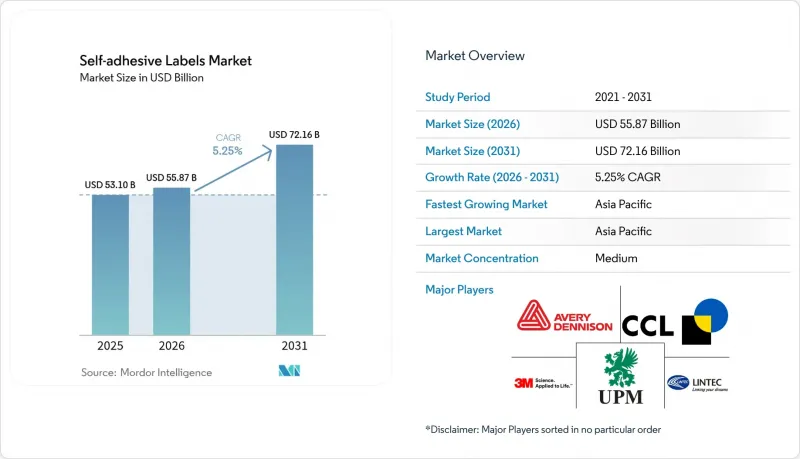
This report is Segmented by Adhesive Type (Hot-Melt, Emulsion-Acrylic, and Solvent Based), Face Material (Paper and Plastic [Polypropylene, Polyester, Vinyl, and Other Plastics]), End-User Industry (Food and Beverage, Pharmaceutical, Logistics and Transport, Personal Care, and More), and Geography (Asia-Pacific, North America, and More). The Market Forecasts are Provided in Terms of Value (USD).
Global Self-adhesive Labels Market Trends and Insights
E-Commerce Parcel Volume Surge Fueling Logistics Label Demand
Cross-border parcel flows jumped during 2024-2025, and some of those shipments now leave warehouses with pre-printed return labels. Pressure-sensitive constructions integrate variable-data printing for QR codes and customs declarations at digital-press speeds above 100 m/min, matching the two-hour dispatch cycles of urban micro-fulfillment centers. Time-temperature indicators built into polyester facestocks document cold-chain breaches on perishables, while IATA regulations obligate lithium-battery hazard markings on almost one-fifth of international parcels. Together, these functional requirements are widening the performance gap between the self-adhesive labels market and traditional wet-glue alternatives.
Expansion of Packaged Food and Beverage Production in Emerging Asia
In 2025, China's ready-to-eat meal category experienced significant growth, pushing converters to certify microwave-safe hot-melt labels that retain bond strength at 120 °C without delamination. India's organized retail footprint expanded in the same year, enabling centralized label procurement that trims SKU inventory and accelerates pan-India rollout. ASEAN harmonization reduced label-approval cycles to four months, lifting adoption of pressure-sensitive formats across Indonesia and Vietnam. Collectively, these shifts inject additional volume into the self-adhesive labels market.
Recycling Challenges From Adhesive and Facestock Contamination
Each year, the PET and HDPE regrind in Europe face contamination from adhesive residue. This contamination reduces pellet clarity and lowers resale values. By 2028, PPWR will require wash-off labels, pushing suppliers to adjust their hot-melts with hydrophilic tackifiers. These suppliers will also need to pass a six-month migration test, resulting in an increase in material costs. In North America, EPR schemes levy fees on non-recyclable packaging, intensifying pressure on converters who struggle to absorb these added costs. While Recyclass certification provides a pathway to compliance, only a small percentage of submissions secured an A rating, highlighting the technical challenges involved.
Other drivers and restraints analyzed in the detailed report include:
- Converter Shift to High-Speed Automated Hot-Melt Lines
- Regulatory Preference for Solvent-Free Adhesives in Consumer Packaging
- Competitive Threat From Linerless Label Technologies
For complete list of drivers and restraints, kindly check the Table Of Contents.
Segment Analysis
Hot-melt formulations represent the fastest-growing adhesive class, advancing at 6.14% CAGR through 2031 as converters standardize on high-speed lines that cure instantly and cut energy use by one-quarter. In contrast, emulsion-acrylic held 44.14% of the self-adhesive labels market share during 2025 because its waterborne chemistry easily passes global food-contact regulations. The self-adhesive labels market, particularly linked to hot-melt systems, anticipates a boost by 2031. This surge follows SIS polymer upgrades, which have unlocked the coveted heat resistance essential for microwave-ready meals. On the other hand, solvent-based products are facing challenges due to migration caps. Even with a shift to pricier aliphatic isocyanates, suppliers grapple with a tightening regulatory window.
Ongoing research and development is honing in on polyolefin-friendly hot-melts. These innovations bond seamlessly to low-surface-energy plastics without the need for primers. A notable stride in this direction was the introduction of a new portfolio in 2025. Complementing these chemical advancements, equipment manufacturers are integrating inline UV varnishing. This innovation not only eliminates the need for post-press handling but also reduces changeover times to mere minutes. Such a cohesive strategy solidifies hot-melt's position as the preferred choice for logistics and consumer-durable labels, further influencing the dynamics of the broader self-adhesive labels market.
Complete Report Scope:
- By Adhesive Types
- Hot-Melt
- Emulsion-Acrylic
- Solvent Based
- By Face Material
- Paper
- Plastic
- Polypropylene
- Polyester
- Vinyl
- Other Plastics
- By End-user Industry
- Food and Beverage
- Pharmaceutical
- Logistics and Transport
- Personal Care
- Consumer Durables
- Other End-user Industries
- By Geography
- Asia-Pacific
- China
- India
- Japan
- South Korea
- Rest of Asia-Pacific
- North America
- United States
- Canada
- Mexico
- Europe
- Germany
- United Kingdom
- Italy
- France
- Rest of Europe
- South America
- Brazil
- Argentina
- Rest of South America
- Middle-East and Africa
- Saudi Arabia
- South Africa
- Rest of Middle-East and Africa
- Asia-Pacific
Geography Analysis
Asia-Pacific generated 35.80% of 2025 global revenue and is growing fastest at a 6.09% CAGR. In China, the surge in microwave meals drives the demand for SIS hot-melt labels, engineered to withstand reheating at high temperatures. Meanwhile, India's retail expansion is steering brands towards centralized pressure-sensitive lines, effectively reducing regional SKU duplication. Japan's rigorous pharmaceutical track-and-trace regulations bolster the demand for PET serialization labels. In South Korea, an uptick in cosmetics exports is propelling the adoption of holographic facestock. Furthermore, investments in cold-chain logistics across Southeast Asia are broadening label penetration beyond tier-1 cities, fueling sustained volume growth in the self-adhesive labels market.
In Europe and North America, the emphasis is on recyclability over sheer volume. The PPWR mandates that PET bottles must utilize wash-off labels. This shift is prompting more frequent hot-melt reformulation cycles and pushing up costs. Additionally, several states in the U.S. have introduced EPR fees on non-recyclable packaging, creating a competitive edge for early adopters of hydrophilic adhesives. While a surge in cross-border parcels buoys logistics label volumes, the absolute tonnage in the U.S. lags behind Asia, primarily due to saturation in the fast-moving consumer goods sector.
South America and the Middle-East, and Africa, though contributing less to revenues, are witnessing notable accelerations. In Brazil, a consolidation in packaged foods is leaning towards imported pressure-sensitive materials, even with tariff challenges. Argentina's macro-stabilization has revitalized beverage label line upgrades, slashing changeover times significantly. In Saudi Arabia, as the nation localizes its drug manufacturing, there's a corresponding spike in demand for serialized labels, in line with SFDA regulations. South African wine exporters, aiming to maintain market access, are now using EU-compliant wash-off labels. However, infrastructure challenges, especially in refrigerated transport, continue to hinder the broader adoption of self-adhesive labels in the market.
- 3M
- Asteria Group
- Avery Dennison Corporation
- CCL Industries
- Fuji Seal International, Inc.
- H.B. Fuller Company
- HERMA GmbH
- Lecta Adestor
- LINTEC Corporation
- Mondi
- Optimum Group
- Symbio Inc.
- UPM Global
Additional Benefits:
- The market estimate (ME) sheet in Excel format
- 3 months of analyst support
TABLE OF CONTENTS
1 Introduction
- 1.1 Study Assumptions and Market Definition
- 1.2 Scope of the Study
2 Research Methodology
3 Executive Summary
4 Market Landscape
- 4.1 Market Overview
- 4.2 Market Drivers
- 4.2.1 E-commerce parcel volume surge fueling logistics label demand
- 4.2.2 Expansion of packaged food and beverage production in emerging Asia
- 4.2.3 Converter shift to high-speed automated hot-melt labeling lines
- 4.2.4 Regulatory preference for solvent-free adhesives in consumer packaging
- 4.2.5 Rapid uptake of microwave-safe hot-melt labels for ready-meal trays
- 4.3 Market Restraints
- 4.3.1 Recycling challenges from adhesive and facestock contamination
- 4.3.2 Competitive threat from linerless label technologies
- 4.3.3 Oxidative discoloration of rubber-based hot-melt labels in premium cosmetics
- 4.4 Value Chain Analysis
- 4.5 Porter's Five Forces
- 4.5.1 Bargaining Power of Suppliers
- 4.5.2 Bargaining Power of Buyers
- 4.5.3 Threat of New Entrants
- 4.5.4 Threat of Substitutes
- 4.5.5 Degree of Competition
5 Market Size and Growth Forecasts (Value)
- 5.1 By Adhesive Types
- 5.1.1 Hot-Melt
- 5.1.2 Emulsion-Acrylic
- 5.1.3 Solvent Based
- 5.2 By Face Material
- 5.2.1 Paper
- 5.2.2 Plastic
- 5.2.2.1 Polypropylene
- 5.2.2.2 Polyester
- 5.2.2.3 Vinyl
- 5.2.2.4 Other Plastics
- 5.3 By End-user Industry
- 5.3.1 Food and Beverage
- 5.3.2 Pharmaceutical
- 5.3.3 Logistics and Transport
- 5.3.4 Personal Care
- 5.3.5 Consumer Durables
- 5.3.6 Other End-user Industries
- 5.4 By Geography
- 5.4.1 Asia-Pacific
- 5.4.1.1 China
- 5.4.1.2 India
- 5.4.1.3 Japan
- 5.4.1.4 South Korea
- 5.4.1.5 Rest of Asia-Pacific
- 5.4.2 North America
- 5.4.2.1 United States
- 5.4.2.2 Canada
- 5.4.2.3 Mexico
- 5.4.3 Europe
- 5.4.3.1 Germany
- 5.4.3.2 United Kingdom
- 5.4.3.3 Italy
- 5.4.3.4 France
- 5.4.3.5 Rest of Europe
- 5.4.4 South America
- 5.4.4.1 Brazil
- 5.4.4.2 Argentina
- 5.4.4.3 Rest of South America
- 5.4.5 Middle-East and Africa
- 5.4.5.1 Saudi Arabia
- 5.4.5.2 South Africa
- 5.4.5.3 Rest of Middle-East and Africa
- 5.4.1 Asia-Pacific
6 Competitive Landscape
- 6.1 Market Concentration
- 6.2 Strategic Moves
- 6.3 Market Share/Ranking Analysis
- 6.4 Company Profiles {(includes Global level Overview, Market level overview, Core Segments, Financials as available, Strategic Information, Products and Services, and Recent Developments)}
- 6.4.1 3M
- 6.4.2 Asteria Group
- 6.4.3 Avery Dennison Corporation
- 6.4.4 CCL Industries
- 6.4.5 Fuji Seal International, Inc.
- 6.4.6 H.B. Fuller Company
- 6.4.7 HERMA GmbH
- 6.4.8 Lecta Adestor
- 6.4.9 LINTEC Corporation
- 6.4.10 Mondi
- 6.4.11 Optimum Group
- 6.4.12 Symbio Inc.
- 6.4.13 UPM Global
7 Market Opportunities and Future Outlook
- 7.1 White-space and Unmet-need Assessment

