PUBLISHER: Mordor Intelligence | PRODUCT CODE: 2122630

PUBLISHER: Mordor Intelligence | PRODUCT CODE: 2122630
Fixed-Line Communications - Market Share Analysis, Industry Trends & Statistics, Growth Forecasts (2026 - 2031)
According to Mordor Intelligence, fixed-line communications market size in 2026 is estimated at USD 321.43 billion, growing from 2025 value of USD 289.24 billion with 2031 projections showing USD 544.82 billion, growing at 11.13% CAGR over 2026-2031.
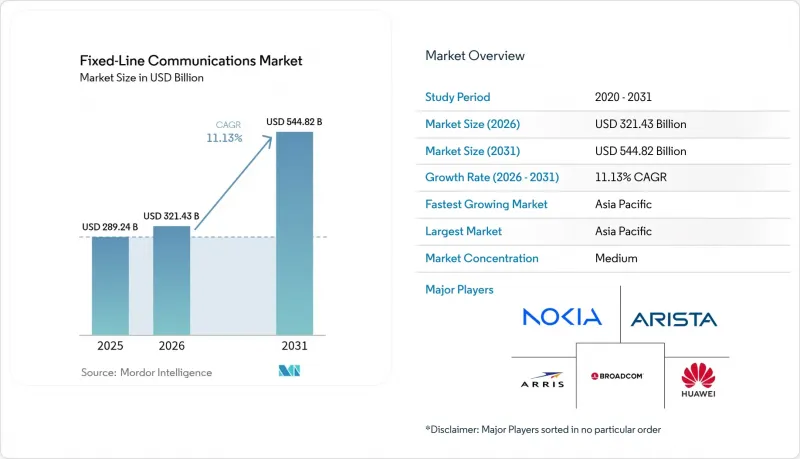
This report is Segmented by Product Type (Transmission Equipment, Switching Equipment, and More), Service Type (Fixed Voice, Fixed Broadband Data, and More), Technology (Digital Subscriber Line, Coaxial (Docsis), and More), End User (Residential, Small and Medium Enterprises, Large Enterprises, and More), and Geography.
Global Fixed-Line Communications Market Trends and Insights
Rising demand for gigabit-speed broadband in urban clusters
Key Highlights
- Remote work, multi-stream 4K video, and cloud gaming have made multi-gigabit service a baseline expectation in major cities. Operators can no longer rely on oversubscription rules that once kept capacity costs in check; instead, they push symmetric fiber deeper into apartment blocks to guarantee high-throughput paths. Enterprise tenants in mixed-use buildings additionally request guaranteed uplink speeds for cloud backup and video collaboration, allowing carriers to bundle premium SLAs at higher average revenue per user. Dense geography shortens fiber build paybacks, encouraging aggressive promotional pricing that locks in market share before 5G fixed-wireless alternatives gain traction. Municipal digital-equity policies further amplify adoption by underwriting low-income household connections, indirectly boosting take rates for premium tiers once the fiber is in place.
Massive fiber-to-the-home roll-outs by incumbents and altnets
Incumbent telcos have shifted from incremental copper upgrades to full-scale fiber replacement, as seen in AT&T's pledge to pass 30 million premises with FTTH by 2026. Challenger altnets, backed by infrastructure funds, pick off pockets of under-served suburbs, forcing faster reactions from legacy operators eager to defend their base. Subsidy frameworks such as BEAD in the United States redirect billions toward rural builds, further tilting the cost equation in favor of deep fiber. The combination of faster deployment techniques (micro-trenching, connectorized drops) and duct re-use lowers capex per home, keeping internal rates of return attractive even in mid-density territories. Longer term, establishing a ubiquitous fiber platform positions carriers to upsell edge-compute hosting and private 5G services.
High capex and long ROI cycles for last-mile fiber
Passing a single rural premise can cost more than USD 1,000, a figure that climbs sharply in rocky or mountainous terrain. Smaller carriers without scale economics shoulder significantly higher financing costs, and their debt covenants often dictate slower roll-out schedules. Where crews must attach fiber to utility poles, make-ready work and legal disputes over attachment fees add months of delay. Wage inflation for certified fiber splicers compounds the problem, with some markets offering signing bonuses that previously only mobile-network engineers received. Although government grants defray part of the build expense, restrictions on permissible vendors or technology can push total project cost back up, stretching payback periods beyond typical investor horizons.
Other drivers and restraints analyzed in the detailed report include:
- Cloud/hyperscale data-center back-haul requirements
- Government universal-service and subsidy programs (BEAD, RDOF, EU CEF-2)
- Substitution risk from 5G fixed-wireless and satellite broadband
For complete list of drivers and restraints, kindly check the Table Of Contents.
Segment Analysis
Fiber-optic cables generated 28.02% of revenue in 2025, cementing their position as the volume backbone of the fixed-line communications market. Intensifying demand for 800 G coherent transmission pushes operators to accelerate outside-plant upgrades, while associated optical line terminals and passive splitters lift access-equipment spend at a 13.45% CAGR. Transmission-equipment vendors benefit as carriers swap legacy 100 G optics for pluggables that halve power per bit, enhancing total network efficiency. Switching gear revenue expands in tandem because software-defined control planes require high-performance leaf-spine fabrics inside central offices.
Customer-premises equipment continues to ride the multi-gigabit wave as households adopt Wi-Fi 7 routers and mesh nodes. Vendors now bundle managed Wi-Fi analytics that let carriers troubleshoot in-home performance remotely, reducing truck rolls. Meanwhile, fixed-wireless CPE shipments overtook DOCSIS modems in 2024, showing that wireless substitution can capture specific deployment scenarios even as the fixed-line communications market size for fiber remains dominant.
Fixed broadband data services accounted for 68.45% of total 2025 revenue, confirming the irreversible pivot from minutes-based billing to bandwidth monetization. IPTV and other value-added platforms follow with a 12.05% CAGR, reflecting how carriers translate sunk fiber investments into recurring content and cloud-gaming revenue. Traditional fixed voice continues its secular slide as enterprises migrate to cloud PBX offerings and households rely exclusively on mobile.
Managed service bundles that merge connectivity with cybersecurity and edge-compute orchestration gain favor, especially among mid-sized enterprises lacking in-house IT teams. Enhanced video analytics powered by on-network AI engines enable ultra-targeted advertising, adding incremental margins without additional capex.
Complete Report Scope:
- By Product Type
- Transmission Equipment
- Switching Equipment
- Access Equipment (DSLAM, OLT, etc.)
- Customer-Premises Equipment (Routers, STB, ONT)
- Fiber-optic Cables
- Others
- By Service Type
- Fixed Voice
- Fixed Broadband Data
- IPTV / Value-added Services
- By Technology
- Digital Subscriber Line
- Coaxial (Docsis)
- Fiber (FTTx/FTTH)
- Hybrid Fiber-Coax
- By End User
- Residential
- Small and Medium Enterprises
- Large Enterprises
- Government and Public Sector
- Data Centers
- By Geography
- North America
- United States
- Canada
- Mexico
- South America
- Brazil
- Argentina
- Rest of South America
- Europe
- Germany
- United Kingdom
- France
- Russia
- Rest of Europe
- Asia Pacific
- China
- India
- Japan
- South Korea
- ASEAN
- Rest of Asia Pacific
- Middle East and Africa
- Middle East
- Saudi Arabia
- United Arab Emirates
- Turkey
- Rest of Middle East
- Africa
- South Africa
- Nigeria
- Rest of Africa
- Middle East
- North America
Geography Analysis
Asia Pacific retained 38.45% of 2025 revenue and is projected to expand at an 11.18% CAGR, cementing its position as the largest fixed-line communications market. China's mandate for 10 G city networks drives nationwide fiber deployment, while India's Digital Bharat program triggers public-private joint ventures that add more than 0.5 million route-kilometers annually. Japanese and Korean operators upgrade to 25 G and 50 G PON to support immersive media and industrial automation.
North America leverages the BEAD program to close rural gaps. Tier-1 carriers accelerate urban builds, racing satellite broadband players to lock in long-term subscribers. Verizon's fixed-wireless subscriber gains highlight substitution risk, yet fiber build counts hit new quarterly highs as pole-attachment reforms shorten permitting queues. Canadian open-access rules compel incumbents to wholesale fiber loops, fostering retail competition that stimulates take-rates without eroding network-owner economics.
Europe's Gigabit Infrastructure Act streamlines trenching approvals and enforces "dig-once" coordination, cutting civil-works costs by double digits. France and Spain now post FTTH take-up rates above 75%, proving demand elasticity once ubiquitous gigabit service is available. Germany's late start accelerates on the back of private-equity-funded altnets, while the United Kingdom's Project Gigabit auctions extend coverage to hard-to-reach hamlets.
- Huawei Technologies Co. Ltd
- Cisco Systems Inc.
- Nokia Corp.
- ZTE Corp.
- Broadcom Inc.
- Arris (CommScope)
- Arista Networks Inc.
- Avaya Inc.
- Allied Telesis Inc.
- Corning Inc.
- Prysmian Group
- Adtran Inc.
- Calix Inc.
- DZS Inc.
- Ribbon Communications
- Telefonaktiebolaget LM Ericsson
- Juniper Networks Inc.
- FiberHome Telecommunication
- CommScope Holding Co.
- NEC Corp.
Additional Benefits:
- The market estimate (ME) sheet in Excel format
- 3 months of analyst support
TABLE OF CONTENTS
1 INTRODUCTION
- 1.1 Study Assumptions and Market Definition
- 1.2 Scope of the Study
2 RESEARCH METHODOLOGY
3 EXECUTIVE SUMMARY
4 MARKET LANDSCAPE
- 4.1 Market Overview
- 4.2 Market Drivers
- 4.2.1 Rising demand for gigabit-speed broadband in urban clusters
- 4.2.2 Massive fiber-to-the-home (FTTH) roll-outs by incumbents and altnets
- 4.2.3 Cloud/hyperscale data-center back-haul requirements
- 4.2.4 Government universal-service and subsidy programs (BEAD, RDOF, EU CEF-2)
- 4.2.5 Repurposing of legacy copper ducts lowers civil-works cost (under-reported)
- 4.2.6 Edge-compute densification needs ultra-low-latency fixed links (under-reported)
- 4.3 Market Restraints
- 4.3.1 High capex and long ROI cycles for last-mile fiber
- 4.3.2 Substitution risk from 5G FWA and satellite broadband
- 4.3.3 Skilled-labor shortages for fiber splicing and testing
- 4.3.4 Municipal right-of-way and pole-attachment delays (under-reported)
- 4.4 Value Chain Analysis
- 4.5 Regulatory Landscape
- 4.6 Technological Outlook
- 4.7 Porter's Five Forces Analysis
- 4.7.1 Threat of New Entrants
- 4.7.2 Bargaining Power of Buyers
- 4.7.3 Bargaining Power of Suppliers
- 4.7.4 Threat of Substitutes
- 4.7.5 Competitive Rivalry
- 4.8 Investment Analysis
5 MARKET SIZE AND GROWTH FORECASTS (VALUE)
- 5.1 By Product Type
- 5.1.1 Transmission Equipment
- 5.1.2 Switching Equipment
- 5.1.3 Access Equipment (DSLAM, OLT, etc.)
- 5.1.4 Customer-Premises Equipment (Routers, STB, ONT)
- 5.1.5 Fiber-optic Cables
- 5.1.6 Others
- 5.2 By Service Type
- 5.2.1 Fixed Voice
- 5.2.2 Fixed Broadband Data
- 5.2.3 IPTV / Value-added Services
- 5.3 By Technology
- 5.3.1 Digital Subscriber Line
- 5.3.2 Coaxial (Docsis)
- 5.3.3 Fiber (FTTx/FTTH)
- 5.3.4 Hybrid Fiber-Coax
- 5.4 By End User
- 5.4.1 Residential
- 5.4.2 Small and Medium Enterprises
- 5.4.3 Large Enterprises
- 5.4.4 Government and Public Sector
- 5.4.5 Data Centers
- 5.5 By Geography
- 5.5.1 North America
- 5.5.1.1 United States
- 5.5.1.2 Canada
- 5.5.1.3 Mexico
- 5.5.2 South America
- 5.5.2.1 Brazil
- 5.5.2.2 Argentina
- 5.5.2.3 Rest of South America
- 5.5.3 Europe
- 5.5.3.1 Germany
- 5.5.3.2 United Kingdom
- 5.5.3.3 France
- 5.5.3.4 Russia
- 5.5.3.5 Rest of Europe
- 5.5.4 Asia Pacific
- 5.5.4.1 China
- 5.5.4.2 India
- 5.5.4.3 Japan
- 5.5.4.4 South Korea
- 5.5.4.5 ASEAN
- 5.5.4.6 Rest of Asia Pacific
- 5.5.5 Middle East and Africa
- 5.5.5.1 Middle East
- 5.5.5.1.1 Saudi Arabia
- 5.5.5.1.2 United Arab Emirates
- 5.5.5.1.3 Turkey
- 5.5.5.1.4 Rest of Middle East
- 5.5.5.2 Africa
- 5.5.5.2.1 South Africa
- 5.5.5.2.2 Nigeria
- 5.5.5.2.3 Rest of Africa
- 5.5.5.1 Middle East
- 5.5.1 North America
6 COMPETITIVE LANDSCAPE
- 6.1 Market Concentration
- 6.2 Strategic Moves
- 6.3 Market Share Analysis
- 6.4 Company Profiles (includes Global level Overview, Market level overview, Core Segments, Financials, Strategic Information, Market Rank/Share, Products and Services, Recent Developments)
- 6.4.1 Huawei Technologies Co. Ltd
- 6.4.2 Cisco Systems Inc.
- 6.4.3 Nokia Corp.
- 6.4.4 ZTE Corp.
- 6.4.5 Broadcom Inc.
- 6.4.6 Arris (CommScope)
- 6.4.7 Arista Networks Inc.
- 6.4.8 Avaya Inc.
- 6.4.9 Allied Telesis Inc.
- 6.4.10 Corning Inc.
- 6.4.11 Prysmian Group
- 6.4.12 Adtran Inc.
- 6.4.13 Calix Inc.
- 6.4.14 DZS Inc.
- 6.4.15 Ribbon Communications
- 6.4.16 Telefonaktiebolaget LM Ericsson
- 6.4.17 Juniper Networks Inc.
- 6.4.18 FiberHome Telecommunication
- 6.4.19 CommScope Holding Co.
- 6.4.20 NEC Corp.
7 MARKET OPPORTUNITIES AND FUTURE OUTLOOK
- 7.1 White-space and Unmet-need Assessment

